Note to self: When you allow yourself to be defined by the scepticism of others, you impose their limitations on yourself.
Recognising that all mental and emotional limitations are self-imposed is critical to growth.
These limitations are revealed in how we believe we are compelled to respond to someone or some experience.
It is revealed in how we believe in our ability to do the extraordinary, while our support structure, or our tribe convinces us that we’re supposed to focus on responsibility only.
It is revealed when we look for validation and approval for our aspirations or ambitions, before we commit ourselves wholeheartedly towards its pursuit.
The greatness that exists in all of us is often snuffed out by our need to be accepted before we pursuit that which will set us apart.
Whose permission are you waiting for before you unleash your passion, or pursue your dream?
Tomorrow is not guaranteed, but death bed regrets are…if you don’t live a life that duly honours the struggles of your life.
Own your life. Before someone else does.
Photo credit : Adobe Stock
#selfworth #selfawareness #ownyourlife #selfmastery #mindfulness #personalpower #ownyourshit #mentalhealthrecovery #mentalhealth #mentalhealthawareness #lifecoaching #zaidismail #motivation #optimism #lifegoals
Tag: mentalhealthawareness
-

Own your life
-

Are you grateful for you?
Whenever asked about gratitude, the inevitable response is one that is focused on everything we have around us.
Sometimes, we consider our health and our skills.
At other times we recognise the value of things not being as bad as they could have been.
And we convince ourselves that this is being grateful.
But how often do we stop to contemplate gratitude for the traits and attributes that we have which makes our appreciation of all of that possible?
How often do we stop to appreciate the essence of who we are, and the tough and selfless choices that we made under difficult circumstances, when we could easily have taken the selfish or easy way out?
This is not about judging the choices that we’ve made, but about recognising how we still showed up, with conviction, to do our best to make something good out of a bad situation.
You cannot nurture that which you don’t acknowledge to be true. So how are you going to nurture the value of who you are, if your gratitude is only focused on what you have?
Striking a balance between selfishness and gratitude for the self is what makes the difference between being defined by your struggles in life, versus defining the outcomes of the struggles of your life.
You won’t be able to determine the difference if you lack gratitude for who you are, and what your contribution is towards improving the state of your life, and the lives of those around you.
The next time you contemplate what you’re grateful for, be sure to include yourself in that moment of reflection.
Photo credit : Adobe Stock
#selfworth #selfawareness #ownyourlife #selfmastery #mindfulness #personalpower #ownyourshit #mentalhealthrecovery #mentalhealth #mentalhealthawareness #lifecoaching #zaidismail #loveyourself #gratitude #appreciation #compassion #kindness -
Misery is the thief of time
Anything that requires a concerted effort is exhausting…like being miserable or morbid…it demands that we suppress any inclination to find joy or happiness in simple things.
Can anyone guess why we would do this? 🤔
Joy is what we give up when we hold on to misery.
Don’t become so distracted by how you were betrayed or abused by others that you grow fixated on wanting to see them get their own back while putting your own joy on hold.
Remember that it took a specific event to make you feel miserable, but up to that point joy came naturally.
This means that our natural state is one of joyfulness, and it also means that we have to put in a lot of effort to prevent ourselves from experiencing joy.
That’s why misery and depression is so exhausting.
It’s not just a lack of motivation, it is an energy thief.
Invest your life in moments that uplift others and yourself, not in waiting for revenge or karma to come around.
P. S. At the time of originally posting this in 2019, I was thinking of making the title for my book The Book of Mindfulness. But I eventually decided on Own Your Shit. You can order your copy today from my website at zaidismail.com or on Amazon and Kindle.
#joy #happiness #emotionalmaturity #theegosystem #mindfulness #selfawareness #mentalhealth #mentalhealthawareness #mentalhealthrecovery #selfworth #selflove #optimism #optimisticquotes -
Growth is inevitable
This was an important realisation that has carried me through many difficult experiences in life.
What’s even more important to realise is that when we choose a positive growth for ourselves, there is no guarantee that the people around us will choose the same.
Don’t back down from being a better version of you because of it.
All you can do is try to inspire them to be better as well. But the final choice will always be theirs to make.
Trials are there to teach us lessons about what we previously took for granted.
With it, comes a greater level of awareness.
Awareness carries with it a responsibility to either contribute more, or to apply yourself in better ways. That’s how growth takes place.
When you resist such growth, you grow in defensiveness. So you’re effectively exchanging positive growth for negative growth.
Growth is therefore inevitable. You only get to decide in which direction it takes you.
#growth #awareness #trialsandtribulations #life #selfawareness #selfrespect #mindfulness #inspiration #goals #mentalhealth #mentalhealthawareness #mentalhealthrecovery #theegosystem -
Invest in hope
When you’re lost on a journey, do you keep driving around in circles hoping that your destination will miraculously arrive, or do you try a different route until you find it?
Or do you sit behind the wheel and judge yourself for being a bad driver because you’re on the wrong road? If you do, does it suddenly make your destination appear?
Life is no different.
Hopelessness is never the end of the road. It’s a sign that you need to take a new one.
The fact that you knew how to get yourself onto THAT road means that you have the ability and skill to change routes.
When we find ourselves in a rut, we shouldn’t remain invested in that rut hoping that someone else will come along and change it for us.
We need to change it for ourselves because we know what destination we’re in search of. No one else does.
Holding others responsible for getting to our destination assumes that they are not also searching for their destination. Or are lost in their own rut.
It’s how our journeys intersect with each other that we find companionship and comfort in others. Not in waiting for them to navigate or journey for us.
Own your life. It’s yours to own.
#hope #expectation #sincerity #selfworth #selfawareness #mentalhealth #mentalhealthawareness #mentalhealthrecovery #hopelessness #suicideprevention #suicide #zaidismail #lifecoaching #ownyourshit #ownyourlife #theegosystem #embracingME -
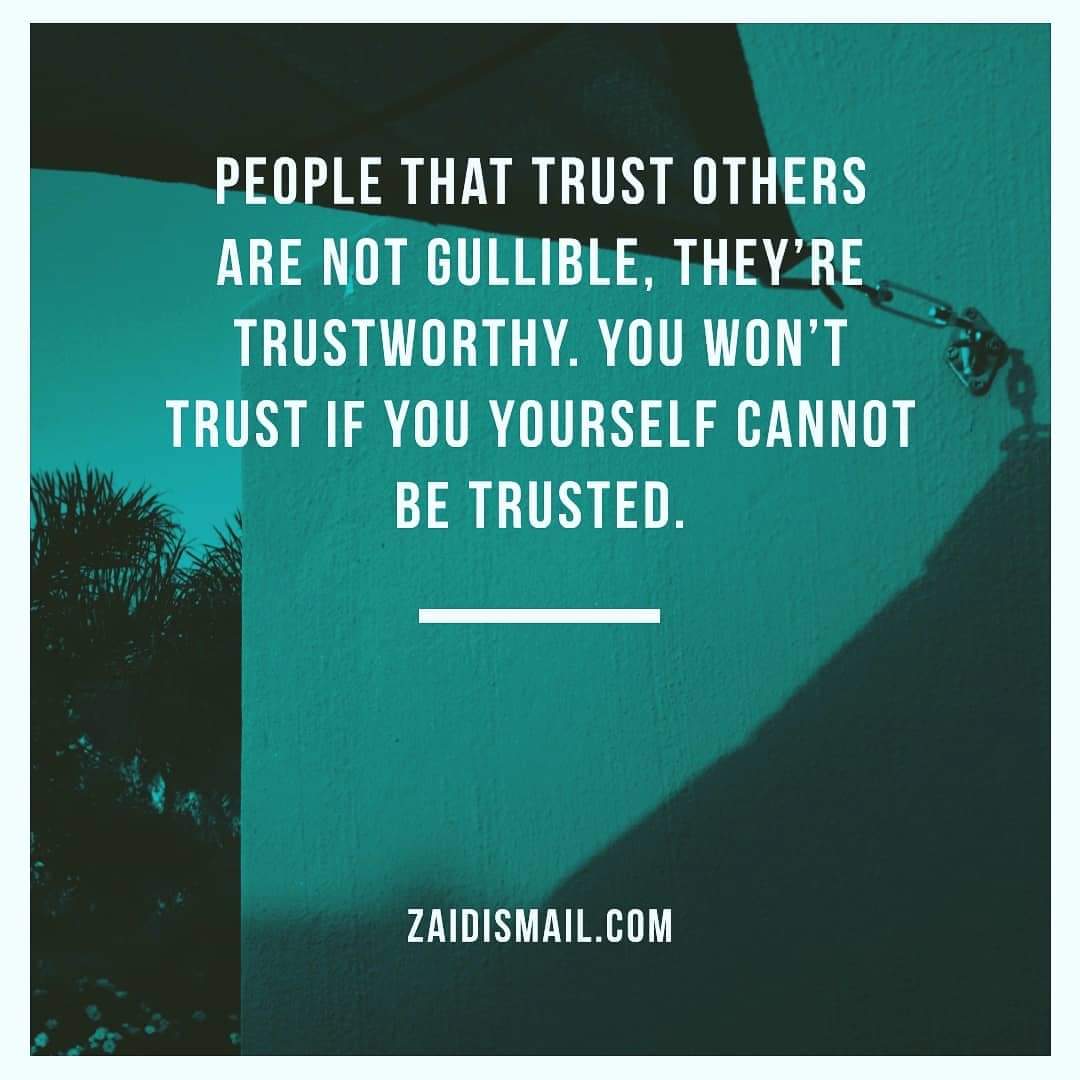
Give trust, before taking it away
Earn my trust!
Earn my respect!
Consider how lofty our opinion is of ourselves when we demand that from others.
If you don’t trust someone for good reason, then no problem.
But if you don’t trust someone just because you don’t know them, then you have trust issues.
That’s how life becomes burdensome because we need to live with our defenses up before we find reason to let our guard down.
When we demand that others must earn our trust or earn our respect before we give them either, it suggests that by default, we are allowed to disrespect and mistrust others through no fault of their own.
Often, such a perspective stems from arrogance or defensiveness because we’re still affected by a past betrayal.
We judge people based on how we judge ourselves.
And we justify their behaviour based on how we believe we would also react in a similar situation.
So when you judge, recognise that it is you first that is being judged, before anyone else.
By all means, allow space for someone to earn your trust on more important issues, but don’t start out by being suspicious.
There is an important difference between assuming the worst and being suspicious of others, versus creating space for someone to demonstrate their trustworthiness without deliberately testing them first.
Learning the difference is what allows for peace, instead of creating opportunity for anxiety.
#selfworth #selflove #selfawareness #selfrespect #mindfulness #judgementalpeople #respect #trustissues #trustworthy #mentalhealth #mentalhealthawareness #mentalhealthrecovery -
Father : A silent duty
Fathers are often overlooked or forgotten, because they’re seldom in the limelight.
Silently serving in the background, they often do what is seen as just their job, or their duty.
Not wired with an overt nurturing instinct, but rather that of a silent sentinel, ensuring their family’s safety and comfort, they often grow accustomed to being in the background, creating the spaces needed for their family to thrive.
When we expect fathers to behave in a similar way to mothers, we diminish their contribution and their sacrifices.
When we expect fathers to show up like mothers, we under estimate their emotional needs, and ignore their silent pleas for gratitude.
When we expect fathers to experience emotion and sentiment in the same way that mothers do, we assume that they were gifted with the beauty of connecting with a soul growing within them, not realising that they were always on the outside looking in.
There is a bond between mother and child that a father will never experience because of the sanctity of childbirth. Perhaps that is why fathers will always find a different way to express their love for their family compared to mothers.
Honour your father by recognising his struggle and efforts without finding reason to judge him compared to your mother.
And if you find he is falling short anyway, approach him with understanding, believing that the gentleness you wish to experience with him lies beneath that seemingly impenetrable exterior that developed only because he quietly accepted his place as a provider and forgot to nurture his own emotional needs.
And to the fathers who show up despite not knowing how it is done because they didn’t have the loving guide of a mentor in their lives, I especially salute you. Breaking cycles of toxic dysfunction is never easy, and is often excruciatingly lonely.
So if no one else notices you today, I do. With love, appreciation, and respect.
Happy father’s day.
#fatherhood #fathersday #fatherdaughter #fatherson #father #husband #parenting #singleparenting #parents #ownyourshit #ownyourlife #theegosystem #mentalhealth #mentalhealthawareness #mentalhealthrecovery #zaidismail -
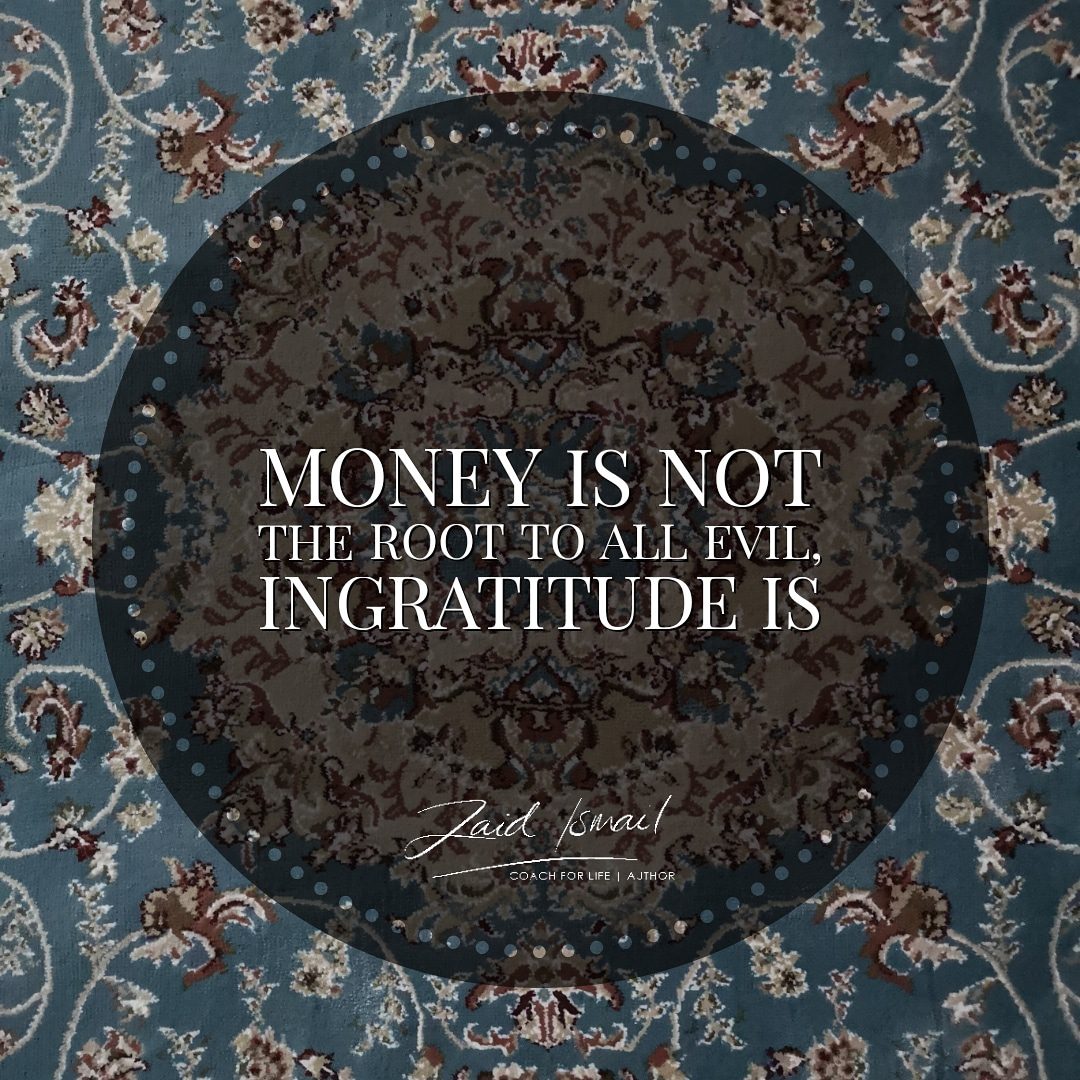
Money is not the root of evil
Money is nothing more than a tool.
It’s a means to an end, not a motivation in itself.
Even its accumulation through miserliness, or its wastage through extravagance still makes it nothing more than a tool to achieve a greater goal.
Ingratitude is what results in such tools being used to our detriment, or to the detriment of others.
Money in the hands of an ingrate is used to harm others, or the self.
Ingratitude is therefore the demon that we must learn to understand if we hope to use money in a way that creates a fulfilled life.
Ingratitude is born of the belief that we are entitled to things or outcomes.
That sense of entitlement is based on our need to feel validated by such privilege, because we see it as a measure of how much we mean to others.
Our need for such validation is from a lack of appreciation for who we are and what our unique contribution to this world can be, and instead, a fixation on everything that we don’t have.
Understand the source of your ingratitude, and tools like money will carry with it benefits and blessings in ways you never thought possible, without contaminating your ego in the process.
#hope #expectation #sincerity #selfworth #selfawareness #mentalhealth #mentalhealthawareness #mentalhealthrecovery #gratitude #appreciation #zaidismail #authenticity #servingothers #servantleadership