The struggle in countering the influence of a village of idiots will never be truly appreciated until we experience the impact of the dysfunction that it produces in our lives.
That impact usually only becomes evident when we’re facing upheaval that challenges any sensibility that we may rely on about life.
Parenting is largely a lost art with the opportunity to outsource a large chunk of it to social media making it easy to ‘cope’ in that way.
Losing ourselves to our own struggles that rage in our minds blinds us to the impact of our obliviousness to those around us.
The absence of drama is not peace, nor is it wholesome family time.
That is what social media and social distractions offer us. The absence of contention or conflict.
That’s how we lose sight of the values that we’re imparting without meaning to, because on the one hand, we’re validating social media as a legitimate source of learning how life works, while also confirming that such an approach to parenting or to sharing life’s moments and wisdom is all that we have available to offer.
We have greater impact through what we don’t do than what we do.
Unfortunately, we’re mostly too distracted by needing validation for what we do that we lose sight of our abdication of accountability for what we should do more of…or just what we should be doing in the first place. Period.
Our demons that distract us from what others need from us destroys more relationships than any real conflict that exists between two people.
Own your life before you end up destroying someone else’s.
#parenting #divorce #marriage #marriagegoals #lifecoaching #zaidismail #theegosystem #ownyourlife #relationshipgoals #singleparenting
Tag: singleparenting
-
The absence of drama is not peace
-

Be the village
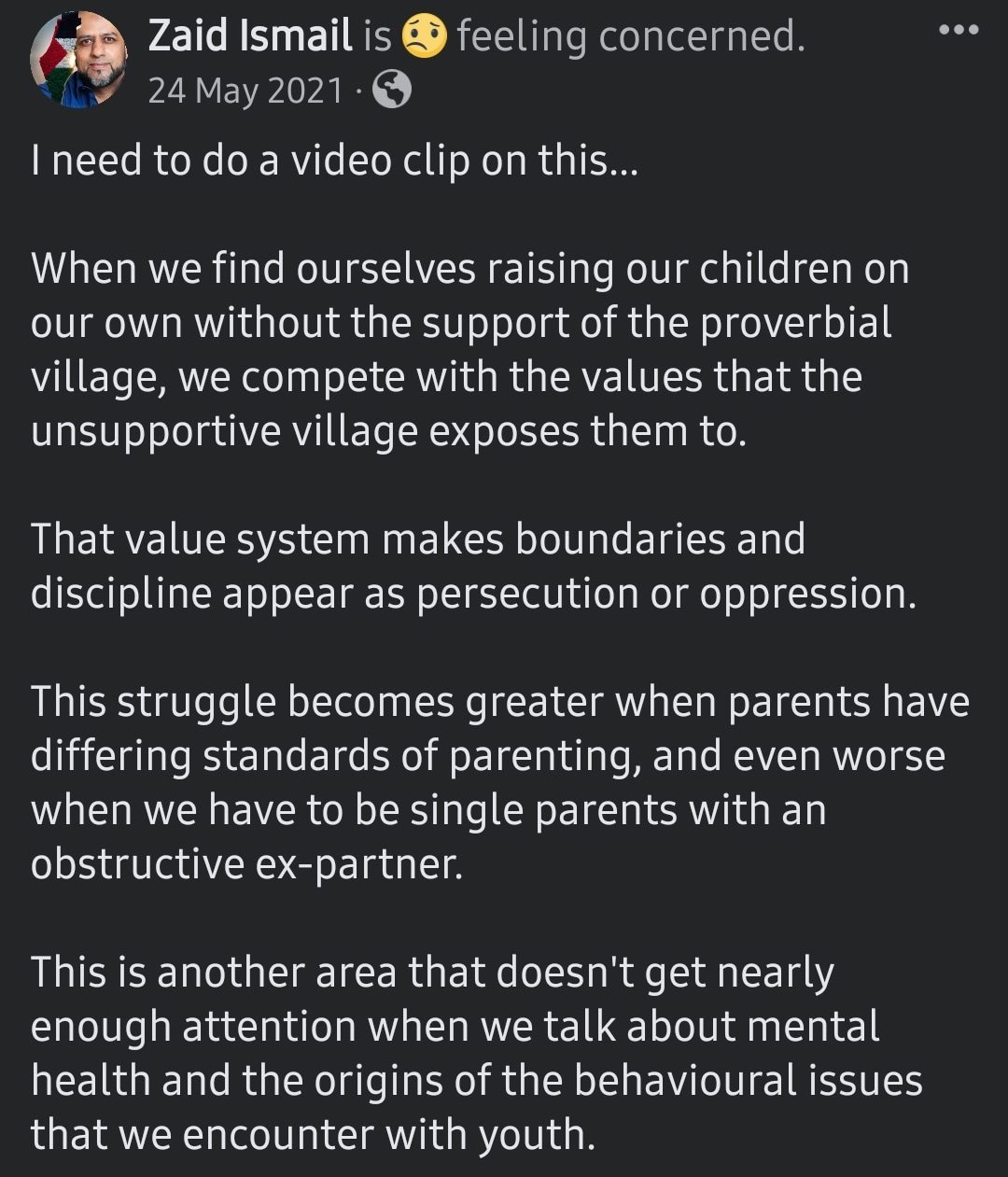
While it takes a village to raise a child, it also takes a village to corrupt a child.
Parenting is a monumental challenge in itself, but becomes infinitely more challenging when being done by a single parent.
Add to the single parenting challenge by having an obstructive co-parent, and the challenge continues to grow ever more insurmountable.
If that’s not enough, throw in the depraved value system of the global village that is available on every Internet connected device that your child has access to, and suddenly you realise exactly what you’re competing with in trying to raise a wholesome, healthy, and grounded human.
But it’s not impossible to achieve, despite those impossible odds stacked against any dedicated parent/s.
Firstly, you need to realise the impact of your role in their life, especially when the self-pity sets in from the extended struggle of trying to be the most prominent influence in their life.
Secondly, you need to understand that wayward behaviour is their fears driving them towards wanting to be significant in their social circles. Focus on understanding those fears, rather than fixating on the bad behaviour.
Thirdly, even if they currently reject the values that you’re trying to instill, you cannot compromise on those values or else you convince them that it’s optional. Standing firm gives them a point of reference for later in life when they will need those values more than ever.
Lastly, parenting is not for those who need instant gratification, nor is it about the parent.
It’s about demonstrating the value and benefit of living life the way that you want them to live theirs, and not compelling them through the fear of consequences to do the right thing.
Fear is never a sustainable motivator to be a good person.
But sometimes it’s a necessary tool to break a harmful cycle.
Be very careful with how you use it.
#parenting #generationaltrauma #singleparenting #ownyourlife #theegosystem #lifecoaching #zaidismail #selfworth #selfawareness #mentalhealth #mentalhealthawareness #mentalhealthrecovery -
The courage to parent properly
The courage that is needed, is the courage to seek sincere, informed advisors to help us to understand why we may be struggling to connect with our children.
We don’t know what we don’t know.
If we try to figure life out by ourselves, we’ll only ever learn the hard way, from our own mistakes.
While some may think that to be a fun or rewarding approach, we need to stop to consider how those mistakes negatively affect those around us.
Making mistakes is inevitable, but making avoidable mistakes is irresponsible.
Insecurity as a parent shows up when we see every act of non-compliance as an act of blatant defiance.
When we’re insecure about who we are, that becomes the lens through which we interpret the motives behind the actions of those around us.
But we don’t see that lens, because we’re distracted by needing to establish our authority or our significance, because we think that’s how we need to instil respect and good manners by not letting ‘them’ take advantage of us.
The moment this is your mindset, understand that you’re insecure about your position or your role, and your reaction to that will cause more harm than good, despite your best intentions.
Give yourself a break, and give your children a chance.
Learn from the mistakes that raised you to be insecure, by reflecting on why those who raised you couldn’t have known better.
And do your part to reduce the reasons your children will have to reflect on such matters that negatively affect their sense of self.
[this is an incomplete thought process, but worth sharing]
#parenting #mentalhealth #mentalhealthawareness #lifecoaching #zaidismail #singleparenting #raisingadults #selfworth #selfawareness #ownyourlife #theegosystem -
A path to insanity
We work with the assumption that our partners and our children share the same values that we try to uphold in our lives.
This is rarely true.
While we may share the same frame of reference or even the same cultural norms, values are much more personal, and therefore unique.
Our personal value systems are shaped by what we take from life.
Note, what we take, not what we’re taught.
Our teachings form the frame of reference within which we live our lives.
However, what we place emphasis and priority on, and what flexibility we allow ourselves within that frame of reference is what shapes our unique value system.
For this reason, two siblings raised in the same home under the same rules of discipline, and with the same privilege and emotional access to their parents may adopt very different values because of what they assumed to be true about the motives or sincerity of their parents towards them.
The difference between the two is self-worth.
The important thing about self-worth is that it’s about how we feel about ourselves, and not how someone else feels about us.
No matter how much we convince ourselves that we feel how we feel because of how someone else treats us, it doesn’t change this fact.
Self-worth is about how we feel about ourselves.
How we develop this sense of self is a complex process that can change with life experiences, but until we’re aware of what we allow to influence how we feel about ourselves, we’ll blame the world for our unhappiness or misery.
It is this that we must bear in mind when we try to rationalise the behaviour of others when it conflicts with the value system that we thought we shared.
Self-worth or self-loathing is what makes the difference between authenticity and selling ourselves short to gain validation.
It always starts with you.
#selfworth #selfawareness #ownyourlife #selfmastery #mindfulness #personalpower #mentalhealth #mentalhealthawareness #lifecoaching #zaidismail #loveyourself #lifegoals #parenting #singleparenting #pursuitofhappiness -
Do what’s right, or else…
When raised with fear and compliance as the tool to ensure good behaviour, or religious subscription, we create validation-seeking individuals whose willingness to compromise on what is right will be driven by social acceptance.
Instilling values in our children, or living by our own values, must be grounded in a substantial appreciation for why it is valuable, and not why it is right.
When we focus on right and wrong, we focus on judging others rather than understanding them.
Arriving at a conclusion about whether something is right or wrong has its place.
But without understanding and an appreciation for the value of what we want to establish, compassion is lost, and harshness is assumed to be justified to uphold truth or morality.
It is counter-productive to use harshness to teach understanding.
And it’s an exercise in futility to ignore what influences you are working against when trying to instil, or live by such values.
Being mindful of two things is therefore critical towards maintaining your sanity.
Firstly, connect with purpose and substance to the values that you stand for by connecting it to the good that you want to create in the lives of those around you.
Secondly, be aware of your ability to influence the adoption of those values in the lives of those you care for.
Sometimes, the appeal of instant gratification, or social inclusion may render your influence impotent.
When that happens, take the time to plant the seed, but don’t exhaust yourself in nurturing it.
We’re all responsible for nurturing our own seeds of goodness in our lives.
Own Your Life.
#hope #expectation #sincerity #selfworth #selfawareness #mentalhealth #mentalhealthawareness #lifecoaching #zaidismail #loveyourself #lifegoals #parenting #singleparenting #gratitude -
That war within
Sometimes that village is a family, sometimes it’s a group, and sometimes it’s just one person who represents everything that the village stands for.
That child grows into the raging adult who destroys every wholesome thing, because they feel like no one deserves peace if they were denied love and acceptance.
When you treat the vulnerable, or the gentle one’s, with contempt, you create the same monsters that made you.
That’s how the raging adult spawns more troubled souls that are driven towards burning down their village, with each generation growing more destructive, until someone chooses self-respect over self-loathing.
The distraction of their rage prevents them, and us, from seeing their plea for love and acceptance.
It’s a war within that rages without, because what they feel is at odds with what they need, and despite their best efforts, they don’t know how to achieve it.
So, the shame that bubbles beneath the surface – the shame that they hide from the world about that internal war – drives them to behave in ways that appear to claim what they believe others will not care to give them.
Thus, they project their rage on any innocent being that expects them to be better than that, because they’re no longer children…and only children throw tantrums.
Adults don’t throw tantrums because they don’t need someone else to destroy for them.
They destroy others to feel significant, not because they want the destruction, but because it at least gives them reason to believe that they’re not invisible.
That they still have an impact.
That they will be taken seriously…or else…
Your anger at the world is yours to tame.
You either rage at those who don’t have what you need, or you create it yourself through the alchemy of your soul.
Because that’s what makes us human.
Not that we hurt, or that we love, but that we can create love in the midst of hate, and calm in the midst of chaos, without any aides but the attributes of who we are beyond the rage.
It always starts with you.
#ownyourlife #theegosystem #mentalhealth #mentalhealthawareness #lifecoaching #zaidismail #loveyourself #parenting #singleparenting #selfworth #selflove #selfloathing -
Allow them to learn
Sometimes, out of concern, we try to protect those we care about from mistakes that they are inclined to make.
We become the buffer between their bad decisions and the consequences thereof, so that they don’t find themselves in harm’s way.
This show of concern or compassion is good, as long as it doesn’t become their crutch in life, or ours.
If we’re not careful, we may give them reason to believe that they’ll always have a soft landing, or someone to bail them out.
By protecting them from the consequences of their decisions, you also prevent them from growing to appreciate why they should trust your advice and support.
However, choose carefully when to allow them to fall, because you don’t want to set yourself up for regret if there are long term consequences.
Focus on opportunities where the outcome or the impact can be contained or minimised.
The point is to allow them to learn from their decision making process, and not to maliciously prove a point that they should trust you more.
Always be focused on the benefit that you want to create for them, and not on the satisfaction that you need to feel when you point out that you were right.
Connect with compassion, not malice or bitterness.
This is especially true for parenting teens who are more inclined to demand control of decisions in their lives.
Not everything that they get wrong will hound them for the rest of their lives, so choose instances to teach such lessons based on the effort required for them to make right what they got wrong.
And sometimes, you’ll be surprised at how what you thought you needed to protect them from was actually beneficial for their growth.
#parenting #singleparenting #fatherhood #raisinggirls #daughters #mentalhealth #mentalhealthawareness #lifecoaching #zaidismail #enablingbehaviours -
Parents owning it
When we find cause for concern about a specific generation of humans, we must look to the generation before them for answers if we hope to address more than the symptoms of what is wrong.
None of us raised ourselves. Similarly, the troubled youth and many adults that we see struggling to make a good life did not raise themselves.
Understanding what was lacking in their upbringing is not shifting blame or justifying their behaviour.
Instead, it’s needed if we hope to break the cycle of generational trauma, or dysfunction that often seems to run in the gene pool of a given family unit.
It’s not the genes that are defective, but the common character traits and cultural inclinations that respond to the pressures of life in the same way that creates similar outcomes in each member’s life.
We cannot give what we don’t have, at least not until we’ve become aware of what we don’t have, so that we may finally acquire it through deliberate and conscious effort.
Until we reach such a level of self-awareness and understanding, we’ll keep chasing ghosts, or blaming the youth for being ungrateful or rebellious, or deliberately deviant.
If we didn’t acquire a healthy self-esteem during our childhood, we’ll likely spend most of our life struggling to feel significant, and behaving badly in the process.
Arts how it becomes that much more difficult for us to raise children with a healthy self-esteem. And the same applies to our parents when they raised us, and so on.
Parents who are struggling with the behaviour of their children need to reflect on their own feelings of self-worth without attaching shame to it.
It’s only in connecting with our own humanness that we’ll ever be able to connect with the humanness of others, especially our children.
It always starts with you.
#hope #expectation #sincerity #selfworth #selfawareness #mentalhealth #mentalhealthawareness #lifecoaching #zaidismail #parenting #singleparenting #drugabuse #addiction