Self-indulgence leads to self-loathing because there are too many who think that contentment lies in putting yourself first.
Putting yourself first is easy.
Look around and see how many self-indulgent people you have in your life, and then consider how it is that they may really just be trying to take care of themselves because they don’t feel cared for.
And then consider how many around them feel the exact same way because they’re invisible to the one who is self-indulgent, while finding that to be reason to be self-indulgent too.
That’s how the crazy cycle of loneliness and isolation of spirit is maintained.
The lower your self-esteem, the more you try to raise visibility for your struggle.
‘You don’t know how hard it is…’
‘If only you experienced what I experienced…’
‘Nobody understands…’
‘Nobody cares…’
‘No one gave me a start in life…’
Whether that is true is irrelevant to what you need to do.
When you need your struggle to be heard, to be seen, to be appreciated, or to be celebrated before you move on from it, you hold yourself back while looking for validation.
Only, you don’t think it’s validation. You think it’s honouring yourself.
Your struggle is for your growth so that you can contribute what you didn’t receive.
That’s how we improve the world and the quality of lives of those we care for, because that’s what feeds our soul.
The more you indulge yourself before others, the more you’ll chase fulfilment in a never ending spiral while blaming everyone for not caring, or for using you.
If you only offer material benefit, how is anyone supposed to take emotional comfort from you?
Own your life, because if you’re not owning it, you’re probably messing up someone else’s without meaning to.
#hope #expectation #sincerity #selfworth #selfawareness #mentalhealth #mentalhealthawareness #lifecoaching #zaidismail #parenting #fatherhood #motherhood #ownyourlife #theegosystem
Tag: fatherhood
-

Self-indulgent self-loathing
-

Allow them to learn
Sometimes, out of concern, we try to protect those we care about from mistakes that they are inclined to make.
We become the buffer between their bad decisions and the consequences thereof, so that they don’t find themselves in harm’s way.
This show of concern or compassion is good, as long as it doesn’t become their crutch in life, or ours.
If we’re not careful, we may give them reason to believe that they’ll always have a soft landing, or someone to bail them out.
By protecting them from the consequences of their decisions, you also prevent them from growing to appreciate why they should trust your advice and support.
However, choose carefully when to allow them to fall, because you don’t want to set yourself up for regret if there are long term consequences.
Focus on opportunities where the outcome or the impact can be contained or minimised.
The point is to allow them to learn from their decision making process, and not to maliciously prove a point that they should trust you more.
Always be focused on the benefit that you want to create for them, and not on the satisfaction that you need to feel when you point out that you were right.
Connect with compassion, not malice or bitterness.
This is especially true for parenting teens who are more inclined to demand control of decisions in their lives.
Not everything that they get wrong will hound them for the rest of their lives, so choose instances to teach such lessons based on the effort required for them to make right what they got wrong.
And sometimes, you’ll be surprised at how what you thought you needed to protect them from was actually beneficial for their growth.
#parenting #singleparenting #fatherhood #raisinggirls #daughters #mentalhealth #mentalhealthawareness #lifecoaching #zaidismail #enablingbehaviours -
Home breakers
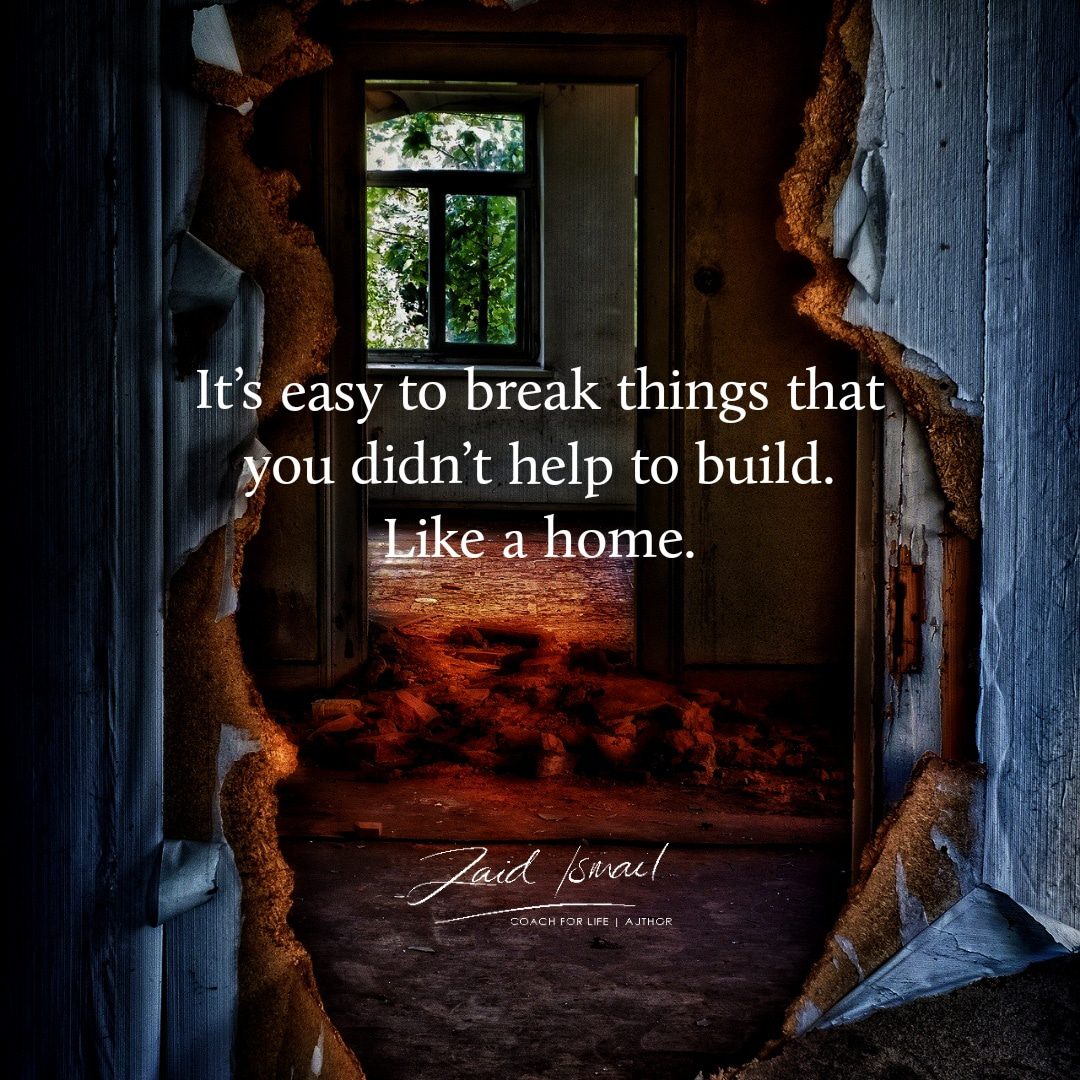
Those who live with the expectation of receiving what they need, rather than putting in the effort to create it with their own heart and hands, will take for granted that which others have exhausted themselves building.
Like a home. There are too many who expect to feel at home because of their material contribution, but don’t know what it takes to create that homely feeling.
Providing the house doesn’t make it a home. Nor does cleaning the house make it a home.
Buying the groceries doesn’t make an endearing family meal. Nor does cooking it.
What connects our efforts with the hearts of those around us is not in the material or dutiful contribution that we make. It’s in the love and appreciation that accompanies how we treat ourselves and them, that connects our hearts and creates a home.
Those who were raised in an environment where their responsibility was more important than their emotional needs will find it easier to judge the quality of their relationships based on what they get from it, rather than how they’re loved or appreciated.
True love and appreciation will automatically result in wanting to create that homely feeling, or that endearing family meal.
Without that love and appreciation, love becomes a transaction, and a check list of things to do so that we avoid blame when things go wrong.
The better we are at that check list, the more we believe we’re truly loving and appreciating life. Until we stop getting what we need.
But, as always, you can’t give what you don’t have.
If you treat yourself like a commodity, your affection for others will be based on the fear of not having them around, or not getting what you need from them.
Who they are and what they need will not feature at all. Sadly, you probably won’t even be aware of it when you’re in that state.
That’s why self awareness is so important. Because it always, always starts with you.
#hope #expectation #sincerity #selfworth #selfawareness #mentalhealth #mentalhealthawareness #mentalhealthrecovery #theegosystem #ownyourlife #lifecoaching #zaidismail #loveyourself #lifegoals #motivation #optimism #purpose #fatherhood #motherhood #parenting #relationshipgoals -
Celebrate the dead. Discard the living.
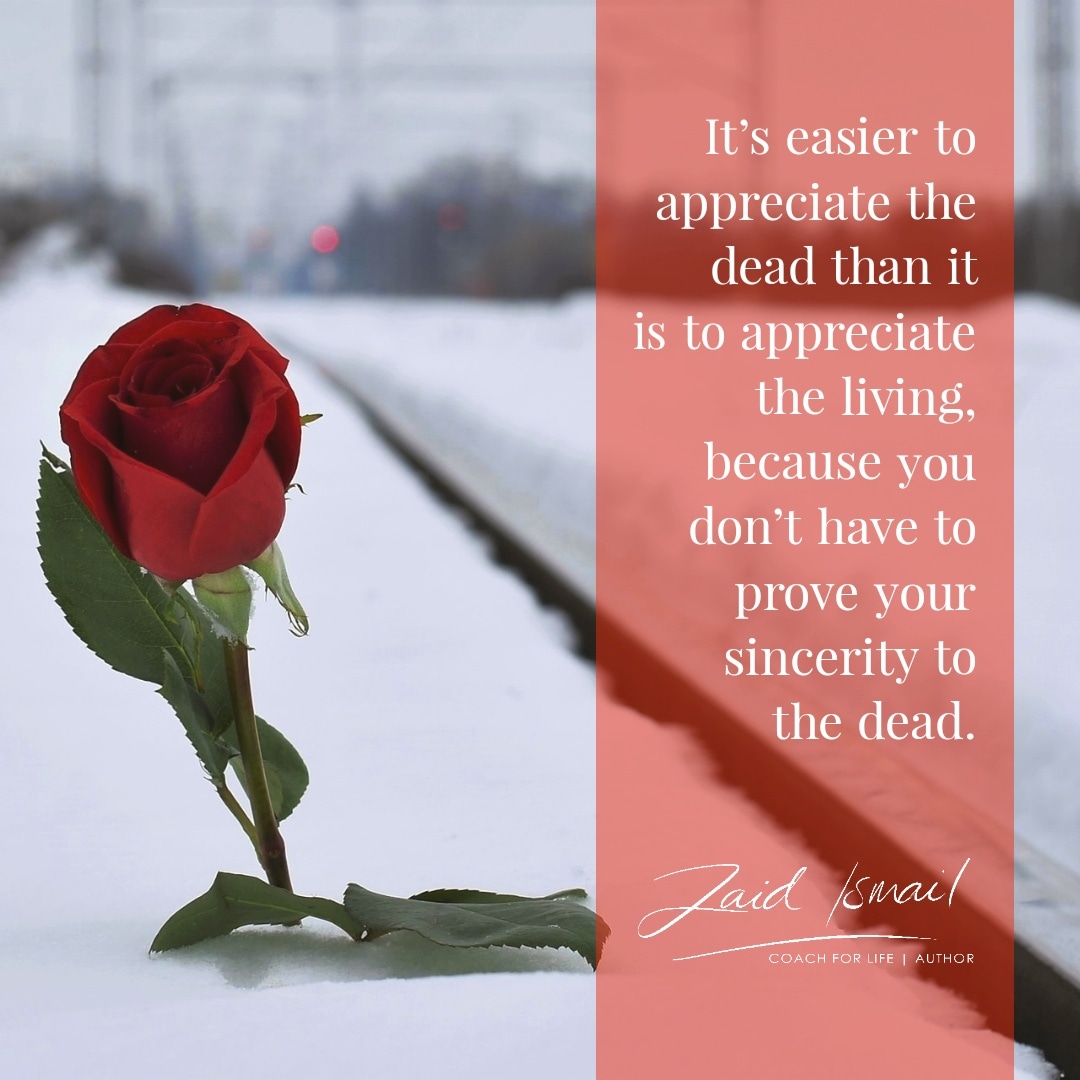
Ever notice how often people are revered when they’ve passed on, but the same people were neglected, ignored, or even treated badly while they were alive?
Sometimes the reverse is also true. The one who passed on may have left a path of destruction in the lives of those around them, but because of their social standing or their role in their family, they’re revered to the point of exaggerating their good while dismissing the impact that they had on those who were victim to their ways.
Some would have us believe that it’s because we must not disparage the dead. Which is true. We shouldn’t.
But does that also mean that we must exaggerate their good to the point of diminishing the damage or harm that they caused?
The reason we do this is not out of respect for the dead, but more likely because it draws attention to our virtue.
It’s easier to demonstrate such kindness towards the dead, because they have no expectation from us to follow through with sincerity or commitment towards how important we say they are in our lives.
If we were truly committed to establishing good, we would place as much emphasis on remedying the harm that they caused, while remembering the good that they did.
If we don’t, we end up revering the dead to the detriment of the living, thereby reinforcing the harm that the deceased caused, and further oppressing those who are already struggling with the impact of the harm done to them by the deceased.
That’s how we enable generational trauma.
That’s how we create more harm for the victims of those oppressors who have passed on.
That’s how we become part of that cycle of harm.
#hope #expectation #sincerity #selfworth #selfawareness #mentalhealth #mentalhealthawareness #mentalhealthrecovery #theegosystem #ownyourlife #lifecoaching #zaidismail #grieving #death #fatherhood #raisinggirls #parenting -
Father : A silent duty
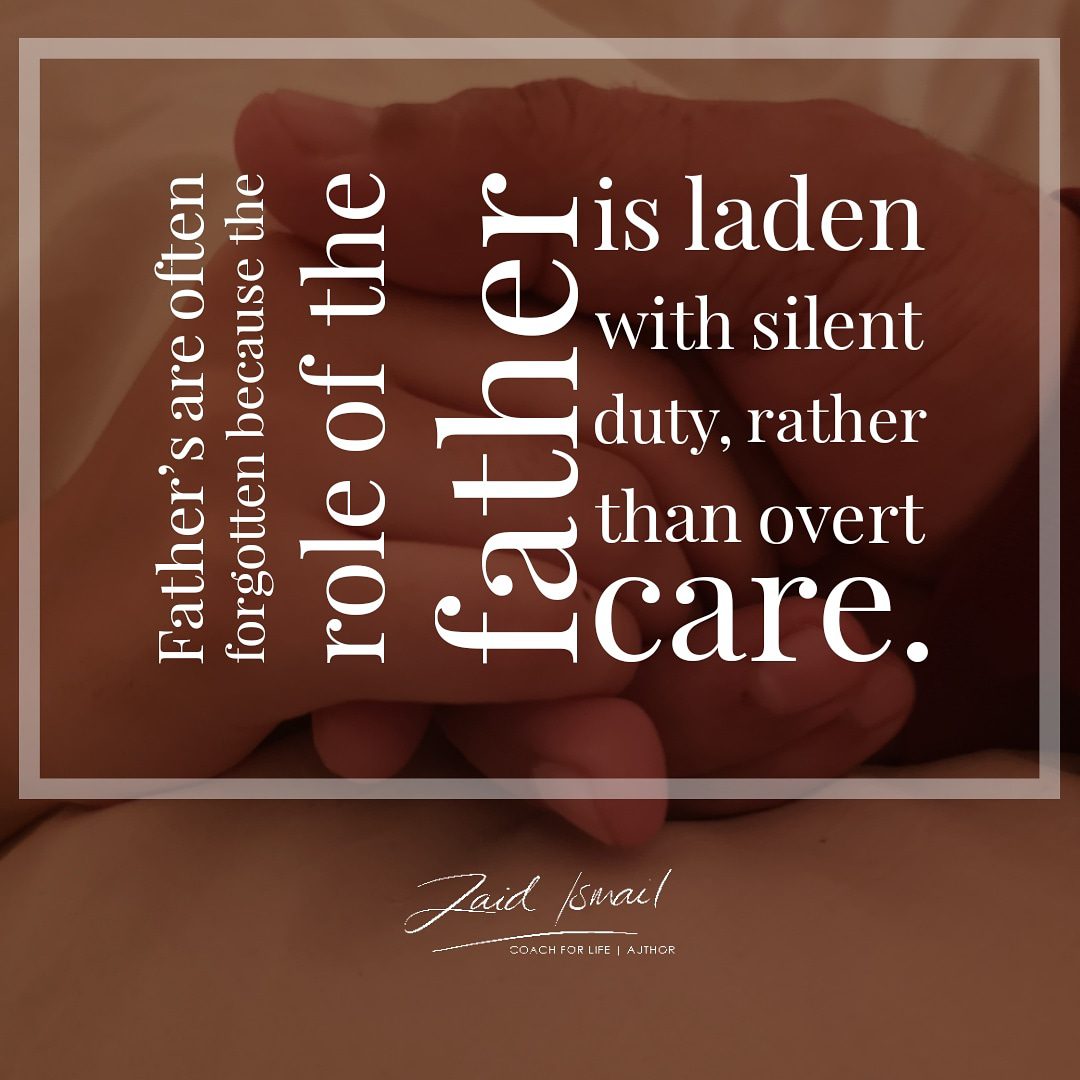
Fathers are often overlooked or forgotten, because they’re seldom in the limelight.
Silently serving in the background, they often do what is seen as just their job, or their duty.
Not wired with an overt nurturing instinct, but rather that of a silent sentinel, ensuring their family’s safety and comfort, they often grow accustomed to being in the background, creating the spaces needed for their family to thrive.
When we expect fathers to behave in a similar way to mothers, we diminish their contribution and their sacrifices.
When we expect fathers to show up like mothers, we under estimate their emotional needs, and ignore their silent pleas for gratitude.
When we expect fathers to experience emotion and sentiment in the same way that mothers do, we assume that they were gifted with the beauty of connecting with a soul growing within them, not realising that they were always on the outside looking in.
There is a bond between mother and child that a father will never experience because of the sanctity of childbirth. Perhaps that is why fathers will always find a different way to express their love for their family compared to mothers.
Honour your father by recognising his struggle and efforts without finding reason to judge him compared to your mother.
And if you find he is falling short anyway, approach him with understanding, believing that the gentleness you wish to experience with him lies beneath that seemingly impenetrable exterior that developed only because he quietly accepted his place as a provider and forgot to nurture his own emotional needs.
And to the fathers who show up despite not knowing how it is done because they didn’t have the loving guide of a mentor in their lives, I especially salute you. Breaking cycles of toxic dysfunction is never easy, and is often excruciatingly lonely.
So if no one else notices you today, I do. With love, appreciation, and respect.
Happy father’s day.
#fatherhood #fathersday #fatherdaughter #fatherson #father #husband #parenting #singleparenting #parents #ownyourshit #ownyourlife #theegosystem #mentalhealth #mentalhealthawareness #mentalhealthrecovery #zaidismail -
Claim your humanness
My daughter looked quite distressed when she asked me this question over the weekend.
“What drives people to be so cruel to animals, like skinning them alive, or abusing them for profits?”
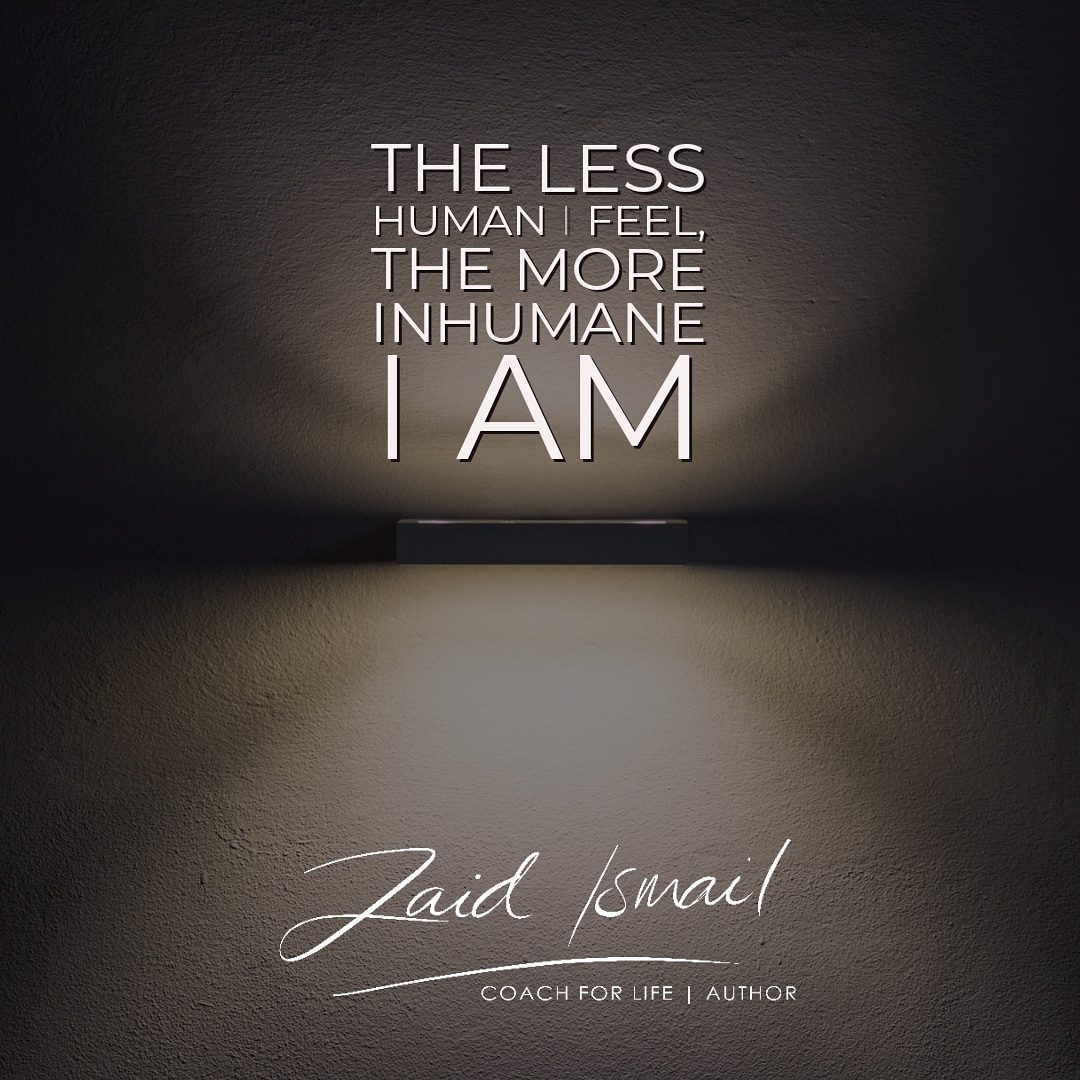
The first thought that came to mind was this. We only lose our humanity when we feel less than human.
The truth is, we only lose our humanity when we believe that we are defined by what happened to us, rather than what our choices were in response to those trials of life.
Watching her grappling with the reality of who she is versus how others have treated her and betrayed her trust in her short life is grounding me in ways that I never thought possible.
I swayed from anger at not knowing how to be there for her, to self-pity for not being a good enough parent, to a quiet albeit sad patience, knowing that all I can do is allow her the space to come to terms with the harshness of life in a way that makes sense to her.
As her father, I fear that she may outgrow me in the process, which stirs up the self-pity and anger, but just as soon, I regain my composure knowing that by giving in to either, I will only create a self-fulfilling prophecy if I insist on inserting myself into this precarious space in which she finds herself.
So my test in her test is to be consistent and available while she finds her way through it.
The struggle of single parenting is grossly underrated.
And the struggle of a single father raising a daughter even more so underrated.Through it all, there was another battle just beneath the surface of the ones that I thought were important. That is, the battle to claim my humanness in the face of exactly the same kinds of betrayals and cruelty that I had faced, which are echoed in the struggles that taunt her.
And it’s through recognising this deeper battle within that I realised the root of my anger and self-pity. It is the need to have my sincerity and effort accepted by one I hold dear, so that the lessons learnt at the hands of brutes and hypocrites will allow me to give that which I did not receive.
Also, it is my need to protect her from the demons that have so often derailed my efforts in life. I want to protect her from that which ravaged me when I was her age.
But I can’t. No one can save us from the journey that we must take to discover the beauty of who we are.
The only thing we can do is remind them that giving up midway through that journey is never worth it. Because once you emerge from the other side, there is a depth and breadth to your humanness that would otherwise have escaped you, and would have left you empty and wanting in your efforts to connect with the beauty around you.
The irony being that the depth and breadth that is discovered further isolates you from those who distracted themselves through that journey, rather than embraced the pain and the education that it offered.
A beautiful patience and a courageous perseverance is needed to hold on to your humanness in an inhumane world.
Photo credit : Adobe Stock
#parenting #singleparenting #fatherhood #raisinggirls #daughters #hope #expectation #sincerity #selfworth #selfawareness #mentalhealth #mentalhealthawareness #mentalhealthrecovery #theegosystem #ownyourlife #ownyourshit #embracingME #zaidismail -
Orphaned
I’ve found that the most unassuming leaders and role models are the ones with the greatest impact. They are not the ones that are celebrated from the pulpits. In fact, from the pulpits is where you will find them despised or judged. But that is not a testament to their being, instead it is an indictment against the bearers of those stations.
Seeing a father celebrated tonight left me ambivalent, as the subject of fatherhood often does. I looked across at one whose father was taken away at a young age. I saw the fight to maintain composure dull the eyes that was just a minute ago filled with the enthusiasm of youth. But even in that there is a blessing that I struggle to relate to, and I wonder if those that have lost truly appreciate the gravity of the grounding point that they have in life, even if only for those few short years beyond which they may understandably feel cheated out of a lifetime of love and affection, not least of all the wisdom that often accompanies such a presence.
Oddly enough it really is the presence more than the conscious efforts of fatherhood that appear to leave the most powerful impressions. Perhaps in that presence I can relate, but not much beyond. I often recall the words of a man I once met when he described the influence his father offered in his life. He recounted how he awoke every morning to see his father sit comfortably in his favourite armchair reading the newspaper, allowing all about him to continue uninterrupted, but equally uninterested. It was that scene that prompted him to be more than his father ever was, to him or to those around him. That is a reality I can relate to.
But tonight was a reminder for more than just that. I found myself questioning my views about celebrating life versus celebrating occasions and witnessed first hand how people that I have anyways recognised and admired for living a full life seemed to be galvanised by the occasion of marking a milestone in a life fully lived. Perhaps they, like me, don’t recognise the amount of life they live. Perhaps they too, looking from the inside through the lenses that filter their reality, may not recognise the amount of life they have lived relative to the struggles and loss that scarred their landscape.
The reality I’m faced with is that life is not separate from the bad times, or the occasions. Celebrating the occasions in the absence of celebrating life at least gives us speckles of appreciation even though I still spurn the distraction it causes in its wake. Contemplating all this, including some unexpected interactions this evening gnaws away at yet another old companion that I’ve held dear for so long. Jadedness is spawned by bitterness. It’s a response needed to dull the ache that a lost youth and an absent father etches into our distorted view of what promise the world holds. It’s this same distortion that often sees us fighting battles that exist only in our minds.
Maybe the fatigue of being me is suddenly not a fatigue, but instead it is a surrender to a reality that was self imposed. Self imposed or not, it is still my reality. Tonight, sitting here, isolated in my thoughts, surrounded by the warmth of an extended family of whom only a select few I have ever connected with but still feeling the familiarity of a blood line I am tied to in spite of my exclusion for reasons unknown to any of us, I find my soul oddly consoled, yet still restless. But it’s a fading restlessness, even if just for tonight.
Perhaps my jaded soul will learn what it means to feel human after all. Perhaps not.