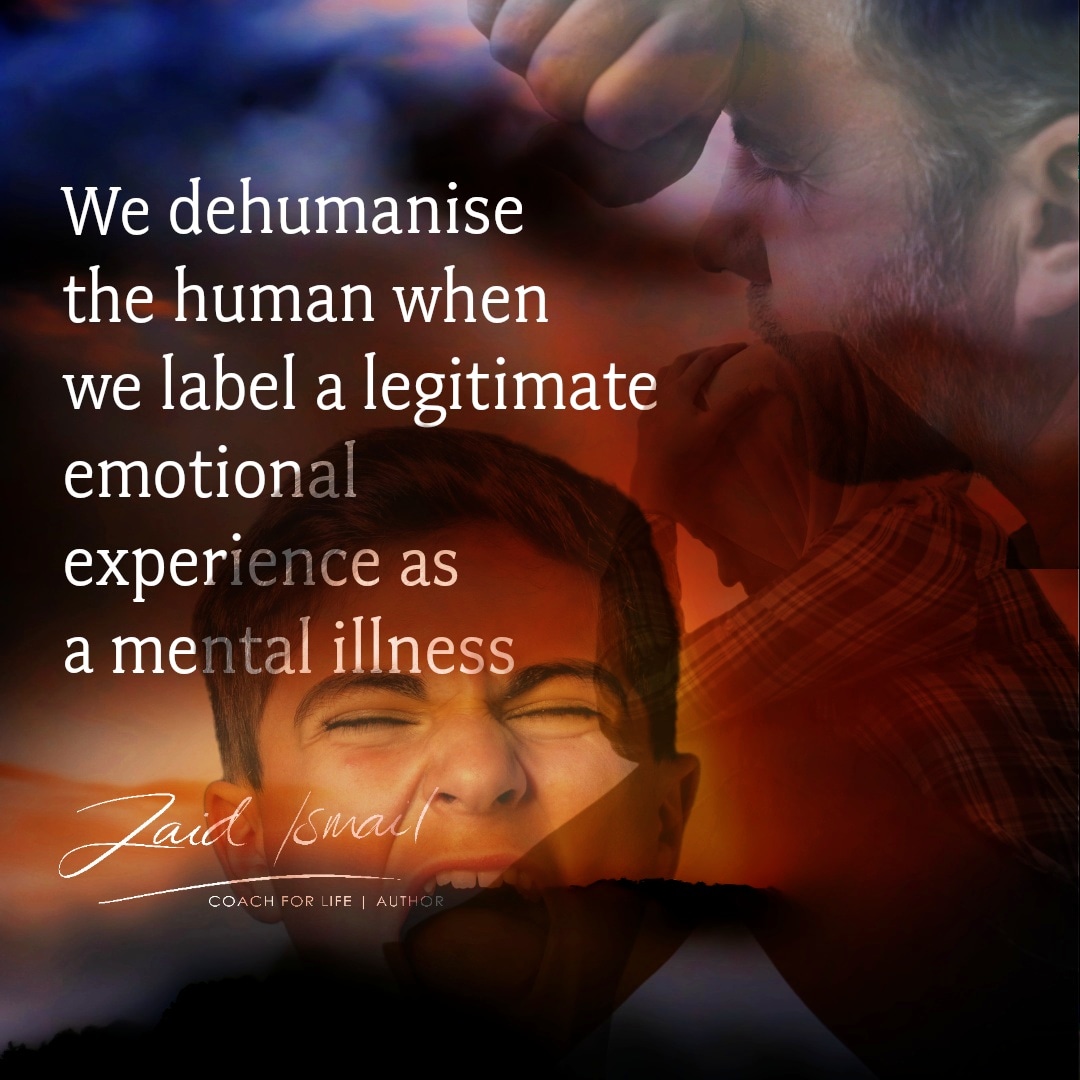
We dehumanise the human when we label their emotional experience as an illness.
The moment we attach a label to a life experience, we focus on the label and discard the merits of the experience.
We make people invisible when we deny the reality of their experience by suggesting that there is something clinically wrong with them, despite causality of their emotional upheaval being clearly associated with their experiences in life.
In other words, there is a clearly troubling or traumatising experience that they’ve endured to explain their emotional duress, yet we diminish their experience by ‘diagnosing’ them with an illness for feeling overwhelmed, anxious, or stressed, etc. simply because they’re affected by it for longer than we think they should be affected by it.
The victim readily embraces such labels because it offers hope where they feel hopeless, and allows them to abdicate responsibility for rising above it.
The oblivious or insensitive ones happily embrace such labels because it demands less emotional investment, or less accountability in their efforts to uplift or support those around them.
Our aversion to embrace the entirety of the human behind the troubled behaviour denies the victim a voice, or an opportunity to understand their painful experiences in life.
These labels are worn with shame because it denies us our humanness and makes us a symptom.
You cannot break the stigma of mental health by undermining the humanness of the ones affected by the stigma.
Kill the label, kill the stigma.
If you stigmatise someone’s real life experience, how can you possibly expect them to feel whole?
#mentalhealth #mentalhealthawareness #mentalhealthrecovery #suicide #suicideprevention #suicidalawareness #suicideawarenessmonth #depression #anxiety #ownyourlife #theegosystem #embracingME #zaidismail
Tag: embracingME
-

Labelling humans
-

The meandering twists of fate
Betrayal is not always a result of harsh words, lies, or cruel action.
We’re often so focused on what we’re not getting from others, that we don’t pause to consider what they may not be getting from us either.
The deepest cuts are those that are inflicted when we trust someone to be there, but they walk away instead.
It’s when our rock in this world goes silent when we desperately need to hear their comforting voice.
The searing edge of the blade of betrayal is when we repeatedly make excuses for others failing us, but we’re discarded the moment we have a moment of weakness.
When there is inaction from those towards whom we look expectantly while recalling the times that they drew on our energy in moments when we barely had enough to sustain our own spirit, we find ourselves holding on, desperately clawing with both hands, to the remnants of the shards of our broken spirit, knowing that only we will be there for us, with the only solace needed being our trust in the One who created us.
People fail us for the same reasons that we may fail others.
It doesn’t make it right.
It doesn’t make it wrong.
It makes us all flawed humans who sometimes succumb to the demons of the past, while oblivious to the demons we just spawned in another because we were distracted.
Striking a balance between recognising their humanness, while allowing ourselves to be human, while protecting ourselves from the impact of their demons, while grappling with our own demons is what defines the struggle of life, and the devastating risk of love.
But we do it anyway, because without it, what would be the point of life?
#mindfulness #inspiration #introspection reflection #ownyourlife #theegosystem #embracingME #mentalhealth #mentalhealthawareness #mentalhealthrecovery #selfworth #selflove #selfawareness #selfrespect #zaidismail #lifecoaching -
Kill the label. Kill the stigma.
⚠ Trigger Warning ⚠
The moment we attach a label to a life experience, we focus on the label and discard the merits of the experience.
We make people invisible when we deny the reality of their experience by suggesting that there is something clinically wrong with them, despite causality of their emotional upheaval being clearly associated with their experiences in life.
When we readily embraces such labels, it disempowers us to make sense of, and to rise above that which weighs us down.
When we create such detachment from the cause of our duress, it denies us a voice in expressing our hurt or pain.
Instead, it convinces us that we’re defective in some way.
When the shame of such labels grows to define how we appear to others, we find familiarity and a common cause with others who suffer a similar struggle, resulting in a victim mindset that focuses on claiming their space as struggling humans who are afflicted with mental illness.
That’s how we break each other down as humans, while building each other up as victims.
You cannot break the stigma of mental health by undermining the humanness of the ones affected by the stigma.
We need to see the human behind the labels that we throw at each other.
Until then, compassion and empathy will continue to be in short supply.
Kill the label, kill the stigma.
#mentalhealth #mentalhealthawareness #mentalhealthrecovery #suicide #suicideprevention #suicidalawareness #suicideawarenessmonth #depression #anxiety #ownyourlife #theegosystem #embracingME #zaidismail #lifecoaching -
What are you waiting for?
I’ve often advised someone about something that I truly believed them to be capable of achieving, and the response I received was, “Not everyone is like you!”
Henry Ford said, “If you think you can, or you think you can’t, you’re right.”
Sadly, too many think that they can’t, and then blame the world for the state in which they find themselves.
But why would someone willingly put themselves down, or sell themselves short?
Did I hear you say fear of failure? No. That’s what we see, and often what they feel on the surface.
Dig a little deeper and you’ll realise that failure is such a threat because it threatens to reduce our significance among those who are important to us.
It’s the threat of insignificance through being incompetent or unsuccessful that fills us with the fear of failure.
But, we must always remember that fear is only the response to what we’re assuming is the probable outcome of our efforts.
In other words, when we’re convinced that we won’t be able to accomplish something, or we have doubts about achieving it, the assumptions that we’ve made is what we’re focused on. Hence the feeling of dread or fear when we contemplate the future outcome.
Hence the fear of failure.
The important question to consider is therefore not if we’re capable of achieving that goal, but rather why is our feeling of significance as a person defined by our level of success?
And before you say it’s because people judge you as a failure if you don’t accomplish things the way you’re expected to, the next question you should be asking is why does the judgement of others define your self-worth more than your opinion of yourself?
People’s opinions will only weigh you down if you give them permission to do so.
Talking about permission, when was the last time you gave yourself permission to learn from your failures instead of judging yourself for failing?
#optimisticquotes #mentalhealth #selfworth #selflove #selfawareness #selfrespect #mindfulness #inspiration #ownyourlife #theegosystem #embracingME #lifecoaching #zaidismail #loveyourself #lifegoals #motivation #optimism -
Never abandon hope
Hope is born in moments when you have no reason to believe in the moment that is to follow, but something good unexpectedly lands in your lap.
It’s born when that unexpected call changes your life for the better.
It’s born when that stranger smiled an understanding smile in that moment that you thought the world was oblivious to your presence.
It’s born when you wake in the morning and discover that despite your worst premonitions, you have a good day.
Hope can be torturous when the events of your life have given you little reason to believe that the good that you experience will last for more than a fleeting moment.
But, knowing that it’s possible for it to last beyond that brief period of joy is what makes it impossible to ignore the hope that bubbles beneath the surface.
Hope is faith. And faith is hope.
Both are intricately woven into the fabric of our struggles.
When we focus on our struggles only, we lose sight of all those moments that planted the seeds of hope in our hearts so many lifetimes before the present moment.
In forgetting, we burden ourselves with more than the burdens of life. We burden ourselves with the burden of ingratitude as well.
Focus on hope, and faith will have your back.
#hope #expectation #sincerity #optimism #perseverance #motivation #goals #ambition #success #selfawareness #selfrespect #mindfulness #inspiration #zaidismail #ownyourshit #ownyourlife #theegosystem #embracingME #mentalhealth #mentalhealthawareness #mentalhealthrecovery -
Growth is inevitable
This was an important realisation that has carried me through many difficult experiences in life.
What’s even more important to realise is that when we choose a positive growth for ourselves, there is no guarantee that the people around us will choose the same.
Don’t back down from being a better version of you because of it.
All you can do is try to inspire them to be better as well. But the final choice will always be theirs to make.
Trials are there to teach us lessons about what we previously took for granted.
With it, comes a greater level of awareness.
Awareness carries with it a responsibility to either contribute more, or to apply yourself in better ways. That’s how growth takes place.
When you resist such growth, you grow in defensiveness. So you’re effectively exchanging positive growth for negative growth.
Growth is therefore inevitable. You only get to decide in which direction it takes you.
#growth #awareness #trialsandtribulations #life #selfawareness #selfrespect #mindfulness #inspiration #goals #mentalhealth #mentalhealthawareness #mentalhealthrecovery #theegosystem -
Invest in hope
When you’re lost on a journey, do you keep driving around in circles hoping that your destination will miraculously arrive, or do you try a different route until you find it?
Or do you sit behind the wheel and judge yourself for being a bad driver because you’re on the wrong road? If you do, does it suddenly make your destination appear?
Life is no different.
Hopelessness is never the end of the road. It’s a sign that you need to take a new one.
The fact that you knew how to get yourself onto THAT road means that you have the ability and skill to change routes.
When we find ourselves in a rut, we shouldn’t remain invested in that rut hoping that someone else will come along and change it for us.
We need to change it for ourselves because we know what destination we’re in search of. No one else does.
Holding others responsible for getting to our destination assumes that they are not also searching for their destination. Or are lost in their own rut.
It’s how our journeys intersect with each other that we find companionship and comfort in others. Not in waiting for them to navigate or journey for us.
Own your life. It’s yours to own.
#hope #expectation #sincerity #selfworth #selfawareness #mentalhealth #mentalhealthawareness #mentalhealthrecovery #hopelessness #suicideprevention #suicide #zaidismail #lifecoaching #ownyourshit #ownyourlife #theegosystem #embracingME -
What do you see in the mirror?
Given how easily we can change how we present ourselves to others through social media these days, it’s important to remember how much of our authenticity has to be sacrificed in the process.
Be true to yourself, online and offline, and you won’t need filters to make your life or yourself appear to be different from your reality.
We convince ourselves, sometimes of truths and sometimes of delusions of who we are.
When it’s a delusion, we forget that in the process, we also have to convince ourself that we’re not who we really are.
It sounds complicated but it’s really simple. Before we can believe that we’re someone we’re not, we have to convince ourselves that who we really are is not true.
Why would we do such a thing? Because we’re afraid that if we don’t fit someone else’s expectations, we may find ourselves isolated or alone. And no one wants to be alone. Right?
However, loneliness is most felt when you’re in company that doesn’t recognise who you really are. To connect sincerely and meaningfully with another, we must be true to ourselves first, or else we’ll lose every moment in our efforts to be what we took that need, rather than who we are.
And that’s how we lose ourselves in the process.
Read that again if you must, but internalise it.
It could save your sanity and your peace.
#selfworth #selfdoubt #selfawareness #selfrespect #reflection #mindfulness #validation #mentalhealth #mentalhealthawareness #mentalhealthrecovery