Tag: selfrespect

  • Resisting the norms

    Resisting the norms

    The relentless pace of society towards retiring those who are no longer contemporary is enough reason to settle into the rhythm of preparing for old age. Just writing that out makes me nauseous.

    To regain my sanity, or at least to push back against the approaching insanity, I remind myself that I have a good 20 to 30 years still left in me should I not succumb to the violence that pervades so many social spaces. 20 to 30 years is a lifetime in itself, which makes it difficult for me to grasp why someone would willingly plan to surrender a lifetime in favour of a belief system that has put out to pasture the wisdom of lives lives and struggles overcome.

    Society is only as strong as the most pervasive weakness that it celebrates. At present, we appear to celebrate mediocrity, sensationalism, materialism, and debilitating comfort. Passion and purpose do not feature in the most important discussions around me, both in my personal domain or in the public domains that I frequent.

    My aversion to such norms has seen me increasingly isolating myself from such spaces leading to a dulling of my spirit that threatens to land me in exactly the state the thought of which nauseates me. Thus, if left to my own devices without a grasp on life itself, I will succumb to the very thing about which I judge others. That has proven to be the only truth about the struggles of my life.

    The judgement that I flirted with in my youth visited me in my adulthood and threatens to define my twilight years. However, I refuse to embrace the twilight. I will marvel at it, and perhaps even taunt it, but I have no intention of embracing it. My irreverence at that sight of social norms creates a tension within me each time I even contemplate fitting in or going with the flow of the river of affluence that stenches up the environment around me.

    An art neglected will be lost. Thus, I find my ability to express myself slowly eroding while the mental clutter of everything that I have grown to despise about mediocrity takes its place. The despicable narrative of the contempt that I hold for the lack of conviction that I am bombarded with takes up more head space than it ever should.

    The absence of a sounding board or an understanding gaze leaves me adrift in a sea of tumultuous currents that have exceedingly brought me closer to tipping over and losing myself to the idealism of a mind fraught with angst at the sight of everything that threatens the wholesomeness that I hope to experience before my final calling.

    When the spoken word is not welcomed, the written word is all that remains of my avenue of protest against a world that celebrates vulgarity and self-aggrandisement rather than the substance and wondrous nature of life itself.

    A distracted clown appears deeply philosophical. A whimsical philosopher appears foolish.

    I must avoid both.

  • Have you ever truly lived?

    Have you ever truly lived?

    Is your definition of success really your definition of success?

    Or did you perhaps borrow it from society without really noticing?

    Our fixation on appearing successful is so toxic, that we readily give up our hopes and dreams in favour of acceptance.

    Most people don’t have a greater purpose in life beyond achieving what secures their place in society, or in their social circles.

    The chase for acceptance or validation is how we die a million deaths in a single lifetime, but rarely live a single wholesome life before death.

    Do we even know what a wholesome life feels like between all the distractions and our efforts to appease others?

    When was the last time you reconnected with the idealistic teen in you?

    If you had to meet your teenage self, would you be proud or disappointed in who you are now?

    Or were you already wasted to the peer pressure back then that you’ve never known a life beyond that?

    Today is a good day to reconnect with you.

    death

  • Feeling triggered?

    Feeling triggered?

    ⚠️ Trigger warning ⚠️ archive post.

    Blaming chemicals for your emotional state is like blaming the overflowing rivers for the rain.

    Smile, and you generate feel good hormones even if you don’t have a good reason to smile.

    That’s science, not conjecture. If you don’t believe me, Google the science of a smile. And while you’re at it, Google neuroplasticity to see how your brain REACTS to new information and experiences, and does not create those perspectives.

    Don’t dehumanise the human experience by labelling it as an illness.

    Take back your agency by understanding why you may feel the way that you do.

    Stop judging yourself or others harshly for being human.

    I wish we’d realise that by defining the human experience as an illness, we effectively dehumanise the human experiencing it.

    Think about that the next time you convince yourself or others that their reasons for experiencing an intensity of emotions is due to chemicals and not because their life experiences and perspectives warrant such a reaction.

    It’s time to start understanding, instead of judging harshly, or abdicating responsibility for who we are.

    Every emotional experience has a legitimate basis within the context of our life.

    Whether we’re correct or incorrect about why we feel that way doesn’t change the fact that we, in our mind, have reason to feel that way.

    Understand that, connect the dots to your experiences, and suddenly an overwhelming emotion becomes a source of information to work with rather than to fear or to suppress it.

    Own your life before it owns you.


  • The victim-hood of self-loathing

    The victim-hood of self-loathing

    No good deed goes unpunished. I was reminded of this in recent days when the bitterness of a self-loathing human distracted me from what is important about life. It’s not the bitterness that was jarring. It’s the intensity, and the immensity of the self-loathing that has become the battle cry of too many that jarred me most.

    The delusion that doing good attracts goodness adds to the mind-numbing effort of being human. We don’t attract what we do or what we give, we attract those who are most in need of what we’re offering.

    That’s why the vapid seek the wholesome.

    The weak seek the strong.

    The self-loathing seek the grateful.

    And the cursed seek the blessed.

    But the twist is a terrible one. Just because you’re self-loathing doesn’t mean that you’re not blessed. It just means that you will not see in yourself what others see in you.

    It’s easy to lose yourself to the bitterness of a world full of ingrates disguised as humans parading as the wounded selfless ones. But in that lies the clue to recognise the twist of that dagger of self-loathing before it is inserted into your tender flesh.

    The selfless, the truly selfless, never parade.

    The ones who wear their heart on their sleeves, their struggle on banners of goodness and humility, and their inaction as a claim to exhaustion from their reality are the ones who are ungrateful for who they are and what they have. That’s why they look for validation for what they parade in sometimes subtle tones, but most often in blatant distortions of their reality.

    Naivety is the knife that you drive into your own gut when you trust blindly, serve loyally without question or wisdom, and when you surrender who you are for who you believe you must be.

    Joy is ephemeral when not shared. It becomes a fleeting moment celebrated privately when what we honour comes to pass, but is just as quickly set aside because it doesn’t really matter if we don’t matter. It is this core of being human that turns our humanness into a frailty that is exploited by the self-loathing.

    Self-loathing is born from our assumption that we are incapable of what is needed to earn affection or inclusion. Such an assumption demands that we must present our best case to defend our pitiful state before others see us as pitiful or lacking. That’s when our struggle grows to define us. That’s when we need everyone to revere our struggle and not dare to advise us to rise above it because rising above it becomes a threat to our sense of self.

    If we don’t recognise the self-loathing in others, we’ll exhaust ourselves to the point of depletion in our efforts to be enough for them, or to inspire them to be better, or to believe in them until they begin to believe in themselves, while never holding them accountable for their ingratitude for everything that the have, and all that they are.

    If we don’t recognise the self-loathing in others, we’ll assume that they’re victims of life, while losing sight of the victims of their carnage as they go through life taking from everyone but always having reason not to reciprocate in equal measure. That’s how a healthy self-esteem in one who is sincere in uplifting another can easily be exchanged for crippling self-doubt after struggling to understand why we may never be enough for one who seems so full of potential if only…If only they see themselves the way that we see them.

    Self-loathing doesn’t create space for such realisation because self-loathing is the abdication of accountability for who we choose to be. Without accountability, there can be no healthy self-esteem because we need accountability to take a stand for what we stand for before we will ever experience the self-respect that results from standing for something that we believe to be important, rather than chasing things that make us important to others.

    Self-loathing is the ultimate barometer of gratitude, or more accurately, ingratitude. If we can’t be grateful for who we are, how can we possibly be grateful towards others for what they do? We cannot give what we don’t have. Which means that we can only give what we have. That is how our behaviour, when understood clearly, reflects the light or the darkness that we court within.

  • You’re human. Be human.

    You’re human. Be human.

    We need to be careful with subscribing to a victim mindset.

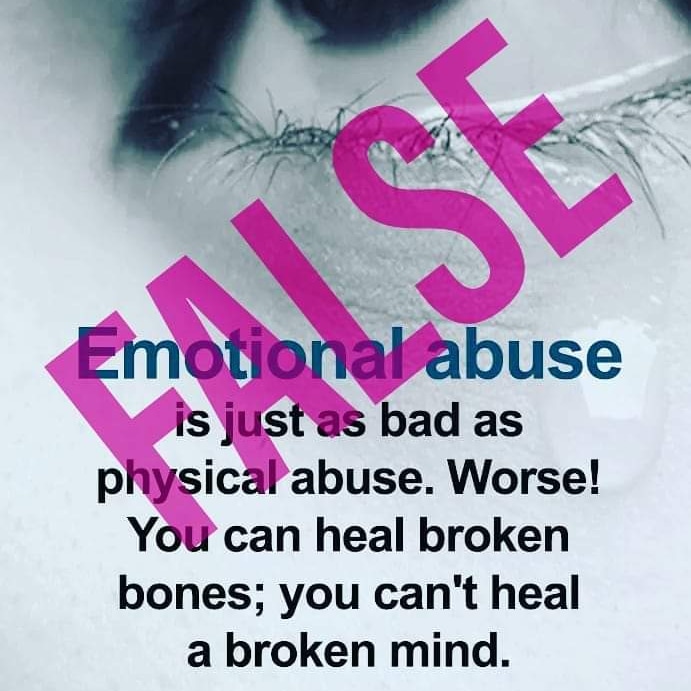
    Any form of abuse leaves emotional scars.

    But that doesn’t mean it breaks us.

    Nor does it mean that it’s impossible to heal from it.

    Don’t believe everything you read.

    No human is broken.

    And every mind can be healed.

    When we convince ourselves that we’re broken or that we can’t be healed, we create a self fulfilling prophecy, because what you set out to achieve is what you will achieve.

    Besides, it’s not the physical pain of physical abuse that sticks with us, it’s the mental and emotional anguish that it leaves that haunts us.

    Memes like the one above are well meaning, but they cause more harm to our mental health than they offer benefit or relief.

    Be careful what you take from the Internet.

    Good intentions have destroyed many lives.

    No matter how elaborate and sincere your effort at solving a problem may be, if you don’t understand the problem well enough, you will go about solving the wrong problem until you eventually convince yourself that the real problem cannot be solved.

    There is a solution for every problem except death. So if you’re not figuring it out, it means that you need more information and a fresh perspective of what you’re dealing with.

    Remember: No one is broken. No one is damaged. No one is beyond help. It takes a single moment of realisation to turn your entire world around.

  • Divinely obnoxious?

    Divinely obnoxious?

    Godliness is like humility. It is lost when we actively pursue it.

    Living by the doctrine to which you subscribe is infinitely more important than preaching it.

    People learn from how you treat them, not from how you chastise them.

    Judging the faith of another reveals the cracks in your self-worth more than it offers any revelation about the faith of another.

    When our self-worth is low, our association with divinity, religion, or other groups will be used to compensate for what we believe we lack in ourselves so that we may get the respect that we need.

    When we assume ourselves to be above those that behave worse than us, or those that disagree with us, we grow arrogant in our thinking and our ways, which directly opposes our efforts towards godliness, or piety.

    When we speak on behalf of the Almighty, we assume to have knowledge of the unseen because we believe ourselves to be devout enough in our practices and superior in our morals to claim such authority.

    Such pride and arrogance causes a decay in the soul that results in harshness, ingratitude, and rigidity, making it increasingly difficult to receive advice from sincere advisors.

    All this conflict within us results from a low self-worth, because when your self-worth is low, your life will be focused on compensating for that, rather than living purposefully or sincerely.

    Peace lies on the other side of gratitude, and gratitude is impossible if you lack awareness and appreciation for who you are, and who you want to be.

    That, right there, is the building blocks of self-worth.

    It always starts with you.

    rewards

  • You cannot make them rise

    You cannot make them rise

    I’ve seen, and experienced first hand, the disaster that awaits when we convince ourselves that the demons that others deal with is our responsibility to resolve.

    Being kind, compassionate, and even understanding does not mean that we must own the decisions that others have made, especially when those decisions include them choosing to hold on to anger from their past instead of embracing the opportunities of the future.

    Remember that you can only offer someone a hand up, you cannot make them rise.

    The same way that you must own the consequences of your decisions, you are responsible for giving them every opportunity to own theirs.

    That includes not making yourself available as a doormat to them when they’re not owning it.

    You’re not a hospital for the wounded egos of others.

    Compassion doesn’t mean that you must be a martyr.

    Sacrificing yourself to uplift another not only reflects ingratitude on your part for who you are and what you have, it denies your contribution of love to those that have a right to it, including yourself.

    Moderation in everything, and everything in moderation.

    Embrace your life fully, not only its struggles.

  • The meandering twists of fate

    The meandering twists of fate

    Betrayal is not always a result of harsh words, lies, or cruel action.

    We’re often so focused on what we’re not getting from others, that we don’t pause to consider what they may not be getting from us either.

    The deepest cuts are those that are inflicted when we trust someone to be there, but they walk away instead.

    It’s when our rock in this world goes silent when we desperately need to hear their comforting voice.

    The searing edge of the blade of betrayal is when we repeatedly make excuses for others failing us, but we’re discarded the moment we have a moment of weakness.

    When there is inaction from those towards whom we look expectantly while recalling the times that they drew on our energy in moments when we barely had enough to sustain our own spirit, we find ourselves holding on, desperately clawing with both hands, to the remnants of the shards of our broken spirit, knowing that only we will be there for us, with the only solace needed being our trust in the One who created us.

    People fail us for the same reasons that we may fail others.

    It doesn’t make it right.

    It doesn’t make it wrong.

    It makes us all flawed humans who sometimes succumb to the demons of the past, while oblivious to the demons we just spawned in another because we were distracted.

    Striking a balance between recognising their humanness, while allowing ourselves to be human, while protecting ourselves from the impact of their demons, while grappling with our own demons is what defines the struggle of life, and the devastating risk of love.

    But we do it anyway, because without it, what would be the point of life?

    reflection