Is your definition of success really your definition of success?
Or did you perhaps borrow it from society without really noticing?
Our fixation on appearing successful is so toxic, that we readily give up our hopes and dreams in favour of acceptance.
Most people don’t have a greater purpose in life beyond achieving what secures their place in society, or in their social circles.
The chase for acceptance or validation is how we die a million deaths in a single lifetime, but rarely live a single wholesome life before death.
Do we even know what a wholesome life feels like between all the distractions and our efforts to appease others?
When was the last time you reconnected with the idealistic teen in you?
If you had to meet your teenage self, would you be proud or disappointed in who you are now?
Or were you already wasted to the peer pressure back then that you’ve never known a life beyond that?
Today is a good day to reconnect with you.
#hope #expectation #sincerity #selfworth #selflove #selfawareness #selfrespect #mindfulness #inspiration #goals #mentalhealth #mentalhealthawareness #mentalhealthrecovery #success #reality #failure #life death #ownyourlife #coachzaidismail
Tag: reality
-

Have you ever truly lived?
-

You can’t wish away your struggle
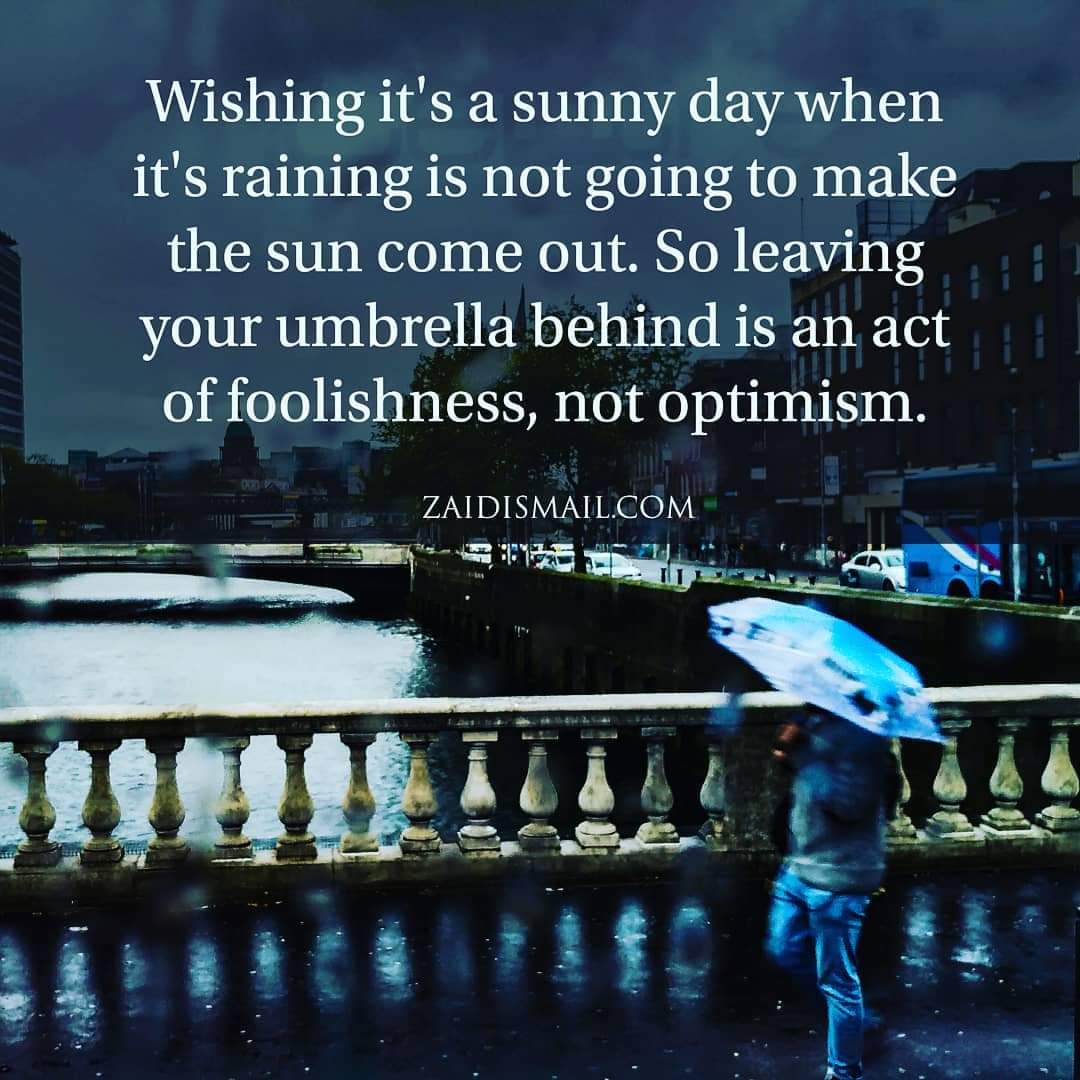
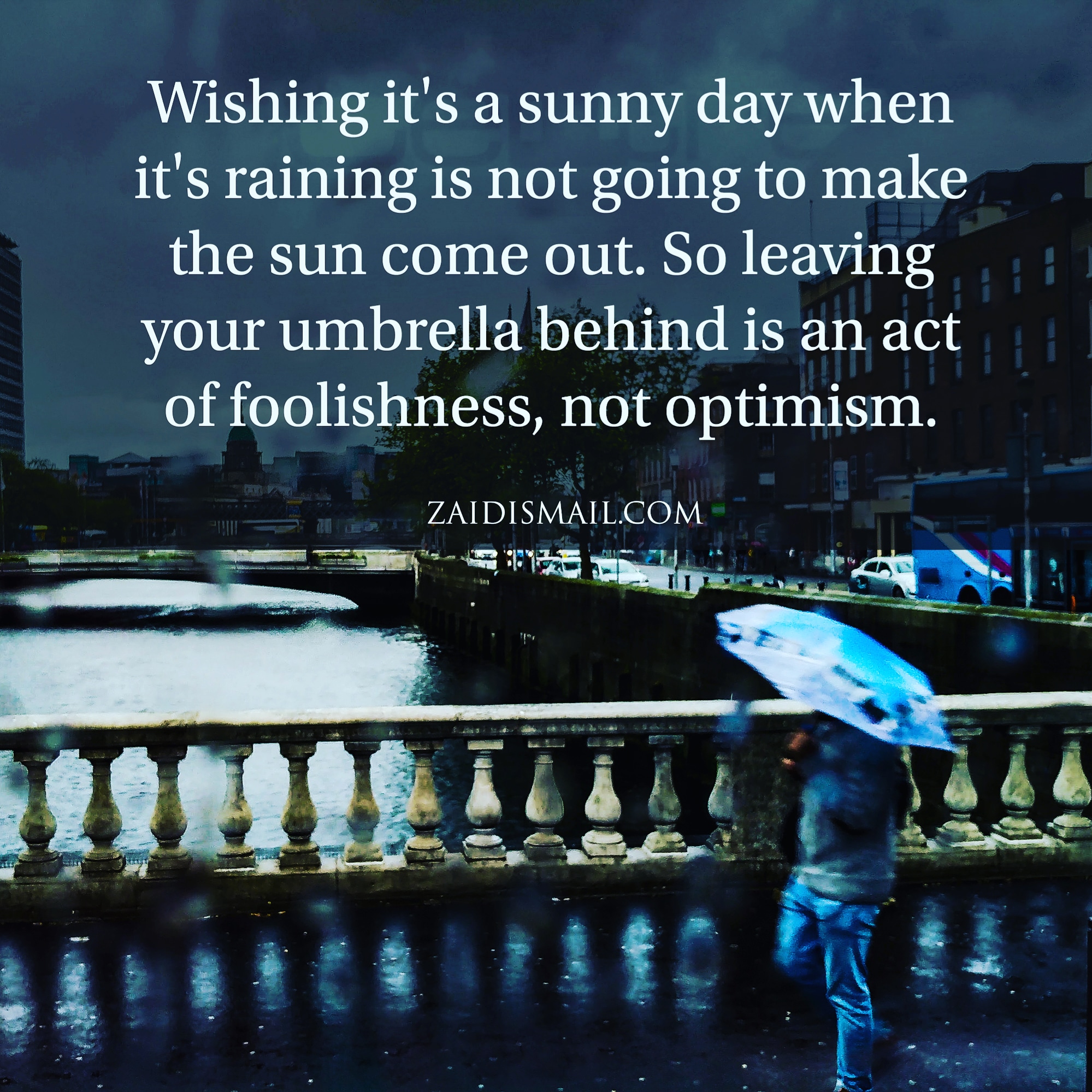
Wishing it’s a sunny day when it’s raining is not going to make the sun come out.
Therefore, leaving your umbrella behind is an act of foolishness, not optimism.
A positive mindset can often lead us into delusional states.
When our overbearing sense of deliberate positivity doesn’t produce results, it crushes our spirit even more than before we started.
Keep it real.
Positivity is about focusing on opportunities, not about wishing away reality.
Whispering to the universe, if not followed by real and decisive action, will remain nothing more than a whisper.
Positivity doesn’t only attract positivity, it also attracts the negative ones who are in need of positivity.
If you don’t recognise this, you’ll struggle to reconcile why your efforts at being positive still yield negative results.
You attract what others need, not what you are.
If nothing else, let that be the grounding point for your sanity.
#positivethinking #optimism #optimisticquotes #reality #keepitreal #mindfulness #mentalhealth #mentalhealthawareness #mentalhealthrecovery #selfworth #ownyourlife #ownyourshit -
Silent Protest
A protest that cannot be articulated, is a protest spawned by futility, to feed futility.
My contempt for what I am presented with is rarely expressed plainly. My reservations to express at all is grounded in years of ridicule and dismissal around issues I have held with great conviction. Experience is a bitter pill, whether swallowed or not. Each cycle of decay results in a shortening of the fuse that prompts us into action. I believe that our response at break point is chosen long before we reach that point. It’s not something that happens instinctively. Instead, it has been internalised for so long that when we do reach that tipping point, no contemplation or deliberation is needed. The response is not intended to be measured. It is intended to finally release the silent protest that we chose not to express outwardly for reasons that suddenly fade from significance.
Silent protests are born when our pleas for sanity or reason go unanswered in a setting that we feel compelled to embrace. It’s a cry for recognition of who we are and what we need that has fallen on inattentive ears, or calloused hearts, leaving us bound to the commitments we once made, while resisting the urge to respond in kind lest we be reduced to the same stature of that which we have grown to despise. But the contempt is not easily expressed. The contempt is reined in to ensure that the commitment remains the priority. After all, in the absence of the commitment, no such claim of aloofness would be credible.
So the silent protest plays out, often for years, and assumes a sub-conscious frame of reference that we rarely realise exists. The weightiness sets in, the lethargy overwhelms, the fatigue smothers, and the passion withers. Life ceases to be life at this point. Instead, it steps aside to allow existence to take over. Existence, then, becomes the final protest. It protests the onset of death, denies the potential of life, and secretly yearns for both.
Breathe. Exhale. Remind yourself why the silent protest started, if indeed you are able to remember, and decide if it is still worth the commitment you are trying to honour. If you can’t remember, then remind yourself about where your passion once flared, and use that as a point to return to in order to retrace your steps to the point where you lost your voice.
-
Saving my insanity
Sometimes I write to share my insanity, but sometimes I write to save it.
When everything about the world feels unnatural, sanity offers no relief.
Besides, like Vonnegut said, “A sane person, when compared to an insane society, will appear insane.”
I have often considered myself that lone voice of sanity, and in that assumption, I found myself to be insane.
Fulfilment lies in finding one who will embrace such insanity with me.
Despite the search being over, the insanity remains unfulfilled.
#sanity #insanity #reality #mentalhealth #mentalhealthawareness #mentalhealthrecovery #selfworth #selflove #selfawareness #selfrespect #mindfulness #inspiration #ownyourshit #ownyourlife #theegosystem #embracingME #pursuitofhappiness #zaidismail #relationshipgoals #love #loss #fittingin -
Choose your reality
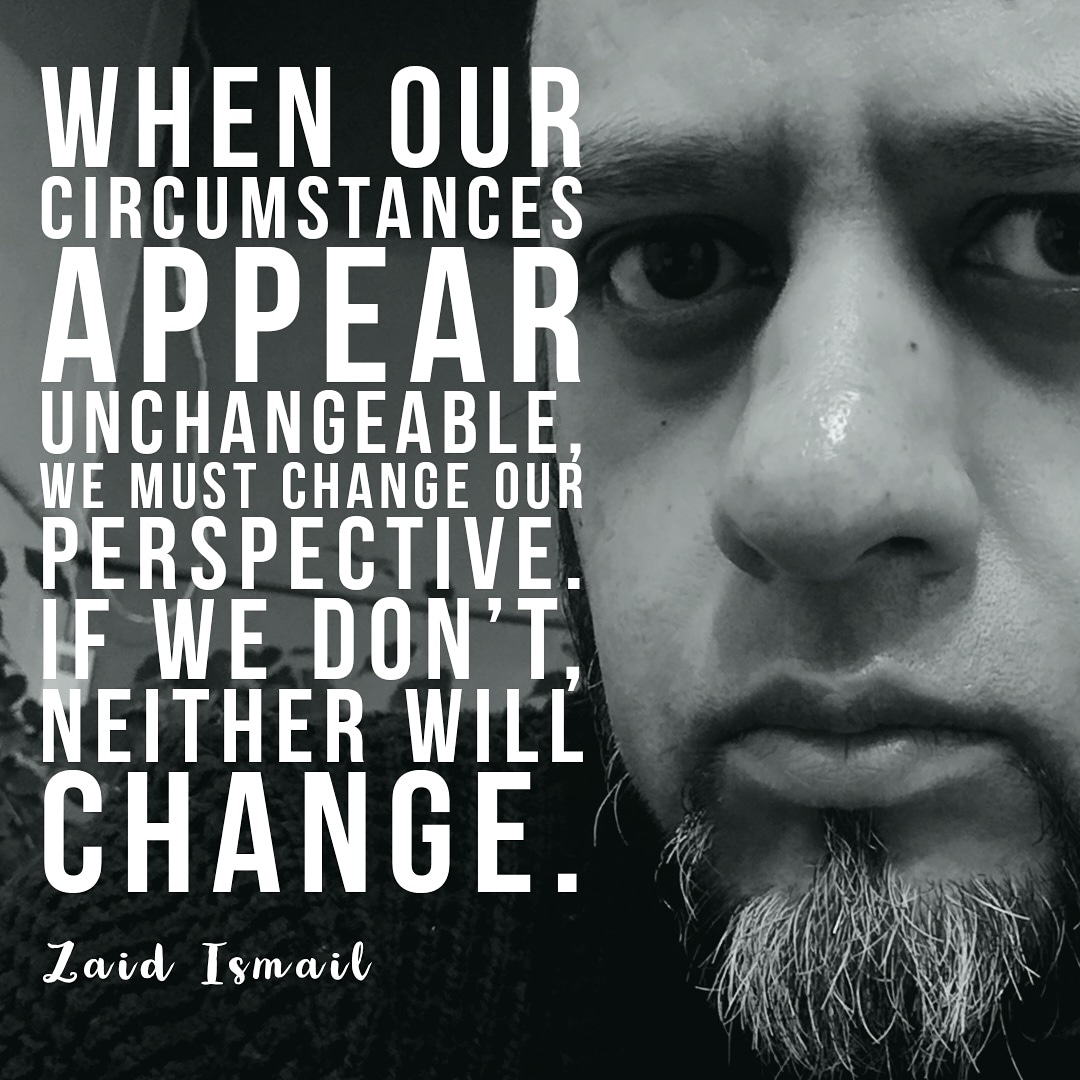
When our circumstances appear unchangeable, we must change our perspective. If we don’t, neither will change.
Perception shapes our reality, because we can always create an alternate reality, but we can never change reality itself.
When we look at something and feel overwhelmed by it, we generally find ourselves choosing between two things.
We either try to find someone to blame for it and hope that we’ll be miraculously saved in the process, or we’ll try to understand it better so that we can identify a way to overcome it.
The former is a victim mindset. The latter is simply being sensible.
We need more sensible people. And sensible people are those who are aware of their contribution towards the outcomes that they experience in life.
Sensibility starts with self awareness, and emotional mindfulness is at the heart of it all.
#selfawareness #selfrespect #mindfulness #inspiration #ownyourshit #ownyourlife #theegosystem #embracingME #21daystolive #mentalhealth #mentalhealthawareness #mentalhealthrecovery #lockdown #covid_19 #corona #coronavirusmemes -
Hopelessly hopeful
In all the times that hope seemed to escape me, I realised that it was not because the future held no hope. It was because I had given up hope of being able to participate meaningfully in that future.
I’ve often believed that it’s not depression that exists, but instead, it is hopelessness. It is the absence of hope, or the absence of our belief in hope, that gives us reason to feel deflated about the future. Yet we focus so much on the depression, that we don’t consider putting effort into restoring hope.
It would be simple if we weren’t invested in the present moment, or the current place, or the relationships that we cherish. The world is larger than any life we could ever live, yet we willingly forego the possibility of finding joy somewhere other than where we are.
Have we convinced ourselves that success is only relevant when shared with those that we hold significant? What if they don’t return that sentiment? Does that render us unsuccessful? Or any less valuable? Why then, do we hold on to the need to get the right response from the right person at the right time before we are willing to embrace hope?
I often toyed with the idea of being a merchant of hope. One who sells the value of moving beyond where we are, so that we allow ourselves to be recipients of beauty from those who do not hold within them the bitterness of our past. Perhaps we stay because we court the idea of being able to guide them back to joy, and in so doing, place the hope of our joy in them finding theirs? Or convincing them to see the joy in us beyond what they’ve grown to know.
Joy is cheap if not shared. Eventually, even uplifting others loses its sparkle if inclusion in their joy feels unreachable. It’s that feeling, that deeply seated desire to be instrumental in the joy experienced by another, but also being recognised and appreciated by them for creating such joy that perhaps, keeps us rooted to the pursuit of an outcome that may torment us in the present, but elevate us in the future.
The hopelessness of hope lies in the truth that hope, even when deliberately abandoned, never leaves. It never abandons us, despite the intensity of our efforts to abandon it. And, I think, it is in that tenacity of hope itself, that the ego is frustrated because even in this effort towards hopelessness it finds it impossible to attain success.
-
Why we need more idealists
I am an idealist. It attracts mockery, condescension, ridicule and any number of other derogatory and passive aggressive responses from people that want to appear a certain way. But I choose to be an idealist in spite of them. The alternate may be choosing to be a realist. However, experience has taught me that realists are focused on reacting to challenges and working with what they have. Seldom do they strive to create something larger than their current reality. That means they are effective at maintaining the status quo, not at improving the human condition beyond it’s current ideal state.
I could be a pragmatist. Insisting that only what is within my control is what I should assume to hold any influence or control over. Practical realities assume that we know everything about what it is that we’re faced with. We never do. Thus, pragmatists are a hindrance rather than a benefit.
The world is plagued with problems created by realists who demand that the only realistic view of the world is their view because they have tangible evidence to support their view. But, right there lies the problem. The tangible is what distracts us from the greatness that lies beyond it. When we focus on manipulating what we have into permutations of what we know, we lose sight of what more is possible.
I choose to be an idealist because it is our belief in the intangible possibility of being more than we are now that has always spurred us into action. Inspiration does not lie in what is known. What is known is quickly taken for granted because, well, it is known. It is obvious. It is commonly accepted for what it is. But look beyond the known, look at the possibility of creating a new reality out of the dysfunction that exists within the current reality and suddenly we re-frame what possibilities the world holds for us.
Not only do we see purpose beyond duty, but we see duty in being dreamers. Duty in believing that we are capable of more than what we have and who we are. But, we resign such thinking to material gains. To improving quality of life through comforts or accumulation of wealth, or occasionally through philanthropy. All that has its place, but it doesn’t alter the human condition, it only makes it more bearable.
I choose to apply my idealism to the state of the human condition. I choose to use it to inform my choices to see beyond the distractions of apparent evil, and instead to gain sight and understanding of the wounds that drive such evil. But this approach is an approach that is not favoured by many. It finds ridicule, and rejection, just like idealists do, because it rejects the right to vengeance and instead focuses on the need for understanding and correction.
Justice defined by victims will be justice entrenched in vengeance. Rarely do victims consider a reality beyond either vengeance or forgiveness. The entire landscape between those poles is ignored because in seeking to understand, it demands that we accept accountability for the effort needed to reach such understanding. It demands that we set aside our fury and our rage so that we can understand why we were just a convenient outlet for the filth or the abuse or the violence that someone else harboured within them. Provocation is only an acceptable excuse for retaliation in the case of self-defense. Beyond that, provocation is a demand for understanding and justice. Unfortunately, the one blinded by hate or anger is seeking retribution from anyone that resembles the source of their anger and hatred. At that moment, it doesn’t matter that the target is innocent, it only matters that within the mind of the aggressor, the target resembles or represents the threat that robbed them of their humanity at some point. Without seeking to understand this, we will create victims who will become survivors, but will not progress beyond that. That the aggressor must be punished for their aggression is a given. But even that in itself is not enough. That in itself will never fully realise the ideals of justice. For this reason, even when justice is served, many don’t feel the sense of peace that should accompany such justice.
As I stated many times before, survivors don’t enjoy the sweetness of life, they only enjoy the deferral of death. As long as we consider ourselves to be survivors, we remain defined by the event or experience that we survived. Thriving is impossible when we are rooted to a moment in the past. Letting go of that moment becomes difficult when we have yet to experience a sense of justice, or vengeance for what was done to us. For this reason, even those that forgive continue to hold on to the effects of that experience, but through forgiveness have only given up the desire for direct retribution. Often, such retribution is entrusted to a higher power that prevails beyond the realities of this world as we experience it.
There are no easy answers for idealists. But there are simple ones for realists, and pragmatists, because they see things in obvious tones, and absolutes. Anything beyond that is considered an indulgence of ideals that have no value. And perhaps there are moments when this may be true. When urgency demands that ideals be suspended and practical realities take precedence. But, what is the result when such an approach becomes the norm? What happens when the value of that immediacy of response underpins the belief that it is the only value that is achievable? Is that when we set aside humanity in favour of perceived justice? Is that when retribution replaces justice, and balance or harmony is replaced by perceived rights?
I am an idealist because I believe, with conviction, that we are capable of better than who we are today, or who we have been over the generations that passed. I am an idealist because I recognise the value of the principles that spurred on our predecessors that we now idolise, or at times follow blindly, but I do not follow blindly. I choose to reinterpret their principles within the context of my life, because I understand, without doubt, that if something is not growing, it is dying. This is also true for the human condition. As long as we stagnate in our growth by holding on to beliefs from a distant past without appreciating the value of the principles that underpinned those beliefs, our condition begins to wither away. And as it is with all withering, the resultant decomposition of values will reveal the worst of us, because we chose to stop pursuing the ideal of being the best of us.
-
Optimism versus Reality
Positivity is about focusing on opportunities, not about wishing away reality.
Wishing it’s a sunny day when it’s raining is not going to make the sun come out. So leaving your umbrella behind is an act of foolishness, not optimism. A positive mindset can often lead us into delusional states. When our overbearing sense of deliberate positivity doesn’t produce results, it crushes our spirit even more than before we started because the little hope we were holding onto becomes more difficult to believe in.
Keep it real.