Tag: motivation

  • Resisting the norms

    Resisting the norms

    The relentless pace of society towards retiring those who are no longer contemporary is enough reason to settle into the rhythm of preparing for old age. Just writing that out makes me nauseous.

    To regain my sanity, or at least to push back against the approaching insanity, I remind myself that I have a good 20 to 30 years still left in me should I not succumb to the violence that pervades so many social spaces. 20 to 30 years is a lifetime in itself, which makes it difficult for me to grasp why someone would willingly plan to surrender a lifetime in favour of a belief system that has put out to pasture the wisdom of lives lives and struggles overcome.

    Society is only as strong as the most pervasive weakness that it celebrates. At present, we appear to celebrate mediocrity, sensationalism, materialism, and debilitating comfort. Passion and purpose do not feature in the most important discussions around me, both in my personal domain or in the public domains that I frequent.

    My aversion to such norms has seen me increasingly isolating myself from such spaces leading to a dulling of my spirit that threatens to land me in exactly the state the thought of which nauseates me. Thus, if left to my own devices without a grasp on life itself, I will succumb to the very thing about which I judge others. That has proven to be the only truth about the struggles of my life.

    The judgement that I flirted with in my youth visited me in my adulthood and threatens to define my twilight years. However, I refuse to embrace the twilight. I will marvel at it, and perhaps even taunt it, but I have no intention of embracing it. My irreverence at that sight of social norms creates a tension within me each time I even contemplate fitting in or going with the flow of the river of affluence that stenches up the environment around me.

    An art neglected will be lost. Thus, I find my ability to express myself slowly eroding while the mental clutter of everything that I have grown to despise about mediocrity takes its place. The despicable narrative of the contempt that I hold for the lack of conviction that I am bombarded with takes up more head space than it ever should.

    The absence of a sounding board or an understanding gaze leaves me adrift in a sea of tumultuous currents that have exceedingly brought me closer to tipping over and losing myself to the idealism of a mind fraught with angst at the sight of everything that threatens the wholesomeness that I hope to experience before my final calling.

    When the spoken word is not welcomed, the written word is all that remains of my avenue of protest against a world that celebrates vulgarity and self-aggrandisement rather than the substance and wondrous nature of life itself.

    A distracted clown appears deeply philosophical. A whimsical philosopher appears foolish.

    I must avoid both.
  • Break the stigma

    Break the stigma

    I think it was Dr Wayne Dyer who said that if you change the way you look at things, the things you look at change.

    This is true both positively and negatively.

    Do you know someone who has a problem for every solution? Who sees doom and gloom at the happiest of moments? Who is preempting a negative outcome despite things going in their favour?

    Do you think they have a mental illness, or have they just been hurt so many times before, that they are afraid to hope for a positive outcome? Are they simply protecting themselves from being let down again?

    This is how we experience life when we finally give up hope about the future, or we give up hope about being appreciated.

    That absence of hope is what causes us to feel depressed. Depression is a legitimate experience of human emotions after we’ve taken one too many hard knocks from life about something important to us.

    The same is true for every other emotional experience.

    Emotions are not deficiencies. They’re the essence of what makes us human.

    If we ever hope to win this battle against a consistently declining quality of life, we need to stop referring to emotions as mental health, and we need to stop defining the duress that we experience in life as a mental illness.

    We need to reconnect with the human behind the pain, instead of dehumanising them by denying the legitimacy of their emotional experience.

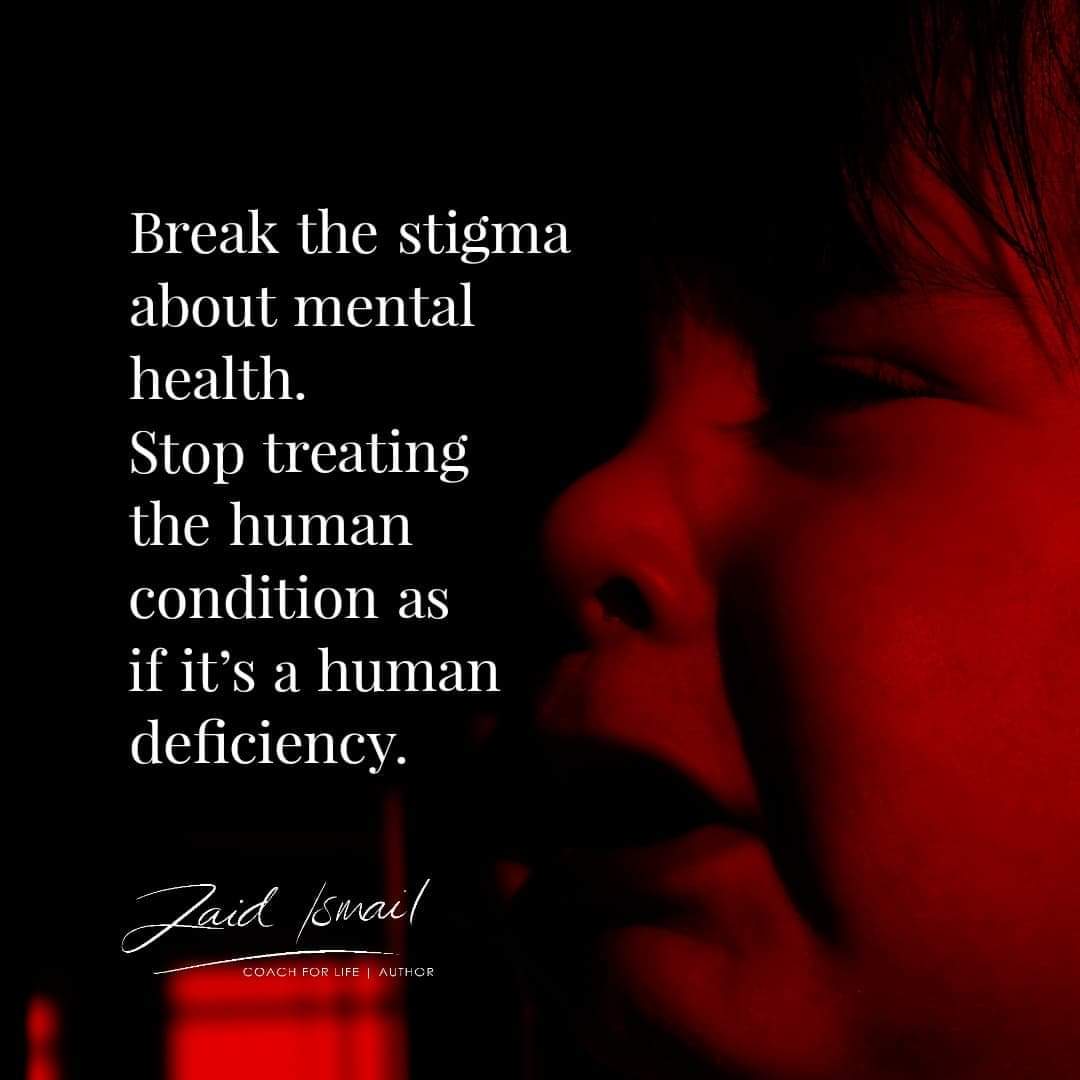
    Break the stigma. Stop the labelling. Embrace the humanness.

  • You’re human. Be human.

    You’re human. Be human.

    We need to be careful with subscribing to a victim mindset.

    Any form of abuse leaves emotional scars.

    But that doesn’t mean it breaks us.

    Nor does it mean that it’s impossible to heal from it.

    Don’t believe everything you read.

    No human is broken.

    And every mind can be healed.

    When we convince ourselves that we’re broken or that we can’t be healed, we create a self fulfilling prophecy, because what you set out to achieve is what you will achieve.

    Besides, it’s not the physical pain of physical abuse that sticks with us, it’s the mental and emotional anguish that it leaves that haunts us.

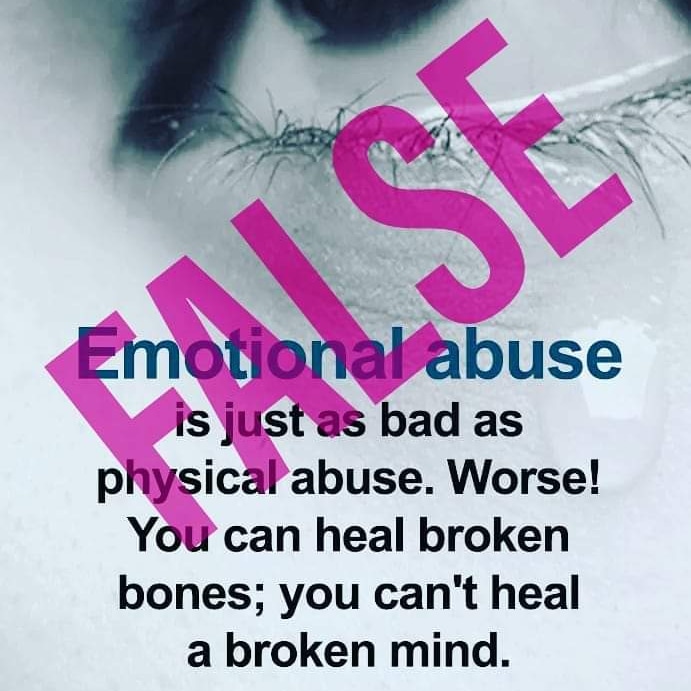
    Memes like the one above are well meaning, but they cause more harm to our mental health than they offer benefit or relief.

    Be careful what you take from the Internet.

    Good intentions have destroyed many lives.

    No matter how elaborate and sincere your effort at solving a problem may be, if you don’t understand the problem well enough, you will go about solving the wrong problem until you eventually convince yourself that the real problem cannot be solved.

    There is a solution for every problem except death. So if you’re not figuring it out, it means that you need more information and a fresh perspective of what you’re dealing with.

    Remember: No one is broken. No one is damaged. No one is beyond help. It takes a single moment of realisation to turn your entire world around.

  • Every mind can be healed

    Every mind can be healed

    TRIGGER WARNING:

    If you prefer a victim mindset, don’t read further.

    This is an extremely important reminder given the horribly unhealthy mindset that this meme encourages.

    There is no such thing as a broken mind.

    There is a struggling human, and there is good reason to feel duress, even debilitating duress.

    Understanding the reasons for feeling that way empowers you to process it in a healthy and meaningful way, and to rise above it.

    The moment you convince yourself that an emotional experience cannot be overcome, you will prove yourself right.

    Not because it cannot be overcome, but because you are looking for all the evidence that confirms why it cannot be overcome, instead of looking for evidence that provides insight towards overcoming it.

    Perspective is especially critical when it comes to mental health and processing emotional trauma.

    No human is broken.

    And every mind can be healed.

    When we convince ourselves that we’re broken or that we can’t be healed, we create a self-fulfilling prophecy, because what we set out to achieve is what we’ll achieve.

    Besides, it’s not the physical pain of physical abuse that sticks with us, it’s the mental and emotional anguish that it leaves that haunts us.

    Memes like this are well meaning, but they cause more harm to our mental health than they offer benefit or relief.

    Be careful what you take from the Internet.

    Good intentions have destroyed many lives.

    If you want to learn how to heal yourself, get a copy of Own Your Life and discover the power of understanding your emotions, rather than judging it.

    Choose your advisors carefully, and please, for the love of everything sacred, do NOT believe every meme that resonates with your emotional space.

    It will destroy you.

  • Who defines your behaviour?

    Who defines your behaviour?

    Understanding can only result from sincere interest in what someone is going through.

    When we try to advise without first seeking to understand, we’re judging, rather than supporting.

    We’re dictating, rather than uplifting.

    Doing for others what you would have done unto you is never more true than in that moment when you find someone behaving badly.

    While the urgency of the matter might dictate that you restrain their bad behaviour as a priority, it should never stop there.

    Once you’ve prevented them from causing harm, you need to help them to understand why their rage, or their insecurity is overwhelming their better judgement.

    No one wakes up in the morning wanting to be miserable, or abusive, or toxic.

    Those behaviours are a result of their internal war for significance in their lives.

    In many ways, the bad behaviour is a defence mechanism to protect themselves from appearing vulnerable.

    Under such circumstances, the moment we challenge the behaviour, we validate their need to defend themselves.

    That’s why it’s important to understand what’s driving the behaviour so that we don’t escalate the cycle but instead, we resolve the underlying cause, which in turn, will render the behaviour redundant.

    But first, we need to care about the war that is raging within them, without feeling as if we’re doing them a favour.

    It must be because of who we are, not because of what they deserve.

    Sadly, most of us are defined by how others treat us, that’s why we have a clash of behaviours when understanding and empathy is needed.

    Your triggers are yours to own.

    Until you own them, you will go through life being provoked by every person that doesn’t treat you in the way that you want them to.

    And that’s how you become part of the problem of others behaving badly.

    It always starts with you.

  • Pitying yourself because of your self-pity

    Pitying yourself because of your self-pity

    When we realise the impact that our self-pity has on those around us, we’ll discover that we’re part of the cycle that leads to us feeling sorry for ourselves.

    Focusing on what we don’t have distracts us from all the opportunities that are possible with what we do have.

    Similarly, focusing on who we are not, distracts us from all the amazing things that we are capable of because of who we are.

    The root of this problem of self-pity lies in two things.

    We compare ourselves to others.

    And then we assume to know what they think of us because of how they treat us.

    Any comparison we make must be focused on learning and growing by observing in others what is possible within ourselves.

    It must be a source of inspiration to constantly improve, not because we’re deficient, but because we’re capable of more.

    Any focus on what others may think of us must be driven by our need to measure our effectiveness in our efforts to impact their lives in the way that we intended to.

    And any consideration of what is implied by how they treat us must include our understanding, or at least our effort towards understanding, what they may be grappling with in their own life that causes them to behave badly towards us.

    Ingratitude is formed within us when we diminish the value of what we have because we’re fixated on everything that we don’t have.

    You can’t build a life with what you don’t have.

    You can only create something with what you do have.

    Start there.

    Or else you won’t start at all.

    It always starts with you.

  • When gratitude becomes a transaction

    When gratitude becomes a transaction

    When we lack gratitude for who we are but wish to feel grateful, we surround ourselves with things and people who don’t expect more from us than we expect from ourselves.

    To do this, we must push away those who believe that we’re capable of more.

    Focusing on proving your gratitude, to yourself and to others, is ingratitude.

    Gratitude is like humility, or happiness.

    Gratitude is not a choice, nor is it an attitude.

    Gratitude is a state of being.

    It’s a deeply profound connection that we have between who we are and what we desire to improve in the world around us.

    The distraction comes in when we focus on improving that world around us because we want to be appreciated, or because we want to appear generous, or benevolent in some way.

    However, these choices are rarely, if ever, conscious choices that we make.

    The ones who are consciously putting up a front will reveal clear signs of self-loathing in their physical state.

    That’s why the ones who are trading acts of gratitude to compensate for their lack of self-worth will put in that much more effort in how they show up physically, while fading away the moment someone looks deeper than their facade.

    Self-loathing is ever more destructive when we blame others for how we feel about ourselves, because most often, we lash out dry, or discard, the ones who built us up in the first place.

    Self-loathing destroys more than just your peace.

    It also destroys the peace of those who care enough to want you to be in a better space.

    It always starts with you.

  • Are you really passionate?

    Are you really passionate?

    They say that there is no limit to what a man can do if he doesn’t care who gets the credit for it.

    Right there is the reason why most of us don’t achieve our dreams.

    We chase validation more than we pursue excellence.

    When we don’t get that validation, we give up our dreams and rage at the world instead.

    Waiting for others to validate your efforts, or to buy into your dream before you pursue it yourself means that you aren’t truly convinced about the value of it in the first place.

    However, when we get to that point, we try to convince ourselves that we could’ve been great if only…

    The reality is…our main reason for wanting to achieve it was what we hoped it would draw in appreciation or praise from others, and not because we truly wanted to create something of value to us.

    Needing validation is a human trait.

    We need to feel appreciated, or understood, or celebrated even.

    However, none of that comes from chasing for it.

    It comes from people connecting with the value of who we are and what we create in the world around us.

    When we give up on our dreams because of the absence of support from others while we’re trying to achieve it, we deny them an opportunity to experience the value of what we believed in.

    Worse than this, we deny ourselves the opportunity to experience the joy of creating something of value because we found it valuable, and not because we needed to be noticed.

    Life feels empty, despite our successes, when we rely on the reactions from others to encourage us to pursue what’s important to us.

    Are you really passionate about your dream, or are you hoping it will attract people into your life?

    If you’re not investing in you, why should anyone else?


    Own Your Life.