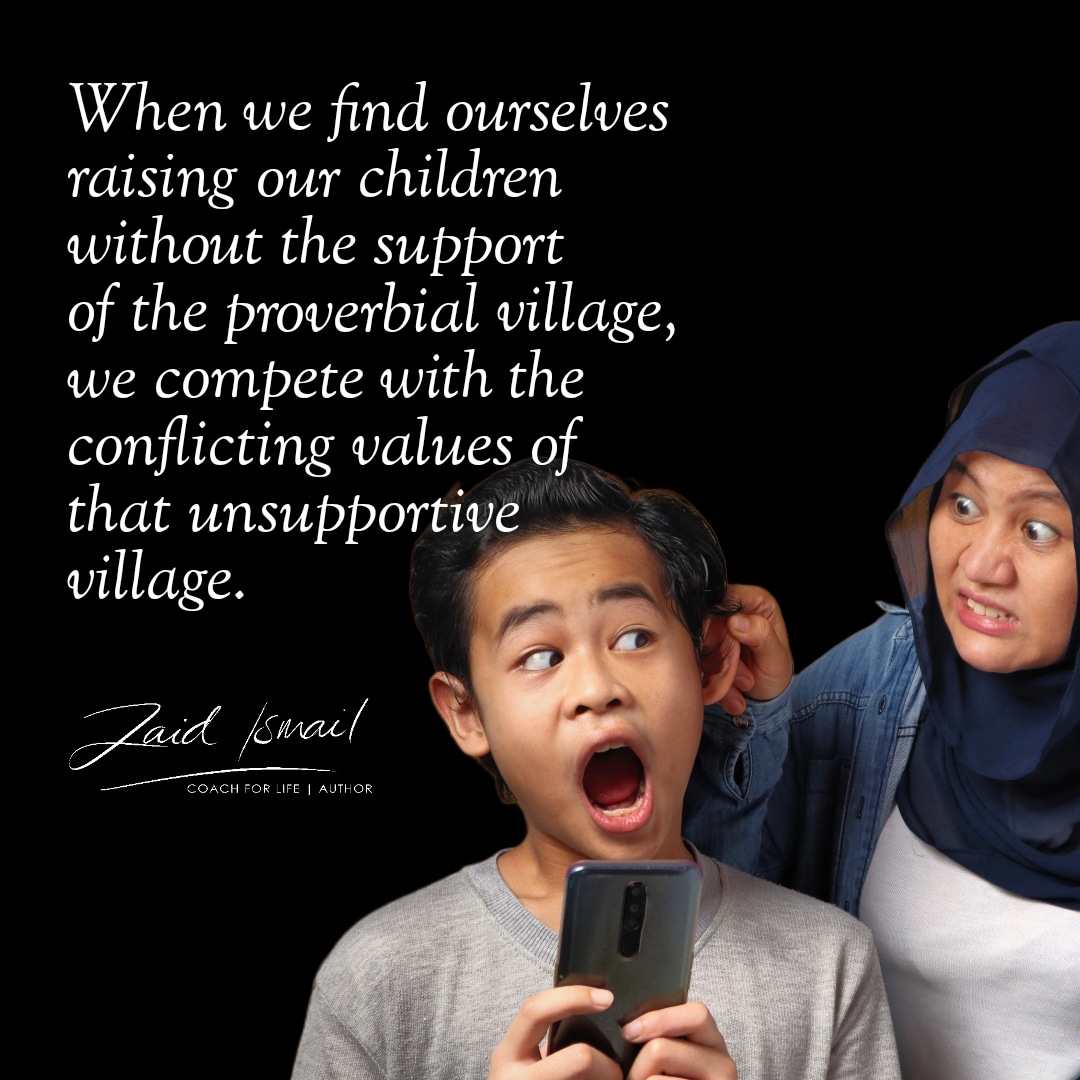
While it takes a village to raise a child, it also takes a village to corrupt a child.
Parenting is a monumental challenge in itself, but becomes infinitely more challenging when being done by a single parent.
Add to the single parenting challenge by having an obstructive co-parent, and the challenge continues to grow ever more insurmountable.
If that’s not enough, throw in the depraved value system of the global village that is available on every Internet connected device that your child has access to, and suddenly you realise exactly what you’re competing with in trying to raise a wholesome, healthy, and grounded human.
But it’s not impossible to achieve, despite those impossible odds stacked against any dedicated parent/s.
Firstly, you need to realise the impact of your role in their life, especially when the self-pity sets in from the extended struggle of trying to be the most prominent influence in their life.
Secondly, you need to understand that wayward behaviour is their fears driving them towards wanting to be significant in their social circles. Focus on understanding those fears, rather than fixating on the bad behaviour.
Thirdly, even if they currently reject the values that you’re trying to instill, you cannot compromise on those values or else you convince them that it’s optional. Standing firm gives them a point of reference for later in life when they will need those values more than ever.
Lastly, parenting is not for those who need instant gratification, nor is it about the parent.
It’s about demonstrating the value and benefit of living life the way that you want them to live theirs, and not compelling them through the fear of consequences to do the right thing.
Fear is never a sustainable motivator to be a good person.
But sometimes it’s a necessary tool to break a harmful cycle.
Be very careful with how you use it.
#parenting #generationaltrauma #singleparenting #ownyourlife #theegosystem #lifecoaching #zaidismail #selfworth #selfawareness #mentalhealth #mentalhealthawareness #mentalhealthrecovery
Tag: generationaltrauma
-
Be the village
-

You are responsible for your abusive ways
This is true about abusive men and women. Not just men.
“Stop complaining and just take it like a man!”
“Why can’t you just be a man?”
“He’s so useless. I wish my husband was like yours!”
“it’s not as bad as you’re making it out to be”
“You deserved it.”
“If it was another man, you’d be dead by now!”
“Why do you always make me angry?”
And so the horrid rhetoric goes as it is spewed from those raging at the weak because they don’t have the courage to face the ones who treated them badly.
Those who abuse others will draw attention to their victim’s supposed weakness to pacify their own conscience about their despicable behaviour.
When we can’t face the reasons for our self-loathing, we find a soft target on which to project our rage.
Believing you’re inadequate feels like weakness, but feeling vulnerable because of that weakness is what stirs the rage within.
And all that happens because you’re judging yourself based on how someone important may have mistreated you.
Most often, it’s a parent that didn’t give you a chance to be heard, or seen. And that parent is usually the father, or the absence of one.
Your parents gave you what they had, not what you deserved.
Nonetheless, how we judge ourselves becomes our responsibility once we’ve reached the age of self-awareness.
Any blame from that point on only harms us and those who deserve more from us. It does nothing to change the reality of the past that left us questioning our worth.
When we give up accountability for how we feel about ourselves, we make others responsible for how they supposedly make us feel, and then use that to justify our bad behaviour towards them.
That’s why some men can’t deal with successful women, and why some women can’t respect gentle men.
Your feelings of inadequacy are never enough reason to abuse those who had nothing to do with how your self-worth was formed.
The only person responsible for how you feel about yourself is YOU.
Own that, and you’ll own your life!
#generationaltrauma #genderbasedviolence #relationshipgoals #mentalhealth #mentalhealthawareness #lifecoaching #zaidismail #theegosystem #ownyourlife #selfworth #selfawareness -
Are you sure you have an attitude of gratitude?
With all the ‘attitude of gratitude’ narratives, I thought it might be helpful to identify when we’re not being as grateful as we think we are.
Gratitude for the self is reflected in how you value who you are without a need to diminish the value of others.
Sometimes, we convince ourselves that we need to take care of ourselves at the expense of the rights that others have over us, while not realising that this mindset is one of a victim who feels oppressed.
Defensiveness and imbalance in how we deal with life is therefore a common outcome when we lack gratitude for who we are.
Gratitude is not reflected in putting yourself first.
Again, that’s a victim mindset.
Gratitude for the self is reflected in how you feel about yourself when others are grappling with their self-worth while blaming you for it.
As mentioned before, gratitude is what we do with what we appreciate, that’s why the truth of your gratitude for yourself is reflected in how you exercise your abilities to create value in your life and the lives of those around you, despite not being acknowledged or appreciated for it.
So, if you connected with any of the 9 points in the above post, you have some introspection due.
You cannot give what you don’t have.
If you’re lacking in gratitude for yourself, you’re likely teaching your kids and others how to be selfish, or how to be martyrs, but it’s unlikely that you’re teaching them how to be grateful for who they are.
It always starts with you.
#gratitudeattitude #gratitude #growthmindset #ownyourlife #theegosystem #mentalhealth #mentalhealthawareness #lifecoaching #zaidismail #parenting #generationaltrauma #relationshipgoals -
Selective inheritance
Our relationship with our parents, whether they were present or absent, wholesome or abusive, will have a distinct impact on how we shape our character through life.
Not only will we develop our sense of self based on how we felt in their presence, but they are also our main point of reference in how to raise children, or show up as a partner to our spouse.
Whether you actively adopt or actively reject what you experienced with them, that becomes the grounding point that informs your decisions about what is or isn’t acceptable in your future relationships, and specially in your parenting style.
Judgement has nothing to do with it because knowing right from wrong or good from bad is easy.
There is no shortage of material and advisors to point out what or who is right or wrong.
Unfortunately, there’s a critical shortage of advisors to help us to understand why, despite knowing what’s right, so many of us struggle to do what’s right. Including our parents.
Connecting with the human behind the role, both in your parents and in yourself or your partner, reignites the empathy and compassion that judgement kills within us.
It is judgement that makes us harsh and rigid towards each other, while understanding breeds appreciation and compassion, if not affection.
Join me with panelists Hana Haths and Dineo Nomayeza Sibuyi on Saturday, 29 October 2022 at 2pm for an in depth discussion about this and other topics related to the gender wars that prevail in the SA Muslim community.
Tickets available at zaidismail.com at a nominal charge of R100 for in-person attendance and R60 for Zoom participation if you’re not in the Johannesburg area.
Refreshments will be provided.
Limited seating available so book now before the last minute rush.
#events #parenting #generationaltrauma #mentalhealth #mentalhealthawareness #lifecoaching #zaidismail #marriageadvice #divorce #relationshipgoals -
Recycling generational trauma
One of the biggest mistakes in trying to break the generational trauma cycle is that we focus on NOT wanting to be like our parents.
All that allows us to do is figure out what we don’t want for ourselves and our children.
While that might seem like enough, it also means that we will only become aware of our own unhealthy traits that we’re passing onto our children through trial and error.
Remember that knowing what you don’t want doesn’t mean that you know what is good or healthy. It means that you only know what of the unhealthy stuff you don’t want, but it doesn’t mean that you know what other unhealthy stuff awaits you.
Trial and error is a very painful and exhausting way to figure out how to build healthy relationships with our children, or with our parents, and by extension, with our partners.
By focusing on what we don’t want in life, we go through life in defence mode because we’re constantly protecting ourselves from the threats that may lead to a repeat of our experiences in our childhood or past relationships.
Thus, we risk replacing one cycle of generational trauma with another.
Seeking to understand why our parents may not have been capable of more than what we got from them is key to breaking the cycle.
But, we don’t know what we don’t know. That’s why fresh perspectives are needed in our efforts to unravel these difficult experiences of life.
This will be one of the key discussion points at the next event on Gender Wars on 29 October 2022.
If you haven’t booked your ticket yet, do so now at zaidismail.com.
Zoom tickets also available.
#events #genderwars #ownyourlife #theegosystem #mentalhealth #mentalhealthawareness #lifecoaching #zaidismail #parenting #generationaltrauma #marriageadvice
#divorce