When you’re lost on a journey, do you keep driving around in circles hoping that your destination will miraculously arrive, or do you try a different route until you find it?
Or do you sit behind the wheel and judge yourself for being a bad driver because you’re on the wrong road? If you do, does it suddenly make your destination appear?
Life is no different.
Hopelessness is never the end of the road. It’s a sign that you need to take a new one.
The fact that you knew how to get yourself onto THAT road means that you have the ability and skill to change routes.
When we find ourselves in a rut, we shouldn’t remain invested in that rut hoping that someone else will come along and change it for us.
We need to change it for ourselves because we know what destination we’re in search of. No one else does.
Holding others responsible for getting to our destination assumes that they are not also searching for their destination. Or are lost in their own rut.
It’s how our journeys intersect with each other that we find companionship and comfort in others. Not in waiting for them to navigate or journey for us.
Own your life. It’s yours to own.
#hope #expectation #sincerity #selfworth #selfawareness #mentalhealth #mentalhealthawareness #mentalhealthrecovery #hopelessness #suicideprevention #suicide #zaidismail #lifecoaching #ownyourshit #ownyourlife #theegosystem #embracingME
Tag: mentalhealth
-
Invest in hope
-

Give trust, before taking it away
Earn my trust!
Earn my respect!
Consider how lofty our opinion is of ourselves when we demand that from others.
If you don’t trust someone for good reason, then no problem.
But if you don’t trust someone just because you don’t know them, then you have trust issues.
That’s how life becomes burdensome because we need to live with our defenses up before we find reason to let our guard down.
When we demand that others must earn our trust or earn our respect before we give them either, it suggests that by default, we are allowed to disrespect and mistrust others through no fault of their own.
Often, such a perspective stems from arrogance or defensiveness because we’re still affected by a past betrayal.
We judge people based on how we judge ourselves.
And we justify their behaviour based on how we believe we would also react in a similar situation.
So when you judge, recognise that it is you first that is being judged, before anyone else.
By all means, allow space for someone to earn your trust on more important issues, but don’t start out by being suspicious.
There is an important difference between assuming the worst and being suspicious of others, versus creating space for someone to demonstrate their trustworthiness without deliberately testing them first.
Learning the difference is what allows for peace, instead of creating opportunity for anxiety.
#selfworth #selflove #selfawareness #selfrespect #mindfulness #judgementalpeople #respect #trustissues #trustworthy #mentalhealth #mentalhealthawareness #mentalhealthrecovery -
Father : A silent duty
Fathers are often overlooked or forgotten, because they’re seldom in the limelight.
Silently serving in the background, they often do what is seen as just their job, or their duty.
Not wired with an overt nurturing instinct, but rather that of a silent sentinel, ensuring their family’s safety and comfort, they often grow accustomed to being in the background, creating the spaces needed for their family to thrive.
When we expect fathers to behave in a similar way to mothers, we diminish their contribution and their sacrifices.
When we expect fathers to show up like mothers, we under estimate their emotional needs, and ignore their silent pleas for gratitude.
When we expect fathers to experience emotion and sentiment in the same way that mothers do, we assume that they were gifted with the beauty of connecting with a soul growing within them, not realising that they were always on the outside looking in.
There is a bond between mother and child that a father will never experience because of the sanctity of childbirth. Perhaps that is why fathers will always find a different way to express their love for their family compared to mothers.
Honour your father by recognising his struggle and efforts without finding reason to judge him compared to your mother.
And if you find he is falling short anyway, approach him with understanding, believing that the gentleness you wish to experience with him lies beneath that seemingly impenetrable exterior that developed only because he quietly accepted his place as a provider and forgot to nurture his own emotional needs.
And to the fathers who show up despite not knowing how it is done because they didn’t have the loving guide of a mentor in their lives, I especially salute you. Breaking cycles of toxic dysfunction is never easy, and is often excruciatingly lonely.
So if no one else notices you today, I do. With love, appreciation, and respect.
Happy father’s day.
#fatherhood #fathersday #fatherdaughter #fatherson #father #husband #parenting #singleparenting #parents #ownyourshit #ownyourlife #theegosystem #mentalhealth #mentalhealthawareness #mentalhealthrecovery #zaidismail -
Money is not the root of evil
Money is nothing more than a tool.
It’s a means to an end, not a motivation in itself.
Even its accumulation through miserliness, or its wastage through extravagance still makes it nothing more than a tool to achieve a greater goal.
Ingratitude is what results in such tools being used to our detriment, or to the detriment of others.
Money in the hands of an ingrate is used to harm others, or the self.
Ingratitude is therefore the demon that we must learn to understand if we hope to use money in a way that creates a fulfilled life.
Ingratitude is born of the belief that we are entitled to things or outcomes.
That sense of entitlement is based on our need to feel validated by such privilege, because we see it as a measure of how much we mean to others.
Our need for such validation is from a lack of appreciation for who we are and what our unique contribution to this world can be, and instead, a fixation on everything that we don’t have.
Understand the source of your ingratitude, and tools like money will carry with it benefits and blessings in ways you never thought possible, without contaminating your ego in the process.
#hope #expectation #sincerity #selfworth #selfawareness #mentalhealth #mentalhealthawareness #mentalhealthrecovery #gratitude #appreciation #zaidismail #authenticity #servingothers #servantleadership -
What do you see in the mirror?
Given how easily we can change how we present ourselves to others through social media these days, it’s important to remember how much of our authenticity has to be sacrificed in the process.
Be true to yourself, online and offline, and you won’t need filters to make your life or yourself appear to be different from your reality.
We convince ourselves, sometimes of truths and sometimes of delusions of who we are.
When it’s a delusion, we forget that in the process, we also have to convince ourself that we’re not who we really are.
It sounds complicated but it’s really simple. Before we can believe that we’re someone we’re not, we have to convince ourselves that who we really are is not true.
Why would we do such a thing? Because we’re afraid that if we don’t fit someone else’s expectations, we may find ourselves isolated or alone. And no one wants to be alone. Right?
However, loneliness is most felt when you’re in company that doesn’t recognise who you really are. To connect sincerely and meaningfully with another, we must be true to ourselves first, or else we’ll lose every moment in our efforts to be what we took that need, rather than who we are.
And that’s how we lose ourselves in the process.
Read that again if you must, but internalise it.
It could save your sanity and your peace.
#selfworth #selfdoubt #selfawareness #selfrespect #reflection #mindfulness #validation #mentalhealth #mentalhealthawareness #mentalhealthrecovery -
A diet of fear
This is probably one of the most important things you could ever connect with.
So much damage is caused by fear driven decisions. It destroys your spirit leaving you to find comfort in the very source of the fear that is destroying you.
If you’ve been raised on a diet of fear and compliance, it is inevitable that your choices will reflect your fears, and not your dreams
Fear destroys hope and replaces it with futility.
In the face of futility, we resort to compliance, because compliance provides us with familiarity.
Familiarity tethers us to rituals, traditions, and behaviours that feed the cycle that sustains the power of fear.
That is, the cycle of compliance at all costs.
When compliance becomes the objective, blind following becomes the method, and critical thinking is set aside in favour of inclusion.
The need for inclusion destroys dreams, breaks hearts, and damages souls, leaving in its wake a field of martyrs who surrender their joy in the face of futility, not realising that it is fear that breeds futility, and not overwhelming odds.
Be courageous, brave soul. Self-imposed martyrdom is not the only path to peace. In fact, it defeats that very goal.
#courage #fear #compliance #tradition #inclusion #familyties #traumabonds #abusiverelationships #dreams #mentalhealth #mentalhealthawareness #mentalhealthrecovery #selfworth #selflove #selfawareness #selfrespect #mindfulness #inspiration #ownyourshit #ownyourlife #theegosystem #embracingME #pursuitofhappiness #victimmentality #zaidismail -
Know your worth
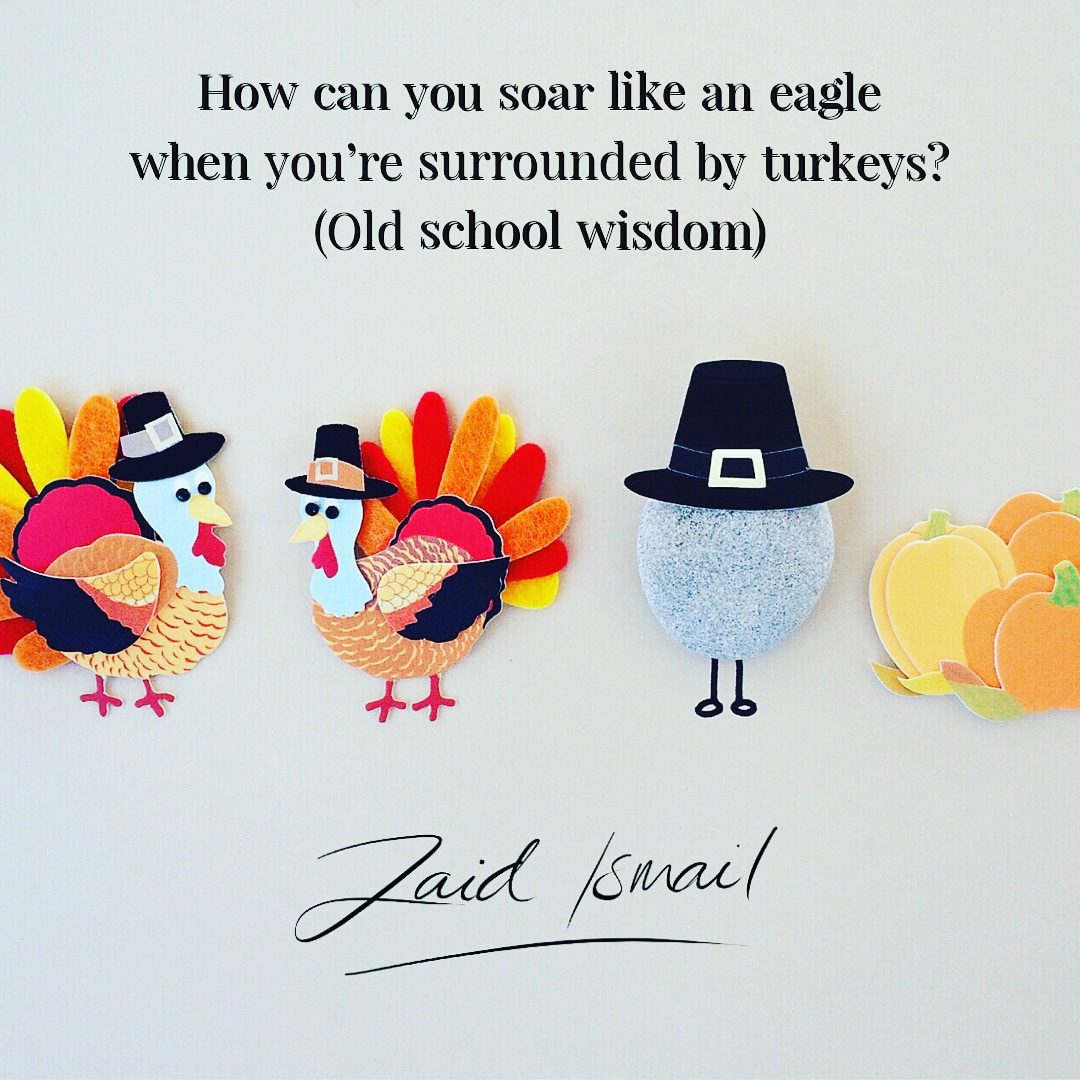
How many of us spend our lives trying to convince turkeys that they’re eagles, and in the process, sabotage our own growth and happiness?
To quote another piece of old school wisdom, birds of a feather flock together.
If you don’t know your own nature, you will associate with those who are not aligned with your goals or your passion in life.
That’s the easiest way to embrace mediocrity while yearning for greatness.
Of course, the downside to that is that if you’re surrounded by turkeys, and you claim your space, you may find yourself embracing loneliness and isolation.
The conundrum of life.
I pray that you are born into a home, a family, or at least a community that shares your passion and inspires your growth.
Photo credit : Adobe Stock
#selfworth #selfawareness #ownyourlife #selfmastery #mindfulness #personalpower #ownyourshit #mentalhealthrecovery #mentalhealth #mentalhealthawareness #lifecoaching #zaidismail #motivation #optimism #lifegoals #soulfood #soulmates #fuckit -
That toxic status quo
When we are raised in an environment focused on discipline before purpose, or compliance before understanding, we develop the belief that fitting in is more important than what is right.
This same mindset leads us to be bullish in our efforts to uphold the status quo because of the inclusion that it offers, while violently rejecting any opinions that challenge our cultural heritage or traditions.
The need to belong, to be validated by that social structure smothers any passion to contribute towards improving anything, because we’re led to believe that our traditions have already perfected everything.
Thus, the unique expression of the individual is snuffed out, only to be replaced by a militancy of spirit that is celebrated as devout submission.
Critical thinking is abandoned in favour of academic prowess, and without realising it, indoctrination is readily believed to be higher education.
All this leads to the subservient mindset that needs permission before choosing consciously, or seeks permission before thinking independently.
That’s how cycles of abuse are maintained, and the unique contribution of the individual is seen as an offence against the collective.
Everyone must know their place to uphold a power structure that reveres the powerful, while enslaving the minds of the masses.
And that is how the masses, the average soul, grows to believe that unless they have permission to break the bleak and toxic cycles of their lives, they have no choice but to comply quietly for the greater good of society.
Photo credit : Adobe Stock
#selfworth #selfawareness #ownyourlife #selfmastery #mindfulness #personalpower #ownyourshit #mentalhealthrecovery #mentalhealth #mentalhealthawareness #lifecoaching #zaidismail #socialorder #peerpressure #culturalbias #blindfollowing