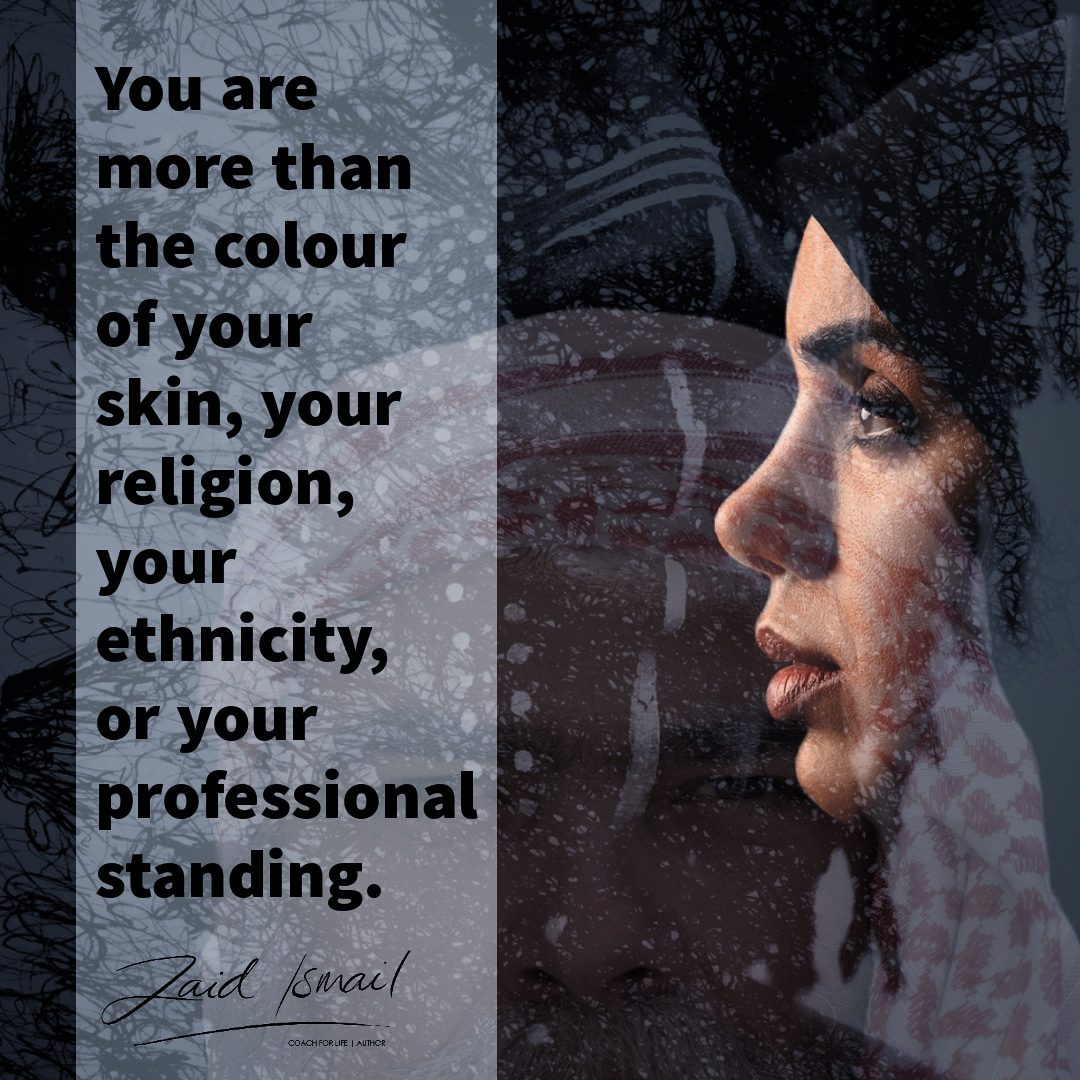
Taking pride in the colour of your skin or ethnicity distracts you from your humanity.
Our humanness, our gentleness, our inclination towards kindness – these are all part of our natural state.
We lose it when our need to be associated with significance or superiority distracts us from this, and replaces it with the fear of being inadequate.
When we lose sight of the fear of inadequacy, responding from a place of fear becomes our new normal.
Everything that threatens the source of our significance – that is, our skin colour, religion, cultural roots, etc. – then feels like a threat to our sense of self.
Thus, we feel the anger, resentment, or blind rage that rises when we are judged by the colour of our skin, our religion, our ethnicity, or any other association that makes us feel significant.
But, we grow convinced that we’re standing up for a good cause by protecting what we value, even though the way in which we protect it undermines the very essence of what we claim to stand for.
That’s when it becomes clear that we only stand for what we do because it offers us a place in this world through being associated with the cause.
It offers us significance and protects us from irrelevance.
That’s when we’ve traded who we are, for who we want to be perceived as, because we’re convinced that we are not enough.
Own Your Life.
It always starts with you.
#racism #colourism #religion #culture #prejudice #bigotry #socialacceptance #herdmentality #ownyourshit #ownyourlife #theegosystem #mentalhealth #mentalhealthawareness #mentalhealthrecovery #selfworth #selflove #selfawareness #selfrespect #mindfulness #inspiration #zaidismail
Tag: selflove
-
Where is your humanity?
-

That war within
Sometimes that village is a family, sometimes it’s a group, and sometimes it’s just one person who represents everything that the village stands for.
That child grows into the raging adult who destroys every wholesome thing, because they feel like no one deserves peace if they were denied love and acceptance.
When you treat the vulnerable, or the gentle one’s, with contempt, you create the same monsters that made you.
That’s how the raging adult spawns more troubled souls that are driven towards burning down their village, with each generation growing more destructive, until someone chooses self-respect over self-loathing.
The distraction of their rage prevents them, and us, from seeing their plea for love and acceptance.
It’s a war within that rages without, because what they feel is at odds with what they need, and despite their best efforts, they don’t know how to achieve it.
So, the shame that bubbles beneath the surface – the shame that they hide from the world about that internal war – drives them to behave in ways that appear to claim what they believe others will not care to give them.
Thus, they project their rage on any innocent being that expects them to be better than that, because they’re no longer children…and only children throw tantrums.
Adults don’t throw tantrums because they don’t need someone else to destroy for them.
They destroy others to feel significant, not because they want the destruction, but because it at least gives them reason to believe that they’re not invisible.
That they still have an impact.
That they will be taken seriously…or else…
Your anger at the world is yours to tame.
You either rage at those who don’t have what you need, or you create it yourself through the alchemy of your soul.
Because that’s what makes us human.
Not that we hurt, or that we love, but that we can create love in the midst of hate, and calm in the midst of chaos, without any aides but the attributes of who we are beyond the rage.
It always starts with you.
#ownyourlife #theegosystem #mentalhealth #mentalhealthawareness #lifecoaching #zaidismail #loveyourself #parenting #singleparenting #selfworth #selflove #selfloathing -
Raging for love
Nothing destroys more than ingratitude, and ingratitude for the self is expressed through self-loathing.
But self-loathing is disguised in many ways, the most common of which is anger.
Anger is a defence mechanism that distracts attention away from what we feel inadequate about.
It demands that we be taken seriously when we have no reason to believe that who we are is worthy of being taken seriously.
But more than this, anger is a profession that in that moment, we believe that we are not good enough for one whose validation we desperately need.
Hence it being the most common confirmation of self-loathing when all our defence and coping mechanisms are claiming otherwise.
It also happens when our internal conversation is focused on comparing ourselves to those we think are better than us, or those whose validation we need.
And then we get married to feel complete, only to hold our partners accountable for how we feel about ourselves.
And then we have children to fill that void that just doesn’t seem to fill up, and we become ever more threatened with fears of inadequacy when we don’t know how to be enough as parents.
Thus, innocent lives get destroyed, all because we didn’t learn to be grateful for who we are, while trying to make up for it by raging at those who have nothing to do with how we feel about ourselves.
It always starts with you.
#selfworth #selfawareness #ownyourlife #selfmastery #mindfulness #selfloathing #selflove #mentalhealth #mentalhealthawareness #lifecoaching #zaidismail #angermanagement -
Reclaim your worth
Peace is most ravaged when we convince ourselves that we were treated badly by others, or by someone we trusted, because we weren’t good enough for them.
A betrayal of trust, no matter how noble the person, reflects cowardice on their part.
We only betray the trust that others place in us when we feel burdened by that trust, or we avoid accepting the responsibility that it demands of us.
Either way, it’s a shortcoming on the part of the betrayer, not the betrayed.
Sometimes we’re so focused on getting even with those who betrayed our trust that we fail to notice how that fixation distracts us from fulfilling the rights of others, which in itself is also a betrayal of trust.
Understand the internal struggle of those who treated you badly, so that you will realise that they were simply incapable of being better than that in that moment.
It may not take away the disappointment or the hurt, but that is part of your humanness.
When that disappointment overwhelms your joy in life and steals your enthusiasm for the future, it’s no longer because of how someone treated you,it’s because of how you see yourself because of how they treated you.
It’s that easy to give up your power to influence the outcomes and the happiness that you experience in life.
You do so by believing that how you were treated by troubled souls is a reflection of your worth.
That’s simply ingratitude for who you are.
Misplacing your trust in someone is a mistake made from good intentions.
Discard the mistake after learning from it. Don’t discard the good that inspired that good intention.
It always starts with you.
#truth #trust #betrayal #honesty #sincerity #authenticity #mentalhealth #mentalhealthawareness #mentalhealthrecovery #selfworth #selflove #selfawareness #selfrespect #reflection #mindfulness #dignity #lifecoaching #zaidismail -
Escaping addiction
It’s not drugs that steal our children from us. Like us, they also need to feel significant.
Taking drugs is not just a bad habit. It’s a means to escape what we don’t want to deal with in the world around us.
Is it a bad decision? Absolutely. Because escaping something never resolves it, it only defers it to a later time.
But we all indulge in escapism of some kind, that’s why we have little to no communication in homes that centre around technology or social media, leaving the young ones struggling to find a space in which they belong, physically and emotionally.
The emotional connection that they then forge with fellow escapees is what makes drugs the escape of choice.
If we treat them as addicts, they will behave like addicts. If we deny what is lacking in their emotional make up, we’ll deny ourselves the opportunity to address it.
Addressing it doesn’t only benefit them, it also benefits us because the only reason that they would feel emotionally isolated is because we’re not emotionally accessible.
That means that we’re also denying ourselves the sweetness of life because if we’re emotionally unavailable, then we’re convinced that what is important to us is not important to anyone else.
That’s why we lose ourselves to duty and dismiss any demands to be emotionally available for those around us.
That’s how we create the environment that makes substance abuse or gambling, or other escapes attractive as a coping mechanism.
Break the cycle.
It always starts with you.
#drugs #addiction #narcissisticabuse #narcissisticparents #youth #selfworth #selflove #selfawareness #selfrespect #mindfulness #inspiration #lifecoaching #zaidismail #ownyourlife #theegosystem #mentalhealth #mentalhealthawareness #mentalhealthrecovery -
Cyclical abuse
At first, we remain in a bad relationship because we truly believe in the sincerity of the claims of our partner to want to improve, or to overcome what they’re struggling with.
After some time, if we’re not careful, our inability to get them to follow through will convince us that we’re not a good enough reason for them to be better.
When that continues for long enough, we begin to doubt our ability to be enough for anyone else, and thus find ourselves trapped in a cycle that we’re unintentionally sustaining.
Some may claim that they stay because it’s their way of expressing unconditional love.
Unconditional love, if it ever exists, is the sacrifice of one in favour of another. When you sacrifice yourself to compensate for the bad behaviour of someone else, that’s not love, that’s self loathing.
If you don’t love yourself, loving another becomes a cry for significance or acceptance, and love has nothing to do with it.
More importantly though, the choice of how to respond to bad or abusive behaviour is not binary. It’s not just about staying or leaving.
Between those two choices lies a number of ways to potentially break cycles of abuse, all of which requires a better understanding of why the abusive behaviour is the way in which the other person is trying to feel significant, or to rage at an injustice done to them in the past.
By understanding what drives their behaviour, we allow ourselves to see the human struggle behind the behaviour, rather than to judge the entirety of the human by their behaviour.
But this is only possible when we don’t feel inadequate about who we are in that situation.
A healthy self-esteem is therefore at the heart of truly breaking cycles of abuse, otherwise we may exit that situation, but we’re likely to be attracted to yet another cycle of abuse in our search for significance.
It always starts with you.
#abusiverelationship #selfworth #selfawareness #selflove #gratitude #appreciation #mentalhealth #mentalhealthawareness #mentalhealthrecovery #selfloathing #relationshipgoals #lifecoaching #zaidismail -
Judging bad behaviour
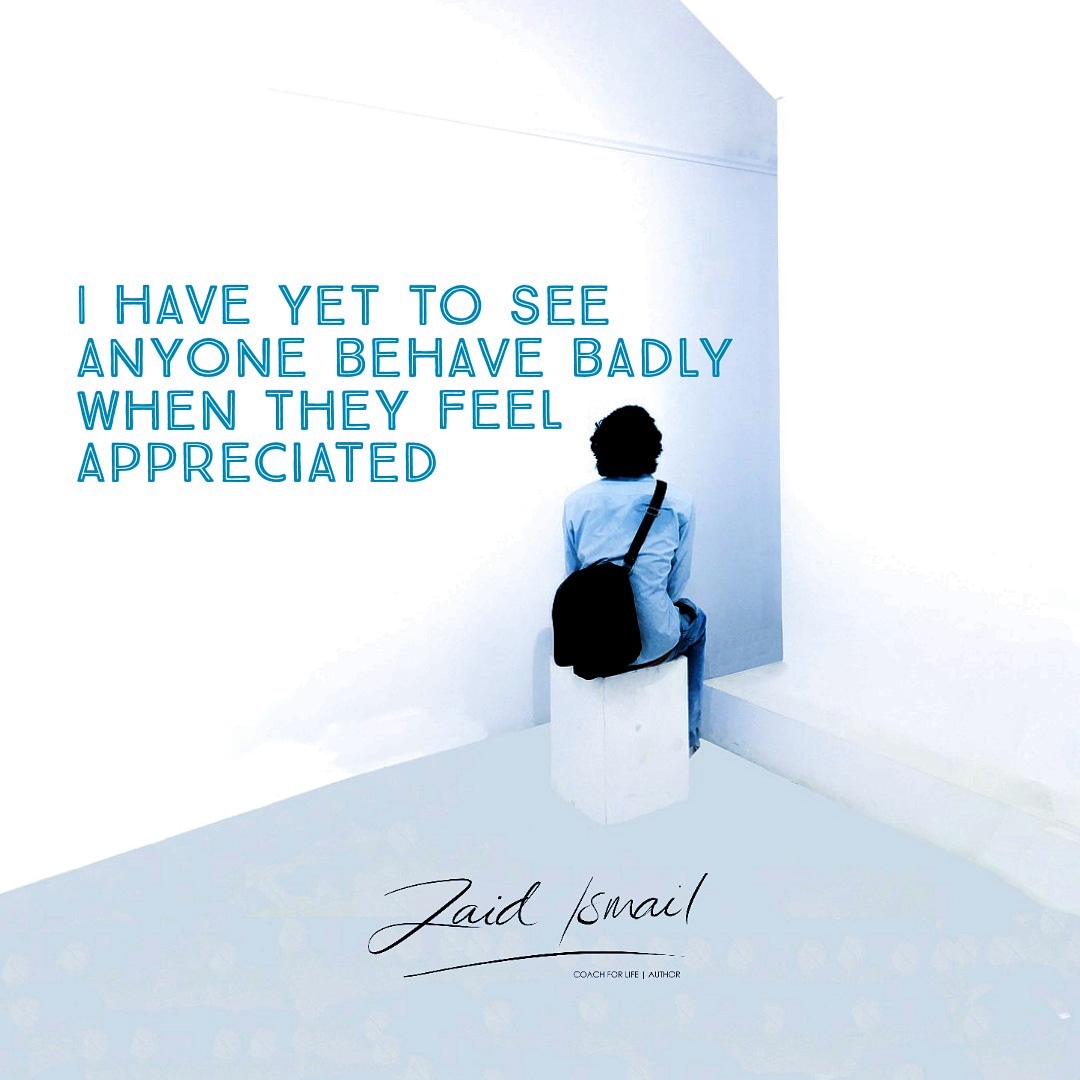
I have yet to meet someone who behaves poorly when they feel appreciated.
Yet, we’re most often focused on the poor behaviour instead of their feeling of insignificance.
The same is true for us.
Our anger, bitterness, or rebellion is simply an expression intended to reclaim our significance when significant others treat us as if we don’t matter. Or when we feel like we don’t matter to them.
This doesn’t excuse the behaviour, but hopefully, it prompts us to be more understanding rather than judgemental when we find ourselves faced with unacceptable behaviour from those around us.
It’s easier to judge others when being kind or understanding feels like weakness on our part, or if we’re afraid of condoning their behaviour.
Both those assumptions are based on our assumptions about what their intentions are behind their bad behaviour.
Consider that the next time you become aware of how you’ve chosen to judge someone.
Are you judging their behaviour because of what you don’t want to be associated with? Are you judging it because you expect them to be better than that? Or are you judging it because it undermines your role in their life?
Whichever one it is, judgement should be reserved for the courts, and understanding and compassion should drive our interactions with those around us so that we can encourage the best in them, rather than judge the worst in them.
And if you want to understand why you’re driven towards assumptions about what drives your behaviour, or the behaviour of those around you, get a copy of my book, The Egosystem.
It answers exactly such questions so that you might be able to find that elusive peace that you need within your soul.
#selfworth #selflove #selfawareness #selfrespect #mindfulness #theegosystem #mentalhealth #mentalhealthawareness #mentalhealthrecovery #ownyourlife #gratitude #compassion #understanding #lifecoaching #zaidismail #loveyourself #lifegoals #relationshipgoals -
Allow your children to be their own person
We always have good intentions when we strive to give our children everything that we didn’t have.
Often, this includes protecting them from the hardships or difficulties that we experienced.
Unfortunately, when we do this, we end up protecting them from reality, and in the process, we deny them the very life lessons that taught us to appreciate what we have.
This is one of the most common reasons for kids growing up to be timid, entitled, or disrespectful…or all of the above.
Hardships and difficulties are character building experiences.
Find a way that strikes a balance between allowing them to experience it, and providing guidance and support as they navigate their way through it.
Too many assume that hardship is a denial of a good life.
It’s not.
Allow them to earn their privileges so that they’ll experience gratitude and fulfilment when they achieve it.
Lastly, when you shy away from something that weighs you down, or you try to hide it from them, you’re teaching them to feel ashamed of getting things wrong, or failing at achieving goals.
That’s how we raise them with a value system that conflicts with the kind of humans that we want them to be.
Be mindful of your rule as a parent, but more than this, be mindful of your contribution as a human being.
It always starts with you.
#parenting #children #fears #raisingadults #ownyourlife #theegosystem #mentalhealth #selfawareness #selfrespect #mindfulness #inspiration #youngadults #mentalhealthawareness #mentalhealthrecovery #selfworth #selflove #selfawareness #lifecoaching #zaidismail