I see too many people take pride in being a survivor, which in itself is not the biggest problem.
The problem arises when that act of survival defines you for the rest of your life.
When a traumatic event, or an abusive relationship, defines you beyond the immediate impact of experiencing it, you keep it relevant long after its occurrence.
We surrender our lives to the efforts of survival when we lose sight of our ability to change our circumstances as we wait for change to arrive.
What’s worse is that we don’t realise that those who are not showing up for us are likely in survival mode themselves.
That’s how we do to others what has been done to us without realising that we’re part of that cycle.
While we’re ‘surviving’ or waiting, those who have rights over us to show up for them as fully formed humans are denied the experience of feeling significant because we treat them as duty.
But, more important than this, it’s not their ignored rights that is the greatest oppression.
Taking for granted our ability to create ease and joy despite our backdrop of struggles is the worst oppression against ourselves.
That’s the greatest loss of all.
Nothing compares to the loss of opportunity to contribute towards the sweetness of life for yourself and for others.
Not even death compares, because in death there is no life waiting to be lived.
In death there is no need to create joy or to experience the wonderment of life.
Yet so many yearn for death because of a tormenting moment from the past, while discarding their ability to create joy because of the horrors caused by troubled souls.
That’s how we become equally troubled and repeat their mistakes in our own unique way while lamenting the burden of existence, forgetting that we gave up on life itself.
Regret and sorrow has its place only as long as it spurs us into action, otherwise it ceases to be about what happened to us and becomes an indulgence of self-pity because we need our struggle to be appreciated.
#selfworth #selfawareness #selflove #mentalhealth #mentalhealthawareness #mentalhealthrecovery #theegosystem #ownyourlife #lifecoaching #zaidismail
Tag: selflove
-

Surviving sucks
-

A destined misery…or is it?
Are you sightseeing while wishing that what you see could be your reality?
Most often, it is our belief in what we deserve that limits us more than what we actually deserve or are capable of achieving.
In fact, considering what we deserve or don’t deserve is a distraction most likely grounded in self-pity or entitlement, neither of which changes reality.
Couple that with resigning your fate to destiny and you have a recipe for misery.
It’s like waiting up all night to witness an amazing sunrise only to give up as the first streaks of dawn appear, followed by convincing ourselves that it was our destiny not to see the sunrise.
No. Destiny is the sum total of the choices that you make with the opportunities that present themselves to you.
If you’re too distracted to notice those opportunities, or lack the courage to embrace it, that’s your choice, not destiny.
The only thing that can reasonably be blamed on destiny is the consequences that affect us of the bad decisions that others make.
Likewise, they are confronted with the fateful outcomes of our poor decisions, or our inaction to improve things.
How we respond to that which is out of our control is a reflection of who we are and what we value about life.
Don’t settle for less and then blame the world for not treating you fairly, or for not allowing you to have the life that you want.
You only accept or pursue that which you believe you deserve, or that which is safe for you to pursue when you’re distracted by what others think of you.
That’s why most of us settle for the dawn because we believe that we’re undeserving of the majestic sunrise.
It always starts with you.
Not with destiny.
#fate #destiny #happiness #conviction #commitment #confidence #optimisticquotes #resilience #tenacity #mentalhealth #mentalhealthawareness #mentalhealthrecovery #selfworth #selflove #selfawareness #selfrespect #reflection #mindfulness #opportunity #ownyourlife #theegosystem #lifecoaching #zaidismail -
Judging self into misery
When we internalise our struggle to the point of believing it to be so unique that it cannot possibly be grasped by anyone else, we give it a power of magnitude beyond the experience itself.
Misery intensifies the more we dwell on it.
When we live inside our heads, we convince ourselves that our struggle and our pain defines our courage because if only ‘they’ knew what we were dealing with while still showing up, they wouldn’t judge us the way that they do.
We judge ourselves harshly long before we give the world an opportunity to judge us.
We then take that self-judgement and treat it as a truth of what we think others think of us.
Then we treat others based on that assumption that we made from the self-judgement while blaming them for judging us.
Crazy, right?
That’s what holding on to pain or misery does.
It distorts our grasp on reality because we only find what we’re looking for, while we ignore or dismiss anything that conflicts with that.
It’s not as confusing as it may sound.
If you go to the grocery cupboard looking for a can of tuna, you’re not going to notice if you have enough rice left, because you weren’t looking for rice, you were looking for tuna.
Same with life.
What you focus on is what you’ll find, and that’s why you won’t see what others see if you’re busy judging yourself or waiting for justice, because they’re looking at your life very differently.
That’s how we create self-fulfilling prophecies in relationships, or we create anxiety about what we need to deal with in life.
Step back.
Take a deep breath.
Break the routine.
And surround yourself with people or an environment that helps you to regain perspective beyond what is weighing you down.
That’s how we reconnect with hope and with joy in life.
It always starts with you.
#joy #pain #misery #selfpity #courage #life #ownyourlife #mentalhealth #mentalhealthawareness #mentalhealthrecovery #selfworth #selflove #selfawareness #selfrespect #companionship #love #understanding #lifecoaching #zaidismail -
Your dignity is yours to claim
Did you notice how some people, when faced with soul destroying realities, are still dignified in how they rise above it.
If you wait for your aggressor or abuser to treat you with dignity before you find reason to respect yourself, you’re doing life back to front.
Expecting recognition of your humanness from the world is like expecting your tormentor to become your mentor.
It’s irrational.
Dignity is not bestowed, it is claimed!
It is undignified to ask to be treated with dignity because that means that your dignity is dependent on how others treat you.
It means that it’s dependent on others agreeing that you’re deserving of dignity.
You either maintain your dignity in the face of them being undignified towards you, or you trade your dignity for inclusion or validation.
However, be sure that you’re offering what you’re demanding from others.
Expecting people to treat you with respect and dignity while you treat them harshly or dismissively is hypocrisy, and hypocrisy is the opposite of dignity.
As always, you cannot give what you don’t have.
If you lack self-respect, you’re likely to demand respect from others so that you can feel better about yourself, while ignoring the fact that you not only treat others with disrespect, but you also treat yourself the same way.
If you lack mindfulness of who you are in moments when your patience is tested, you’ll feel compelled to respond the way that you think they deserve, rather than being able to consciously choose who you want to be in that moment.
It always starts with you.
#selfworth #selflove #selfawareness #selfrespect #reflection #mindfulness #dignity #decency #victimmindset #selfmastery #mentalhealth #mentalhealthawareness mentalhealthrecovery #ownyourlife #theegosystem #lifecoaching #zaidismail -
With whom are you competing?
Who are you really competing with in life?
The only person you should be competing with is the one you were yesterday!
The most common limiting belief that I encounter in others is the belief that they’re not as good as others.
The way I encounter this within myself is when I question whether I’m good enough to achieve something, or when I think I’m fooling myself into believing that I’m capable of influencing the change that I am passionate about seeing in this world.
If we stop and pay attention for a brief moment, we’ll realise that it’s not about better or worse, it’s about competing with what we believe to be true about ourselves.
The day I began trying to prove myself wrong about all the things that I thought were just dreams or whimsical wishes is the day that I broke away from the expectations of others.
Better or worse is only important if you’re competing to be just like everyone else.
If everyone else had things figured out, the world wouldn’t be in the state in which we find it.
We’re all struggling with our own demons on the inside, while presenting a confident and bold facade on the outside.
That’s not necessarily being fake.
Sometimes it’s just how we preserve our dignity.
The moment you believe the facade, you judge yourself against a standard that doesn’t exist.
The fact that you find reason to judge yourself at all is problematic.
Your only focus should be in determining if you’re moving closer to, or further away from, the goals that you set for yourself.
Remaining connected with purpose and conviction to those goals is the only challenge you have.
Be you. Life is so much more rewarding when you are, and love becomes that much more attainable.
#selfworth #selflove #selfawareness #selfrespect #mindfulness #inspiration #lifecoaching #zaidismail #ownyourlife #theegosystem #mentalhealth #mentalhealthawareness #mentalhealthrecovery -
Every mind can be healed
TRIGGER WARNING:
If you prefer a victim mindset, don’t read further.
This is an extremely important reminder given the horribly unhealthy mindset that this meme encourages.
There is no such thing as a broken mind.
There is a struggling human, and there is good reason to feel duress, even debilitating duress.
Understanding the reasons for feeling that way empowers you to process it in a healthy and meaningful way, and to rise above it.
The moment you convince yourself that an emotional experience cannot be overcome, you will prove yourself right.
Not because it cannot be overcome, but because you are looking for all the evidence that confirms why it cannot be overcome, instead of looking for evidence that provides insight towards overcoming it.
Perspective is especially critical when it comes to mental health and processing emotional trauma.
No human is broken.
And every mind can be healed.
When we convince ourselves that we’re broken or that we can’t be healed, we create a self-fulfilling prophecy, because what we set out to achieve is what we’ll achieve.
Besides, it’s not the physical pain of physical abuse that sticks with us, it’s the mental and emotional anguish that it leaves that haunts us.
Memes like this are well meaning, but they cause more harm to our mental health than they offer benefit or relief.
Be careful what you take from the Internet.
Good intentions have destroyed many lives.
If you want to learn how to heal yourself, get a copy of Own Your Life and discover the power of understanding your emotions, rather than judging it.
Choose your advisors carefully, and please, for the love of everything sacred, do NOT believe every meme that resonates with your emotional space.
It will destroy you.
#mentalhealth #mentalhealthawareness #mentalhealthrecovery #selfworth #selflove #selfawareness #selfrespect #mindfulness #theegosystem #ownyourlife #motivation #lifecoaching #zaidismail -
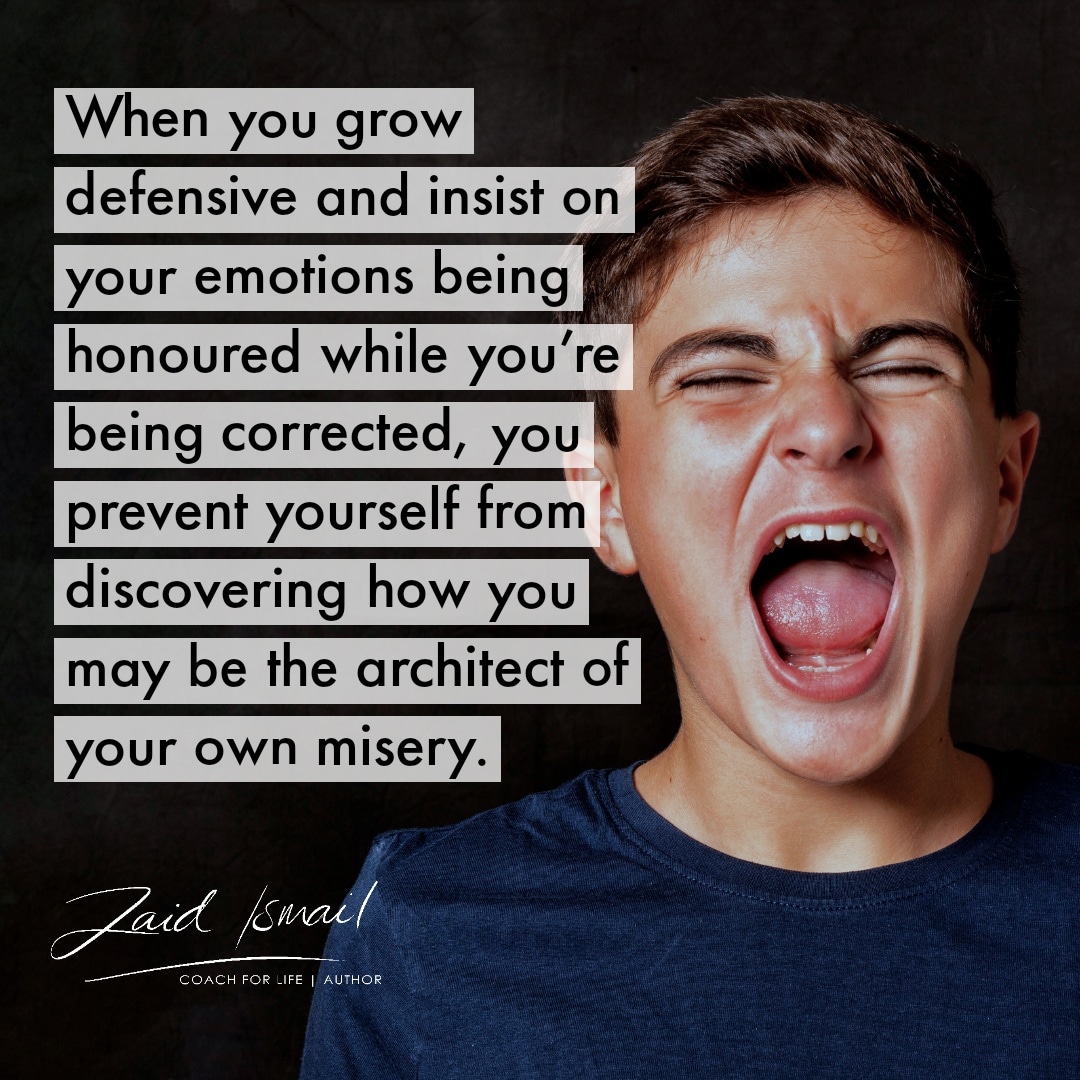
Defending myself into misery
Defensiveness is driven by a belief that you’re under attack.
Hence the need to defend ourselves when someone tries to correct us.
The defensive response on our part confirms that we assume their intention to be other than genuine concern for what we’re experiencing.
We also assume that we must be right to feel a certain way, and therefore shut down any opportunity to understand why someone’s hurtful or offensive behaviour may be a reaction to their own emotional duress.
We don’t justify it, but it makes it easier to understand it and respond more effectively to it if we pause to understand the real reason for it.
The most common reason for feeling emotional is fear.
In various forms, it is the fear of loss, or the fear of being insignificant that causes emotional duress.
Therefore, when we choose to honour our emotions above all else, we’re in fact honouring that fear and preventing ourselves from understanding and undoing the grip that it has on us.
We’re human. So we don’t expect to never get emotional.
What’s important though is how long does it take us to regain our composure after feeling the emotional impact of an experience, rather than not feeling emotions at all.
Be careful about losing your sense of self to your emotions, and then insisting that the emotional state is simply who you are.
Moderation in everything.
#mentalhealth #mentalhealthawareness #lifecoaching #zaidismail #loveyourself #ownyourlife #theegosystem #selfworth #selflove #selfawareness -
Do you remember you?
Sometimes, we lose ourselves to the hopelessness of others.
Sometimes, we lose ourselves to the failed expectations of life.
And sometimes, we lose ourselves because we thought it was our failings that earned us pain, while oblivious to the fact that it was in fact our success that threatened the ones we loved.
In these, and so many other scenarios, our perspective is tainted by our belief that what we wish to achieve with others, is what is important to them to achieve with us.
When this belief proves to be false, we question our self-worth when our best efforts only cause upheaval, and our best intentions are always misconstrued as arrogance or materialism.
If we don’t stop to see the demons that our significant others are battling, we’ll judge ourselves by how they fail to overcome their demons.
That’s when our demons strengthen their hold on us.
Unless we reconnect with who we are, we’ll forever wait for someone else to do right by us before we allow ourselves to find joy in who we are.
Rediscover who you really are, so that you can shake off the debris that you accumulated through the years with each toxic character that convinced you that you were someone you’re not.
The risk of coping with failure or betrayal is that our act of coping grows to define who we think we are.
But that’s when we lose sight of who we were before that moment.
The only way to move beyond it is to recognise that coping is only needed as long as we’re still holding on to the hurt or the disappointment of what could’ve been, but didn’t happen.
Let go of it, and the joy that you experienced before that defining moment will return.
It always starts with you.
#selfworth #selflove #selfawareness #selfrespect #reflection #mindfulness #validation #mentalhealth #mentalhealthawareness #mentalhealthrecovery #thebookofmindfulness #personaldevelopment #growth #growthmindset #gratitude #lifecoaching #zaidismail