
Are you sightseeing while wishing that what you see could be your reality?
Most often, it is our belief in what we deserve that limits us more than what we actually deserve or are capable of achieving.
In fact, considering what we deserve or don’t deserve is a distraction most likely grounded in self-pity or entitlement, neither of which changes reality.
Couple that with resigning your fate to destiny and you have a recipe for misery.
It’s like waiting up all night to witness an amazing sunrise only to give up as the first streaks of dawn appear, followed by convincing ourselves that it was our destiny not to see the sunrise.
No. Destiny is the sum total of the choices that you make with the opportunities that present themselves to you.
If you’re too distracted to notice those opportunities, or lack the courage to embrace it, that’s your choice, not destiny.
The only thing that can reasonably be blamed on destiny is the consequences that affect us of the bad decisions that others make.
Likewise, they are confronted with the fateful outcomes of our poor decisions, or our inaction to improve things.
How we respond to that which is out of our control is a reflection of who we are and what we value about life.
Don’t settle for less and then blame the world for not treating you fairly, or for not allowing you to have the life that you want.
You only accept or pursue that which you believe you deserve, or that which is safe for you to pursue when you’re distracted by what others think of you.
That’s why most of us settle for the dawn because we believe that we’re undeserving of the majestic sunrise.
It always starts with you.
Not with destiny.
#fate #destiny #happiness #conviction #commitment #confidence #optimisticquotes #resilience #tenacity #mentalhealth #mentalhealthawareness #mentalhealthrecovery #selfworth #selflove #selfawareness #selfrespect #reflection #mindfulness #opportunity #ownyourlife #theegosystem #lifecoaching #zaidismail
Tag: resilience
-
A destined misery…or is it?
-

Don’t blame destiny
Most often, it is our belief in what we deserve that limits us more than what we actually deserve or are capable of achieving.
It’s like waiting up all night to witness an amazing sunrise only to give up as the first streaks of dawn appear and then convince ourselves that it was our destiny not to see the sunrise.
No. Destiny is the sum total of the choices that you make with the opportunities that present themselves to you.
If you’re too distracted to notice those opportunities, or lack the courage to embrace it, that’s your choice, not destiny.
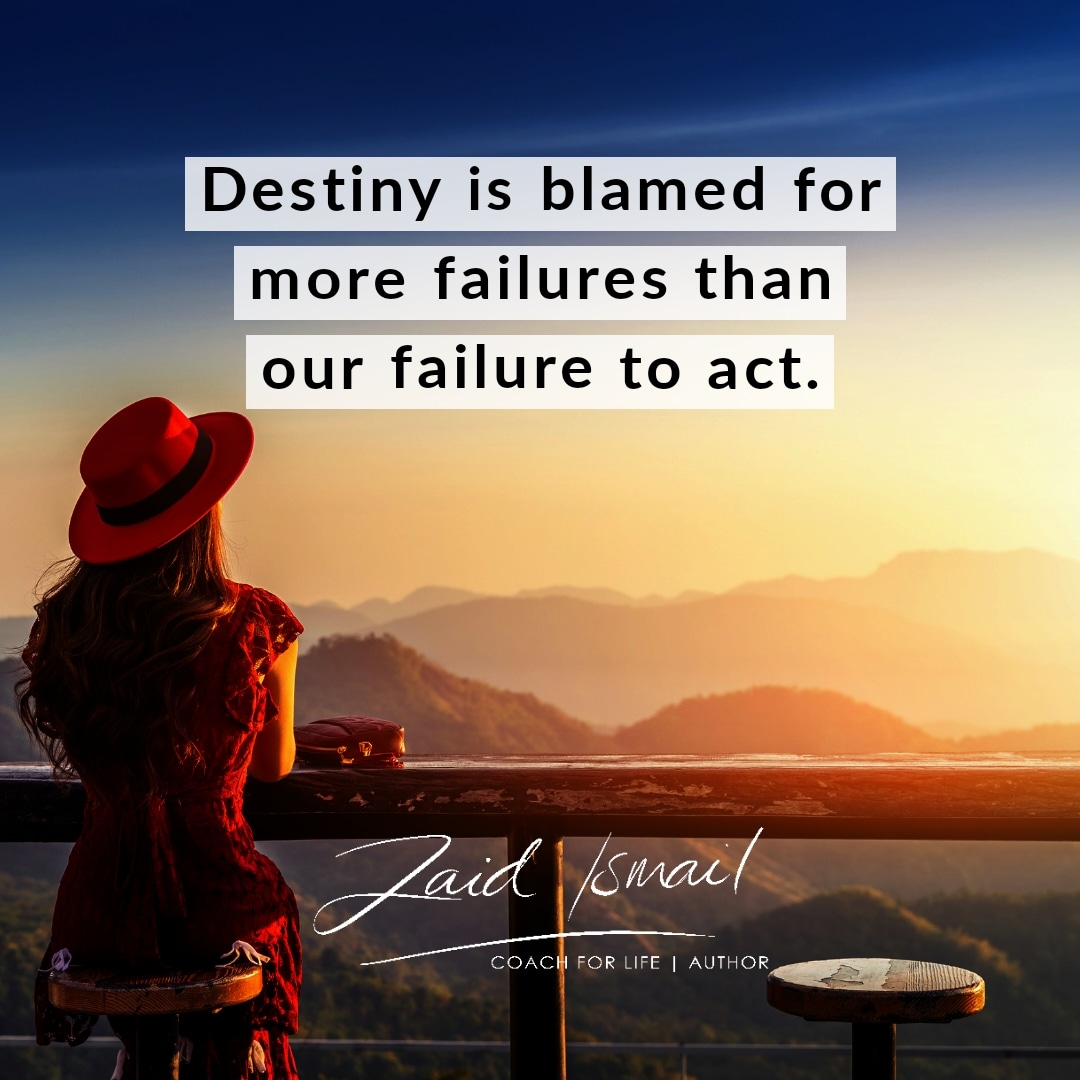
Destiny is blamed for more failures than our failure to act.
#fate #destiny #happiness #conviction #commitment #confidence #optimisticquotes #resilience #tenacity #mentalhealth #mentalhealthawareness #mentalhealthrecovery #selfworth #selflove #selfawareness #selfrespect #reflection #mindfulness #opportunity -
Hopelessly hopeful
In all the times that hope seemed to escape me, I realised that it was not because the future held no hope. It was because I had given up hope of being able to participate meaningfully in that future.
I’ve often believed that it’s not depression that exists, but instead, it is hopelessness. It is the absence of hope, or the absence of our belief in hope, that gives us reason to feel deflated about the future. Yet we focus so much on the depression, that we don’t consider putting effort into restoring hope.
It would be simple if we weren’t invested in the present moment, or the current place, or the relationships that we cherish. The world is larger than any life we could ever live, yet we willingly forego the possibility of finding joy somewhere other than where we are.
Have we convinced ourselves that success is only relevant when shared with those that we hold significant? What if they don’t return that sentiment? Does that render us unsuccessful? Or any less valuable? Why then, do we hold on to the need to get the right response from the right person at the right time before we are willing to embrace hope?
I often toyed with the idea of being a merchant of hope. One who sells the value of moving beyond where we are, so that we allow ourselves to be recipients of beauty from those who do not hold within them the bitterness of our past. Perhaps we stay because we court the idea of being able to guide them back to joy, and in so doing, place the hope of our joy in them finding theirs? Or convincing them to see the joy in us beyond what they’ve grown to know.
Joy is cheap if not shared. Eventually, even uplifting others loses its sparkle if inclusion in their joy feels unreachable. It’s that feeling, that deeply seated desire to be instrumental in the joy experienced by another, but also being recognised and appreciated by them for creating such joy that perhaps, keeps us rooted to the pursuit of an outcome that may torment us in the present, but elevate us in the future.
The hopelessness of hope lies in the truth that hope, even when deliberately abandoned, never leaves. It never abandons us, despite the intensity of our efforts to abandon it. And, I think, it is in that tenacity of hope itself, that the ego is frustrated because even in this effort towards hopelessness it finds it impossible to attain success.
-
Resilience is not cheap
I’ve watched some emerge stronger from harrowing ordeals, while others crumble from comparatively minor setbacks. This made me wonder what it is that makes some resilient while others remain fragile? Sometimes it’s the final straw that makes us appear weak when we crumble from a seemingly petty incident, while others have no insight into how many straws we carried on our backs up to that point. Yet at other times it is something that surprises even us when we find ourselves bewildered by the ferocity of a trial that strikes from a quarter from which we least expected.
Seeing something coming a mile off, or not expecting much from someone that eventually disappoints us has little impact to our composure. It takes a lot more of those anticipated occurrences to wear us down, as opposed to a single blow from someone we trust deeply. Our apparent resilience is therefore not something that is fixed or easily predictable, but rather it is relative to what we hold dear, or what we’re willing to do without. That suggests that what we tolerate is a deeply personal choice, some of which we’re aware of consciously, but most of which is shaped quite unconsciously throughout our lives.Importantly though, we can’t assume that everyone is, or should be equally resilient, or that our tolerance to bear burdens or trials is equal. It’s not. We define our tolerance levels long before we reach it, and it is that tolerance level that often defines our resilience. On the other hand, our capacity to deal with troubling life events is largely the same. What we allow to consume that capacity versus what we let go of is what determines our resilience. Those choices are not so easy to make. Most often, that elusive state of mindfulness ensures that in the absence of mindfulness, we barely realise that we’re making such huge choices to begin with.
I always picture it as a wheel barrow that we push through life. As we go along, we pack in our troubles. As those troubles pass, we offload them from that wheel barrow and make space for new growth events. Sometimes we even allocate specific areas in the wheel barrow for different types of life events. When that specific area starts filling up, we grow anxious because it threatens to take up spaces that we set aside for other important life events. And in that way, challenges in one part of our life ends up threatening experiences in other parts of our lives. In such circumstances, we may find we lose patience in one area, like work, while we’re completely composed in another area, like a relationship with a significant other. When we don’t create those unique spaces, we find that one area of our life will more easily contaminate the quality of a totally and often unrelated other area of our life. Add to this the fact that many of us don’t ever offload those events because the events themselves have grown to define the state of our being, and you quickly see how easily it is that we sabotage our ability to carry our burdens through life in that little wheel barrow we were each given. That’s when that wheel barrow fills up until it either gives in under all that weight, or we lack the strength to push it any further. That is what determines our capacity to deal with new experiences. The more we hold on to the past, the less capacity we have to embrace the present. The less capacity we have, the lower our resilience to deal with what comes our way.
Before we can choose what we hold on to versus what we let go of, we need to know what we want. Sometimes we know what we want, but we don’t articulate it well enough to ourselves, so we go chasing after something we don’t really want, and then find ourselves devastated when we acquire it only to find that it is not what we were looking for to begin with. It sounds cryptic, but no more cryptic than how many of us live our lives.
Our ability to face adversity, smile, maintain our composure and move on is determined long before that adversity strikes. It is determined in those moments when we hold on to a bad memory and promise ourselves never to forgive or forget, or it is determined by those moments when we shrug, smile, accept what we could not change, and move on with the knowledge we gained from the experience.
Very simplistically, I see resilience as a sense of conviction driven from a deeply held desire to serve a greater purpose, which outweighs our need to exact retribution for a past event. But that begs the question at to what is purpose? Purpose must be greater than a selfish benefit. It has to benefit others as well. If it only benefits us, it’s not true purpose, it is more likely convenience or indulgence. Purpose becomes important for resilience because it is all that stands between us and the distractions that prevent us from reaching our goals. In fact, if your goal is not aligned with a specific purpose, it is more likely to have a fleeting effect on your happiness, rather than a lasting one. Goals without purpose tend to be instant gratification. Instant gratification doesn’t require conviction. It merely requires a short term satisfaction of a fleeting need. Such needs are usually instinctive and spontaneous, and feed an emotional state, not necessarily a spiritual one.
The expense associated with resilience is therefore the resolve we need to establish to let go of that which no longer serves our greater purpose. We choose those greater purposes that we wish to serve based on what we believe we are most capable of influencing as a beneficial outcome to those around us. The lower our self esteem, the less likely we are to be convinced of our ability to contribute in this regard. But before you feel pity for the one with the self esteem deficit, consider what it is that they are choosing to keep in their wheel barrows, as opposed to showing gratitude for the opportunities they have, and the growth they experienced?
Resilience is not cheap because it demands a level of conviction in who we are before anyone else is willing to invest in us. It demands that we recognise our abilities and take accountability for our contributions towards our lives, rather than pretending to be victims of circumstance or fate. Resilience dictates that we take charge, that we lead, that we own our space before it gets owned by others. When we give in and assume that life happens regardless of our input, or that we need saving before we feel significant, it confirms that we’re ungrateful for what we have. It also confirms that we choose not to learn from our mistakes nor accept accountability for our contributions to what weighs us down. When we get into that state, that victim mentality, we become a burden to others, a major deficit to society, and we test the resilience of those that have to pick up the slack because they see the value beyond the trials we placed in their paths instead of stopping and questioning why it is that they need to deal with what the fickle and ungrateful refuse to own.
Resilience is not cheap because anything in short supply is expensive to attain. The demand for resilience on those that live with conviction increases disproportionately with every wimp that cowers in the face of adversity.
[An incomplete thought process]
-
Obliviously Resilient
I’ve always taken comfort from my sense of resilience, but noticed recently that it appears to be waning. I seem to be more sensitive than before to the emotional jarring that goes with betrayal, and this concerns me. Well, at first it did, but now I’m simply afraid of reflecting any further on the subject. There have been times when in the moment, I found myself unfazed by the abrasiveness or abuse being meted out towards me. It always appeared to be black or white for me. Something was either right, or it was wrong, and the underlying principle that supported my observation or perception was all that I cared about. It was such an easy way to live.
Life isn’t as simple anymore. Principles still drive me, but they’re not as defining as they used to be. The reason I’m afraid of reflecting further is because I’ve realised that the more I grow to understand my weaknesses, my needs, or my flaws, the more I relate to the flaws and weaknesses and failings of others. Unfortunately, this also implies that the reverse is true as well, not in them knowing me, but rather in me also being able to grow more familiar with the arrogance, the aloofness, and the smug condescension that lurks behind the smile that dresses the words of so many I meet. It is in this realisation that I start doubting my past resilience and wonder if it was in fact resilience based on strength of character, or was it resilience grounded in obliviousness.
The net effect remains a beneficial one, so the concern I feel must be an indulgence in my own ego. Anyone claiming to be free of their ego is in fact driven by it. I guess that is the obvious sibling to the realisation that the proclamation of humility is in fact arrogance. I’m so easily distracted from the point of my ramblings these days. Being oblivious, not by choice, therefore appears to be a blessing. It’s what causes us to appear resilient, but it also causes us to appear grounded and uninterested in things that don’t concern us. Strangely enough I am once again reminded of the parallels between this and humility. I’ve previously argued that humility can only be observed and not practiced. I guess in some way, the same applies to resilience.
The same way that I may appear humble when in fact I am too jaded to acknowledge the superficial praises of others makes me jaded, not humble. Similarly, being oblivious to the true repercussions of the events I am experiencing results in a resilience that is unintended, although mostly beneficial. I think there is a point in here somewhere. I think my distracted state is a source of inspiration. I’m just too distracted to figure out how to put it to good use.
Perhaps distraction and naivety are the precursors to obliviousness. Such obliviousness, where its roots are not conscious choices, contributes to our sense of resilience. Questioning that resilience appears to be akin to looking a gift horse in the mouth. So perhaps I should be grateful for my inclination to be unconcerned about the fickleness of society, and instead of questioning how I may have appeared to others in my moments of oblivion that I previously embraced as resilience, I should draw on those experiences to harness this innate ability to be oblivious so that I can continue to feign resilience.
Fake it until you make it, right? Who can truly lay claim to sincerity when such a claim requires a healthy dose of self-indulgence to begin with? But that’s a post for another day. My brain is tired. And if you can make sense of this post, please take a moment to explain it to me as well.
-
Defining Moments
I’ve often mulled over the idea of one day listing the moments that I believe defined me in ways I often still don’t fully understand.
The images that flash through my mind when I contemplate those defining moments are often not scenes of hope and happiness, but most often they’re scenes of struggles, pain, isolation, betrayal, and detachment. Being one of six siblings in a small house makes it easy to disappear into the clutter. Sibling rivalry never needed solicitation.
Standing in the cold night air urinating into the flower bed in front of my uncle’s house when I was a scared little kid barely 6 years old, I remember staring across the road at the sight of my mother standing in tears under the carport of our house out of concern for my wellbeing. I was physically dragged by my collar and kicked out of the house for not being able to find something I didn’t lose. A lesson my father thought was very much needed in order to teach me not to forget my jacket outside after playing with my cousins; so he chose to hide it away until he was ready to stop teaching me that lesson. It worked. I’m anally responsible these days.
Moments like those were numerous and such a harsh approach to establishing discipline was the norm. I often find myself resisting the inclination to apply similarly harsh measures in dealing with untoward behaviour from my children. It’s strange how easily we adopt the nature of those that reared us, despite having had distinctly distasteful moments at their hands. I was born with an inherent resilience that prevented me from seeking affirmation from others. I was odd and I didn’t give a damn, and for the most part I still don’t. I sat and browsed through encyclopaedias that showed me life in full colour while siblings, cousins, and friends played cricket in the streets of the township where we lived. I sometimes joined them, but it often ended in injury, so there was hardly ever much attraction for me to immerse myself into the sporting experiences that others seemed to live for. This, I realised later in life, was a source of much disappointment for my father. It didn’t deter me. For as long as I can remember, anyone attempting to coerce me into doing something I didn’t like or want for myself often departed frustrated and unfulfilled in their attempts to prevail over me, or the situation.
My academic achievements at school were largely unnoticed and barely celebrated, until I lost total interest, slipped from the top of the grade to the bottom of the pile, and eventually dropped out of high school without anyone caring, including me. Girls wouldn’t talk to me and guys wouldn’t bully me because neither group knew what to expect in return. But those weren’t particularly defining moments for me.
Being jailed for bogus charges of domestic violence and child abuse against my own children. Now that was a defining moment, especially since I was the one that called the police to stop the abuse meted out against me for years. My timing as always was impeccable. I chose to do that at a time when domestic violence against women was a priority for the South African justice system. Nonetheless, it spelt the end of a tumultuous relationship with a depraved soul that was diagnosed as having several severe mental disorders, when in fact all she cried for in the most destructive ways was security and affirmation from parents that made dysfunction look like an admirable next step in life. Unfortunately she projected her demons on me and found it therapeutic to win the favour of others by demonising me instead. It was during those four distasteful years that I lost the very few friends whose presence I always cherished in my life up to that point.
Pacing around the courtyard of the holding cells at our local police station on the coldest night of winter that year left me even more detached. My pleas to the police officer for common sense to prevail echoing in my head while the nagging knowledge of having hardened criminals sleeping in the cell alongside me left little space for peace. But the moon looked distinctly beautiful that night as I watched it cross the sky through the metal grids that sealed the courtyard above the 20 foot high walls, just in case someone was able to climb up the sheer face of it. It was odd how the police officer that arrived on the scene appeared to be more traumatised than I was. I later discovered that he had presided over another arrest relating to domestic violence during which the alleged perpetrator hanged himself in the bathroom. No wonder the indignity I was afforded when I needed to use the bathroom that night before being taken away by the police. I still smile at the memories of standing in the holding cells below the courthouse and having random convicts coming over to me to tell me their stories of claimed innocence. I seem to attract the weirdest kind.
Wintery nights seem to be the common thread in many defining moments. Years before, I was held at gunpoint by my previous wife while she went through yet another crazy mood swing demanding that I call the police to settle an argument or else she would shoot me with my gun while holding our daughter in my arms. You read that right. It didn’t make sense to me either, but such is the logic of a recovering drug addict. Again, the police were sympathetic towards her, while confiscating my firearm that she mishandled, and asked me to leave the house while entrusting my daughter into her care for the night. Amazing what the weaker sex can get away with.
My naivety has been a loyal friend throughout my life, and still remains a bosom buddy if recent events are anything to go by. Many accuse me of gullibility, but I would rather live a life of being consciously naïve than to live suspiciously.
I’ve had good moments, and even a few great ones. I’ve recoiled at the unexpected loss of loved ones, but always receded into a private space to grieve, rarely showing my pain to the world. It’s none of their business after all. The buoyancy of my spirit often mocks me because it leaves me confused about who is being fooled. Or perhaps no one is being fooled, and in fact this inherent resilience that I cannot lay claim to, but nonetheless do possess, perhaps this is what makes it possible for me to see the present moment for what it is rather than what it should be relative to the souring experiences of my past.
The moments that have defined me are many, but their realisation and conscious recollection still largely eludes me. There is a strong undertone of changes blowing through my life right now. Profound changes that barely show in the normal light of day. Perhaps this is why my mind has been distracted to the point of mild dyslexia recently. My sub-conscious mind is pre-occupied with contemplating these changes, while my conscious mind knows nothing of it in the face of the routine that effortlessly persists.
I still feel a need to define who I am, but I suspect that I may never fully achieve this goal in this lifetime. Life is…undefinable, and I remain a mystery to myself, and most often, to those around me as well.
-
The Fragility of Trust
A question I received from a friend this morning coincided with something I was considering yesterday. I wondered why it’s sometimes easy to trust, and at other times it’s nearly impossible. Why does it seem so easy for some to walk away from depression, while others are haunted with it for most of their lives? In fact, why is depression so closely linked to issues of trust and betrayal?
I think that sometimes it’s a balance we have to strike between wanting to trust, and not caring about the potential of betrayal. At some point we will accept that there’s a certain amount of risk we’re willing to take because we’re confident enough to deal with the consequences of a potential breach of that trust. So the reality is that we trust more easily when we have a greater sense of self, or perhaps a greater level of confidence in our ability to be resilient in the face of betrayal. Unfortunately the very nature of the issue drives us to defend or protect our fragility and vulnerability in the aftermath of betrayal, and quite quickly, without noticing, we end up stuck in that cycle not realising that we’re only as vulnerable or as fragile as our ability to rise above it.
I’ve previously said that a healthy self-esteem is the greatest gift any parent can give their child. That self-esteem must inform the way they view themselves, their choices, and the associated outcomes. It must teach them that no matter what bad things may happen to them in life, the only part of the encounter that defines them is how they chose to respond, and never what was presented. The power of choice, and more importantly, the realisation of that power of choice, is the key to unlocking our resilience. But resilience, like happiness and humility, are only end states, but not a skill or trait in itself. Our belief in our own principles and convictions, and our courage to stand up for it in the face of ridicule is what determines (in part) our level of resilience.
Unless we believe in ourselves, we’ll find it impossible to believe in anyone else, and by extension, it will be impossible to trust. Under such circumstances, it’s easy to confuse a hopeless surrender and dependence on others as trust. When we undermine ourselves, we empower our enemies, and like they say, the friend of my enemy is my enemy. So it stands to reason that that is how we become our own worst enemies.
-
No matter how much I try to find normal friends, I always end up polarising towards people that are as screwed up as me. Birds of a feather and all that crap, you know. Even at times when I meet someone that seems to be perfectly normal and well-adjusted, they turn out to be screwed up like me. Sometimes they seem to have a balanced life, a reasonable circle of friends that they actually know in real life, and they seem fairly balanced in their views on love and life and all that crap…but in the end, they turn out to be just as screwed up as me!
So I’m wondering, am I really screwed up, or am I…erm… normal? Perhaps I’m judging myself too harshly? Perhaps I’m more resilient than most given how little it takes for others to fall apart relative to what brought me close to breaking point? Perhaps, and this is probably it, I’m just so emotionally stinted that it takes that much more to get a reaction from me, which is why I seem resilient while others seems flaky?

