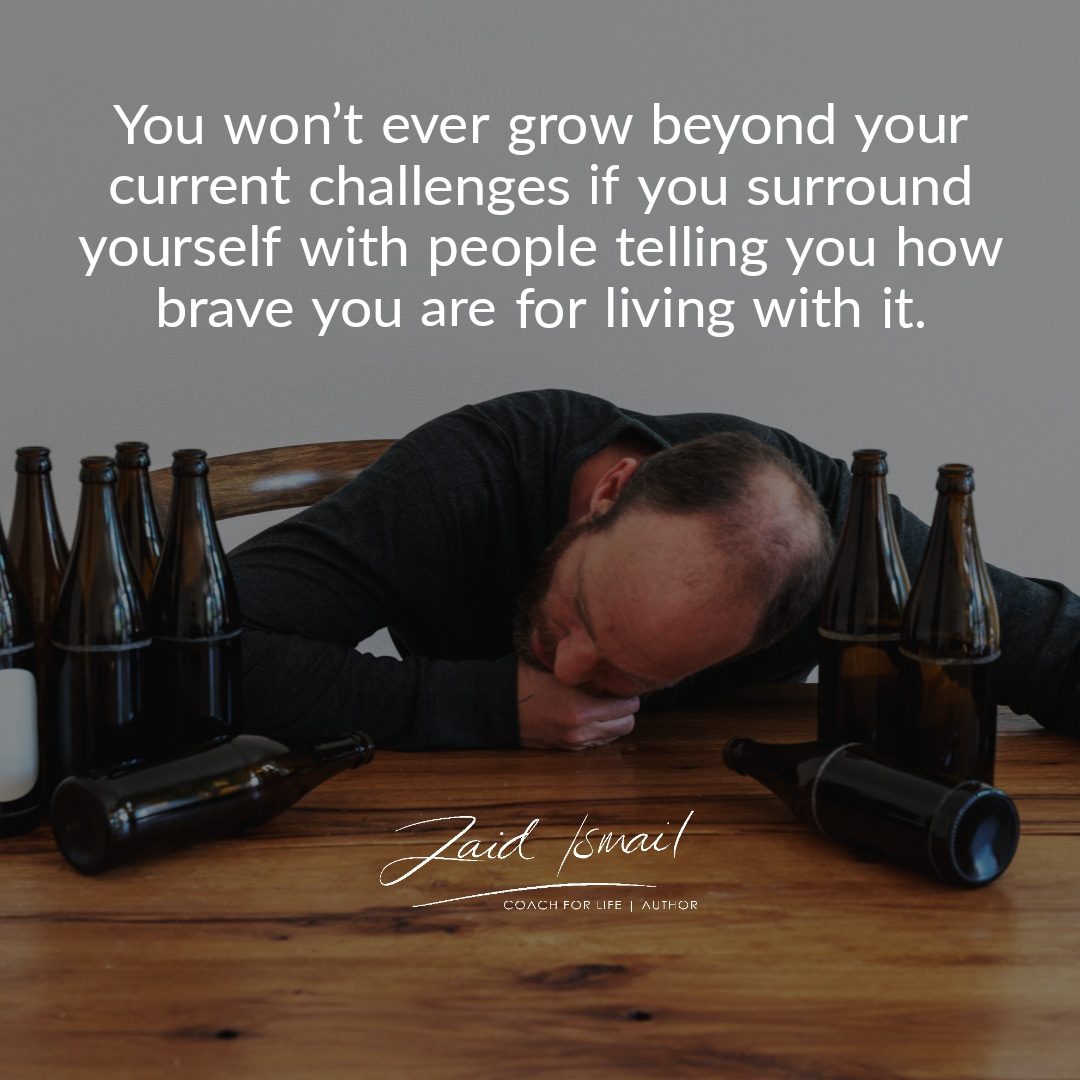
When we internalise our struggle to the point of believing it to be so unique that it cannot possibly be grasped by anyone else, we give it a power of magnitude beyond the experience itself.
Misery intensifies the more we dwell on it.
When we live inside our heads, we convince ourselves that our struggle and our pain defines our courage because if only ‘they’ knew what we were dealing with while still showing up, they wouldn’t judge us the way that they do.
We judge ourselves harshly long before we give the world an opportunity to judge us.
We then take that self-judgement and treat it as a truth of what we think others think of us.
Then we treat others based on that assumption that we made from the self-judgement while blaming them for judging us.
Crazy, right?
That’s what holding on to pain or misery does.
It distorts our grasp on reality because we only find what we’re looking for, while we ignore or dismiss anything that conflicts with that.
It’s not as confusing as it may sound.
If you go to the grocery cupboard looking for a can of tuna, you’re not going to notice if you have enough rice left, because you weren’t looking for rice, you were looking for tuna.
Same with life.
What you focus on is what you’ll find, and that’s why you won’t see what others see if you’re busy judging yourself or waiting for justice, because they’re looking at your life very differently.
That’s how we create self-fulfilling prophecies in relationships, or we create anxiety about what we need to deal with in life.
Step back.
Take a deep breath.
Break the routine.
And surround yourself with people or an environment that helps you to regain perspective beyond what is weighing you down.
That’s how we reconnect with hope and with joy in life.
It always starts with you.
#joy #pain #misery #selfpity #courage #life #ownyourlife #mentalhealth #mentalhealthawareness #mentalhealthrecovery #selfworth #selflove #selfawareness #selfrespect #companionship #love #understanding #lifecoaching #zaidismail
Tag: companionship
-

Judging self into misery
-

Own your misery
Miserable are the ones who compete with their companions, and then go searching for companionship among those that will ruin them.
Self-pity and self-loathing are the marks of ingratitude that turn your greatest supporters into your greatest distractions.
All because you think that they see the inadequacy and shame with which you view yourself.
That’s why at times, when someone believes in us, we convince ourselves that they’re simply trying to humiliate us.
Such is the seeds of ingratitude and self-loathing, that we end up taking advice from enemies, and discarding advice from those who care most about our success.
Your self-loathing is your ingratitude for who you are.
Stop blaming the world for you getting in your own way.
It always starts with you.
#selfworth #selfawareness #ownyourlife #selfmastery #mindfulness #personalpower #mentalhealth #mentalhealthawareness #lifecoaching #zaidismail #loveyourself #lifegoals #motivation #optimism #purpose #companionship #selfpity #selfloathing -
Woe is me…or is it?
The need to be pacified about the struggles of our life is an indication of how much or how little we believe in ourselves to rise above it.
When we lose sight of our contribution towards our current state, we surrender to destiny or fate, and wait to be saved or celebrated for how strong we are for persevering.
Meanwhile, our inaction at changing, or breaking the cycles in which we’re caught, reflects our self-worth more than it reflects our bravery or resilience.
When the oppressed or the abused remain submissive, they choose to live with shame rather than fight with dignity.
That fight doesn’t have to be confrontational. Especially when we are physically incapable of subduing the other.
However, understanding what we’re doing to feed the cycle that is harming us is the beginning of changing what we contribute to such cycles.
This is not victim blaming. This is victim empowering.
The difference being that we don’t blame the victim for the oppressor’s actions, but we encourage the victim to reclaim their voice and their dignity, which in turn reduces the validation that the oppressor or abuser gains from their abuse.
Understanding the cycle is therefore paramount to effective action.
Action without understanding is like gambling with your life.
Seek to understand before you surrender to your reality.
Otherwise you’ll go through life believing you’re trapped, while not realising that there was always an exit strategy available to you.
It always starts with you.
#hope #expectation #sincerity #selfworth #selfawareness #mentalhealth #mentalhealthawareness #lifecoaching #zaidismail #loveyourself #lifegoals #motivation #optimism #purpose #companionship #relationshipgoals #narcissisticabuse #narcissism -
Are you there for you?
We’re more inclined to recognise the needs of the weak, than we are of the strong.
Without meaning to, we diminish the humanness of those who persevere without complaint, because they often make it look so easy.
When we’re the strong ones persevering without complaint, we risk diminishing our own humanness as well, because we become defined by being strong for others.
Whether you’re strong or weak, you need to take time to connect with the human behind the strength, or the struggle that you observe in others, and especially within yourself.
If you don’t, you risk becoming the enabler of weakness and dependence, or the enabler of harshness and insensitivity.
Because that’s what happens when we lose contact with our humanness.
We stop expecting, or allowing ourselves and others to be human.
That’s when everything becomes dutiful and focused on rights and responsibilities.
And empathy and compassion, let alone love and affection, leave through the window.
All this because we forgot that we’re human, and that the ones failing us are human too.
We cannot choose differently for how others show up in our lives, but we can choose how we show up for them, and for ourselves.
Focus on that, and let the rest take care of itself.
When you achieve this, you’ll taste the sweetness of life and not just the accomplishment of goals.
Own Your Life.
It always starts with you.
#selfworth #selfawareness #ownyourlife #selfmastery #mindfulness #personalpower #mentalhealth #mentalhealthawareness #lifecoaching #zaidismail #compassion #companionship #relationshipgoals -
To be loved
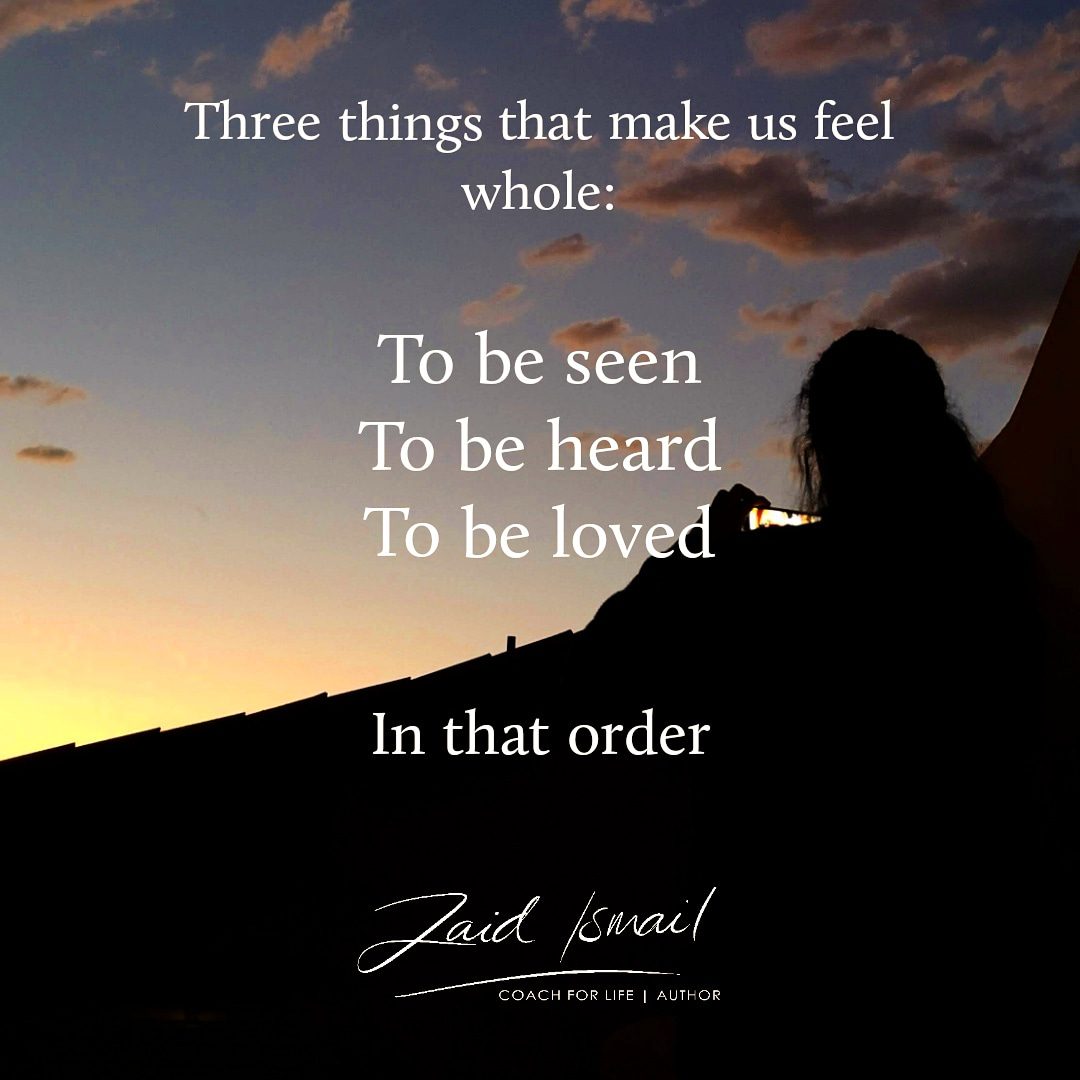
To be seen… Beyond the facade. To have the essence of who we are, known to those we trust and hold dear.
To be heard… Not only when we cry out, but also when we speak gently of the troubles in our heart.
To be loved… For more than how we make others feel, but to be loved for what we need in return, without having to claim it.
In that order, because a voice without an identity is not a voice. It’s only a whisper in the wind.
A face without a voice is only window dressing, or a trophy. And not a complete being.
And love… Love without a reciprocal embrace…an embrace of what we hold within, as well as what we willingly give, is an empty love that taints towards bitterness, rather than beauty.
Love beyond lust or infatuation is rare. True love is never abandoned.
I see you.
I hear you.
I love you.
Three of the most valuable gifts you could ever give.
But, you cannot give what you don’t have.
For this reason, you must first see, hear, and love who you are, before you will be able to share it with another.
#love #romance #companionship #soulfood #soulmates #anincompletelovestory #gratitude #appreciation #zaidismail #authenticity #relationshipgoals #joy -
Torturous love
And so it is…love and torture have always been stablemates.
Sometimes, without warning, someone enters your life and challenges every assumption that you ever made about what’s possible.
What you thought you deserved was limited to what you were capable of achieving up to that point, and maybe just a quiet desire to acquire some peace beyond it.
Until they see in you what you thought was your own delusions, and you see in them what you thought were only your dreams.
Once you connect with that truth, nothing can convince you that anything less is what you must settle for.
Settling becomes a vulgar thought, and fulfilment becomes incomplete without them.
When that happens, the distance between love and torture grows, and you find yourself stretched between the two, with only shards of sanity to prevent you from being torn apart.
Those shards will tear at your dreams and taunt your delusions until their embrace is secured.
Until then, life becomes a dyslexic dance with insanity, and love remains elusive.
(From the archives)
#hope #expectation #relationshipgoals #companionship #love #affection #intimacy #life #anincompletelovestory #adancewithdestiny #zaidismail #romance #lovestory #unrequitedlove #soulfood #soulmates #foreverincomplete -
That self-loathing demon
Ingratitude for the self is reflected in how much time we spend self-loathing.
But self-loathing is disguised in many creative ways.
The above list of 10 common points is only the tip of the iceberg.
Self-loathing is rarely, if ever, a result of our current circumstances, and almost always a result of how we felt about our place in our parent/s home.
The less space they made for us in their lives, the less worthy we feel as humans.
This is especially true for problematic relationships with our fathers, but often extends to criticism or insensitivity from our mothers as well.
Because that shapes our sense of self early in life, it’s difficult to realise its impact because it just feels normal for us.
That’s when we grow to believe that our partners are responsible for how we feel about ourselves, or that they’re responsible for our enthusiasm towards our dreams.
That’s how we grow harsh and cruel, or rigid and abrasive towards them, not realising that we’re holding them accountable for how we feel about ourselves because we had one, or both, parents who were emotionally inaccessible when we needed to feel like we were worthy, or like we belonged.
Self-loathing, beyond our early years when we didn’t know better, is a testament of ingratitude for who we are, and what good we have access to.
Until we start owning how we feel about ourselves, we’ll always have reason to rage at the world, and at the innocent ones around us.
Own Your Life.
It always starts with you.
#selfworth #selfawareness #ownyourlife #selfmastery #mindfulness #personalpower #mentalhealth #mentalhealthawareness #lifecoaching #zaidismail #loveyourself #lifegoals #motivation #optimism #purpose #companionship #relationshipgoals #selfloathing -
Internal struggle, outward joy
The martyr within, breathes life into the angel without.
A rare few live their lives outwardly, as they feel inwardly about themselves.
The need to hide our shame from the world is born from feeling ashamed of who we are, and not because of what others think of us.
The opinions of others only matter in two ways.
It hits a tender spot because it threatens to expose what we already judge harshly about ourselves.
Or it offers us perspective in our efforts to be better than we were the day before.
Most focus on the judgement because their relationship with themselves is so harsh.
That’s why so much effort is put into presenting ourselves to the world in a way that will gain favour or distract attention away from how we feel about ourselves, because we carry too much shame within about who we are.
Understanding where that harsh self-judgement comes from is the beginning of the journey towards reclaiming ourselves, and our joy in life.
When last did you feel the way you looked when you showed up in the spaces of others?
If you can’t recall, we need to talk.
Own Your Life.
It always starts with you.
#hope #expectation #sincerity #selfworth #selfawareness #mentalhealth #mentalhealthawareness #lifecoaching #zaidismail #loveyourself #lifegoals #motivation #optimism #purpose #companionship #relationshipgoals #selfloathing