We focus too much on how others treat us, and too little on how we treat ourselves.
Honesty is one of those things that we find distasteful and repulsive when someone withholds it from us, but we overlook it when we do it to ourselves.
When we’re dishonest with ourselves, we find ways to justify that dishonesty.
That justification comes in the form of avoiding tough discussions, surrounding ourselves with people we find agreeable, and avoiding those who will challenge us when what we say doesn’t resonate with how we behave.
That’s how we end up running away from the harsh truths that we prefer not to face, until eventually we become convinced that our running away is in fact our struggle to create a better life for ourselves.
We convince ourselves that the circles that agree with us are in fact the ones who care, while most often they’re also running away from their own lives, looking for familiarity in their quest to find their ‘tribe’.
We must choose our company wisely. But we must also choose it sincerely.
Like a wound, avoiding the truth of who we are or what we’re responsible for, only creates fertile ground for such realities to become festering wounds that slowly rupture and destroy the very peace that we set out to achieve.
That’s how the past that is not resolved, haunts the future that we’re desperately in need of.
You owe yourself honesty and sincerity before anyone else owes it to you.
It always starts with you.
#hope #expectation #sincerity #selfworth #selfawareness #mentalhealth #mentalhealthawareness #lifecoaching #zaidismail #loveyourself #lifegoals #motivation #optimism #purpose #companionship #compassion
Tag: companionship
-

Dishonesty is the thief of peace
-

When your sincerity is tested
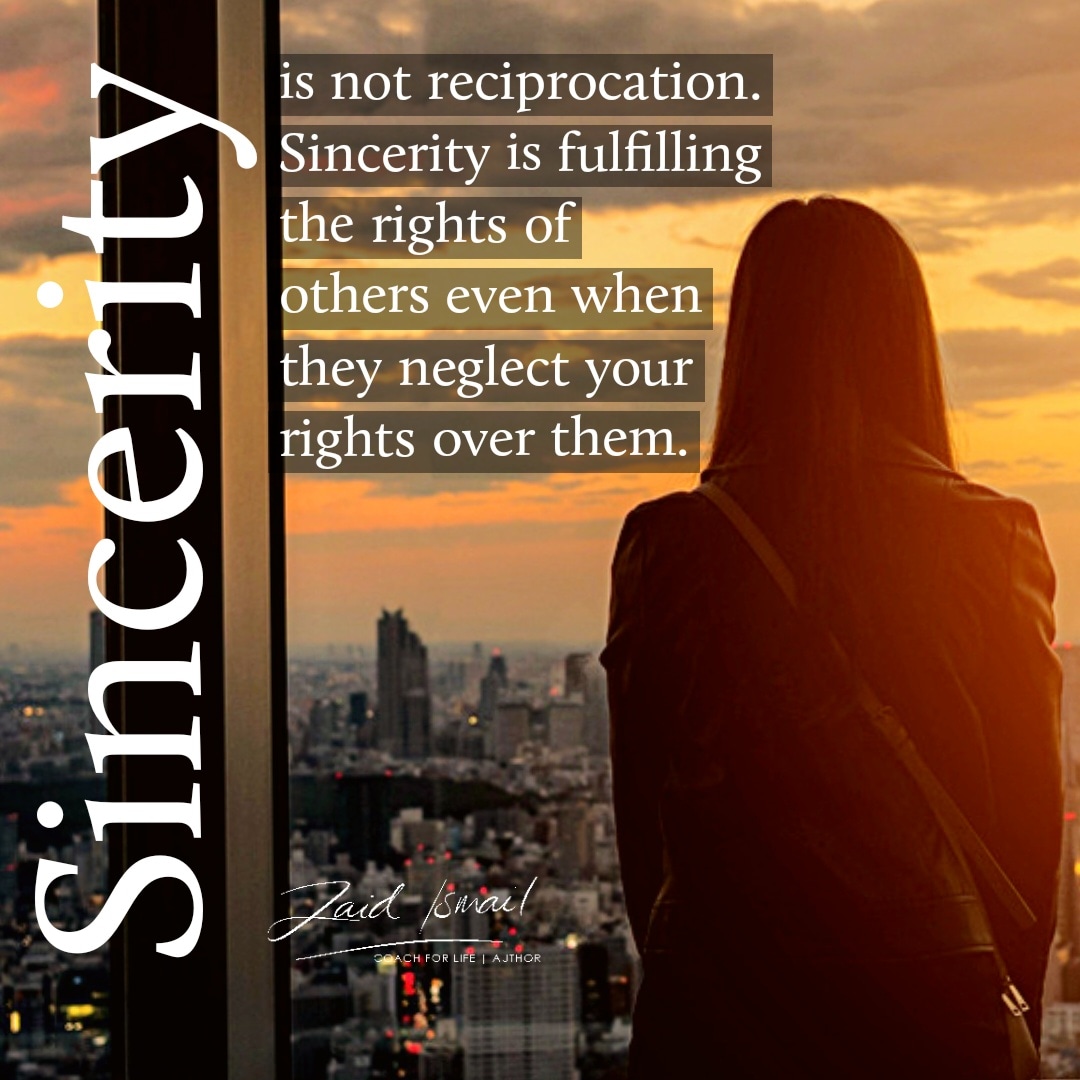
Our sincerity is tested when we’re faced with the opportunity to contribute in kindness, while being treated with disregard or ingratitude.
But it’s not our sincerity towards others that is tested.
It is the sincerity of our convictions about what we hold true as principles to live by.
We lose the best of who we are, when we abandon it in the face of neglect from others.
When we withhold our contribution because we’re afraid that it won’t be appreciated, or repaid in kind, we diminish who we are to become like who they are.
Of course, in everything, there must be moderation.
And the moderation in this is that we must be mindful of when our selfless contribution may be enabling their selfish behaviour, or validating their ingratitude.
So give without the expectation of receiving, but don’t give to the point where you exhaust yourself while feeding the ungrateful mindset of one who feels entitled without good cause.
Moderation is key in everything that you do, except your expression of gratitude.
And sometimes, that gratitude is expressed by withholding your contribution from others because you want them to experience gratitude for what they keep taking for granted before you continue to give.
It always starts with you.
#hope #expectation #sincerity #selfworth #selfawareness #mentalhealth #mentalhealthawareness #lifecoaching #zaidismail #loveyourself #lifegoals #motivation #optimism #purpose #companionship #compassion -
Feeding that generational curse
Don’t contribute towards the generational curse that weighs you down by withholding who you are because of ingratitude from those who themselves are at war within themselves.
We all have our internal battles that cause us to show up badly at times.
When we lose sight of this, we focus on how others show up badly and then judge them, or we judge our value to them, as being inadequate.
That’s when we expect the world to make up for how we feel about ourselves, despite having traded the best of us for the worst of others.
But this transaction is an internal, quietly hidden one.
It’s a transaction that creeps up slowly, almost gently, so as not to cause alarm as we shift from gratitude, towards ingratitude, and finally towards bitterness.
When you feel like you’re facing roadblocks at every turn, it’s time to take stock of where you’re at, so that you can find your way back to the path towards the destination that you wanted for yourself before you were distracted by the demons of others.
You don’t break generational curses by fighting it.
You break it by rising above it, while creating space for your tribe to join you when they’ve had opportunity to experience the value of your journey.
But, if you don’t pursue your journey with conviction and consistency, you deny yourself and others the opportunity to discover a more wholesome way to live.
It always starts with you.
#hope #expectation #sincerity #selfworth #selfawareness #mentalhealth #mentalhealthawareness #lifecoaching #zaidismail #loveyourself #lifegoals #motivation #optimism #purpose #companionship #compassion #ownyourlife #theegosystem -
Do you matter when it matters most?
I often hear about people who are frustrated at not being able to get through to someone.
The most common assumption when that happens is that we’re obviously not important to them, or what we need isn’t important to them.
Sometimes, that may be true. Especially when it comes to those who are not close to us but we have to work with or get along with them for reasons beyond our control.
When we recognise what our role is in someone’s space, we’ll find it easier to choose our moments when our words may be appreciated, versus when silence will be more appropriate.
Even with loved ones.
Assuming that we’re unimportant also assumes that what they need is something that they need from us, let alone something that we can give them. .
That’s the difficult part to accept because of our desire to be everything for those we love.
However, it’s a distraction from what’s really going on in their space.
Without meaning to, we make their needs about us while losing sight of what they need.
Sometimes, seeking to understand before assuming to be insignificant may increase the significance that is felt by both, whereas demanding significance diminishes the significance of both.
The fear of insignificance has probably created more insecurity than insecurity itself.
If you’re convinced of your value, acceptance or validation from others, while still important, will not have an unhealthy impact on you when they’re not expressing it in the way that you need.
It always starts with you.
Own Your Life.
#hope #expectation #sincerity #selfworth #selfawareness #mentalhealth #mentalhealthawareness #lifecoaching #zaidismail #loveyourself #lifegoals #motivation #optimism #purpose #companionship #theegosystem #ownyourlife -
A burdensome labour of love
Responsibility, when met with gratitude, feels like a labour of love.
Remove gratitude, and it becomes a burdensome load.
But only if gratitude is expected.
That’s when expectations weigh down on us more than responsibility, because of the internal wait for others to reciprocate, or to notice.
It’s not unreasonable to hold that expectation.
In fact, we should expect those around us to show gratitude or to share the load, so that the relationship is not reduced to one of a mere exchange of duties.
However, we must remember that they have the same expectation in return.
More than this, if we’re not aware of this expectation that we have, because it’s usually a subconscious one, we feel disappointment or a growing bitterness towards those who we feel are taking us for granted.
And again, the same is true in return from their side.
To overcome this, not only must we be aware of this expectation, we must also understand if the other person is aware of it, and if they’re capable of meeting it.
That opens a whole new can of worms. But that’s part of the fun of relationships, isn’t it?
Having silly moments of realisation when you discover that what you were fretting about was only real in your head because the support or gratitude you were looking for was there all along.
It just wasn’t in the form or expression that you were expecting.
#relationshipgoals #marriageadvice #marriage #mentalhealth #mentalhealthawareness #lifecoaching #zaidismail #loveyourself #lifegoals #motivation #optimism #purpose #companionship #mentalhealthrecovery -
Betrayed expectations
Without realising it, expectations create an underlying sense of entitlement regarding the outcomes that we want.
That entitlement is what influences our attitude and demeanour in how we approach things or relationships.
When we feel justified to have such expectations, we lose sight of the entitlement, which leads to the intensity of emotion that we experience when our expectations are not met.
That intensity of emotion is the sense of betrayal that we feel because entitlement is based on an assumed trust between us and the person who we believe was supposed to show up for us.
Problem is, most times, that expectation is in our heads and is unknown to the ones around us.
Sometimes we communicate it, but most times we don’t.
We need to trust the sincerity behind what significant others do for us, that’s why we are unlikely to tell them specifically what we need from them for two reasons.
Firstly, once we ask for something, we don’t know if they’re doing it out of obligation, or sincerity.
And secondly, we don’t want to appear needy or vulnerable, assuming that we’re even aware of the expectations that we have of them.
Mindfulness is key to healthy relationships. And healthy relationships are ones in which we can trust each other with our expectations of what’s important to us, without feeling like an imposition on the other.
How healthy are your relationships? And more importantly, how healthy is your relationship with yourself?
#selfworth #selfawareness #ownyourlife #selfmastery #mindfulness #personalpower #mentalhealth #mentalhealthawareness #lifecoaching #zaidismail #loveyourself #lifegoals #motivation #optimism #purpose #companionship #mentalhealthrecovery -
Don’t lose yourself to the chase
No one sets out to chase money or the high life.
But many convince themselves that such a lifestyle will earn them the happiness and fulfilment that they desire.
Sadly, we easily become distracted by the lifestyle and lose sight of the fulfilment that we seek.
What we need emotionally, and how we need to show up for those around us, is quickly forgotten in the chase to maintain what we have, or to increase it.
When we become defined by the quality of life that we have, we lose ourselves to its pursuit.
Worse still, when we define our quality of life by what we have, we must realise that we have already lost ourselves and the cherished bonds with those around us.
There are many who fiercely defend the accumulation of wealth and luxury as their service to those around them.
They’re the ones who believe that who they are is not enough, hence the need to compensate by providing materially what they lack emotionally.
Gratitude for the self must precede gratitude for our quality of life, or else we’ll find ourselves forever feeling incomplete, being able to choose our misery, but unable to choose our fulfilment.
Choose carefully, before all you’re left with is wasted time and lots of money.
#hope #expectation #sincerity #selfworth #selfawareness #mentalhealth #mentalhealthawareness #lifecoaching #zaidismail #loveyourself #lifegoals #motivation #optimism #purpose #companionship #compassion #relationshipgoals -
Know why, or else…
I often have to remind myself that it is not the disregard that others show for what I do that matters, it is my need for them to show regard for what I do that distracts me when they are uninterested or condescending.
Similarly, it’s not the disrespect, or the lack of affection that gets us down, it’s the knowledge that we trusted someone with our need, while they chose not to honour our need, that hurts us.
The hurt often distracts us towards fighting for our needs to be honoured, or our trust to be appreciated, while distracting us from two key things.
We gave trust because we have it to give, and can therefore retract it at will rather than waiting for it to be returned.
And, we offered of ourselves to someone who themselves may not have the same to offer in return.
The choice on how to proceed from that point of realisation is dependent on how much value we place in that relationship, and in that need that we have from them.
Recognising these differences could be the difference between abandoning a relationship for the wrong reasons, or staying in it for the wrong reasons.
The right thing to do only comes to us when we understand why something feels wrong.
Otherwise we end up raging or feeling despondent without knowing why, and then wait for the world to make us feel better about ourselves.
If you make big decisions without understanding why you feel compelled to make such decisions, you will find a lot of regret awaiting you on your path through life.
#hope #expectation #sincerity #selfworth #selfawareness #mentalhealth #mentalhealthawareness #lifecoaching #zaidismail #loveyourself #lifegoals #motivation #optimism #purpose #companionship #compassion #relationshipgoals