Sometimes, we lose ourselves to the hopelessness of others.
Sometimes, we lose ourselves to the failed expectations of life.
And sometimes, we lose ourselves because we thought it was our failings that earned us pain, while oblivious to the fact that it was in fact our success that threatened the ones we loved.
In these, and so many other scenarios, our perspective is tainted by our belief that what we wish to achieve with others, is what is important to them to achieve with us.
When this belief proves to be false, we question our self-worth when our best efforts only cause upheaval, and our best intentions are always misconstrued as arrogance or materialism.
If we don’t stop to see the demons that our significant others are battling, we’ll judge ourselves by how they fail to overcome their demons.
That’s when our demons strengthen their hold on us.
Unless we reconnect with who we are, we’ll forever wait for someone else to do right by us before we allow ourselves to find joy in who we are.
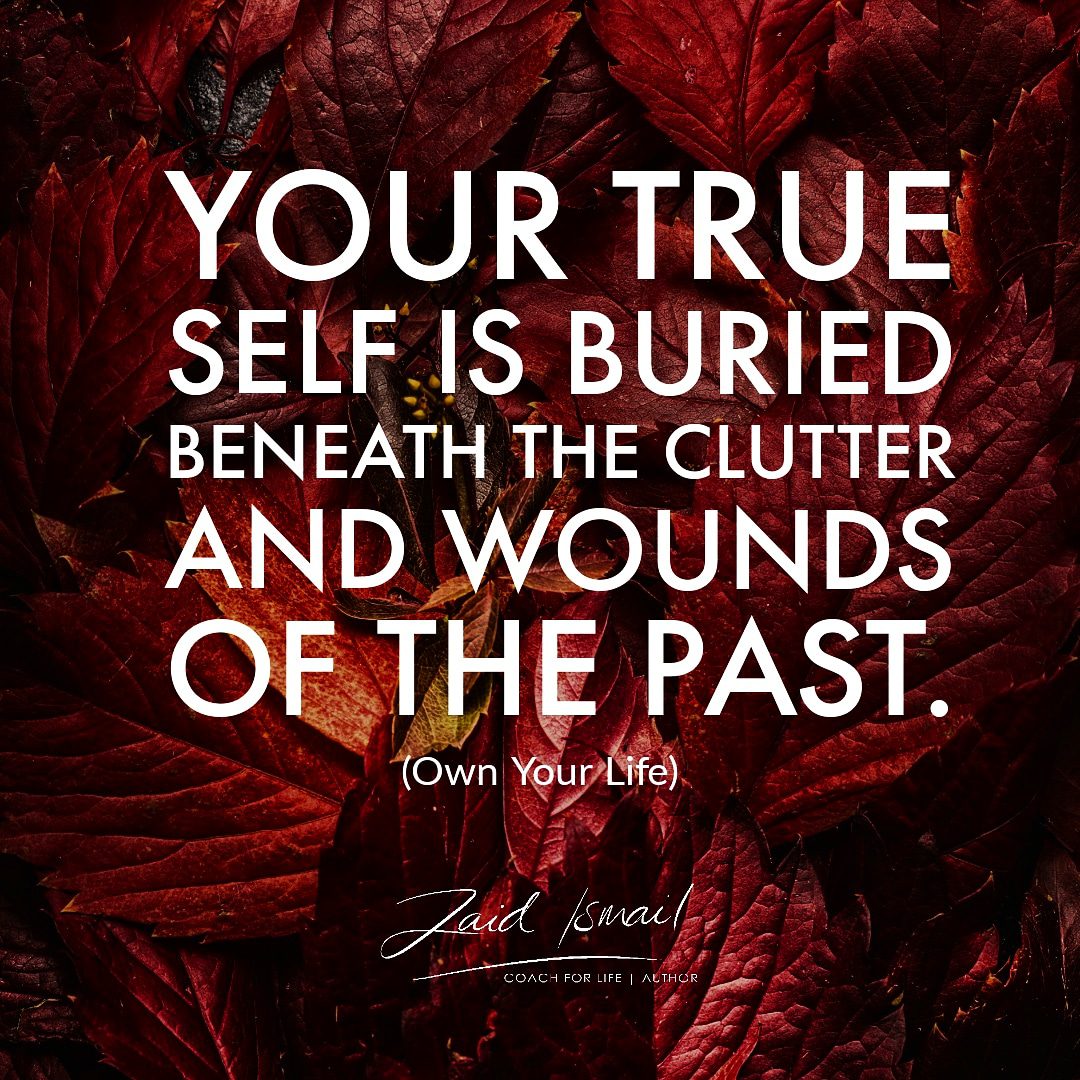
Rediscover who you really are, so that you can shake off the debris that you accumulated through the years with each toxic character that convinced you that you were someone you’re not.
The risk of coping with failure or betrayal is that our act of coping grows to define who we think we are.
But that’s when we lose sight of who we were before that moment.
The only way to move beyond it is to recognise that coping is only needed as long as we’re still holding on to the hurt or the disappointment of what could’ve been, but didn’t happen.
Let go of it, and the joy that you experienced before that defining moment will return.
It always starts with you.
#selfworth #selflove #selfawareness #selfrespect #reflection #mindfulness #validation #mentalhealth #mentalhealthawareness #mentalhealthrecovery #thebookofmindfulness #personaldevelopment #growth #growthmindset #gratitude #lifecoaching #zaidismail
Category: Life
-
Do you remember you?
-

Where is your humanity?
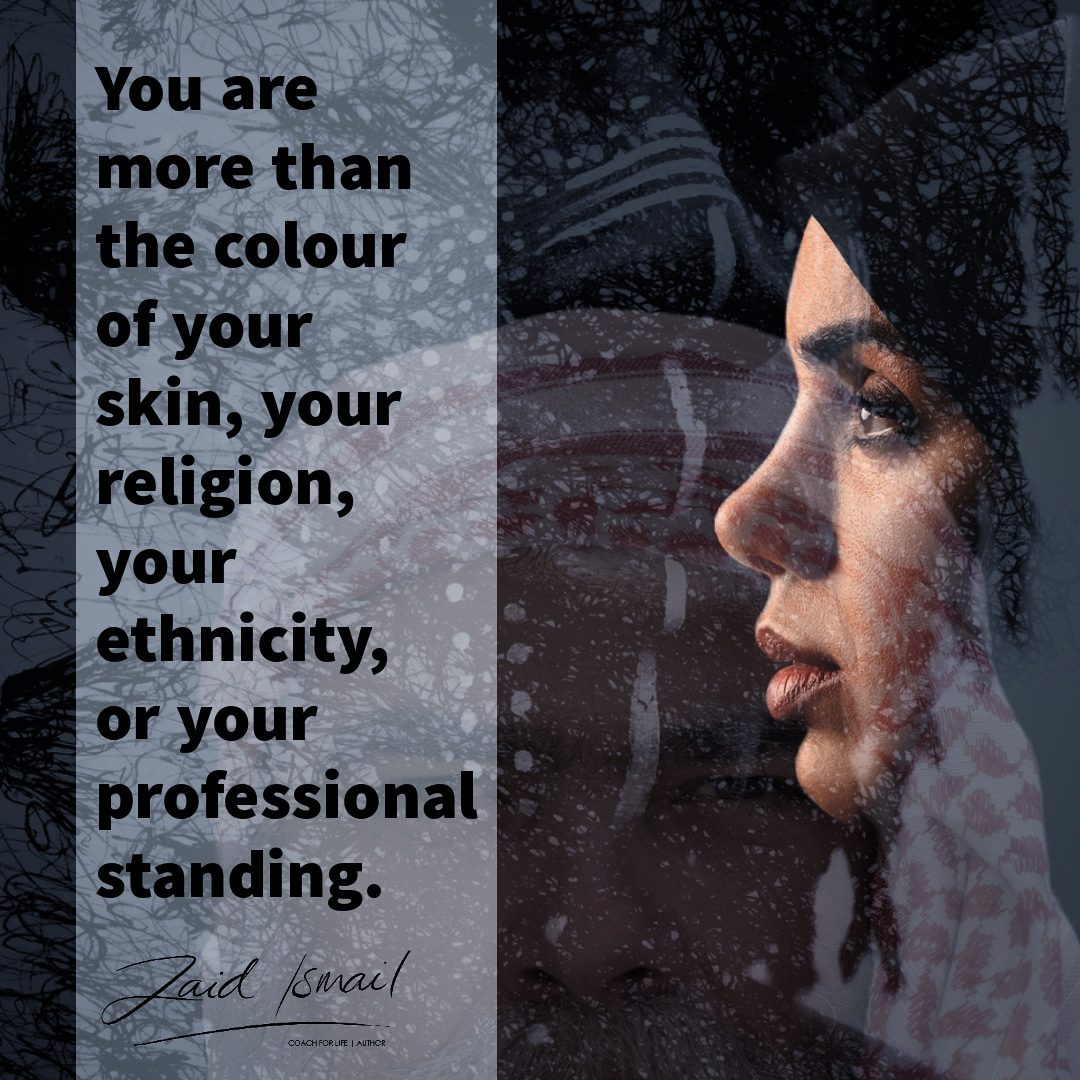
Taking pride in the colour of your skin or ethnicity distracts you from your humanity.
Our humanness, our gentleness, our inclination towards kindness – these are all part of our natural state.
We lose it when our need to be associated with significance or superiority distracts us from this, and replaces it with the fear of being inadequate.
When we lose sight of the fear of inadequacy, responding from a place of fear becomes our new normal.
Everything that threatens the source of our significance – that is, our skin colour, religion, cultural roots, etc. – then feels like a threat to our sense of self.
Thus, we feel the anger, resentment, or blind rage that rises when we are judged by the colour of our skin, our religion, our ethnicity, or any other association that makes us feel significant.
But, we grow convinced that we’re standing up for a good cause by protecting what we value, even though the way in which we protect it undermines the very essence of what we claim to stand for.
That’s when it becomes clear that we only stand for what we do because it offers us a place in this world through being associated with the cause.
It offers us significance and protects us from irrelevance.
That’s when we’ve traded who we are, for who we want to be perceived as, because we’re convinced that we are not enough.
Own Your Life.
It always starts with you.
#racism #colourism #religion #culture #prejudice #bigotry #socialacceptance #herdmentality #ownyourshit #ownyourlife #theegosystem #mentalhealth #mentalhealthawareness #mentalhealthrecovery #selfworth #selflove #selfawareness #selfrespect #mindfulness #inspiration #zaidismail -
Honourable destruction
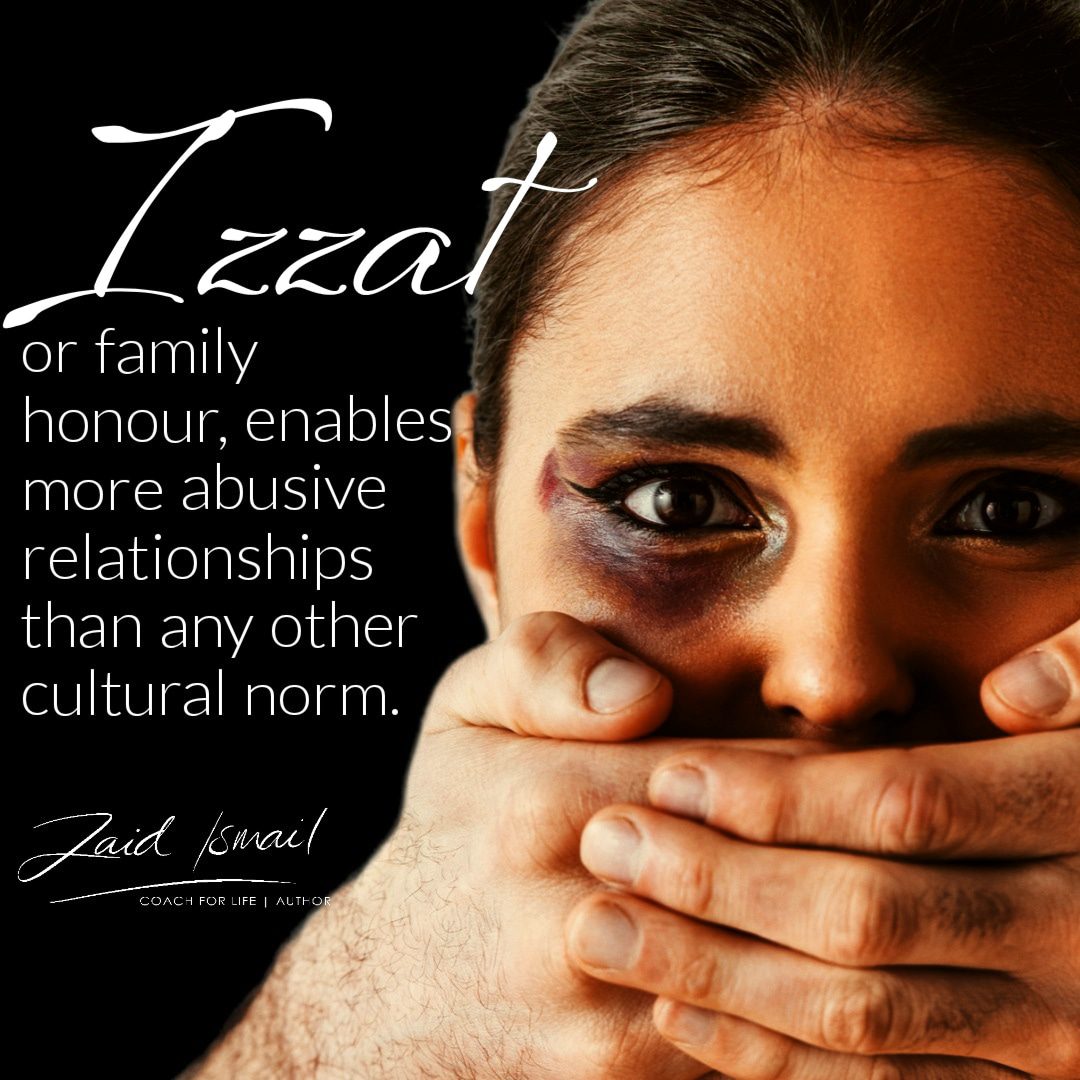
When honour is confused with social standing, abuse becomes an acceptable form of saving face.
Beyond considerations of family honour, this toxic cultural practice convinces the individual that infidelity becomes excusable because divorce is deplorable.
It convinces the brute of the justification of their rage when their partner rejects dehumanising practices by their in-laws.
It replaces ideals of honour and virtue with ideals of being celebrated by the community for the facade that we create of an empty shell of a life.
It teaches our children that what others think of you is always more important than what you think of yourself.
Because we’ve convinced ourselves that it is the village that gives us relevance, we’ve lost sight of how toxic that village has become.
Izzat is the excuse for marital rape, because our rights are infinitely more important than our responsibilities.
Izzat is the excuse for honour killings, because appearing weak is assumed to be caving in to justice, while upholding injustice.
Izzat has eroded the foundation of society, in all societies and not just the Indian culture, because women are seen as symbols of the grandeur of men, and men have grown to be defined by how much his woman raises his stature.
And in the war for self-worth, the physically weak suffer most, while the physically strong destroy the people around them because they don’t know how to deal with their weakness.
Break the cycle.
Own Your Life.
#abuse #maritalrape #honourkilling #honorkilling #mentalhealth #mentalhealthawareness #lifecoaching #zaidismail #relationshipgoals #narcissiticabuse #narcissisticparents #narcissism #cheating -
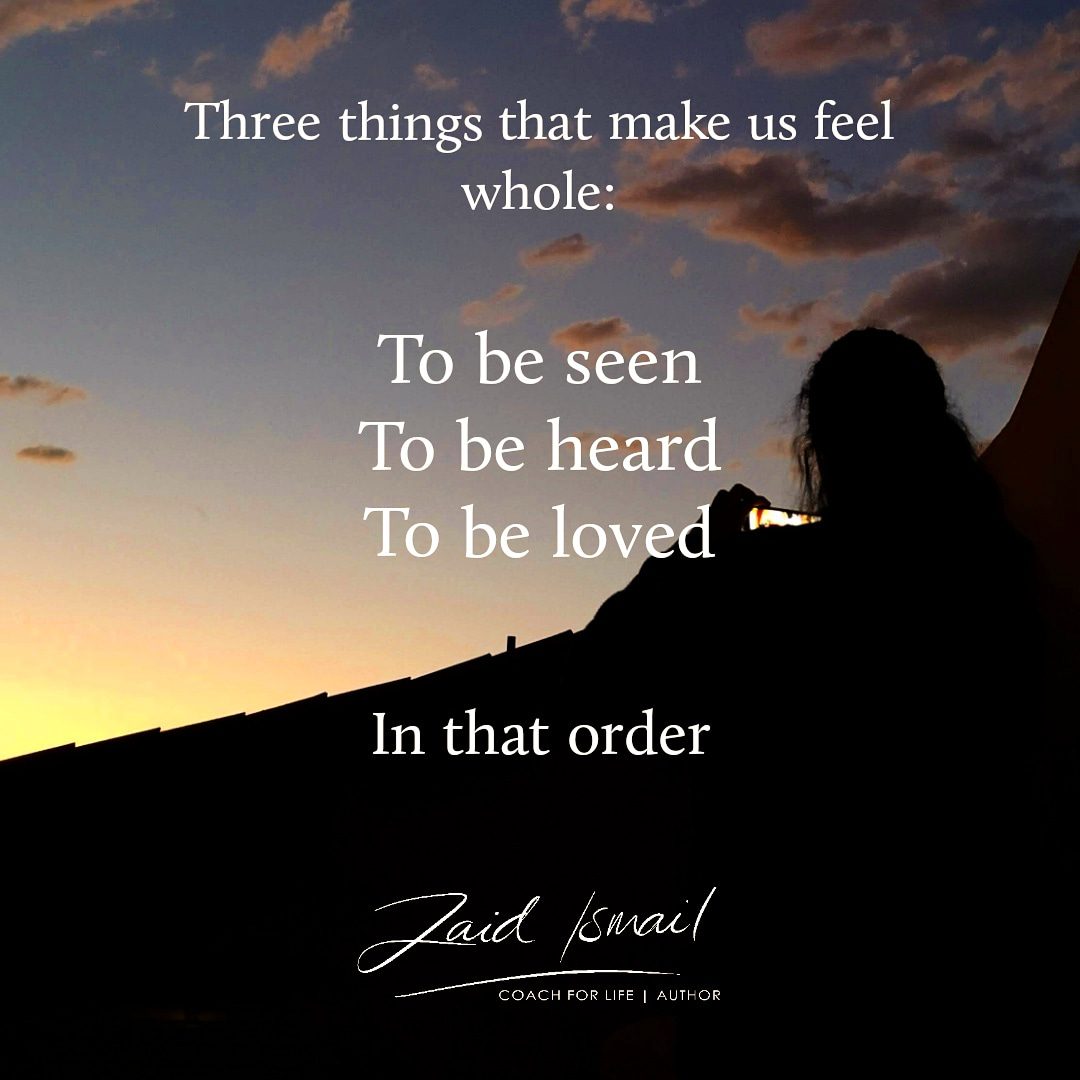
To be loved
To be seen… Beyond the facade. To have the essence of who we are, known to those we trust and hold dear.
To be heard… Not only when we cry out, but also when we speak gently of the troubles in our heart.
To be loved… For more than how we make others feel, but to be loved for what we need in return, without having to claim it.
In that order, because a voice without an identity is not a voice. It’s only a whisper in the wind.
A face without a voice is only window dressing, or a trophy. And not a complete being.
And love… Love without a reciprocal embrace…an embrace of what we hold within, as well as what we willingly give, is an empty love that taints towards bitterness, rather than beauty.
Love beyond lust or infatuation is rare. True love is never abandoned.
I see you.
I hear you.
I love you.
Three of the most valuable gifts you could ever give.
But, you cannot give what you don’t have.
For this reason, you must first see, hear, and love who you are, before you will be able to share it with another.
#love #romance #companionship #soulfood #soulmates #anincompletelovestory #gratitude #appreciation #zaidismail #authenticity #relationshipgoals #joy -
Emotional wellbeing, not mental health
It is only through our internal wars that we lose sight of reality.
The culture of labeling people dehumanises the very human that is struggling with their humanness.
We focus on our demons so intently, that we become defined by them, bearing them patiently in quiet shame, protecting ourselves from being exposed for what we hold within.
When we judge ourselves with such shame and harshness, we see the world through angry eyes.
But, protocol and decorum prevents us from raging and venting without restraint, so we choose safe spaces in which to release the venom from within, on those who are incapable of opposing or resisting us.
In the public space, we create carefully constructed apologies for our inadequacies, latching onto unhealthy concepts like ‘suffering from…’ whatever emotional torment we’re experiencing.
That’s when we feed the belief that human emotion is an illness, or a disorder, because it’s the only hope we have of making sense of the war within.
All this because we convinced ourselves that being any less than happy must be weak, or dysfunctional.
The sway of human emotions, regardless of how crazy that sway may appear or be experienced, is a legitimate response to very real life experiences.
Labeling the response does nothing to create understanding and healing around that traumatic or overwhelming experience.
Stop labelling people because of their behaviour, and reconnect with your own empathy and compassion so that you may once more see the human behind the human condition.
Own Your Life.
#mentalhealth #mentalhealthawareness #mentalhealthrecovery #lifecoaching #zaidismail #empathy #theegosystem #ownyourlife -
That war within
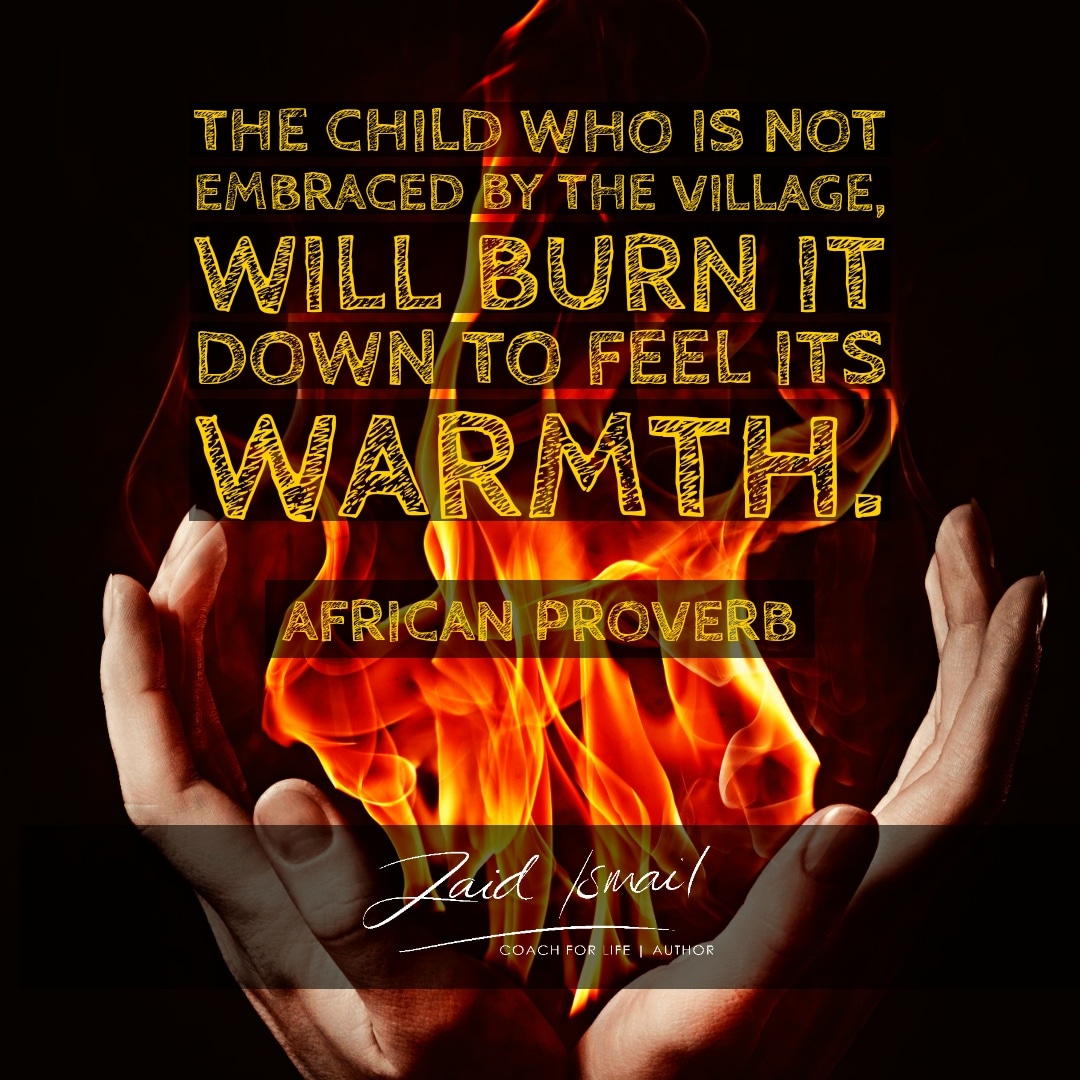
Sometimes that village is a family, sometimes it’s a group, and sometimes it’s just one person who represents everything that the village stands for.
That child grows into the raging adult who destroys every wholesome thing, because they feel like no one deserves peace if they were denied love and acceptance.
When you treat the vulnerable, or the gentle one’s, with contempt, you create the same monsters that made you.
That’s how the raging adult spawns more troubled souls that are driven towards burning down their village, with each generation growing more destructive, until someone chooses self-respect over self-loathing.
The distraction of their rage prevents them, and us, from seeing their plea for love and acceptance.
It’s a war within that rages without, because what they feel is at odds with what they need, and despite their best efforts, they don’t know how to achieve it.
So, the shame that bubbles beneath the surface – the shame that they hide from the world about that internal war – drives them to behave in ways that appear to claim what they believe others will not care to give them.
Thus, they project their rage on any innocent being that expects them to be better than that, because they’re no longer children…and only children throw tantrums.
Adults don’t throw tantrums because they don’t need someone else to destroy for them.
They destroy others to feel significant, not because they want the destruction, but because it at least gives them reason to believe that they’re not invisible.
That they still have an impact.
That they will be taken seriously…or else…
Your anger at the world is yours to tame.
You either rage at those who don’t have what you need, or you create it yourself through the alchemy of your soul.
Because that’s what makes us human.
Not that we hurt, or that we love, but that we can create love in the midst of hate, and calm in the midst of chaos, without any aides but the attributes of who we are beyond the rage.
It always starts with you.
#ownyourlife #theegosystem #mentalhealth #mentalhealthawareness #lifecoaching #zaidismail #loveyourself #parenting #singleparenting #selfworth #selflove #selfloathing -
Silent screams
Crying, or a show of emotion, is still a sign of hope that things can be different.
It’s a means to communicate our dissatisfaction because we believe that our dissatisfaction matters.
Our emotional expression is exactly that. An expression.
No one expresses unless there is an expectation of a response.
That response may be from others, or even from within yourself.
Expressing ourselves to others is driven by the belief that they may still care.
Expressing ourselves to ourselves is driven by the hope that we will find relief in exhaling that pain.
It’s when we lose hope of both, others caring about what vexes us, and finding relief through expression even in our private space, that silence seems like the only fitting tribute to the pain we have no hope of resolving.
Silence is the absence of expectation, and the absence of hope.
Don’t always look for signs of hopelessness, because the most intense form of hopelessness isn’t accompanied by a sign. It is accompanied by isolation and loneliness.
It is silence.
#hope #expectation #silenttreatment #mentalhealth #mentalhealthawareness #lifecoaching #zaidismail #ownyourlife -
Raging for love
Nothing destroys more than ingratitude, and ingratitude for the self is expressed through self-loathing.
But self-loathing is disguised in many ways, the most common of which is anger.
Anger is a defence mechanism that distracts attention away from what we feel inadequate about.
It demands that we be taken seriously when we have no reason to believe that who we are is worthy of being taken seriously.
But more than this, anger is a profession that in that moment, we believe that we are not good enough for one whose validation we desperately need.
Hence it being the most common confirmation of self-loathing when all our defence and coping mechanisms are claiming otherwise.
It also happens when our internal conversation is focused on comparing ourselves to those we think are better than us, or those whose validation we need.
And then we get married to feel complete, only to hold our partners accountable for how we feel about ourselves.
And then we have children to fill that void that just doesn’t seem to fill up, and we become ever more threatened with fears of inadequacy when we don’t know how to be enough as parents.
Thus, innocent lives get destroyed, all because we didn’t learn to be grateful for who we are, while trying to make up for it by raging at those who have nothing to do with how we feel about ourselves.
It always starts with you.
#selfworth #selfawareness #ownyourlife #selfmastery #mindfulness #selfloathing #selflove #mentalhealth #mentalhealthawareness #lifecoaching #zaidismail #angermanagement