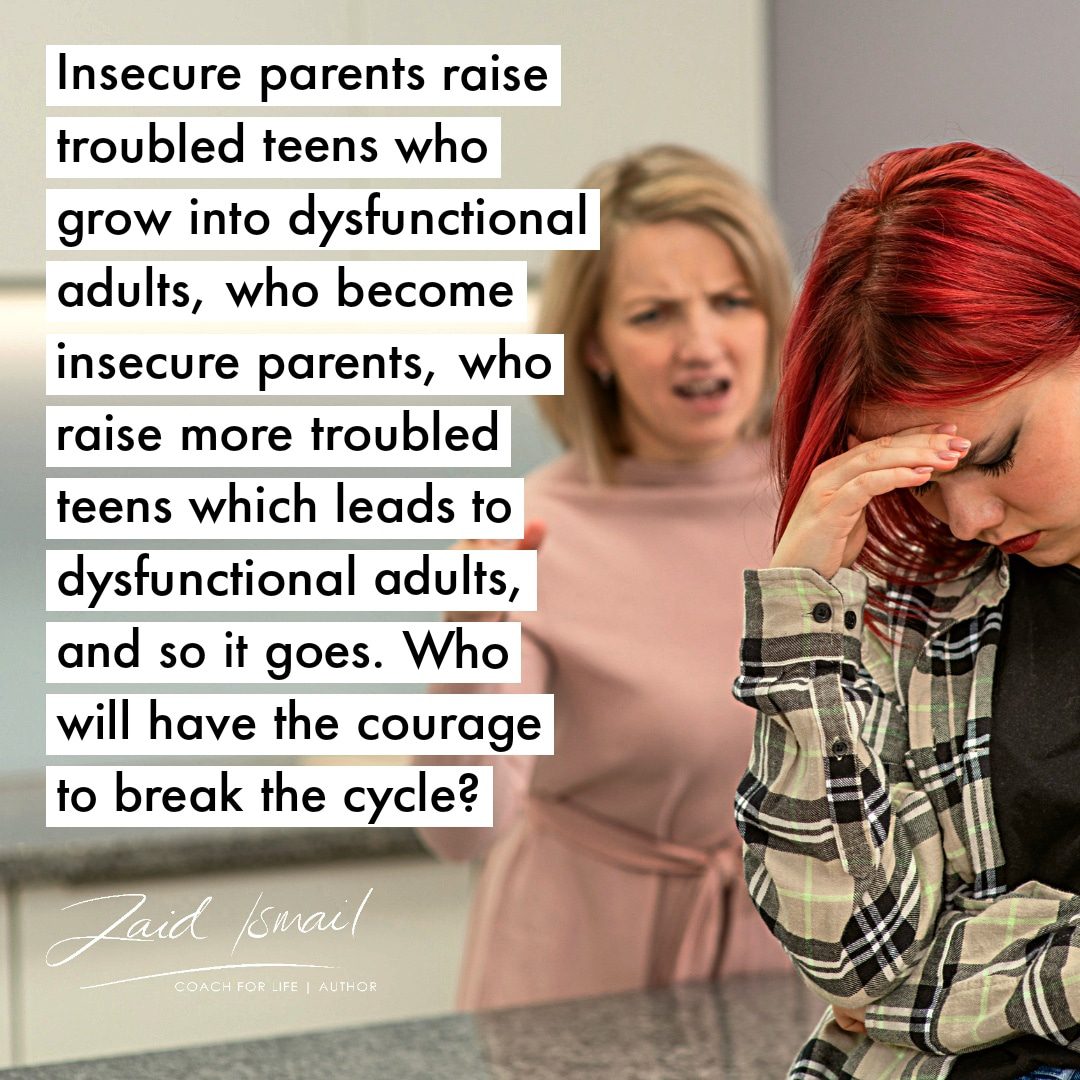
The courage that is needed, is the courage to seek sincere, informed advisors to help us to understand why we may be struggling to connect with our children.
We don’t know what we don’t know.
If we try to figure life out by ourselves, we’ll only ever learn the hard way, from our own mistakes.
While some may think that to be a fun or rewarding approach, we need to stop to consider how those mistakes negatively affect those around us.
Making mistakes is inevitable, but making avoidable mistakes is irresponsible.
Insecurity as a parent shows up when we see every act of non-compliance as an act of blatant defiance.
When we’re insecure about who we are, that becomes the lens through which we interpret the motives behind the actions of those around us.
But we don’t see that lens, because we’re distracted by needing to establish our authority or our significance, because we think that’s how we need to instil respect and good manners by not letting ‘them’ take advantage of us.
The moment this is your mindset, understand that you’re insecure about your position or your role, and your reaction to that will cause more harm than good, despite your best intentions.
Give yourself a break, and give your children a chance.
Learn from the mistakes that raised you to be insecure, by reflecting on why those who raised you couldn’t have known better.
And do your part to reduce the reasons your children will have to reflect on such matters that negatively affect their sense of self.
[this is an incomplete thought process, but worth sharing]
#parenting #mentalhealth #mentalhealthawareness #lifecoaching #zaidismail #singleparenting #raisingadults #selfworth #selfawareness #ownyourlife #theegosystem
Category: Self Worth
-
The courage to parent properly
-

Judge as you wish to be judged
We speak from a position of privilege when we judge the failures of others within the context of what is possible for us.
Even something as simple as the resolve we have, or the choices we made to rise above a challenge, comes from a place of assuming that our emotional resilience is the same as theirs.
When we assume that everyone is equal, we deny the human struggle that affects all of us differently.
Something small for one, could be a mountain for another.
And the mountains that some climb every day because of their circumstances, could be overwhelming for those of us who were never faced with such trials.
Comparing our efforts and accomplishments with that of others who are going through similar challenges that we once experienced is an act of arrogance, not support or concern.
If we are sincere in uplifting or supporting others, then we must seek to understand the reality that they are facing, rather than judging them through our view of reality.
After all, isn’t that what we cry about in the silent, dark hours, when we feel misunderstood or unappreciated?
We treat others the way that we treat ourselves.
When we judge ourselves harshly, or have no reason to expect support from those we cherish, we hold similar expectations of others who we find struggling.
We expect them to ‘man up’ or to ‘put on their big girl panties’ and just move on.
That’s how compassion and empathy are lost, and insensitivity becomes the standard by which we view others.
Choose compassion.
Reclaim your humanness.
#hope #expectation #sincerity #selfworth #selfawareness #mentalhealth #mentalhealthawareness #lifecoaching #zaidismail #relationshipgoals #compassion #empathy #theegosystem #ownyourlife -
The arrogance spawned by fear
Fear causes us to fixate on our intentions, while defending the bad behaviour that such fear spawns.
The fear is most often associated with what we think is under threat, or that others won’t understand.
So we begin preempting what they intend towards us, or what threats they present to what we want for ourselves.
When we are driven by fear, we focus on finding all the evidence that validates our fear, and we subsequently ignore all the evidence that proves us wrong.
Because we don’t want to be wrong.
Because being wrong adds to the fear of not achieving our goals.
So we become defensive, aggressive, abrasive, arrogant, rebellious, and more in our efforts to protect what we assume to be under threat.
And in the process, we turn friends into enemies, and supporters into demons.
And when the intensity of the fear passes, or when we achieve our goal at any cost, we expect others to accept our good intentions without accepting accountability for the impact of our fear-driven behaviour on them.
That’s how we diminish the impact of the harm that we cause, when we fixate on our intentions and treat our fear-based assumptions as facts.
And that’s how we become a source of abuse towards others while we are convinced that we were victims of their lack of understanding.
That’s how arrogance is nurtured, and important relationships destroyed.
It always starts with you.
Own Your Life.
#selfworth #selfawareness #ownyourlife #theegosystem #mentalhealth #mentalhealthawareness #lifecoaching #zaidismail #gratitude #relationshipgoals #authenticity -
The demon of self-loathing
We cannot give what we don’t have.
This is a simple truth that cannot be denied.
When we realise what this means for the behaviour that we display towards others, we’ll realise what it says about how we feel about ourselves.
When we take ourselves for granted, we feel entitled to what others do for us out of sincerity on their part, and not obligation.
When we believe we’re unworthy, we’ll treat others as if they need to earn our favour or be grateful for us making time for them.
When we are ungrateful for who we are, we’ll find it impossible to connect with true appreciation for what we have or what we receive.
And so it goes.
But, we always need to remain significant or relevant, because being invisible is the worst feeling ever.
So we develop elaborate coping mechanisms through personality traits and mannerisms that endear us towards others.
Those who don’t see our self-loathing become our targets for ‘niceness’, while those who push us to be sincere and authentic are viewed as enemies.
All because we carry a shame within us about ourselves that they remind us of, so we demonise them while convincing ourselves that those who don’t call us out on our bad ways, or don’t see beyond the facade that we’ve created, are in fact our sincere advisors and friends.
Self-worth is never about what others think of you. That’s why it’s called SELF-worth.
It’s about what you think of yourself.
It always starts with you.
And when you blame others for how you feel about yourself, you create even more distance between who you are and who you want to be.
#ownyourlife #theegosystem #mentalhealth #mentalhealthawareness #lifecoaching #zaidismail #selfworth #selfawareness #selfrespect #authenticity #sincerity -
Own your misery
Miserable are the ones who compete with their companions, and then go searching for companionship among those that will ruin them.
Self-pity and self-loathing are the marks of ingratitude that turn your greatest supporters into your greatest distractions.
All because you think that they see the inadequacy and shame with which you view yourself.
That’s why at times, when someone believes in us, we convince ourselves that they’re simply trying to humiliate us.
Such is the seeds of ingratitude and self-loathing, that we end up taking advice from enemies, and discarding advice from those who care most about our success.
Your self-loathing is your ingratitude for who you are.
Stop blaming the world for you getting in your own way.
It always starts with you.
#selfworth #selfawareness #ownyourlife #selfmastery #mindfulness #personalpower #mentalhealth #mentalhealthawareness #lifecoaching #zaidismail #loveyourself #lifegoals #motivation #optimism #purpose #companionship #selfpity #selfloathing -
Woe is me…or is it?
The need to be pacified about the struggles of our life is an indication of how much or how little we believe in ourselves to rise above it.
When we lose sight of our contribution towards our current state, we surrender to destiny or fate, and wait to be saved or celebrated for how strong we are for persevering.
Meanwhile, our inaction at changing, or breaking the cycles in which we’re caught, reflects our self-worth more than it reflects our bravery or resilience.
When the oppressed or the abused remain submissive, they choose to live with shame rather than fight with dignity.
That fight doesn’t have to be confrontational. Especially when we are physically incapable of subduing the other.
However, understanding what we’re doing to feed the cycle that is harming us is the beginning of changing what we contribute to such cycles.
This is not victim blaming. This is victim empowering.
The difference being that we don’t blame the victim for the oppressor’s actions, but we encourage the victim to reclaim their voice and their dignity, which in turn reduces the validation that the oppressor or abuser gains from their abuse.
Understanding the cycle is therefore paramount to effective action.
Action without understanding is like gambling with your life.
Seek to understand before you surrender to your reality.
Otherwise you’ll go through life believing you’re trapped, while not realising that there was always an exit strategy available to you.
It always starts with you.
#hope #expectation #sincerity #selfworth #selfawareness #mentalhealth #mentalhealthawareness #lifecoaching #zaidismail #loveyourself #lifegoals #motivation #optimism #purpose #companionship #relationshipgoals #narcissisticabuse #narcissism -
Wow! Look at me now…
Of all the things that test our resolve, the acquisition of knowledge is the most important.
It’s easy to get lost in the praise and social elevation that accompanies achievements such as professional qualifications, religious standing, or even business success.
And because each of it demands a lot of personal sacrifice and discipline, the feeling of entitlement to its rewards takes root without much effort at all.
Especially since there are many who would treat us with privilege because of their need to be associated with such social standing, or success.
However, that’s when we lose ourselves to the trinkets and luxuries that accompanies such success.
That’s when we lose ourselves to the power and influence that such social standing offers.
That’s when the true tests of our convictions and our value systems present themselves.
Not only does it matter how we treat people after enjoying such accomplishments, but more importantly, how we utilise the resources that we have access to, including the social structures of privilege that we belong to, that determines the true value of our accomplishments.
A healthy self-esteem is the only grounding point to prevent such erosion of values or ethical standing.
A healthy self-esteem, not an inflated ego, is what will keep us focused on how much more good we can achieve, or value we can create for those who cannot benefit us, so that we don’t squander our success or opportunities on self-enrichment or extravagance of lifestyle.
The sweetness of life lies in the upliftment of others.
It’s the only accomplishment that doesn’t leave us chasing for validation or acceptance.
It’s rooted in gratitude for who we are and what we have.
Without such gratitude, we forever chase opportunities to subdue the fear of inadequacy.
It always starts with you.
#greed #ethicalcorruption #corruption #selfworth #selfloathing #mentalhealth #mentalhealthawareness #lifecoaching #zaidismail #philanthropy #charity #abuse #narcissism #narcissiticabuse -
Gratitude is more than an attitude
An attitude of gratitude is not gratitude, because gratitude is not about attitude. It’s about a way of being.
Too often we confuse appreciation with gratitude.
Appreciation is what we express for favours or gifts, or the ease that we experience in our lives or with others.
We appreciate the absence of problems, the presence of happiness, or the good fortune of wealth, etc.
We appreciate such things because we know how much more difficult or challenging life would be without it.
Gratitude, I believe, goes beyond such acknowledgements of blessings.
Gratitude is reflected in how we nurture, protect, maintain, or leverage what makes such blessings possible.
For example, if we have the ability to create good, but we restrain ourselves because it’s not our job or our responsibility, then we’re not grateful for that ability.
That ability is merely a tool that we use in a transactional way.
Like having a car that we appreciate because it enables ease of movement, but we don’t take care of it because the thrill of driving recklessly is more important than the blessing of having a car.
By its very nature, gratitude increases the benefits and blessings of what we have and are capable of, whereas mere appreciation for it only maintains the status quo.
It may seem like a play on words, or a philosophical debate, but the moment we connect with gratitude for who we are, rather than just appreciating what we are or what we have, we’ll find opportunity to be of benefit in every sphere of our lives, rather than waiting to feel appreciated before we create the value that we’re capable of creating.
It always starts with you.
Own Your Life.
#gratitude #gratitudeattitude #appreciation #selfworth #selfawareness #mentalhealth #mentalhealthawareness #lifecoaching #zaidismail #ownyourlife #theegosystem