Our relationship with our parents, whether they were present or absent, wholesome or abusive, will have a distinct impact on how we shape our character through life.
Not only will we develop our sense of self based on how we felt in their presence, but they are also our main point of reference in how to raise children, or show up as a partner to our spouse.
Whether you actively adopt or actively reject what you experienced with them, that becomes the grounding point that informs your decisions about what is or isn’t acceptable in your future relationships, and specially in your parenting style.
Judgement has nothing to do with it because knowing right from wrong or good from bad is easy.
There is no shortage of material and advisors to point out what or who is right or wrong.
Unfortunately, there’s a critical shortage of advisors to help us to understand why, despite knowing what’s right, so many of us struggle to do what’s right. Including our parents.
Connecting with the human behind the role, both in your parents and in yourself or your partner, reignites the empathy and compassion that judgement kills within us.
It is judgement that makes us harsh and rigid towards each other, while understanding breeds appreciation and compassion, if not affection.
Join me with panelists Hana Haths and Dineo Nomayeza Sibuyi on Saturday, 29 October 2022 at 2pm for an in depth discussion about this and other topics related to the gender wars that prevail in the SA Muslim community.
Tickets available at zaidismail.com at a nominal charge of R100 for in-person attendance and R60 for Zoom participation if you’re not in the Johannesburg area.
Refreshments will be provided.
Limited seating available so book now before the last minute rush.
#events #parenting #generationaltrauma #mentalhealth #mentalhealthawareness #lifecoaching #zaidismail #marriageadvice #divorce #relationshipgoals
Category: Self Worth
-

Selective inheritance
-

If you think you can’t, then you won’t…
Archive Post… I can’t count how often I’ve been told, “Not everyone is like you!”
That comment was usually in response to me encouraging them to do better or to rise above what was troubling them.
You see, the assumption that a weak person makes is that some people are gifted to be more successful than others.
The reality though, is that we all have the same potential.
Some just realise that waiting for permission to be capable in their own right is a waste of life. So they own their contribution towards what they want to achieve.
Unfortunately, too many convince themselves that they’re not built that way. That they’re not as gifted or that no one understands what they’re going through.
But, like Henry Ford said, “If you think you can, or you think you can’t, you’re right.”
Sadly, too many think that they can’t, and then blame the world for the state in which they find themselves.
We place limitations on ourselves most often out of spite, rather than because we truly believe we’re limited in some way.
Do you know why spite? Because there are too many that will refuse to do something for themselves just because someone they don’t like, or don’t respect suggested that they should do it.
It’s a result of a low self-worth car causes us to focus more on what others may think of us, than what we think of ourselves.
That’s why emotional maturity is so important, and emotional maturity is impossible without self-awareness.
Worrying about what others think of you is a distraction from self-awareness.
With so many people distracted, it’s little wonder that most don’t know how to own their life.
It always starts with you.
#hope #expectation #sincerity #selfworth #selfawareness #mentalhealth #mentalhealthawareness #lifecoaching #zaidismail #loveyourself #lifegoals #motivation #optimism #purpose #theegosystem #ownyourlife -
Burn yourself, why don’t you.
Anger always claims a higher price from ourselves than it ever will from the people on whom we project it.
And before you assume that to be false because of the lasting impact that it has on its victims, understand that that lasting impact is because of their anger at the one who was taking out their anger on them.
When we carry the impact of such anger for long after the incident has passed, it’s because we cannot make peace with what was done to us, while waiting anxiously for our pain or suffering to be acknowledged, and the perpetrator to be given a taste of justice.
No matter the circumstances, our anger is because of our feelings of insignificance or dry the hands of those who treated us badly.
What we hold onto them keeps us on high alert for any signs of anyone else treating us in that way.
That’s why innocent gestures from others will trigger us, because it feels like those experiences that still haunts us.
Anger is our demand for significance from the world, especially from significant others.
Anger is always expressed in a space where we have no fear of repercussions, but is kept at bay when we have reason to fear the consequences of our angry expression.
The one who is angry is the one whose self-worth is low in that moment of anger.
Therefore, as long as you hold onto anger, you diminish your self-worth.
For this reason, we must own our anger, and we must recognise the source of the anger from those around us.
The moment we react in free, we become a willing participant in their war, while believing that we are justified in giving them a taste of their own medicine.
The question is, at what price do we lose ourselves to anger in our fight for justice or in our efforts to correct the wrongs around us?
Anger is not needed for firm and resolute action against injustice.
If anything, it distracts us from our purpose and causes us to become oppressors, just like the ones who oppressed us.
#anger #angermanagement #mentalhealth #mentalhealthawareness #lifecoaching #zaidismail #selfworth #selfawareness #selfrespect #selfloathing #ownyourlife #theegosystem -
Confidently you…and only you
The question is, do you know yourself well enough to have an informed opinion of yourself?
When we rely on others for more than just feedback, and instead, we allow them to validate who we are, we essentially give them the power to define how we feel about ourselves.
Listening to what others think of you must be done with one single focus in mind.
It must be with the objective of determining whether or not the message that you intended was in fact the message that they received.
But that means that you must know what your message is.
What is your unique contribution?
Self-awareness shifts your focus from being aware of how others see you, to being aware of who you want to be.
Once you improve your awareness of who you want to be, you’ll begin to accept input from others as feedback on whether you’re achieving that goal, or not.
You won’t get distracted by trying to convince them to think kindly of you, or by feeling a need to defend what you’ve fallen short in.
It’s a subtle but critical difference, and the difference could be sanity and peace, versus going crazy looking for validation from people who themselves have yet to accept who they are.
Choose wisely, or else it will be a case of the blind leading the blind.
So…do you know who you are, or do you rely on others to validate whether you’re good or bad, likeable or annoying, significant or invisible?
It always starts with you.
#hope #expectation #sincerity #selfworth #selfawareness #mentalhealth #mentalhealthawareness #lifecoaching #zaidismail #loveyourself #lifegoals #motivation #optimism #purpose #confidence -
Assumed to be inadequate
Assumptions are those things that eventually appear as facts because we’ve been making those assumptions for so long that we don’t see reason to question it any longer.
It’s a theme that sets in over a long period of time, and becomes the lens through which we see the world.
More importantly, it becomes the lens through which we see ourselves.
When we lose sight of these assumptions, we either become delusional about our success, or self-deprecating about our inadequacy.
Either way, it denies us a harmonious and fulfilled life.
As we respond to the demands of life, we slowly grow convinced that we were compelled to do much of what has contributed towards the quality of our life.
For example, it’s the avoidance of homelessness that drives many to seek employment, or the need to pay debts that convince us to spend wisely, or the need to hold on to our jobs that drive us to improve our knowledge and skills.
Each of those are driven by fear, even though we may find some joy or accomplishment in them.
When fear is the underlying motivator that drives us to accomplish big goals, we soon find ourselves wondering once more, “OK. What’s next?”
We end up chasing life and slowly getting worn down when we lose sight of the fact that regardless of the reason why we HAD TO DO something, our ability to do it was a true reflection of our capability.
That’s the part that we should focus on. Our capability, not the fear that drove us to be capable.
Take away the fear, and suddenly you’ll realise that you don’t need an external motivator to accomplish goals in life.
You just need to recognise your own abilities, and develop your own vision for the life that you want.
It’s really that simple.
It always starts with you.
Own Your Life.
#hope #expectation #sincerity #selfworth #selfawareness #mentalhealth #mentalhealthawareness #lifecoaching #zaidismail #loveyourself #lifegoals #motivation #optimism #purpose #ownyourlife #theegosystem -
Defending myself into misery
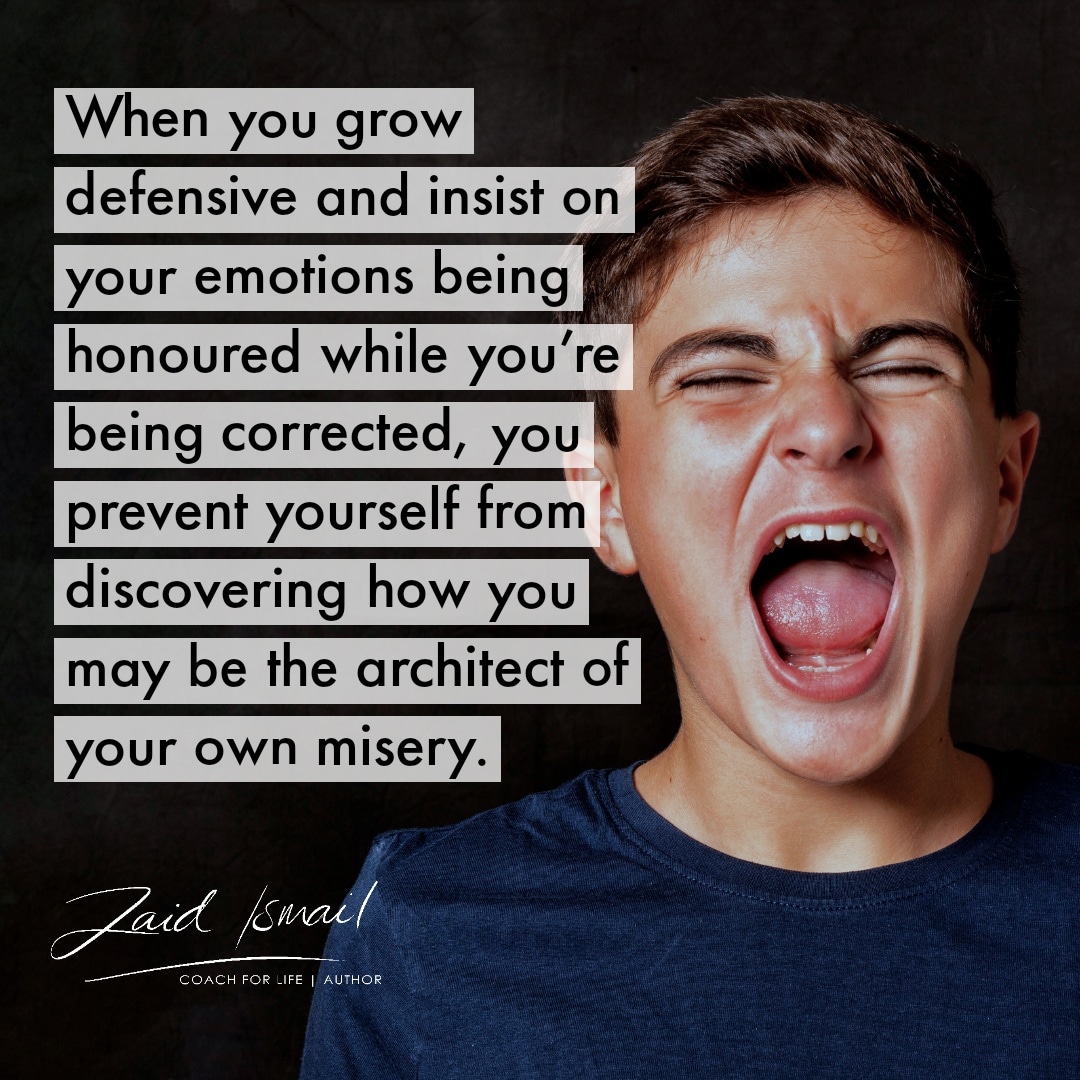
Defensiveness is driven by a belief that you’re under attack.
Hence the need to defend ourselves when someone tries to correct us.
The defensive response on our part confirms that we assume their intention to be other than genuine concern for what we’re experiencing.
We also assume that we must be right to feel a certain way, and therefore shut down any opportunity to understand why someone’s hurtful or offensive behaviour may be a reaction to their own emotional duress.
We don’t justify it, but it makes it easier to understand it and respond more effectively to it if we pause to understand the real reason for it.
The most common reason for feeling emotional is fear.
In various forms, it is the fear of loss, or the fear of being insignificant that causes emotional duress.
Therefore, when we choose to honour our emotions above all else, we’re in fact honouring that fear and preventing ourselves from understanding and undoing the grip that it has on us.
We’re human. So we don’t expect to never get emotional.
What’s important though is how long does it take us to regain our composure after feeling the emotional impact of an experience, rather than not feeling emotions at all.
Be careful about losing your sense of self to your emotions, and then insisting that the emotional state is simply who you are.
Moderation in everything.
#mentalhealth #mentalhealthawareness #lifecoaching #zaidismail #loveyourself #ownyourlife #theegosystem #selfworth #selflove #selfawareness -
Kill the label. Kill the stigma.
⚠ Trigger Warning ⚠
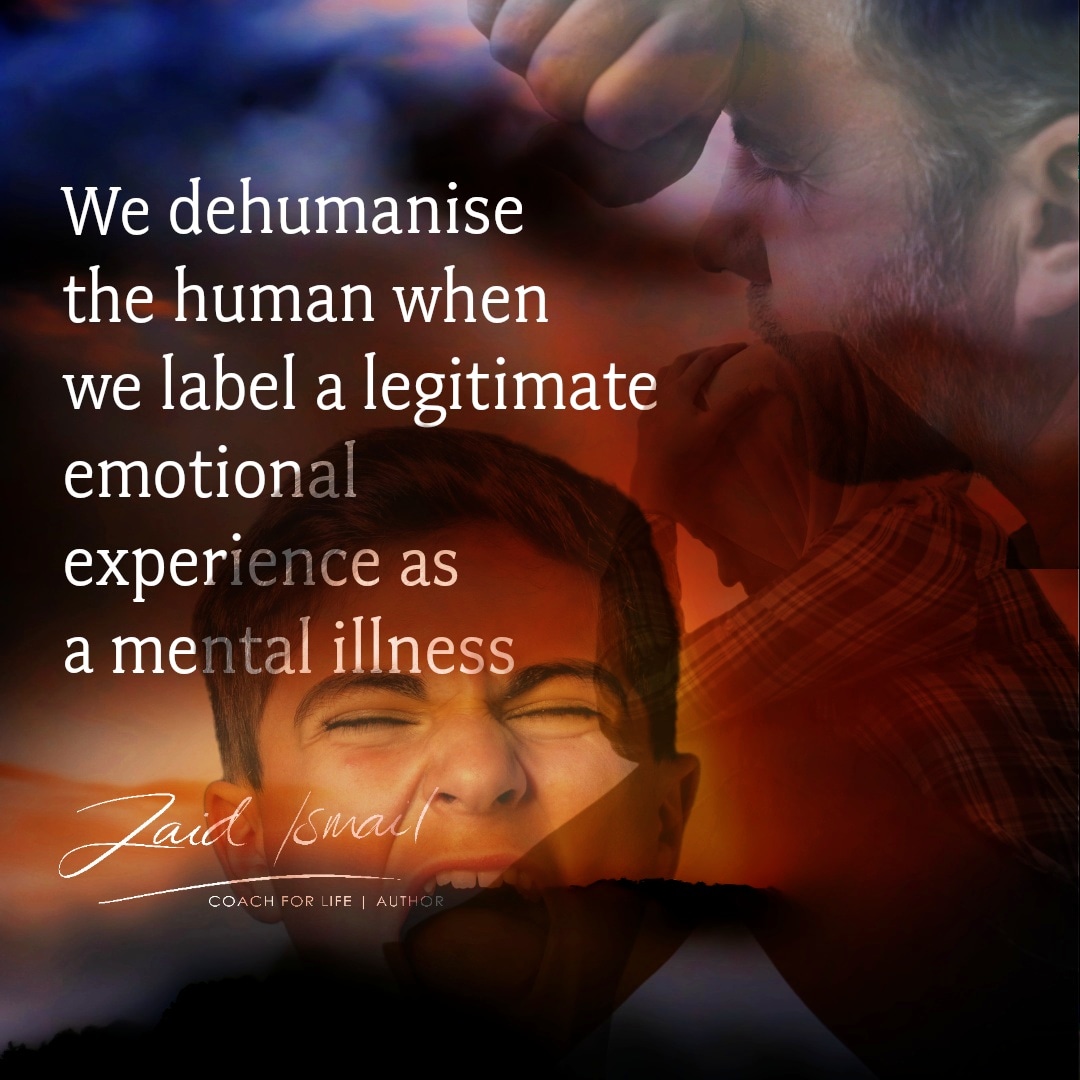
The moment we attach a label to a life experience, we focus on the label and discard the merits of the experience.
We make people invisible when we deny the reality of their experience by suggesting that there is something clinically wrong with them, despite causality of their emotional upheaval being clearly associated with their experiences in life.
When we readily embraces such labels, it disempowers us to make sense of, and to rise above that which weighs us down.
When we create such detachment from the cause of our duress, it denies us a voice in expressing our hurt or pain.
Instead, it convinces us that we’re defective in some way.
When the shame of such labels grows to define how we appear to others, we find familiarity and a common cause with others who suffer a similar struggle, resulting in a victim mindset that focuses on claiming their space as struggling humans who are afflicted with mental illness.
That’s how we break each other down as humans, while building each other up as victims.
You cannot break the stigma of mental health by undermining the humanness of the ones affected by the stigma.
We need to see the human behind the labels that we throw at each other.
Until then, compassion and empathy will continue to be in short supply.
Kill the label, kill the stigma.
#mentalhealth #mentalhealthawareness #mentalhealthrecovery #suicide #suicideprevention #suicidalawareness #suicideawarenessmonth #depression #anxiety #ownyourlife #theegosystem #embracingME #zaidismail #lifecoaching -
Bitter sweet nostalgia
Nostalgia is a beautiful thing, if we connected with the joy in those moments.
Otherwise, it is torturous, as we remind ourselves of what we’ve lost, while losing the present moment along with those memories.
Mindfulness of the blessing of the present moment is the only way to live a fulfilled life without courting regret.
Unfortunately, we spend so much time taking the hurts from the past, using it to interpret what’s going on in the present, while projecting the outcomes on the future, that we forget to even live in the moment.
That’s when bitterness sets in as we wait for others to recognise our struggle, or to empathise with our state.
The impact of life is what we choose it to be.
The moments of hardship or loss are only ever single moments.
What we take from those moments are the choices we make based on how we see ourselves, and what we want others to see in us.
The less aware we are of this, the more we lose ourselves to the struggles of life, resulting in an obliviousness of the present moment that causes us to make uninformed decisions which lead to more regret.
Living inside your head is never a recipe for a fulfilling life.
Connect with the present moment, and when you have the last time of a good thing, it may be bitter sweet. But it will be more sweet than bitter.
#hope #expectation #sincerity #selfworth #selfawareness #mentalhealth #mentalhealthawareness #lifecoaching #zaidismail #loveyourself #theegosystem #ownyourlife #nostalgia