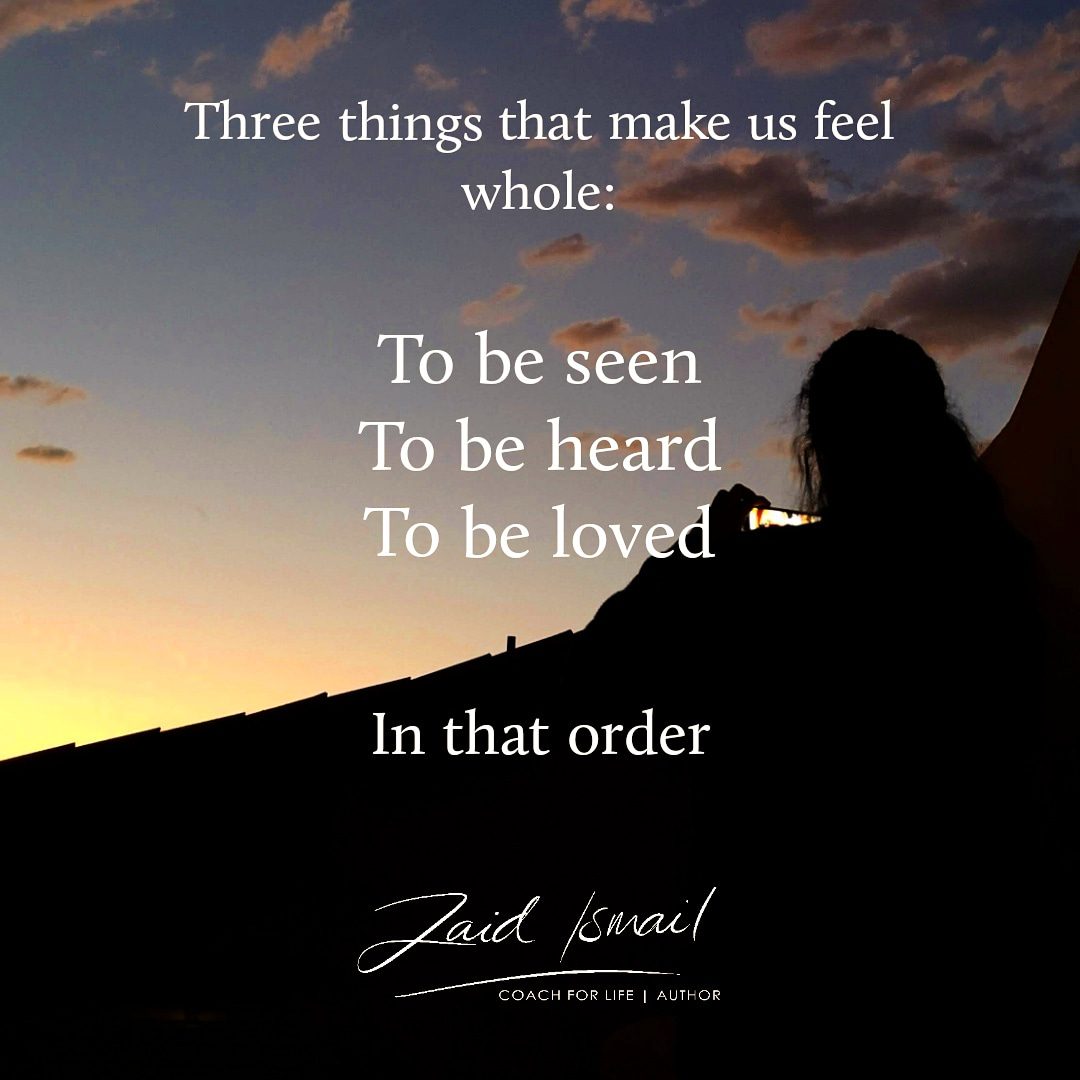
To be seen… Beyond the facade. To have the essence of who we are, known to those we trust and hold dear.
To be heard… Not only when we cry out, but also when we speak gently of the troubles in our heart.
To be loved… For more than how we make others feel, but to be loved for what we need in return, without having to claim it.
In that order, because a voice without an identity is not a voice. It’s only a whisper in the wind.
A face without a voice is only window dressing, or a trophy. And not a complete being.
And love… Love without a reciprocal embrace…an embrace of what we hold within, as well as what we willingly give, is an empty love that taints towards bitterness, rather than beauty.
Love beyond lust or infatuation is rare. True love is never abandoned.
I see you.
I hear you.
I love you.
Three of the most valuable gifts you could ever give.
But, you cannot give what you don’t have.
For this reason, you must first see, hear, and love who you are, before you will be able to share it with another.
#love #romance #companionship #soulfood #soulmates #anincompletelovestory #gratitude #appreciation #zaidismail #authenticity #relationshipgoals #joy
Tag: authenticity
-
To be loved
-

‘Sorry’ isn’t the hardest part
The only thing worse than an insincere apology is the apology that is offered with a demand that it be accepted.
The most important part of an apology is not that it is made, but that it is authentic.
Not just sincere. Authentic.
If an apology is limited to a text message, or a few words uttered, but has no meaningful effort behind it to remedy the offence or harm that was caused, then it isn’t an apology. It’s manipulation.
When we demand that our apology result in a change in attitude from the one that was offended because the apology is supposed to put the offence behind us, it’s not an apology, it’s manipulation.
When we apologise but take offence or become defensive when the impact of our behaviour needs to be discussed by the one we offended, then we didn’t apologise, we were just ‘doing the right thing’. That’s manipulation.
When we are sincere in regretting the harm or offence that we caused, an apology will be the smallest action that we take to make up for what we did.
If we’re sincere, an apology will only mark the first step in our effort to regain the trust and confidence, or the good standing that we had with someone, because they are important to us, and not just because they didn’t deserve what we did, or we feel self-righteous in owning up to being wrong.
On the flip-side, needing someone to admit fault and repeatedly apologise for something that they’ve already shown remorse for is not accepting their apology. Nor is it sincere reciprocation of their efforts to remedy the breach in the relationship.
It’s revenge aimed at inflicting the same harm or offence that we felt from their behaviour.
Whether justified or not, it reflects what we value more. The relationship that we have with them, and how much we value who they are, or being seen as the victim of their mistake.
Be authentic. If not, you’re simply manipulating your way through life.
It always starts with you.
#selfworth #selfawareness #ownyourlife #theegosystem #mentalhealth #mentalhealthawareness #lifecoaching #zaidismail #authenticity #apologize #apologies #narcissism -
Dream killers
Do you find yourself waiting in the shadows, wondering when will it be safe to emerge and take that risk on something that you’ve always dreamt of achieving?
Are you waiting for the perfect moment to ensure that you get it just right?
Or do you find yourself mentioning it to any person that shows an interest in what you’re passionate about, always lighting up with excitement when you talk about it, but also ensuring that you have a good argument as to why you can’t do it just yet?
All the above is most often driven by self-doubt rather than the due diligence needed to ensure that you understand the dynamics to be successful at your passion project.
Due diligence has its place. But only in good measure. Otherwise it ceases to be due diligence and results in analysis-paralysis.
Analysis-paralysis is when we exhaust ourselves in research and understanding to the point of fatigue, so that we accumulate enough information about what may go wrong, while ignoring or downplaying the probabilities of what may go right.
It’s driven by a need for perfection that is a defence mechanism to protect ourselves from appearing incompetent in front of others.
The fear of failure destroys more hope than failure itself.
That’s why it’s important to choose your confidante carefully when wanting a sounding board about a project or venture that you’re passionate about.
Share it with naysayers, and they’ll convince you that your dreams are too big for your social standing.
Share it with visionaries, and they’ll inspire you to overcome the odds while focusing purposefully on the path that you need to navigate to achieve your dreams.
Wanting to run the race means nothing if you don’t get out of the starting blocks.
Decide…do you want to leave a legacy of what-ifs and if-onlys, or do you want to leave a legacy that uplifts and inspires?
#hope #expectation #sincerity #selfworth #selfawareness #mentalhealth #mentalhealthawareness #lifecoaching #zaidismail #lifegoals #dreams #ambition #authenticity #selfdoubt -
Reclaim your worth
Peace is most ravaged when we convince ourselves that we were treated badly by others, or by someone we trusted, because we weren’t good enough for them.
A betrayal of trust, no matter how noble the person, reflects cowardice on their part.
We only betray the trust that others place in us when we feel burdened by that trust, or we avoid accepting the responsibility that it demands of us.
Either way, it’s a shortcoming on the part of the betrayer, not the betrayed.
Sometimes we’re so focused on getting even with those who betrayed our trust that we fail to notice how that fixation distracts us from fulfilling the rights of others, which in itself is also a betrayal of trust.
Understand the internal struggle of those who treated you badly, so that you will realise that they were simply incapable of being better than that in that moment.
It may not take away the disappointment or the hurt, but that is part of your humanness.
When that disappointment overwhelms your joy in life and steals your enthusiasm for the future, it’s no longer because of how someone treated you,it’s because of how you see yourself because of how they treated you.
It’s that easy to give up your power to influence the outcomes and the happiness that you experience in life.
You do so by believing that how you were treated by troubled souls is a reflection of your worth.
That’s simply ingratitude for who you are.
Misplacing your trust in someone is a mistake made from good intentions.
Discard the mistake after learning from it. Don’t discard the good that inspired that good intention.
It always starts with you.
#truth #trust #betrayal #honesty #sincerity #authenticity #mentalhealth #mentalhealthawareness #mentalhealthrecovery #selfworth #selflove #selfawareness #selfrespect #reflection #mindfulness #dignity #lifecoaching #zaidismail -
A moment of trust
It’s impossible to go through life without trusting others.
But, if we’re not careful, the trust that we invest in others could result in consequences that create a struggle for the rest of our lives.
Most often, when choosing a partner, we focus on how trustworthy they are in the present circumstances, but have no idea how they will be should circumstances change.
Equally so, we often have no idea how we may cope under duress should our circumstances change.
That’s when things get complicated, or when things outside of our control bring out the worst in us.
99% of relationships encounter issues because of a change in external circumstances that brings out a side of our partner, or us, that we never thought possible.
In that moment of duress, we either expect them to be understanding and supportive, no matter what, or we expect them to be consistent in their love and trust towards us, no matter what. All depending on who is going through the trying circumstance.
That’s when trust is tested.
Navigating such circumstances become that much more complicated when we assume that they were dishonest about who they were, or what they stood for.
The reality is that most of us fail the consistency test when we encounter unexpected duress as a result of a change in circumstances. This includes the simple change between being in a courtship versus being married.
The change in role results in a change in expectations, which is what provokes insecurities that we never knew we had.
If we don’t have a healthy support structure to help us through that transition, and if we’re not open to advice when we experience such challenges, we set ourselves up for a lifetime of pain because of the belief that we were betrayed, or that we’re not understood.
Be careful with how you rely on trust to get you through life. Most often, it’s not trust that is the issue but inflexible expectations based on insecurity.
Own Your Life.
#selfworth #selfawareness #ownyourlife #theegosystem #mentalhealth #mentalhealthawareness #lifecoaching #zaidismail #trust #authenticity #expectation -
The destruction of self-deprecation
In our efforts to subdue our ego, many resort to self-deprecation.
Sometimes we put ourselves down to test if anyone will be willing to disagree with us, thereby hoping to receive acknowledgement or appreciation that would otherwise not be forthcoming.
At other times, we put ourselves down because we try to convince ourselves that we should not expect more from those around us.
In both instances, we know, deep down inside, that we are being dishonest with ourselves.
However, when we are convinced of our inadequacy, or truly believe that we’re not worth more or good enough, that’s when we become saturated with ingratitude.
The reason we become convinced of our lowly state is not because of who we know ourselves to be. It’s because we constantly judge ourselves by how much others accept or approve of who we are.
If we reject ourselves, we become more reliant on validation from others.
Worse still, if we reject ourselves, we rarely fulfil the rights of others because we don’t believe that we’ll be good enough, so we avoid the rejection by not contributing in the way that is expected from us.
On the surface, we may appear obstinate or selfish, but the truth beneath the surface is that we’re simply putting up our defences to avoid our shame from being revealed. That is, the shame of what we think we’re lacking in.
Gratitude for the self cannot be inserted by anyone else.
No amount of validation from others will establish such gratitude. If anything, external validation will risk taking ourselves for granted because we’ll lose ourselves to doing things for show or praise, rather than sincerity.
Be careful of the slippery slope of ingratitude.
It destroys more lives than any other vice we may have.
#gratitude #selfworth #selfawareness #ownyourlife #selfmastery #mindfulness #mentalhealth #mentalhealthawareness #lifecoaching #zaidismail #authenticity #bestlife -
Judge, as you would like to be judged
When we behave badly, we pacify ourselves by focusing on what we intended, or why it was understandable for us to behave that way.
When others treat us badly, we’re more inclined to assume that it is a true reflection of how little we mean to them, or how malicious they are.
The moment we judge someone else’s intentions to be bad without knowing for certain what they intended, we’re projecting our value system on them, and then holding them accountable for it.
Crazy, right?
When we assume the worst of someone, it’s because we are assuming what would have driven us to behave that way, and then believing that it must be true for them as well.
Such assumptions prevent us from reaching understanding because it results in us expecting others to defend what we insist is true about them, rather than giving them the opportunity to explain themselves.
We judge others as harshly or as kindly as we judge ourselves. That’s assuming that we’re honest with ourselves.
When we’re dishonest with ourselves, we’ll be inconsistent in how we judge others.
Those whose favour we want, we’ll judge kindly. While those who cannot serve our needs, we’ll judge harshly.
That’s how we lose ourselves to our need for validation.
It always starts with you.
#selfworth #selfdoubt #selfawareness #selfrespect #mindfulness #reflection #mentalhealth #mentalhealthawareness #mentalhealthrecovery #theegosystem #ownyourlife #lifecoaching #zaidismail #loveyourself #authenticity -
The need to be godly
Godliness, like humility, is lost the moment we lay claim to it.
It is something that we may exhibit in our conduct or demeanour, but not something that we can directly claim.
It is our ability to manifest the attributes of the divine in our character and in our treatment of others without wanting to appear pious or godly in our approach.
The need to claim such attributes of godliness reflects the insecurity that we feel about our standing among those around us.
The moment we’re focused on how we appear to others, we begin to lose ourselves to their validation.
Similarly, the moment we claim godliness, we lose ourselves to arrogance.
And arrogance is only required to compensate for our insecurities. It is a mask to hide our shame, or to claim our needs because we believe that we’re not significant enough for others to want to care about what we need from them.
That’s why we take, instead of waiting to be offered. Or why we insult or demean rather than advising sincerely.
It’s all a means towards demanding that our virtues be acknowledged because we feel unappreciated by those we care about the most.
If you don’t appreciate who you are, in the absence of validation from others, how can you expect others to appreciate you?
Gratitude begets sincerity, and sincerity fosters brotherhood. Or sisterhood. And claiming divinity or godliness has no place at all.
#compassion #sincerity #authenticity #mentalhealth #mentalhealthawareness #mentalhealthrecovery #selfworth #selflove #selfawareness #selfrespect #mindfulness #inspiration #ownyourlife #theegosystem #forgiveness #rewards #lifecoaching #zaidismail