Tag: authenticity

  • Worship me

    Worship me

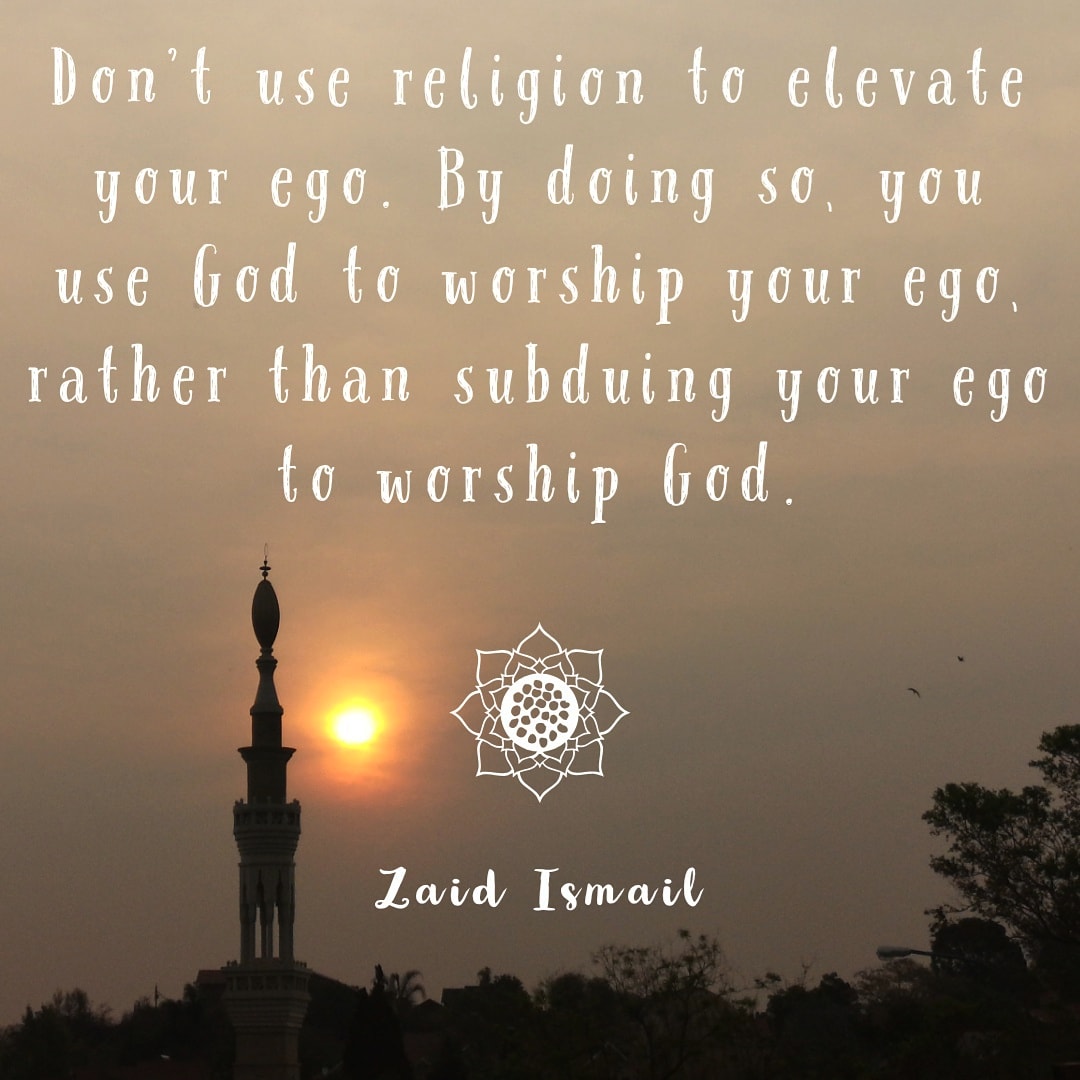
    Don’t use religion to elevate your ego.

    By doing so, you use God to worship your ego, rather than subduing your ego to worship God.

    The appearance of religiosity in others misleads many to assume that they possess piety.

    Piety cannot be measured through outward appearance, only through experiencing a sincerity of action.

    Sincerity, if shown due respect, makes an outward show of religiosity for the purpose of earning respect impossible to display.

  • A Beautiful Mess

    A Beautiful Mess

    The last year has been a beautiful mess. It has been a year of pushing boundaries and testing long-held truths. People, relationships, skills, passions, and even hobbies all came under close scrutiny as I peeled away the layers of assumptions that coated them over the years to test whether they still served me well, or at all.

    I tested my hand at mindful living, more so at carving my own path through the forest and the lessons that I learnt along the way, most of which are still incomplete, have unlocked new realities and resurfaced old joys. My sense of self continues to evolve, almost on a daily basis. Accepting a truth about my reality on one day seems foolhardy or delusional on another. But in between it all there has been a lightness in my steps that has been absent from my gait for decades.

    I lost myself to life over the decades. Courting authenticity with a naive mind can be taxing and expensive. Living out my convictions has increased the isolation around me. Only, it’s an isolation that holds much peace despite the loneliness that it threatens to share. The peace is the absence of expectations, except for the moments that the capitalist structures around me tear away at my being through the yoke that still weighs down on my shoulders. The realisation that what feeds the soul doesn’t feed the belly intensifies each day.

    Uplifting quotes or extended hands to those that find relief in its offering falls short of its reciprocation of upliftment. The multitude of needy hands reaching out while their eyes look defiantly away cuts short any embrace that might once have offered some fulfillment. Fulfillment has been replaced by servitude and servitude proves to be no more than a payment of debt. Social debts and divine rights are pervasive. Harmony and a divine handhold not so much.

    The unbeaten path always promised solitude. Perhaps that is the only promise that has been fulfilled. Everything else carries with it the weight of expectation or reciprocation. Distractions and virtual embraces offer more comfort than the distracted ones around us. Do we connect virtually because we see each other more clearly without the social stigmas and classes present, or do we connect virtually because it is the only connection that is accessible?

    I no longer serve the social structures that I once courted, and along with it gave up any hope of finding the support that this new life demands I have. This used to be a cryptic space but I’ve realised that any confusion or mystery resulted only from my hope that there was more to be enjoyed, or acquired. Seeing the social constructs for what they are leaves little room for expectation, or even hope. Hope is only relevant in a symbiotic relationship, not a cannibalistic mutually exclusive one. Such has been the interaction between society and I for as long as life has held any promise beyond the immediate breath. Serving the divine is all that keeps me tethered to such contracts.

    This beautiful mess is the freedom that such realisations and independence endows. The absence of belonging and only the belonging to absence. It once seemed so vapid in its concept but has proven to be utterly grounding in its experience.

  • When an act of charity becomes business

    When an act of charity becomes business

    If I do good, it will come back to me in unexpected ways. No. It won’t. The streets are full of homeless bodies and souls that have done good, but it wasn’t returned. Or are we suggesting that those that are in a bad state have done no good? This transactional view of life is becoming more popular each day, and it does nothing good for the one that holds this view.

    We do good because we want others to experience less hardship than we did, not because we want to be repaid in some way with another good. Well, at least that is why we should be doing good. Not to earn a reward, but to reduce someone else’s pain or suffering, or simply to enrich their life. If enough people do this, inevitably it will lead to someone doing good for you as they seek to enrich your life out of sincerity, or they may wish to alleviate your burden because they know what it is like to be in a similar position when they may have had less. But that is something that we have no control over. The way that cycle of paying it forward plays out is entirely dependent on the generosity of every soul involved in that cycle. It is not business. It is not a tit-for-tat exchange of deeds. The moment it becomes an expectation of receiving something in return for what you do, you are transacting for gain. That is not charity, nor is it generosity. It is self-serving.

    The selfish motivations that prompts us to give charity so that we can be seen as charitable, or doing good so that we can be seen as benevolent is nothing more than food for the ego, not for the soul. And it’s a poisonous meal as well. Eventually we will find ourselves measuring the value of people in our lives based on what they do for us, rather than how they enrich our lives. The sad part is that most don’t know the difference.

    When someone enriches your life, they don’t necessarily contribute directly to your personal needs, but they make a meaningful contribution to how you experience your world. A simple example would be a spouse or family member that expresses love and appreciation for your children. That is not something that replaces your contribution to your children, but it is something that improves your child’s self-worth. That in turn improves the quality of life that you have with them. Although their act of kindness was not directed at you, it enriched your life, so you should not have reason to withhold kindness from them.

    The irony is that the ones that perpetuate this myth about the universe returning the good that you do are the same ones that would typically believe that integrity is doing the right thing even when no one is looking. While that may be true about the definition of integrity, it loses its authenticity when we find reason to shout out to the world how much integrity we have.

    One lesson that has served me well in life is that you should always be weary of someone that finds every gap to mention their own virtues. They are looking for validation, and people that require validation that badly almost always compromise principles and values to get it. Such people will not think twice about betraying your trust or confidence if it means getting that validation from others. Choose your company carefully.

  • The Burden of Choice

    The Burden of Choice

    Choice is that horrible thing we despise when something doesn’t work out in our favour, but it’s a right we jealously defend when things go our way. Right there is the crux of balance, but balance will remain elusive if we don’t recognise the choices that we made. That is not as basic as it sounds. 

    One human trait that is available in abundance is the trait of obliviousness. Not only are we often oblivious to the impact we have on others, we are equally oblivious to the choices that we make in the process. Not being aware of the impact we have is sometimes a result of being so internally focused on our needs or flaws that we don’t expect to have any meaningful impact on anyone else. 

    When we are so distracted by that internal focus, it is easy to assume that we are simply following the rabbit hole of our thoughts without recognising the decisions we make each time we arrive at a fork in the tunnels. Roads have daylight to warm us during the day, and stars at night to guide us. No, this is a much more daunting journey than that. We rarely travel by daylight or by moonlight when our focus is so intensely internal. That is when we are most oblivious which is quite ironical given that it is exactly such introspection that we hope to make us more aware of who we are and what our contribution to this world might be. 

    And thus we trundle along through those tunnels, bumping into others, sometimes torchbearers on that path, assuming that they are only there for the same reason that we are, but ignoring the fact that they have the same needs as we do. We all just express our needs differently. Right there, in that moment, with that assumption, a choice is made. A choice to engage, to trust, to assume good, or to withdraw and assume that there is no good to be achieved, or that there is no familiarity or comfort to be taken. Those are the choices that we grow oblivious to when we become so intensely focused on our journey that we lose sight of those travelling the same journey, or perhaps having travelled it already.

    In the process of living so selfishly, despite our best intentions, we discard exactly what we may be in search of, and then lament not finding it. Sometimes we are reminded of such choices but grow defensive at the thought of being responsible for our own misery. Surely my sincere pursuit of happiness and enlightenment cannot be the cause of my own misery? Why didn’t someone make me aware of it? Why didn’t someone say something? Why couldn’t they just understand what I was going through? Even if all those questions are answered in the affirmative. it does not change the reality of the fact that it was choices, well-meaning but sometimes destructive choices that we make sincerely and with conviction that isolates the very blessing that we set out to acquire. 

    Lighthouses and travellers. The irony of this is that no one is ever only one of the two for any extended period of time. The dance of life leads us to switch roles without even realising that we are. When a lighthouse is needed, we immediately assume the position because of our desire to breathe life into that which we find wholesome, or beautiful, but just as quickly we become travellers looking to draw pleasure from that same beauty and appreciate the calming presence of the lighthouse.

    If only life was static and predictable. It never is. And the dance between lighthouses and travellers remain a fluid exchange of choices that we make in that moment. The more mindfully we choose, the greater the impact of our choices on our lives. The more oblivious we are with the choices that we make the greater the impact on the lives of others. 

    In that lies the burden of choice. We are not only accountable for the choices we recognise. That is an easy accountability to accept. It is accepting accountability for the choices that we did not intend to make that determines our authenticity and often, it determines the quality of the relationships that contribute towards the joy and comfort that we experience in life. Neglect these out of fear of being accountable for causing harm or pain, and you will find yourself troubled by consequences that seemingly have no good reason to happen to a good person. And that, I believe is one of the reasons why bad things happen to good people.

    P. S. I think it’s human to be oblivious simply because of the scale of distractions that we are exposed to all the time. Therefore, it is in becoming aware (after the fact) of the unintended harm that tests whether our ego is driven towards humility and accountability, or arrogance and deniability.

  • Those Damned Assumptions

    I have a reputation of making people feel awkward, or as some would describe it, infuriated (stop nodding so feverishly, you may lose your balance!). I take a particular pride in knowing that I am viewed this way, because it merely cements my views about the nature of the average Joe that I meet on a daily basis. This came to the fore a few weeks ago in a discussion that I had with a colleague which subsequently spilled online as well.

    I often feel compelled to challenge incorrect assumptions, or to persist in a point that I believe is important until I am certain that I have reached a point of mutual understanding, or at the least, am able to walk away knowing that I tried. So I choose my battles, but I also choose more battles than most (I can see you nodding again!). On this one occasion, I spent a fair amount of time trying to get someone to understand why the point that they were making was actually contrary to what they were trying to achieve. And so I kept asking probing questions and prompting them to consider an alternate perspective so that they may realise what it is that they were doing.

    Some in the room came to me afterwards and suggested that I really shouldn’t bother. Some assumed that I was being argumentative or just simply difficult (stop it already!). Meanwhile, the truth was far from both of those assumptions. While I speak for myself right now, I suspect that many others may be able to relate to what I am about to share.

    When I engage with anyone on any subject, my default assumption is that they are capable of processing the concepts and themes that I feel passionately about. As the discussion progresses, if I see that they’re not grasping my point, I assume that I’m either not explaining myself well enough, or they’re distracted by a bias that is not directly relevant to what I am trying to share with them. My knee-jerk reaction to this is to try to clarify my point so that they may be able to share in the value of what I think is important. In short, I assume we’re at the same level of understanding, but are experiencing a communication gap.

    Unfortunately, the most common assumption in such a situation, especially by those with a low self-esteem, is that my efforts to attain clarity is in fact an attempt to either make them look stupid, or expose how stupid they really are. At no point do they consider that perhaps I simply assumed that their level of understanding was the same as mine, rather than me assuming that they’re beneath me. Their perceptions of themselves informed their observations of me, and while they thought they were judging me, they were in fact judging themselves.

    Of course, if  I were to point this out to them (as I do on occasion, often just for fun!) they would feel justified in their views about my supposed arrogance, or condescension. The turning point in my life regarding my self-worth was when I realised this troublesome truth about people. From that point on, I found it easier to rise above the unqualified criticisms leveled against me, and instead, continued to focus on the passion that I had about the value that I wanted to realise for me and for others. Often, this resulted in the offended party recognising the point I originally tried to make, but only after they had enough time to get over their own insecurities about the interaction. For this reason, I almost always do my best to allow for a graceful exit from such contentious discussions.

    The times that I don’t allow for a graceful exit are the times when the offending moron is pretty much a confirmed bully who just won’t back down. That’s when my favourite philosophy kicks in. Treat an arrogant person with arrogance so that they may taste humility.

    Back to the topic at hand. Assumptions are made all the time. Some are informed, most are not. Another poor assumption on my part when I originally started contemplating writing books on leadership and mentoring others at the office to take leadership roles in their areas of influence was that in doing so, I may work myself into a position of irrelevance. In other words, like the fickle-minded, I thought that I was working myself out of a job. You know, that scarcity mentality thing where we assume that the success of others will rob us of opportunities for our own success? Well, fortunately I snapped out of that mindset soon thereafter when I realised that leadership is so rare because conviction is lacking in most people.

    In general, people want to be associated with greatness, not because they want to be great, but because they want to be with the crowd that is also associated with such greatness. One of the important lessons I learnt in the process is that despite giving someone the golden handbook of how to achieve greatness, and giving then the opportunity and environment in which to achieve it, their deeply ingrained insecurities will prevent them from embracing the opportunity. Everyone wants to be liked, or popular, or part of a group. Except for a few that see the futility in that, and decide to forge their own path in life. They don’t necessarily set out to be leaders. In fact, I would go as far as saying that leadership finds them, while everyone else tries to mimic the assumed journey of the new leader in the hope that they will achieve the same.

    People that set out to become leaders usually lack authenticity. Authenticity is by far the most important leadership trait ever. In the absence of it, you simply have authority and resources at your disposal, but will fail to genuinely influence or inspire others, except for those that aspire to similar levels of materialism. Perhaps this is why we have the leadership void that we have in this world. Perhaps this is why the worst of us has truly become the leaders of us, because we celebrate the wrong attributes, and dismiss the detractors that challenge the status quo.

    We make assumptions negatively about others when we assume that their flaws are the same as our own, while not being willing to acknowledge or own our own flaws. Criticism that has little to no constructive basis behind it simply feeds the ego. It does not encourage growth, nor does it forge new avenues of understanding. When someone takes the time to extend their engagement with you about a topic that they are passionate about, recognise their passion before assuming that they’re simply being arrogant. The biggest mistake most people make is that they fail to recognise the difference between passion and emotion, and are too ready to dismiss a passionate soul as an emotional being. That is the burden on society of a weak mind. It degrades sincerity in favour of popularity. And that is how society ends up being something that everyone wants to criticise, but no one wants to acknowledge being an integral part of it.

  • Fake

    The world is full of brave faces. People showing a strong front while internally their world is crumbling, or has already crumbled. Some let in a select few to witness the destruction first hand while they serve a dual purpose of being a shoulder to lean on. Others are too ashamed to admit to such weakness and block everyone out instead, often aggressively so. Despite these differences, both tend to be focused on how they’re perceived in those trying times rather than how they feel, or more importantly, why they feel the way they do.

    The embrace that most offer in times of trouble often uplifts the spirit and not much more. That small blessing is great, but only if it’s accompanied by a jolt that prompts us into action. The jolt can be our own realization and courage to be decisive about changing our state, or it could be a needed kick up the butt from someone that we trust. Either way, that jolt is needed. In the absence of that jolt we are left with nothing more than a group pacification of our weakened state where we are often convinced by such gestures that just trudging along is worthy of celebration.

    Perhaps, for a short while until the shock and awe subsides, just being able to maintain a semblance of composure is commendable. But it reminds me of something I read once about runners. The level of fitness of a runner is not determined by how far or fast they can run, but instead it is measured by how quickly they can restore their bodies to a state of rest at the end of their run. In other words, how quickly can I stop heaving to catch my breath after the intensity of the exertion has subsided. I think this has relevance in this case as well. The time it takes for us to recover from the shock and awe of life’s less pleasant moments is a reflection of our spiritual resilience in the face of reality.

    I digress…again. The fakeness in us becomes most prominent when we become so focused on how we’re perceived, that we lose our way on that path of self actualization because we gauge the measure of our success on how others celebrate our progress. If we consider that the majority of those around us celebrate mediocrity and conformance without even realising that a world exists above such a dreary standard, that gauge of success effectively prompts us towards complacency the moment we believe that we’ve arrived, relative to those low standards.

    The fake are the ones that draw you close in a moment of weakness, then push you away when they don’t want to be reminded of that same weakness. They’re the ones that embrace when times are tough, but are aloof when the figment of success enters their minds. They live outwardly what they desire inwardly, but they live inwardly what they hide outwardly.

    As obvious as that may seem, most don’t get it. Especially not the fake. It’s easy to miss such important but simple details when the focus of your life is on the perceptions of others. We become prisoners of society despite actively subscribing to such incarceration, yet we complain bitterly when that same society is relentless in its demands for more from us. Conformity to societal whims is a never-ending cycle of trying to appease an insatiable appetite for affirmation. The irony is that those that are fake, desire what they would otherwise receive if only they chose to be authentic. Authenticity begets sincerity, and I’d rather have a single sincere friend than a stadium full of insincere fanatics.

  • Debatable debates, and questionable quotes

    After seeing a post this morning that was quoted to be from Hadith Qudsi, I doubted its authenticity which led to me browsing through the collection of Hadith Qudsi to see if it may have been a variation in translation or not. I couldn’t find it. The ‘offending’ quote was:

    I wonder at a person who preaches to people but not to his own soul

    If anyone has knowledge of the origins of this hadith, or if in fact it is a hadith, please let me know, but so far, it doesn’t appear to be hadith at all. It has a strong under tone of rhetoric, and in my limited knowledge (may Allah forgive me if I’m wrong) I’ve never known Rasulullah (SAW) to speak with rhetoric, so immediately this quote raised alarm bells. 

    However, the good that came out of this for me was being reminded about the following hadith:

    Book 1. Hadith Qudsi. Hadith 006.

    The Authority Of Al-Numan bin Basheer : I heared the messenger of Allah say : “That which is lawful is plain and that which is unlawful is plain and between the two of them are doubtful matters about which not many people know. Thus he who avoids doubtful matters clears himself in regard to his religion and his honor, but he who falls into doubtful matters falls into that which is unlawful, like the shepherd who pastures around a sanctuary, all but grazing therein. Truly every king has a sanctuary, and truly Allah’s sanctuary is His prohibitions. Truly in the body there is a morsel of flesh which, if it be whole, all the body is whole and which, if it be diseased, all of it is diseased. Truly it is the heart.”

    Reporters.

    Narrated by Bukhari and Muslim.

    I’ve italicised those words that I found most inspiring. What strikes me most about this is that it is a reflection of the numerous debates I witness on a daily basis, on Tumblr and in real life, regarding matters that are based on opinions or interpretations, rather than matters that are clearly halaal or haraam. Like this hadith states, “the lawful and the unlawful is plain”, so the extended debates we get into regarding who is more correct about interpretations is usually centred around issues that relate to preferred ways of doing things rather than what is outright forbidden or allowed. 

    This was highlighted to me in another hadith that I came across in the same collection, which reads:

    Book 1. Hadith Qudsi. Hadith 009.

    The Authority Of Abu Hurairah : I heared the messenger of Allah say : “What I have forbidden to you, avoid; what I have ordered you [to do], do as much of it as you can. It was only their excessive questioning and their disagreeing with their prophets that destroyed those who were before you.”

    Reporters.

    Related bu Bukhari and Muslim.

    Again, the italics are mine for emphasis. This excessive questioning is what leads to 99% of the debates we have on Tumblr and in real life. Every single occasion that I have personally witnessed where such debates rage, the underlying tone and manner of such debates was always driven by the egos of those involved in the discussion. I keep reminding myself that halaal and haraam is clear. So in that, there is no doubt. Therefore it makes sense that if there is doubt about something, the doubt would be regarding its interpretation or preferred method of implementation, but not about its validity as being halaal or haraam. So when someone insists that we are compelled to seek a deeper understanding of the inferences and meanings and interpretations behind what is plain, this hadith answers such endeavours clearly:

    Book 1. Hadith Qudsi. Hadith 030.

    The Authority Of Jurthum bin Nashir : The messenger of Allah said : “Allah the Almighty has laid down religious duties, so do not neglect them. He has set boundaries, so do not over step them. He has prohibited some things, so do not violate them; about some things He was silent-out of compassion for you, not forgetfulness, so seek not after them.”

    Reporters.

    A fine hadith related by Al-Daraqutni and others.

    But the most poignant of the ahadith that I came across in my search for the hadith that I found to be suspicious is this:

    Book 1. Hadith Qudsi. Hadith 035.

    The Authority Of Abu Hurairah : The messenger of Allah said : “Do not envy one another; do not inflate prices one to another; do not hate one another; do not turn away from one another; and do not undercut one another, but be you, O servants of Allah, brothers. A muslim is the brother of a muslim: he neither oppresses him nor does he fail him, he neither lies to him nor does he hold him in contempt. Piety is right here-and he pointed to his breast three times. It is evil enough for a man to hold his brother muslim in contempt. The whole of a muslim for another muslim is inviolable: his blood, his property, and his honor.”

    Reporters.

    Related by Muslim.

    Once more, italics are my own emphasis. The thought that this hadith left me with is that if we apply the principles of what is clearly stated here, by holding another Muslim in contempt because of their beliefs or actions, we’re doing either one of two things. We’re either deliberately violating the injunction of this hadith, or; we’re suggesting that in our view, the person we’re holding in contempt is in fact not Muslim. Isn’t this tantamount to declaring takfir on another? 

    I have been taught that debates should be had not to determine who is right and who is wrong, but rather to arrive at the truth. It’s rare these days to find anyone debating for the correct purpose, but instead we expend precious resources in time and energy focused on satisfying nothing more than our nafs under the guise of seeking to establish the truth with others.