To be of consequence, or to feel significant, lies at the heart of our inspiration to accomplish anything.
When we connect with conviction to the significance of who we are, and what value we add to the lives of others, we achieve a sense of peace and contentment.
But, when we doubt this, we set out in search of validation through observing how others respond to our efforts to improve their lives. To make them happy.
If we’re fortunate, we’ll find ourselves surrounded by those who willingly and sincerely acknowledge our contribution and our place in their lives.
If we aren’t fortunate enough to have such people around us, we’ll lose ourselves in our efforts to be enough for them, without realising that they’re also not enough for themselves.
It’s an empty cup trying to fill a broken one, where the one who is giving is depleted, and the one receiving is distracted by their own demons.
Chronic illnesses set in, accompanied by rage that is often directed at the self, because we didn’t realise the value of who we are, while hoping to be validated by those who were distracted by their own self-loathing.
Thus, the joys of life are traded for servitude and a living martyrdom, hanging onto faith by a feeble thread, praying that our sacrifices and self-deprecation will be rewarded with everlasting peace when this harsh reality finally ends.
That’s how we harm ourselves long before we allow anyone else to harm us.
Worse still, we forget that through self-loathing, we withhold the best of who we are for the innocents around us, and end up giving them reason to believe that they were never good enough to bring out the best in us either.
That’s how generational trauma is passed down.
It’s not because of what was done to us, but rather because of how we see ourselves through the eyes
of those for whom we were never enough.
#selfworth #significance #conviction #dreams #sincerity #authenticity #mentalhealth #mentalhealthawareness #mentalhealthrecovery #theegosystem #mindfulness #lifecoaching #zaidismail
Category: Life Coaching
-

Do you matter to you?
-

Emotional wellbeing, not mental health
It is only through our internal wars that we lose sight of reality.
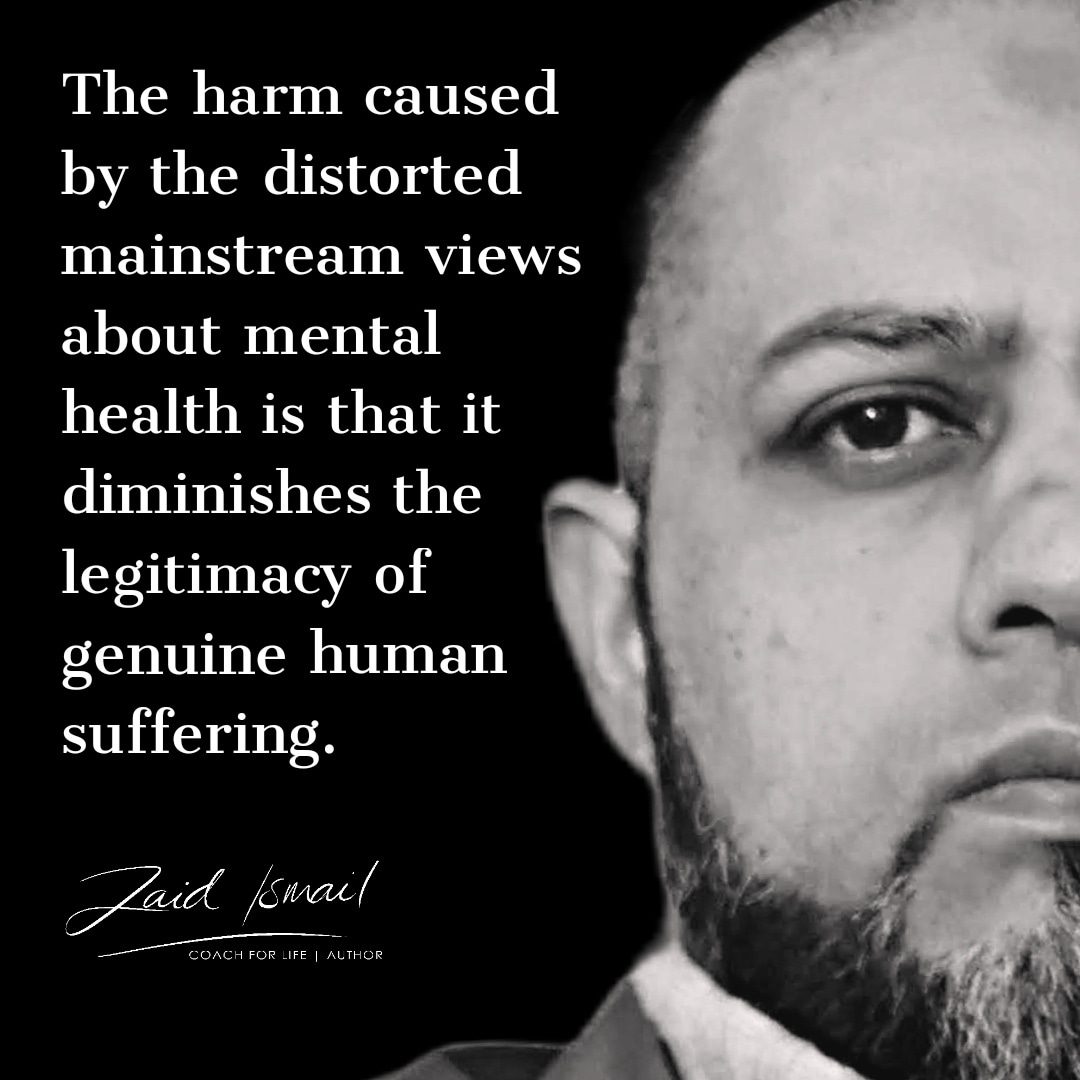
The culture of labeling people dehumanises the very human that is struggling with their humanness.
We focus on our demons so intently, that we become defined by them, bearing them patiently in quiet shame, protecting ourselves from being exposed for what we hold within.
When we judge ourselves with such shame and harshness, we see the world through angry eyes.
But, protocol and decorum prevents us from raging and venting without restraint, so we choose safe spaces in which to release the venom from within, on those who are incapable of opposing or resisting us.
In the public space, we create carefully constructed apologies for our inadequacies, latching onto unhealthy concepts like ‘suffering from…’ whatever emotional torment we’re experiencing.
That’s when we feed the belief that human emotion is an illness, or a disorder, because it’s the only hope we have of making sense of the war within.
All this because we convinced ourselves that being any less than happy must be weak, or dysfunctional.
The sway of human emotions, regardless of how crazy that sway may appear or be experienced, is a legitimate response to very real life experiences.
Labeling the response does nothing to create understanding and healing around that traumatic or overwhelming experience.
Stop labelling people because of their behaviour, and reconnect with your own empathy and compassion so that you may once more see the human behind the human condition.
Own Your Life.
#mentalhealth #mentalhealthawareness #mentalhealthrecovery #lifecoaching #zaidismail #empathy #theegosystem #ownyourlife -
Do what’s right, or else…
When raised with fear and compliance as the tool to ensure good behaviour, or religious subscription, we create validation-seeking individuals whose willingness to compromise on what is right will be driven by social acceptance.
Instilling values in our children, or living by our own values, must be grounded in a substantial appreciation for why it is valuable, and not why it is right.
When we focus on right and wrong, we focus on judging others rather than understanding them.
Arriving at a conclusion about whether something is right or wrong has its place.
But without understanding and an appreciation for the value of what we want to establish, compassion is lost, and harshness is assumed to be justified to uphold truth or morality.
It is counter-productive to use harshness to teach understanding.
And it’s an exercise in futility to ignore what influences you are working against when trying to instil, or live by such values.
Being mindful of two things is therefore critical towards maintaining your sanity.
Firstly, connect with purpose and substance to the values that you stand for by connecting it to the good that you want to create in the lives of those around you.
Secondly, be aware of your ability to influence the adoption of those values in the lives of those you care for.
Sometimes, the appeal of instant gratification, or social inclusion may render your influence impotent.
When that happens, take the time to plant the seed, but don’t exhaust yourself in nurturing it.
We’re all responsible for nurturing our own seeds of goodness in our lives.
Own Your Life.
#hope #expectation #sincerity #selfworth #selfawareness #mentalhealth #mentalhealthawareness #lifecoaching #zaidismail #loveyourself #lifegoals #parenting #singleparenting #gratitude -
‘Sorry’ isn’t the hardest part
The only thing worse than an insincere apology is the apology that is offered with a demand that it be accepted.
The most important part of an apology is not that it is made, but that it is authentic.
Not just sincere. Authentic.
If an apology is limited to a text message, or a few words uttered, but has no meaningful effort behind it to remedy the offence or harm that was caused, then it isn’t an apology. It’s manipulation.
When we demand that our apology result in a change in attitude from the one that was offended because the apology is supposed to put the offence behind us, it’s not an apology, it’s manipulation.
When we apologise but take offence or become defensive when the impact of our behaviour needs to be discussed by the one we offended, then we didn’t apologise, we were just ‘doing the right thing’. That’s manipulation.
When we are sincere in regretting the harm or offence that we caused, an apology will be the smallest action that we take to make up for what we did.
If we’re sincere, an apology will only mark the first step in our effort to regain the trust and confidence, or the good standing that we had with someone, because they are important to us, and not just because they didn’t deserve what we did, or we feel self-righteous in owning up to being wrong.
On the flip-side, needing someone to admit fault and repeatedly apologise for something that they’ve already shown remorse for is not accepting their apology. Nor is it sincere reciprocation of their efforts to remedy the breach in the relationship.
It’s revenge aimed at inflicting the same harm or offence that we felt from their behaviour.
Whether justified or not, it reflects what we value more. The relationship that we have with them, and how much we value who they are, or being seen as the victim of their mistake.
Be authentic. If not, you’re simply manipulating your way through life.
It always starts with you.
#selfworth #selfawareness #ownyourlife #theegosystem #mentalhealth #mentalhealthawareness #lifecoaching #zaidismail #authenticity #apologize #apologies #narcissism -
That self-loathing demon
Ingratitude for the self is reflected in how much time we spend self-loathing.
But self-loathing is disguised in many creative ways.
The above list of 10 common points is only the tip of the iceberg.
Self-loathing is rarely, if ever, a result of our current circumstances, and almost always a result of how we felt about our place in our parent/s home.
The less space they made for us in their lives, the less worthy we feel as humans.
This is especially true for problematic relationships with our fathers, but often extends to criticism or insensitivity from our mothers as well.
Because that shapes our sense of self early in life, it’s difficult to realise its impact because it just feels normal for us.
That’s when we grow to believe that our partners are responsible for how we feel about ourselves, or that they’re responsible for our enthusiasm towards our dreams.
That’s how we grow harsh and cruel, or rigid and abrasive towards them, not realising that we’re holding them accountable for how we feel about ourselves because we had one, or both, parents who were emotionally inaccessible when we needed to feel like we were worthy, or like we belonged.
Self-loathing, beyond our early years when we didn’t know better, is a testament of ingratitude for who we are, and what good we have access to.
Until we start owning how we feel about ourselves, we’ll always have reason to rage at the world, and at the innocent ones around us.
Own Your Life.
It always starts with you.
#selfworth #selfawareness #ownyourlife #selfmastery #mindfulness #personalpower #mentalhealth #mentalhealthawareness #lifecoaching #zaidismail #loveyourself #lifegoals #motivation #optimism #purpose #companionship #relationshipgoals #selfloathing -
Maybe tomorrow…
Just like tomorrow is not guaranteed, neither is our next breath.
Each moment taken for granted is a moment lost.
Each loved one taken for granted is a heartache earned.
Each abandoned resolution made after tasting loss or visiting death’s door is food for the seeds of hypocrisy and self-loathing within.
The victim mindset turns supporters into enemies, and significant others into options, until what we once cherished is lost, and what we’re left with intensifies our yearning for the past, or for death.
When the pain of the past overshadows our joy in the present, the future loses its lightness, and our souls succumb to the darkness.
The shame of admitting failure prevents us from making right what we got wrong.
All because we were distracted by the harsh criticisms echoed in our narrative in our mind.
A narrative that convinces us that sincere advisors are criticising our efforts, and those who celebrate the shadow of what we’re capable of are in fact our friends.
We find what we seek. Shame in the past, purpose in the present, or hope in the future.
Sadly, most lose themselves to the past, while protecting themselves from embracing the promise that the footie holds, in the process discarding the ones who love them most.
Who are you discarding because they believe in you more than you believe in yourself?
Own Your Life.
#hope #expectation #sincerity #selfworth #selfawareness #mentalhealth #mentalhealthawareness #lifecoaching #zaidismail #loveyourself #lifegoals #selfloathing #ownyourlife -
The shame within
Good advice sometimes feels like a threat because it prompts us to acknowledge a flaw that we feel ashamed of.
It’s like putting in your best effort to create a piece of art, and then having someone come along and innocently suggest that you should’ve tried this or that to enhance it further.
No matter how much merit there is in their suggestion, if you’re already feeling insecure about your artistic talents, you’ll find reason to justify taking offence, or to dismiss why you don’t think that will work with what you’re trying to achieve.
That’s what happens when we assume that the motive behind good advice is to highlight our shortcomings, or to emphasise the superiority of our advisor. Or worse still, we assume that the other person deliberately wants to make us feel inadequate.
All it is, is a sense of shame that we carry within us about who we are, or how we’re lacking in our efforts to earn the significance or validation of those we love.
That threat to our significance is what feels like an attack that we respond to with anger, or passive aggression, because anger is a demand for significance.
Being mindful about our opinion of ourselves is one of the hardest things to do.
It means that we must be aware of whether we’re judging ourselves based on what we think others will approve of, or are we viewing ourselves with understanding based on who we aspire to be.
The former is destructive.
The latter is what creates the inspiration to continuously build and improve on who you are and what you wish to leave as your legacy.
It always starts with you.
Own Your Life.
#hope #expectation #sincerity #selfworth #selfawareness #mentalhealth #mentalhealthawareness #lifecoaching #zaidismail #loveyourself #lifegoals #motivation #optimism #purpose #mindfulness #angermanagement -
Who’s doing you in?
This is a phenomenon that I encountered regularly in the corporate world.
When your performance appraisal is reviewed against your targets only, but all mitigating circumstances are dismissed, understand that they’re not interested in rating your performance, they’re interested in finding someone to blame for their lack of competence, or lack of support.
If, however, you find yourself in the same situation repeatedly, then you need to consider if you’re communicating effectively with the people who need to support you with the right tools and resources to achieve your targets, or if you’re always avoiding accountability for outcomes the moment you don’t have the ideal environment in which to achieve your targets.
The latter is a result of a victim mindset, because it’s focused on protecting yourself from being wrong, rather than focusing on taking reasonable risks and initiative to accomplish your goals.
If you’re convinced that others are simply out to get you, then you need to question yourself for sticking around to repeatedly give them such opportunity.
If you truly believe in your ability to contribute positively towards your career goals, you’ll make an effort to find an organisation or a team that appreciates the value that you bring to the table.
If you lack confidence in yourself, you’ll go through life waiting for others to create the perfect circumstances for you to thrive, while blaming the world for not doing enough for you.
That’s when the burden of stupidity that accompanies the absence of appreciation for context becomes your self-defeating behaviour, while you focus on what everyone else is not doing enough of to help you to be successful.
Just a random thought I felt like sharing today.
Own Your Life.
#hope #expectation #mentalhealth #mentalhealthawareness #lifecoaching #zaidismail #careergoals #judgingothers #justsaying #corporatepolitics #selfdefeatingbehaviour #selfsabotage