
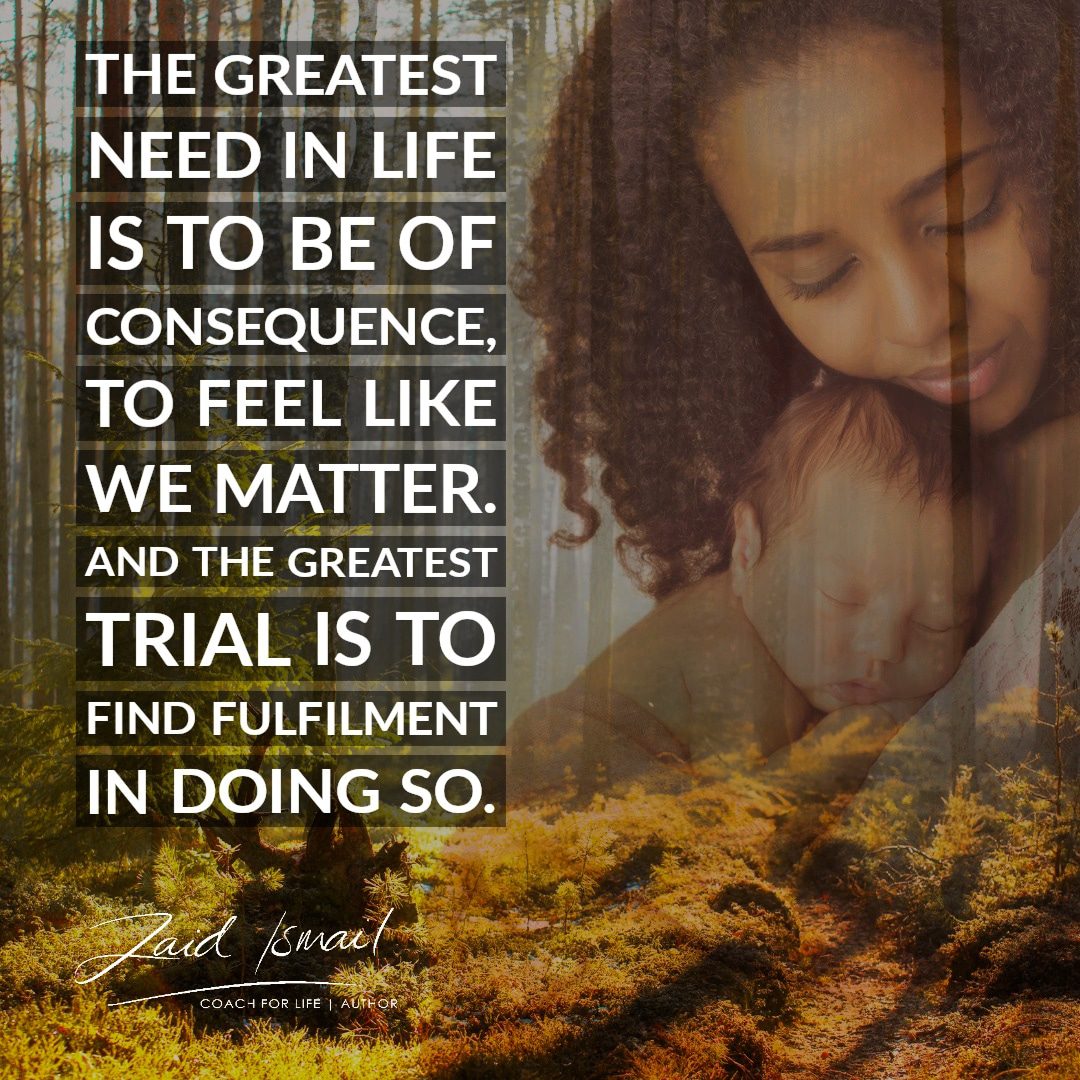
To be of consequence, or to feel significant, lies at the heart of our inspiration to accomplish anything.
When we connect with conviction to the significance of who we are, and what value we add to the lives of others, we achieve a sense of peace and contentment.
But, when we doubt this, we set out in search of validation through observing how others respond to our efforts to improve their lives. To make them happy.
If we’re fortunate, we’ll find ourselves surrounded by those who willingly and sincerely acknowledge our contribution and our place in their lives.
If we aren’t fortunate enough to have such people around us, we’ll lose ourselves in our efforts to be enough for them, without realising that they’re also not enough for themselves.
It’s an empty cup trying to fill a broken one, where the one who is giving is depleted, and the one receiving is distracted by their own demons.
Chronic illnesses set in, accompanied by rage that is often directed at the self, because we didn’t realise the value of who we are, while hoping to be validated by those who were distracted by their own self-loathing.
Thus, the joys of life are traded for servitude and a living martyrdom, hanging onto faith by a feeble thread, praying that our sacrifices and self-deprecation will be rewarded with everlasting peace when this harsh reality finally ends.
That’s how we harm ourselves long before we allow anyone else to harm us.
Worse still, we forget that through self-loathing, we withhold the best of who we are for the innocents around us, and end up giving them reason to believe that they were never good enough to bring out the best in us either.
That’s how generational trauma is passed down.
It’s not because of what was done to us, but rather because of how we see ourselves through the eyes
of those for whom we were never enough.
#selfworth #significance #conviction #dreams #sincerity #authenticity #mentalhealth #mentalhealthawareness #mentalhealthrecovery #theegosystem #mindfulness #lifecoaching #zaidismail
Tag: significance
-
Do you matter to you?
-
Hopelessly hopeful
In all the times that hope seemed to escape me, I realised that it was not because the future held no hope. It was because I had given up hope of being able to participate meaningfully in that future.
I’ve often believed that it’s not depression that exists, but instead, it is hopelessness. It is the absence of hope, or the absence of our belief in hope, that gives us reason to feel deflated about the future. Yet we focus so much on the depression, that we don’t consider putting effort into restoring hope.
It would be simple if we weren’t invested in the present moment, or the current place, or the relationships that we cherish. The world is larger than any life we could ever live, yet we willingly forego the possibility of finding joy somewhere other than where we are.
Have we convinced ourselves that success is only relevant when shared with those that we hold significant? What if they don’t return that sentiment? Does that render us unsuccessful? Or any less valuable? Why then, do we hold on to the need to get the right response from the right person at the right time before we are willing to embrace hope?
I often toyed with the idea of being a merchant of hope. One who sells the value of moving beyond where we are, so that we allow ourselves to be recipients of beauty from those who do not hold within them the bitterness of our past. Perhaps we stay because we court the idea of being able to guide them back to joy, and in so doing, place the hope of our joy in them finding theirs? Or convincing them to see the joy in us beyond what they’ve grown to know.
Joy is cheap if not shared. Eventually, even uplifting others loses its sparkle if inclusion in their joy feels unreachable. It’s that feeling, that deeply seated desire to be instrumental in the joy experienced by another, but also being recognised and appreciated by them for creating such joy that perhaps, keeps us rooted to the pursuit of an outcome that may torment us in the present, but elevate us in the future.
The hopelessness of hope lies in the truth that hope, even when deliberately abandoned, never leaves. It never abandons us, despite the intensity of our efforts to abandon it. And, I think, it is in that tenacity of hope itself, that the ego is frustrated because even in this effort towards hopelessness it finds it impossible to attain success.
-

Serve a greater purpose
Life always has more purpose when you’re serving others. We’re built to serve others. When we lose hope in being served by others, we withhold our service in protest until we convince ourselves that no one will take care of us so we must take care of ourselves. That’s when life becomes hollow because it pulls us away from our core need: To be of significance to others. If you find yourself in this space, consider changing who you surround yourself with, otherwise you feed the very cycle that robs you of peace.
-
Saturation Point
There is a price to be paid for believing in people before they give you reason to believe in them. That price extracts a toll that demands your contribution during the days when they see little reason to believe in themselves. It often results from years of betrayal or failed expectations, until eventually the way the world treated them became the definition of how they viewed themselves, and how they viewed you.
I’ve witnessed first hand how some rise to the challenge simply because they know that there is someone that believes that they can, while others recede and don’t even try because they know that there is no one that cares about the outcome either way. This resonates with me personally as well. I dropped out of school because no one noticed that I was uninterested and barely in school for a large portion of the year in the eleventh grade. So dropping out in the twelfth grade was an easy decision that went unchallenged. I didn’t particularly find it liberating or depressing. It just was that way, and at the time, the consequences were irrelevant. All that mattered was that no one noticed, so I had no reason to care either.
But that only lasted to a point. The complacency and lack of ambition annoyed me. It annoyed me because it felt like there was something missing. Something beyond the token of having completed school, or needing a job others would respect. That something was a need to be consequential. To make a difference.
Going with the flow never directed the flow. It only ever gave force to something already in motion. Sometimes, like dropping out of school, it felt irrelevant. Whether I was in or out didn’t matter, because the decision I had taken wasn’t a decision that mattered. I therefore gave up on the pursuit of something that seemed inconsequential because the effort to sustain something that I did not see any value in felt burdensome rather than purposeful.
Entering the job market in a menial role also didn’t matter. It was a means to an end. Career goals were not foremost in my mind and I had no intention of changing the world. I simply needed to sustain my basic needs and contribute to those around me within the limited expectations that they had of me. It worked, and human attachment didn’t feature at all.
That set the tone for things to come. At least it did until I realised that I always found a way to improve what I was doing even if improvement was not required. It wasn’t about reinvention, or fixing something that wasn’t broken. It was the excitement of realising that the little I had could do more than was originally intended. Whether it was a subconscious scream for purpose, or merely a frustration at seeing opportunities being wasted when someone could benefit instead, it drove me to constantly improve things without there being reward or recognition attached to it.
Without realising it, that became my overwhelming passion and ultimately defined what I saw as purpose in life. At the time, I did not see it as passion or purpose. It was simply who I was, and still am. But that’s how I perceive it (and me) to be. Anyone not party to that journey of mine simply sees a restless soul that is never satisfied or content with what he has before him. I guess such a view has merit, but it’s the same type of merit that suggests that planting a tree whose shade you will not live to enjoy is a fruitless exercise. Such thinking causes the child to be oblivious to the comforting shade of a tree. When that child discovers the comfort of the shade later in life, they then find themselves compelled to plant a tree whose shade they will never live to enjoy, so that another lifetime is not wasted in acquiring such comfort.
The energy to sustain such a drive for purpose in life is only acquired when the belief in the value it creates is held with conviction. That conviction fades when there is a constant barrage of critiques questioning the motives behind the contribution, rather than appreciating its outcomes or sharing its convictions. Eventually the conviction dulls and is replaced by the weightiness of ingratitude. That is the point at which caring becomes optional and servitude becomes obligatory.
We all have physical constraints and self imposed tolerances. We reach the saturation point of tolerance long before our capacity to contribute has been depleted. It’s easy to lose the essence of who you are in your service to others. A life invested in the upliftment of others often results in an under investment of the self. Like it has been so eloquently stated before, you cannot pour from an empty cup. What’s worse is that the cups that were filled by your investment are rarely willing to look back to see how empty yours had become in filling them.
Reaching saturation point means that the investment in what you saw as purpose starts to weigh you down more than the fulfilment of seeing its fruition lifts you up. It sets in when the contribution is constantly paid forward, but seldom is anything paid back.
[This is an incomplete and rather cryptic thought process, the value of which will escape most, and add yet another weight to the burden of investing in others. Perhaps it is an investment that was never intended to yield returns in this lifetime. Perhaps not.]
-
Mindfully Distracted
Mindfulness seems to be the next big binge for self help gurus. I don’t consider myself a self help guru by any stretch of the imagination. However, this does not prevent me from being critical about those that claim to guide others towards self improvement when in fact their guidance merely encourages distractions, or coping mechanisms instead. In its most basic form, mindfulness can be described as the ability to observe while suspending judgement or bias. In other words, don’t jump to conclusions just because what you’re observing or witnessing appears to be a familiar sight relative to a previous experience.
The easy bit of advice would therefore be to suspend judgement and bias. Do that, and suddenly you’re mindful. Right? No. Not so easy. Judgement and bias are innate qualities that guide us through life. Even if we try to be non-judgmental about something, we need a frame of reference as to what being judgemental would be. Once we have that frame of reference, we then consciously choose to subdue parts of it in favour of exploring the possibility that something may be different about what we’re witnessing in that moment. The parts we don’t subdue are the limits of boundaries that we define for what is acceptable in that circumstance. In other words, we encounter a moment of willingness to be informed of something we didn’t previously consider while recognising that some things remain non-negotiable. Take that to the extreme, and it means that we acknowledge that there is a possibility that we may not be fully aware of the circumstances and nuances of what we’re experiencing. This forces us to be more alert and more adaptable because we realise that the outcome is potentially unpredictable, but not necessarily a threat to us.
However, if we recognise that we may not be fully aware of the circumstances and nuances but have a greater desire to appear to be authoritative or in control, we’re more likely to grow aggressive, defensive, or simply obnoxious about how we deal with the situation at hand, often undermining the rights and feelings of others in the process. This response is grounded in insecurity about how we see ourselves, versus how we want others to perceive us. Unfortunately some people are so entrenched in their beliefs about themselves, that considering that they may be wrong about something completely disrupts their composure, which makes them aggressive, passive aggressive, or evasive. At the root of it all is a desire to be significant in that moment.
When we desire significance, we adapt our approach towards that which we believe would encourage acceptance and admiration from those we’re interacting with. If we believe we are capable of winning such admiration and respect, our confidence grows and we become more bold and charming in our presentation of our views or the delivery of our message. However, if we doubt our ability to be convincing in that regard, we feel threatened because a show of incompetence may lead to an erosion of significance. If the audience we’re with could meaningfully influence the quality of our life, we’ll restrain the aggression and put more effort into appearing amenable to alternate perspectives. Stated differently, we try not to be offensive in our response because we believe that their acceptance of us is core to our wellbeing. This induces stress which then demands an outlet if not handled well.
Take the above scenario and change the audience to one that we do not view as being influential on our quality of life, and suddenly our response is very different. Instead of restraining ourselves, we speak our minds, go on the attack to demand significance, and disregard any concerns about how they may view us. Incidentally, we do the same with those that we believe are less likely or unable to reject us if we behave in such an abrasive manner. That could be because of our belief in how reliant they are on us, and therefore would be forced to agree with us. This similar to those times that we felt compelled to be amenable with those characters that we didn’t agree with, but who had authority over us that could significantly affect our quality of life. For example, a boss that could fire us if we spoke openly about what we didn’t like about our job or how they were running things. Of course, sometimes we behave abrasively because the subconscious boundaries that we set for ourselves are being breached.
But how does all of this tie into mindfulness? Each time we get a sense of dread or elation, we’re automatically distracted by the assumption we hold of the probability of the outcome, be it negative or positive. Whether we’re proven right or wrong, in that moment, we lose mindfulness and instead assume a disposition relative to a preempted outcome. It’s for this same reason that we sometimes get hit from out of the blue when something is going so well, but without warning, turns sour. At other times, something that we expect to turn out badly goes really well. In both instances, the hints at how things are going may be so subtle that unless we’re open to observing them, they’re easily missed.
The reality is, we’re human. Our emotional make up is more complex than we could possibly imagine which is why we’re each so unique, even when we try to mimic others. There is always something that sets us apart, sometimes in ways that we like, but often in ways that we don’t. Hence the masses that incline towards fandom rather than defining their own unique path.
The trick therefore is to find the balance between being mindful to the point of being mechanical, versus being emotionally responsive to the point of being irrational. When we recognise and accept our humanness, we’ll be less inclined towards feeling threatened and instead, we’ll find it easier to be accepting of the humanness of others. Developing a habit of reining ourselves in during those moments of dread or elation will allow us to savour the good moments and learn from the bad, without feeling whimsical or threatened in the process.
In between all that a creative outlet is needed to allow for the freedom of expression that does not restrain us relative to the views or expectations of others, because if you look back at all you’ve just read, you’ll realise that everything is about how we are perceived or how we want to be perceived by others. That’s why it gets complicated. That’s why we search for soul mates and kindred spirits. Without them, we find ourselves slowly depleting our energy reserves without getting that boost of inspiration because we have a lack of safe spaces for free expression that defines us based on our convictions and desires, rather than on what we believe we are expected to do for others.
Meditation or prayer is what gives us retrospective pause to realise where on that treadmill of life we find ourselves. Mindfulness is what reduces our need for such deliberate reflection. And sometimes, without realising it, we become distracted in our efforts to be mindful, while allowing moments of excitement, joy, or exasperation to escape us because we are too busy observing the individual components that make up that wholesome experience.
Welcome to the pit of quick sand we often refer to as the human condition.
-
Anger
Anger is a result of failed expectations. When you find yourself losing your temper, consider which expectation you’re allowing to define your self worth.
Zaid Ismail
-
Significance
In my search for significance, I’ve realised that I always come up short. It’s a double-edged sword with a poisoned tip. The very fact that I feel a need to seek significance is damaging to my sense of self, since significance is not something that can be earned. It’s given.
There are so many times that I’ve seen huge sacrifices made by some on behalf of others, but the one making the effort often ends up insignificant and taken for granted anyway. Unless there is an inclination on the part of the recipient to express gratitude or elevate the significance of the giver, it remains a fool’s endeavour.
The poisoned tip is the realisation that I’m inconsequential to the state of happiness of those I covet for significance which is why I need to seek this significance in the first place.
My ingratitude probably distracts me from the realisation of the significance that I do hold in the lives of those around me, because I’m so busy searching for it in one that I wish to be significant in my life. There’s that vicious cycle again.
-
Nothing saddens me more than to witness a soul in the throes of desperation, trying to find significance in the eyes of those that lack the faculties to appreciate the effort, let alone the beauty. Acceptance of self and a minuscule dose of optimism is all that stands between you and a life worth living.
Cynically Jaded


