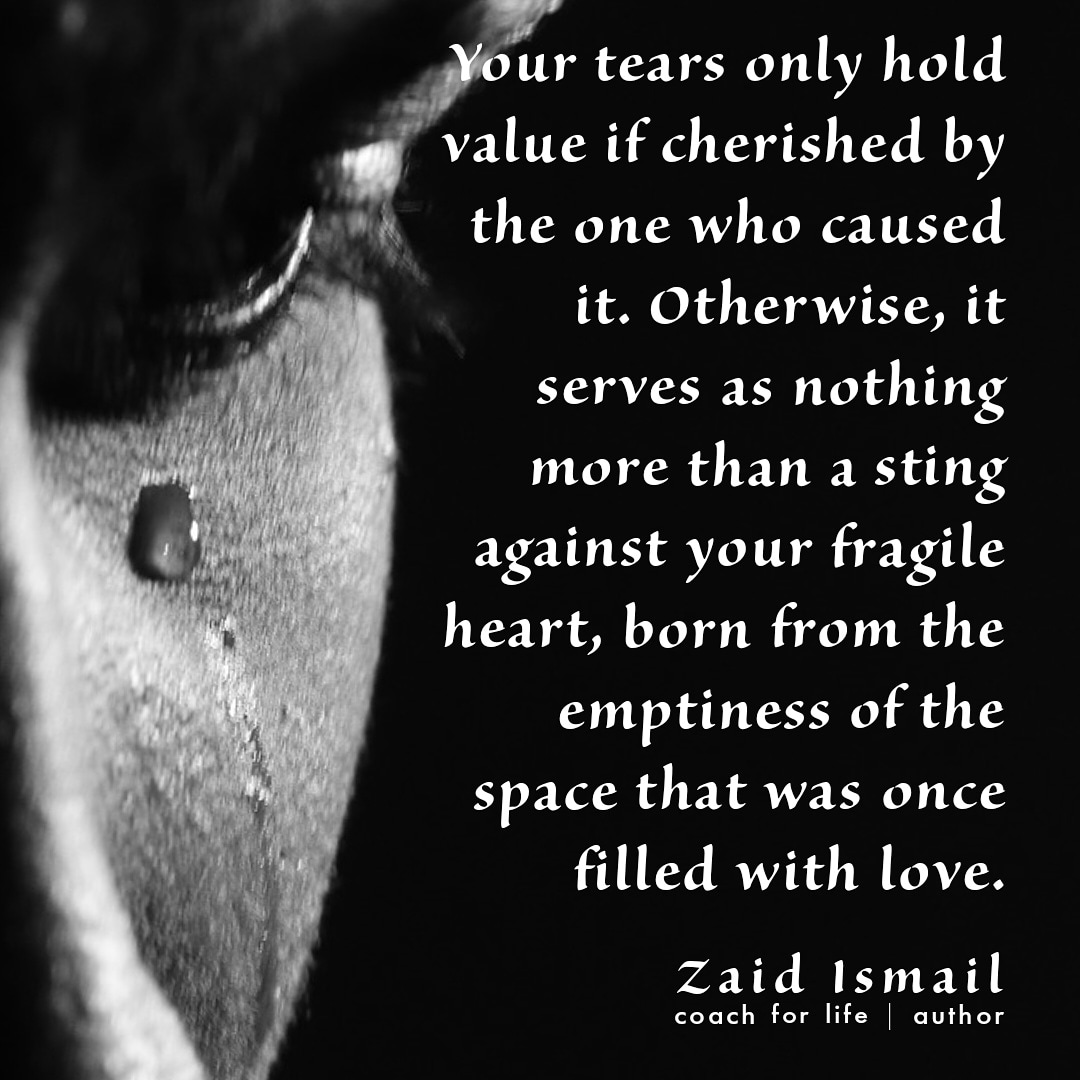
Sometimes your tears are a mourning of what was, and at other times it’s a yearning for what could have been.
More than this, it’s a path to the gentleness of your soul that is oppressed by the trials of life.
When your heart stops yearning for what was, or what you wish could be different, your tears begin to forge a new path. A path towards the hope that you struggle to subdue.
Just like rocks do not bleed, a hardened heart cannot cry. Beloved, take joy from the gentleness that you still possess despite the horrors of your past.
Any bitterness that we court denies us the joy that we deserve, and any joy that we court denies them the bitterness that they hoped to share.
Their bitterness is their heritage of a trial that is not yours to bear.
Breathe, beloved. Breathe. And know that your tears, if shed for them, holds no value for a hardened heart.
If tears must flow, let it flow to forge new paths of joy to replace the failed hopes of the past. But celebrate your tears as testament to the beauty of your soul, and not as regrets for having invested in a heart that was closed to joy.
Photo credit : Adobe Stock
#anincompletelovestory #love #romance #companionship #soulfood #soulmates #authorsofinstagram #romancenovel #mybeloved #zaidismail #lovestory #gbv #abusiverelationship #domesticviolence #selfworth #selflove #selfawareness #selfrespect #mentalhealth #mentalhealthawareness #mentalhealthrecovery
Tag: selfawareness
-
Rocks don’t bleed
-

Uniquely you
When trying to fit in feels burdensome or overwhelming, it may be time to consider that you were created for a purpose greater than just imitating the behaviour of others.
Recognising the uniqueness of who we are becomes difficult if we spend our lives focused on meeting the expectations of others in the hope that we will be accepted.
When we withhold our uniqueness from fear of being ridiculed or rejected, we also deny others the opportunity to experience what is unique about us.
Striking a balance between being true to ourselves and finding a space for ourselves in this world is therefore important.
Claiming our space without consideration for how it is received undermines the value that we hope to create in the lives of others.
It’s through sharing our uniqueness with that of others that we are able to create a new beautiful whole, whereas fitting in with everyone else only maintains the status quo.
Joy is found in striking a balance between being true to your uniqueness, while creating space in your life for the uniqueness of another.
Be true to yourself, but always be purposeful, and authentic.
Photo credit : Adobe Stock
#selfworth #selfawareness #ownyourlife #selfmastery #mindfulness #personalpower #ownyourshit #mentalhealthrecovery #mentalhealth #mentalhealthawareness #lifecoaching #zaidismail #authenticity #ownyourlife -
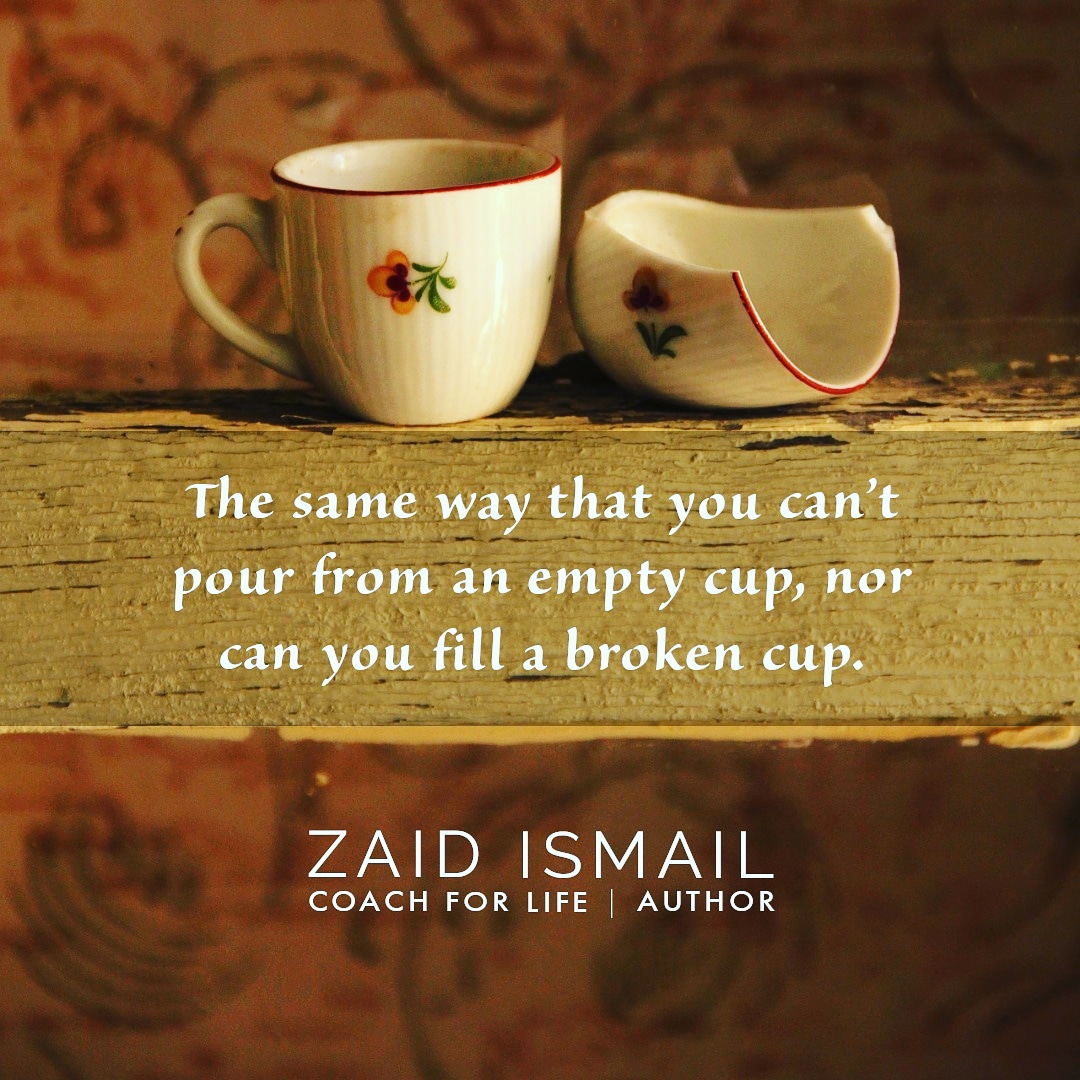
The broken cup
Too often, our focus is on how empty is our own cup.
Sometimes it takes a while before we realise that we’re not taking care of ourselves as we lose ourselves in our concern for others.
So we begin to focus on filling our cup so that the emotional fatigue can finally be overcome.
Sadly, we don’t stop to consider if we’re capable of filling our cup because we don’t realise that it may be broken.
Wounds from the past leave cracks and breaks in spaces that we hope others will mend, not realising that only we hold the key towards mending those cracks.
Sometimes, we don’t realise that someone we love may have a broken cup, and we exhaust ourselves in trying to fill their cup, believing ourselves to be inadequate in our efforts to make them feel loved enough to want to love us in return.
That’s why it’s important to heal before you try to find a home for your heart.
And equally important is the realisation that sometimes it’s not your inadequacy that makes it difficult for them to love you back, but rather their belief in not being worthy of your love that prevents them from embracing you.
Breathe, beloved…slow, rhythmic, deep breaths that fill those spaces left by the calloused hands that handled the most fragile parts of you.
Breathe. Be whole. And then return to love.
Photo credit : Adobe Stock
#hope #expectation #sincerity #selfworth #selfawareness #mentalhealth #mentalhealthawareness #mentalhealthrecovery #selflove #mybeloved #zaidismail #emptycup #anincompletelovestory #relationshipgoals #love #romance #companionship #soulfood #soulmates -
Peace is not the absence of battles
When life feels overwhelming, the most effective way to slow things down is to choose our battles.
Prioritising what’s important over what’s urgent usually sets the tone for what we tolerate or invest our time in, versus what we ignore or postpone.
However, this only creates capacity to deal with new battles that may arise, it doesn’t create space for peace.
Peace often remains elusive because we’re still responding to what comes our way rather than shaping what we want from life.
More importantly, peace begins to feel like the absence of battles. It’s not.
The absence of battles is just a breather. A break from the struggle. But as long as we know the struggle is waiting for us the moment we finished taking our breather, we won’t experience peace.
Peace only becomes possible when we break the cycles that keeps inviting battles into our space.
Breaking that cycle means knowing what we’re doing to feed that cycle of struggles that keep weighing us down.
This demands emotional mindfulness, because it’s how we feel about what we’re facing that determines how we respond. As long as we focus only on the effectiveness of our response, we won’t be able to consciously choose to stop feeding the cycle that makes that response necessary.
It’s not as complicated as it sounds. And peace is very achievable, despite having had a lifetime of pain or hardship.
For more info, check out my website at zaidismail.com or reach out on WhatsApp at +27836599183 for affordable coaching that will bring the change that you so desperately want in your life.
Photo credit : Adobe Stock
#mentalhealth #mentalhealthawareness #mentalhealthrecovery #selfworth #selflove #selfawareness #selfrespect #mindfulness #inspiration #ownyourshit #ownyourlife #theegosystem #embracingME #mybeloved #zaidismail #peacefullife #peace -
It’s not always about you
With due to respect to the author of this quote, I totally disagree with this view. This is why.
It’s one thing to let someone know that you were hurt by something that they did or said. But it’s something totally different to blame them for hurting you.
When you make them aware of how you feel about what they did, that’s owning your response and creating an opportunity for them to understand the impact that they have on you.
When you insist that they hurt you, and deny them the right to say that they didn’t, you impose your belief on their intention behind what they did.
Why is this important? Simple. The moment you blame someone else for your emotional response, you don’t own your response and instead, you give up your power to own your life. In other words, you become a victim of everyone else’s actions.
Worse than this, you become the oppressor after feeling oppressed. Or the hurtful one after feeling hurt, because something completely innocent done by someone else becomes tainted with your trigger to that event. Or your bitterness about something that they are not responsible for.
The same way that you want your emotions to be honoured by others, you need to honour their emotions as well. And you do this by trying to understand why they may do something that is hurtful to you without making it about you.
Seek to understand. Like someone once told me, not all who claim to love, seek to understand. So just because you claim to love someone doesn’t give you the right to blame them for your hurt. That’s not love. That’s abuse. Abuse of the trust that they place in you.
You can do better than that. -
Don’t wait for justice
This world was created for respite, not for justice. Stop waiting for it to be OK before you move on with your life. It will never truly be OK.
And when you eventually do move on, it’s because you stopped waiting for it to be OK, not because it suddenly was OK.
Life is most often wasted waiting for retribution or reciprocation after we’ve been treated poorly or betrayed.
When we wait for such justice to come to pass, it means that we’re more invested in our past than we are in our future.
The irony is that we convince ourselves that we can’t have a future until we get justice for our past.
The truth is, the future only becomes available to us when we have reconciled our contribution towards the outcomes of our lives.
We’ll never be able to get into the heads of those who oppressed us or treated us badly.
Waiting for them to step up and do the right thing is simply perpetuating the very reason why that relationship may have failed in the first place.
The moment you reclaim your voice in your life, you reclaim your future, and you discard the shackles of the past.
This doesn’t mean that by reclaiming your voice the issues from the past that continue to plague you will disappear.
No. What it means is that your response to it will be defined by how much power you want it to have in your future, so that you’ll be able to choose your battles and your conditions for peace more wisely.
Breathe, beloved…don’t forget to breathe. And between each breath, consider if your last breath was invested in your future, or your past…and choose more wisely the purpose of your next breath.
#life #hope #expectation #sincerity #selfworth #selfawareness #mentalhealth #mentalhealthawareness #mentalhealthrecovery #selflove #mybeloved #zaidismail #theegosystem #ownyourlife #ownyourshit #embracingME #motivation #optimism -
Lost moments
The pendulum of time brushes ever so lightly against the arc of eternity, and in that very finite moment of its contact, an entire lifetime is lived. Some are deluded into believing that the pendulum will swing back, realising too late that once the moment is passed, it is lost to eternity.
For some reason, this thought always chokes me up… :'(
Why do people take life for granted and wait for ideal moments before allowing themselves to embrace life more fully and sincerely?
Moments pass so quickly.
The current trends are to catch moments through meditation, long after the moment is lost.
Or to reminisce about why it could have been different if only something else was in place at the time.
The most gut wrenching heartache is caused from moments that held the promise of beauty or peace, but were lost to bad timing, or fear.
I think the secret to living joyfully lies in trusting those who echo the sentiments in your heart.
But such a trust is daunting when it was abused by another, and thus courage becomes a prerequisite for trust.
Discovering the secret of courage then becomes the next pursuit of the heart.
Breathe, beloved…slow deep breaths. And courage will emerge from the depths where it lays dormant after having been subdued by calloused hands.
Photo credit : Adobe Stock
#life #love #mindfulness #selfawareness #selfrespect #selflove #anincompletelovestory #mybeloved #zaidismail #lovestory #authorsofinstagram #romancenovel #ownyourshit #ownyourlife #theegosystem #embracingME -
A silent betrayal
The betrayal of trust is not always due to blatant acts of dishonesty.
Most often, it’s the silence or the restraint from a loved one when their words or their embrace is most needed.
It’s the shrug when we reach out to them or offer them support, or the deliberate obliviousness when we express our need for them.
It’s the trust that bonds hearts that is more fragile than the intellectual trust.
Reconciling dishonesty is easy because we have tangible evidence to work with.
Understanding what’s in someone’s heart when they keep it a secret, or when they become subdued after having been expressive, leads to more anguish than any lie of the tongue.
It is the not knowing that tortures and tests the trust we once placed in someone, especially when all the evidence conflicts with their claims.
That’s when breathing becomes a labour in search of love, and exhaling feels pointless.
Photo credit : Adobe Stock
#hope #expectation #sincerity #selfworth #selfawareness #mentalhealth #mentalhealthawareness #mentalhealthrecovery #mybeloved #zaidismail #trust #betrayal #commitment #companionship #relationshipgoals #soulfood #soulmates #ownyourlife