What brings you peace?
If it’s likes, shares, and comments, then I’m afraid that peace escapes you too.
Reconnecting with the human condition seems to get more difficult by the day with the filters of online life shaping our perceptions and opinions of the struggles or triumphs of others.
Does an authentic human experience still exist in a connected world?
Peace grows ever more elusive when connecting with others is the only soul food you have.
They talk of dopamine and convince you that your emptiness or your fulfilment lies in chemical balances because they themselves lack the appreciation of sincere human connection.
Appreciating the quiet moments becomes more difficult when we lose sight of the value of silence.
The absence of clutter.
The presence of endearing company.
Finding peace in solitude is a gift, and a skill that appears to have been lost to the madness of this world.
Take time to recede, to allow your very valid concerns and urgencies to suspend its calling for long enough to let the breath reach your soul.
When last did you lose yourself in the gentle throb of your own pulse?
#peace #serenity #quiettime #tranquility #solitude #calm #meditation #isolation #worries #fears #introspection #focus #mindfulness #selfawareness #mentalhealth #mentalhealthawareness #mentalhealthrecovery #ownyourlife #coachzaidismail
Tag: peace
-
Elusive peace
-

A bitter end
Holding on to bitterness for a past betrayal is like drinking poison and hoping that your betrayer will die.
Bitterness eats away at your peace while you hope that the intensity of your bitterness will somehow influence the karma of the person who treated you poorly.
If you had that much power, you’d have been able to enforce justice with them already.
The longer you hold on to the bitterness, the more harm you cause for yourself more than any harm that they may have imposed on you.
When you fixate on your reasons to feel bitter, you prevent yourself from considering whether your assumptions about their intentions or motives are true.
You also prevent yourself from seeing the impact of your bitterness on those around you who had nothing to do with that betrayal or hurt caused by someone else.
Sometimes people betray trust because their own fears are stronger than their convictions, and not necessarily because they deliberately wanted to use or hurt you.
Anger in the face of betrayal, even hurt, is understandable.
But just because it is understandable doesn’t mean it’s good for you.
Own how you feel.
Understand what you can do to handle such situations better in future.
Move on.
Life awaits.
#peace #bittersweet #bitterness #selfworth #selfawareness #selflove #selfloathing #selfharm #mentalhealth #mentalhealthawareness #mentalhealthrecovery #justice #remorse #brokenheart #coachzaidismail #ownyourlife -
It doesn’t make you stronger
The belief that what doesn’t kill you makes you stronger is a lie.
It may prepare us for greater trials and opportunities, but we also grow impatient or intolerant when we find ourselves facing the same issues repeatedly.
Life feels fulfilling and purposeful when we solve a problem and move on, but feels exceedingly frustrating when we are compelled to deal with the same problem every day.
Eventually, it’s not the repeated problem that gets to us but rather anyone associated with such problems.
Like going to work and dealing with disrespect or unreasonable demands to constantly have to explain or defend yourself, and then getting home and being faced with similar experiences in a different context.
Those themes that are similar between work and home is what feels like a trigger or a provocation because emotionally, it resonates with the insignificance that we feel in both places.
And the same is true in reverse.
What we experience in our home life preloads us for what we’re willing to tolerate in our public or professional life.
The more mindful we are about this, the less likely we are to rage at those who have nothing to do with our misery. Be they loved ones, or strangers.
Don’t go looking for character building experiences that will make you stronger.
Life has plenty in store for you by design.
#hope #life #ownyourlife #mentalhealth #mentalhealthawareness #mentalhealthrecovery #theegosystem #whatdoesntkillyou #whatdoesntkillus #peace #mindfulness #lifecoaching #zaidismail -
Peace is possible
The belief that what doesn’t kill us makes us stronger is a lie.
Yes, it may prepare us for greater trials and opportunities, but we also grow impatient or intolerant if we repeatedly faced with the same or similar challenge.
Life begins to feel stagnant and suffocating of we find ourselves faced with the same problems every day, every week, every month, every year.
That’s how we grow intolerant towards the challenges that once promised to make us stronger.
Our innate need as human beings is to feel like we are of positive consequence to the outcomes of our lives, and of the lives of those we care about.
Facing the same problems every day goes against that need. That’s why we grow impatient and intolerant.
Recognising these patterns will allow you to change it instead of growing brittle and angry about life.
Emotional mindfulness is at the core of it.
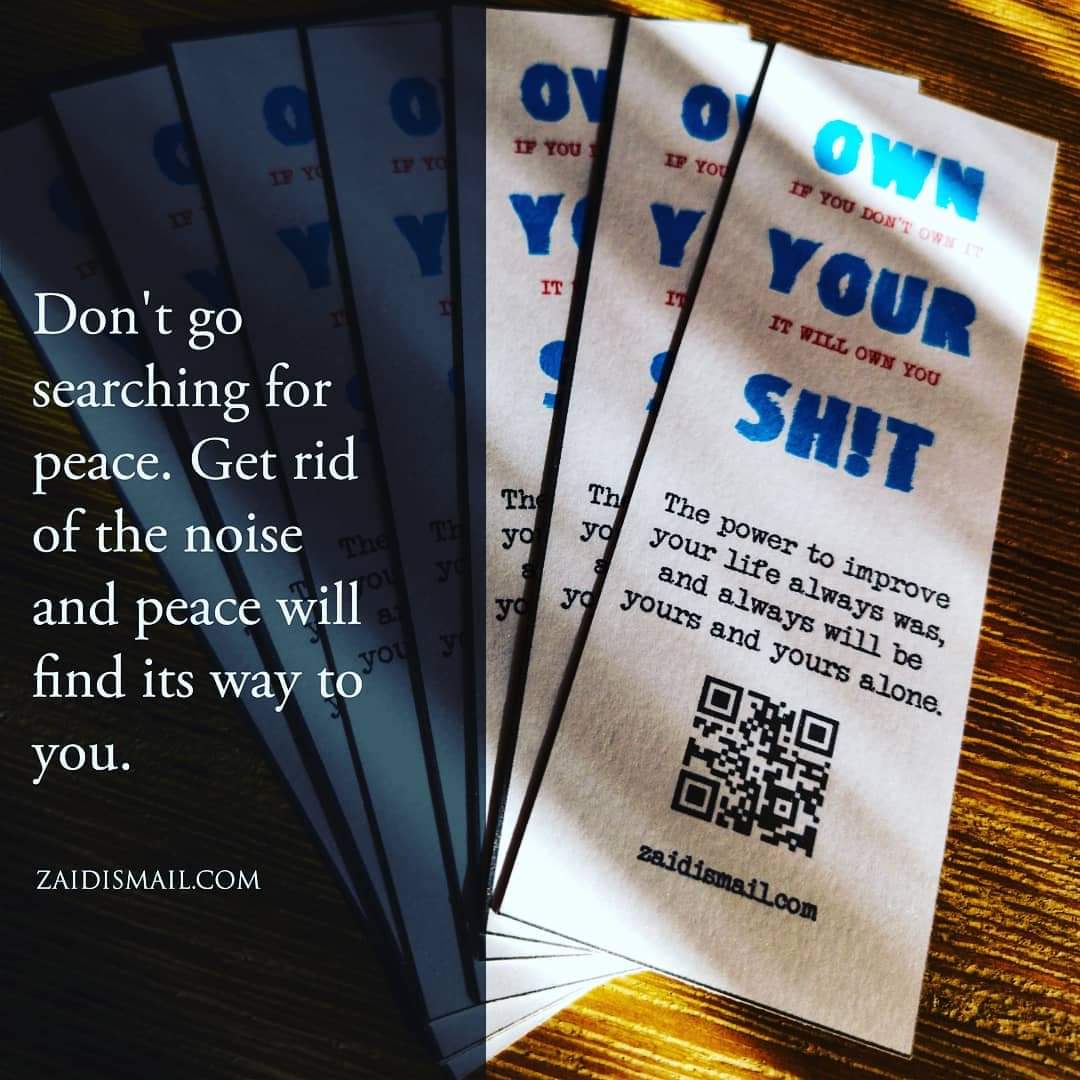
Peace is possible. But first, you need to own your shit. And you can’t own it if you’re not aware of it.
Get your copy of Own Your Shit now.
If you’re in SA, you can order your copy via zaidismail.com for delivery to your door.
International readers can get a copy from Amazon or Book Depository worldwide.
#hope #life #ownyourlife #mentalhealth #mentalhealthawareness #mentalhealthrecovery #theegosystem #ownyourshit #whatdoesntkillyou #whatdoesntkillus #peace #mindfulness #lifecoaching #zaidismail #loveyourself -
Make space for peace
Don’t go searching for peace.
Get rid of the noise and peace will find its way to you.
When you find yourself in darkness, it doesn’t help to try to contain the darkness, does it? Instead, we go in search of a means to create l light.
Similarly, when you’re desiring peace, you need to understand what is robbing you of that peace and focus on resolving that, rather than trying to wish it away by yearning for peace only.
Think about it. Does it help to go on a journey to get rid of baggage if you’re packing the baggage with you for the trip?
That’s why we must take time to recognise what we’re holding onto that brings us discomfort or anguish, so that we can stop investing energy in it.
Remember, it’s not always someone or something that we need to let go of, it’s often how we perceive them, or it, that needs to change.
That’s part of letting go of the noise that doesn’t serve us well so that we can create space for peace in our lives.
Always remind yourself that the opinion that you formed about yourself, or about someone else, was done at a different time in your life, and theirs.
If you can allow yourself to outgrow bad ways, don’t you owe it to others to allow them the same kindness?
And if you’re still judging yourself by a mistake from a different time in your life, then you have yet to understand the true meaning of kindness and compassion.
If you’re grappling with such a challenge, I can assist you to change the narrative of your life for the better. Reach out via my website at zaidismail.com or on WhatsApp at +27836599183 and let’s get the conversation started.
#peace #joy #hope #inspiration #mentalhealth #mentalhealthawareness #mentalhealthrecovery #selfworth #selflove #theegosystem #thebookofmindfulness #ownyourlife #ownyourshit #authenticity #conviction -
Soul food
The physical form demands fulfilment, while the soul demands peace.
Too often, we mistake the fulfilment of our physical needs to be soul food, and we neglect our soul.
As this soul food grows familiar, we seek ever more creative ways to get that fulfilment leading us further into indulgence, and away from peace.
Soul food is the feeling you get from an embrace with a loved one before you notice the scent of their perfume.
It’s the sound of the dove cooing before you admire your beautiful bird bath.
It’s the laughter of family before you notice the luxury with which you clothe them.
Pause.
Take a deep breath.
Look a little closer.
Beyond the physical.
Look at what money can’t buy, or hands can’t manipulate, and you’ll find the divine, sublimely tucked away with the peace that you’ve been searching for, for so long…And remember, what feeds your soul rarely fills your belly.
So don’t be reckless with where you seek fulfilment in your life, because you may just discover that after exhausting yourself in that pursuit for decades, you were only distracting yourself with trinkets that have no soul.
#soulfood #peace #focus #mindfulness #optimisticquotes #mentalhealth #mentalhealthawareness #mentalhealthrecovery #gratitude #appreciation #happiness #hope #optimism #fulfilment #indulgence -
Peace is not the absence of battles
When life feels overwhelming, the most effective way to slow things down is to choose our battles.
Prioritising what’s important over what’s urgent usually sets the tone for what we tolerate or invest our time in, versus what we ignore or postpone.
However, this only creates capacity to deal with new battles that may arise, it doesn’t create space for peace.
Peace often remains elusive because we’re still responding to what comes our way rather than shaping what we want from life.
More importantly, peace begins to feel like the absence of battles. It’s not.
The absence of battles is just a breather. A break from the struggle. But as long as we know the struggle is waiting for us the moment we finished taking our breather, we won’t experience peace.
Peace only becomes possible when we break the cycles that keeps inviting battles into our space.
Breaking that cycle means knowing what we’re doing to feed that cycle of struggles that keep weighing us down.
This demands emotional mindfulness, because it’s how we feel about what we’re facing that determines how we respond. As long as we focus only on the effectiveness of our response, we won’t be able to consciously choose to stop feeding the cycle that makes that response necessary.
It’s not as complicated as it sounds. And peace is very achievable, despite having had a lifetime of pain or hardship.
For more info, check out my website at zaidismail.com or reach out on WhatsApp at +27836599183 for affordable coaching that will bring the change that you so desperately want in your life.
Photo credit : Adobe Stock
#mentalhealth #mentalhealthawareness #mentalhealthrecovery #selfworth #selflove #selfawareness #selfrespect #mindfulness #inspiration #ownyourshit #ownyourlife #theegosystem #embracingME #mybeloved #zaidismail #peacefullife #peace -
Silent Protest
A protest that cannot be articulated, is a protest spawned by futility, to feed futility.
My contempt for what I am presented with is rarely expressed plainly. My reservations to express at all is grounded in years of ridicule and dismissal around issues I have held with great conviction. Experience is a bitter pill, whether swallowed or not. Each cycle of decay results in a shortening of the fuse that prompts us into action. I believe that our response at break point is chosen long before we reach that point. It’s not something that happens instinctively. Instead, it has been internalised for so long that when we do reach that tipping point, no contemplation or deliberation is needed. The response is not intended to be measured. It is intended to finally release the silent protest that we chose not to express outwardly for reasons that suddenly fade from significance.
Silent protests are born when our pleas for sanity or reason go unanswered in a setting that we feel compelled to embrace. It’s a cry for recognition of who we are and what we need that has fallen on inattentive ears, or calloused hearts, leaving us bound to the commitments we once made, while resisting the urge to respond in kind lest we be reduced to the same stature of that which we have grown to despise. But the contempt is not easily expressed. The contempt is reined in to ensure that the commitment remains the priority. After all, in the absence of the commitment, no such claim of aloofness would be credible.
So the silent protest plays out, often for years, and assumes a sub-conscious frame of reference that we rarely realise exists. The weightiness sets in, the lethargy overwhelms, the fatigue smothers, and the passion withers. Life ceases to be life at this point. Instead, it steps aside to allow existence to take over. Existence, then, becomes the final protest. It protests the onset of death, denies the potential of life, and secretly yearns for both.
Breathe. Exhale. Remind yourself why the silent protest started, if indeed you are able to remember, and decide if it is still worth the commitment you are trying to honour. If you can’t remember, then remind yourself about where your passion once flared, and use that as a point to return to in order to retrace your steps to the point where you lost your voice.