
What brings you peace?
If it’s likes, shares, and comments, then I’m afraid that peace escapes you too.
Reconnecting with the human condition seems to get more difficult by the day with the filters of online life shaping our perceptions and opinions of the struggles or triumphs of others.
Does an authentic human experience still exist in a connected world?
Peace grows ever more elusive when connecting with others is the only soul food you have.
They talk of dopamine and convince you that your emptiness or your fulfilment lies in chemical balances because they themselves lack the appreciation of sincere human connection.
Appreciating the quiet moments becomes more difficult when we lose sight of the value of silence.
The absence of clutter.
The presence of endearing company.
Finding peace in solitude is a gift, and a skill that appears to have been lost to the madness of this world.
Take time to recede, to allow your very valid concerns and urgencies to suspend its calling for long enough to let the breath reach your soul.
When last did you lose yourself in the gentle throb of your own pulse?
#peace #serenity #quiettime #tranquility #solitude #calm #meditation #isolation #worries #fears #introspection #focus #mindfulness #selfawareness #mentalhealth #mentalhealthawareness #mentalhealthrecovery #ownyourlife #coachzaidismail
Tag: meditation
-
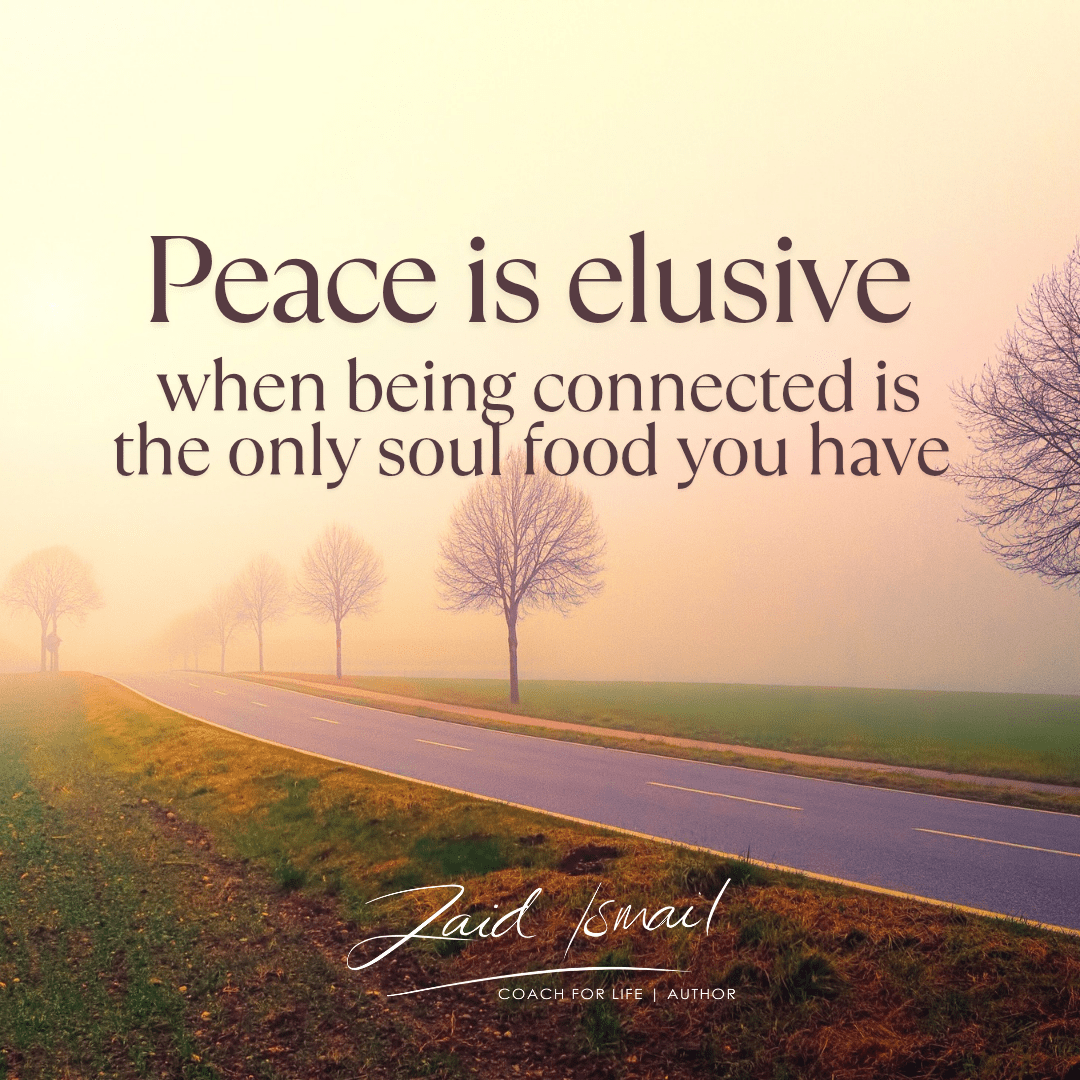
Elusive peace
-

Fleeting Thoughts (VII)
A therapeutic release of clutter is one in which there is no need to string together coherent thoughts.
Coherent thoughts dictate a concern for what came before, or what needs to come after which reflects the earnestness of life.
Life itself does not afford us the indulgence of being inconsequential, or being oblivious to consequence.
Those seemingly oblivious to consequence are simply focused on outcomes that differ with what we may consider important.
Perspective is what you gain when you pay attention to what is not being said.
Unspoken words hold more truth than a blatant show of commitment.
Commitment wanes when expectations are plundered.
Plundering of the soul occurs when those with whom you’ve invested much reciprocate only obligingly.
Obligation fills the gaps, but leave the voids untouched.
Touching yourself deeply holds more hurt and pain than puns of fun.
Sometimes the fun is not just a pun and instead touches you deeply but only briefly.
A brief joy is sometimes more painful than a lasting torment.
Torment is endured when neglect waxes and hope wanes.
Neglect of others forms the bad habits that ends up with the abuse of ourselves.
Abuse is an investment in seeking significance, but without the hope.
Hope is only as relevant as the probability of its fulfilment.
Fulfilment is elusive for the wayward wanderers because a journey without a destination is simply a life without a home.
Home is a journey the heart undertakes each time it needs to breathe.
A breath of air or a breath of sanity is only visited upon the one who sacrificed both in pursuit of either.
To breathe is to hope in the moment that comes next. It is a statement of defiance at the heart breaks of the past.
Heart breaks are bitter sweet. Bitter because of the break, but sweet because of the rarity of the heart that is fragile enough to feel it.
Fragility is sometimes strength, but only if you realise that it requires courage and a brave soul to expose vulnerability.
Vulnerability is only preceived as such for one that does not value conviction or sincerity.
Sincerity is tainted when a fleeting moment defines your entire reality.
Reality is never real. It is always only ever perceived relative to what we wish to take from it.
Give or take. We all are both, but only lament one.
-
Conviction
I always assumed that the key driver that prevented people from making the changes in their lives that they knew needed to be made was a lack of courage. That lack of courage I always assumed to be the result of fear to embrace the new while giving up the comfort zone or the dysfunction that we’ve grown to cope with. But after an interesting discussion with an undefined acquaintance yesterday I realised that there may be another dynamic to all this that I failed to notice. That dynamic is the issue of pride. Pride is what keeps most of us stuck in ways that we know are sub-optimal in our lives, but we stubbornly persist in our ways because backing down is so strongly associated with failure.
I think in that lies the key to understanding the influence that pride has on our convictions. Convictions, I’ve always believed, is a reflection of priorities. That which we place more emphasis on will receive a greater investment of energy, while everything else will fall in line behind that. So if the way we’re perceived by others is a higher priority than the way we find contentment in our personal space, then it stands to reason that we will nurture those behaviours that sustain that perception rather than make the adjustments that will give us peace. Say hello to chronic ailments and mental disorders. But I’ll leave that rant for another time.
The cycle doesn’t start/stop there because the question then arises as to what it is that influences the priorities that we choose for ourselves? The fact that these priorities are a result of an evolutionary process as we grow and is most often not a distinctive thought process that we experience consciously implies that we’re mostly unaware of these priorities that drive us. I guess in this case priorities are pretty much the choices we make in life. When those choices are well-informed, they serve us well. When they’re not, they drive us towards nurturing perceptions rather than substance.
The underlying drivers that prompt us to make these choices are our beliefs in our ability to be successful in the choices we make. More simply stated, if we are confident we’ll be successful, we’ll be more inclined to pursue the change or the improvement. But if we doubt our ability to reach that goal, we’ll compensate by finding distractions or excuses as to why it’s not possible or important for us to pursue it. That’s where that pride factor comes in. The more proud we are, the less likely we’ll be to expose ourselves to situations where failure is a real possibility. The only time we pursue such ‘risky’ endeavours is if we believe that the repercussions of not doing so would be more severe than the repercussions of failure, which brings us back to the issue of priorities.
If it’s more important for me to maintain the façade I created about the perception of success that I think others hold of me, I will sacrifice relationships or rights that others have over me, because fulfilling those rights or maintaining those relationships is not as important to me as being perceived as a success. Success in this case is not limited to material targets or wealth, but can also relate to simple things like being seen as independent, aloof, or righteous, to name a few examples.
Taking all this back to the opening thoughts, the correlation between the perception of failure if we back down, versus the pride of not wanting to be seen as a failure explains why it is that even in the face of overwhelming odds, we sometimes hold on to behaviours that we know are detrimental to our wellbeing. When the motivation to move forward is greater than the motivation to maintain the façade, that is when conviction will triumph over cowardice. However, I guess if we really wanted to, we could argue that conviction in maintaining the façade is what drives that behaviour as well, so it may be safe to say that conviction can be misguided if pride steps into the equation. And pride, as we know, is a result of focusing on what others think of us rather than being true to what we think of ourselves.
Perhaps conviction is more accurately associated with the latter, as in how we perceive ourselves? Pride prevents honesty in that introspection process because if we perceive ourselves through the eyes of others, we immediately curtail perspectives that may uncover flaws that we know will detract from that perception. This thought process is exhausting. I think that’s a pretty accurate reflection of why most people avoid it, and as a result, why we have so few that act with meaningful conviction and so many that behave like attention whores or victims to society. I suspect there isn’t much difference between the two.
