Assumptions are those things that eventually appear as facts because we’ve been making those assumptions for so long that we don’t see reason to question it any longer.
It’s a theme that sets in over a long period of time, and becomes the lens through which we see the world.
More importantly, it becomes the lens through which we see ourselves.
When we lose sight of these assumptions, we either become delusional about our success, or self-deprecating about our inadequacy.
Either way, it denies us a harmonious and fulfilled life.
As we respond to the demands of life, we slowly grow convinced that we were compelled to do much of what has contributed towards the quality of our life.
For example, it’s the avoidance of homelessness that drives many to seek employment, or the need to pay debts that convince us to spend wisely, or the need to hold on to our jobs that drive us to improve our knowledge and skills.
Each of those are driven by fear, even though we may find some joy or accomplishment in them.
When fear is the underlying motivator that drives us to accomplish big goals, we soon find ourselves wondering once more, “OK. What’s next?”
We end up chasing life and slowly getting worn down when we lose sight of the fact that regardless of the reason why we HAD TO DO something, our ability to do it was a true reflection of our capability.
That’s the part that we should focus on. Our capability, not the fear that drove us to be capable.
Take away the fear, and suddenly you’ll realise that you don’t need an external motivator to accomplish goals in life.
You just need to recognise your own abilities, and develop your own vision for the life that you want.
It’s really that simple.
It always starts with you.
Own Your Life.
#hope #expectation #sincerity #selfworth #selfawareness #mentalhealth #mentalhealthawareness #lifecoaching #zaidismail #loveyourself #lifegoals #motivation #optimism #purpose #ownyourlife #theegosystem
Tag: mentalhealth
-

Assumed to be inadequate
-

Defending myself into misery
Defensiveness is driven by a belief that you’re under attack.
Hence the need to defend ourselves when someone tries to correct us.
The defensive response on our part confirms that we assume their intention to be other than genuine concern for what we’re experiencing.
We also assume that we must be right to feel a certain way, and therefore shut down any opportunity to understand why someone’s hurtful or offensive behaviour may be a reaction to their own emotional duress.
We don’t justify it, but it makes it easier to understand it and respond more effectively to it if we pause to understand the real reason for it.
The most common reason for feeling emotional is fear.
In various forms, it is the fear of loss, or the fear of being insignificant that causes emotional duress.
Therefore, when we choose to honour our emotions above all else, we’re in fact honouring that fear and preventing ourselves from understanding and undoing the grip that it has on us.
We’re human. So we don’t expect to never get emotional.
What’s important though is how long does it take us to regain our composure after feeling the emotional impact of an experience, rather than not feeling emotions at all.
Be careful about losing your sense of self to your emotions, and then insisting that the emotional state is simply who you are.
Moderation in everything.
#mentalhealth #mentalhealthawareness #lifecoaching #zaidismail #loveyourself #ownyourlife #theegosystem #selfworth #selflove #selfawareness -
Collective guilt, collective malice
One of the trappings of the victim head space is that it convinces us to surround ourselves with those who will understand why we’re weak, or why we behave badly, because they themselves struggle with similar demons.
Our need to avoid rejection or to feel validated causes us more harm than good.
The comfort that we get from that is fleeting, while what is important to us is neglected.
It’s like placing a band aid over a festering wound to prevent chafing.
It may offer a very brief comfort, but the wound eventually turns septic and results in long term pain.
It’s for this reason that we avoid sincere advisors who push us to get out of the rut that we’re in, while polarising towards those who pacify us about being in that rut because they’re so understanding.
That’s how we surround ourselves with those who share our shortcomings and our excuses, while we convince ourselves that we found our tribe.
Sins are not sinful because it carries with it the threat of damnation or divine punishment. They’re sinful because they’re an injustice against our soul.
An injustice against ourselves results in us treating others unjustly.
Virtues become sins when applied maliciously or excessively, and sins can be received as a virtue when it uplifts with kindness more than the harshness of religiosity can achieve.
If we’re not careful, we’ll celebrate our virtues because it is supported by those who are equally distracted by their self-praise, while harming others because of our arrogance in worship.
How often hasn’t overt worship been the safe space for abusers and oppressors, while the meek pray silently in the darkness?
Be mindful of who you surround yourself with, and what calibre of advisors you seek.
Otherwise, you may end up destroying yourself while feeling like it was your destiny not to find happiness.
It always starts with you.
#justsaying #mentalhealth #mentalhealthawareness #lifecoaching #zaidismail #loveyourself #lifegoals #peerpressure #selfworth #selfawareness #ownyourlife #theegosystem -
Kill the label. Kill the stigma.
⚠ Trigger Warning ⚠
The moment we attach a label to a life experience, we focus on the label and discard the merits of the experience.
We make people invisible when we deny the reality of their experience by suggesting that there is something clinically wrong with them, despite causality of their emotional upheaval being clearly associated with their experiences in life.
When we readily embraces such labels, it disempowers us to make sense of, and to rise above that which weighs us down.
When we create such detachment from the cause of our duress, it denies us a voice in expressing our hurt or pain.
Instead, it convinces us that we’re defective in some way.
When the shame of such labels grows to define how we appear to others, we find familiarity and a common cause with others who suffer a similar struggle, resulting in a victim mindset that focuses on claiming their space as struggling humans who are afflicted with mental illness.
That’s how we break each other down as humans, while building each other up as victims.
You cannot break the stigma of mental health by undermining the humanness of the ones affected by the stigma.
We need to see the human behind the labels that we throw at each other.
Until then, compassion and empathy will continue to be in short supply.
Kill the label, kill the stigma.
#mentalhealth #mentalhealthawareness #mentalhealthrecovery #suicide #suicideprevention #suicidalawareness #suicideawarenessmonth #depression #anxiety #ownyourlife #theegosystem #embracingME #zaidismail #lifecoaching -
Bitter sweet nostalgia
Nostalgia is a beautiful thing, if we connected with the joy in those moments.
Otherwise, it is torturous, as we remind ourselves of what we’ve lost, while losing the present moment along with those memories.
Mindfulness of the blessing of the present moment is the only way to live a fulfilled life without courting regret.
Unfortunately, we spend so much time taking the hurts from the past, using it to interpret what’s going on in the present, while projecting the outcomes on the future, that we forget to even live in the moment.
That’s when bitterness sets in as we wait for others to recognise our struggle, or to empathise with our state.
The impact of life is what we choose it to be.
The moments of hardship or loss are only ever single moments.
What we take from those moments are the choices we make based on how we see ourselves, and what we want others to see in us.
The less aware we are of this, the more we lose ourselves to the struggles of life, resulting in an obliviousness of the present moment that causes us to make uninformed decisions which lead to more regret.
Living inside your head is never a recipe for a fulfilling life.
Connect with the present moment, and when you have the last time of a good thing, it may be bitter sweet. But it will be more sweet than bitter.
#hope #expectation #sincerity #selfworth #selfawareness #mentalhealth #mentalhealthawareness #lifecoaching #zaidismail #loveyourself #theegosystem #ownyourlife #nostalgia -
The courage to parent properly
The courage that is needed, is the courage to seek sincere, informed advisors to help us to understand why we may be struggling to connect with our children.
We don’t know what we don’t know.
If we try to figure life out by ourselves, we’ll only ever learn the hard way, from our own mistakes.
While some may think that to be a fun or rewarding approach, we need to stop to consider how those mistakes negatively affect those around us.
Making mistakes is inevitable, but making avoidable mistakes is irresponsible.
Insecurity as a parent shows up when we see every act of non-compliance as an act of blatant defiance.
When we’re insecure about who we are, that becomes the lens through which we interpret the motives behind the actions of those around us.
But we don’t see that lens, because we’re distracted by needing to establish our authority or our significance, because we think that’s how we need to instil respect and good manners by not letting ‘them’ take advantage of us.
The moment this is your mindset, understand that you’re insecure about your position or your role, and your reaction to that will cause more harm than good, despite your best intentions.
Give yourself a break, and give your children a chance.
Learn from the mistakes that raised you to be insecure, by reflecting on why those who raised you couldn’t have known better.
And do your part to reduce the reasons your children will have to reflect on such matters that negatively affect their sense of self.
[this is an incomplete thought process, but worth sharing]
#parenting #mentalhealth #mentalhealthawareness #lifecoaching #zaidismail #singleparenting #raisingadults #selfworth #selfawareness #ownyourlife #theegosystem -
Judge as you wish to be judged
We speak from a position of privilege when we judge the failures of others within the context of what is possible for us.
Even something as simple as the resolve we have, or the choices we made to rise above a challenge, comes from a place of assuming that our emotional resilience is the same as theirs.
When we assume that everyone is equal, we deny the human struggle that affects all of us differently.
Something small for one, could be a mountain for another.
And the mountains that some climb every day because of their circumstances, could be overwhelming for those of us who were never faced with such trials.
Comparing our efforts and accomplishments with that of others who are going through similar challenges that we once experienced is an act of arrogance, not support or concern.
If we are sincere in uplifting or supporting others, then we must seek to understand the reality that they are facing, rather than judging them through our view of reality.
After all, isn’t that what we cry about in the silent, dark hours, when we feel misunderstood or unappreciated?
We treat others the way that we treat ourselves.
When we judge ourselves harshly, or have no reason to expect support from those we cherish, we hold similar expectations of others who we find struggling.
We expect them to ‘man up’ or to ‘put on their big girl panties’ and just move on.
That’s how compassion and empathy are lost, and insensitivity becomes the standard by which we view others.
Choose compassion.
Reclaim your humanness.
#hope #expectation #sincerity #selfworth #selfawareness #mentalhealth #mentalhealthawareness #lifecoaching #zaidismail #relationshipgoals #compassion #empathy #theegosystem #ownyourlife -
The arrogance spawned by fear
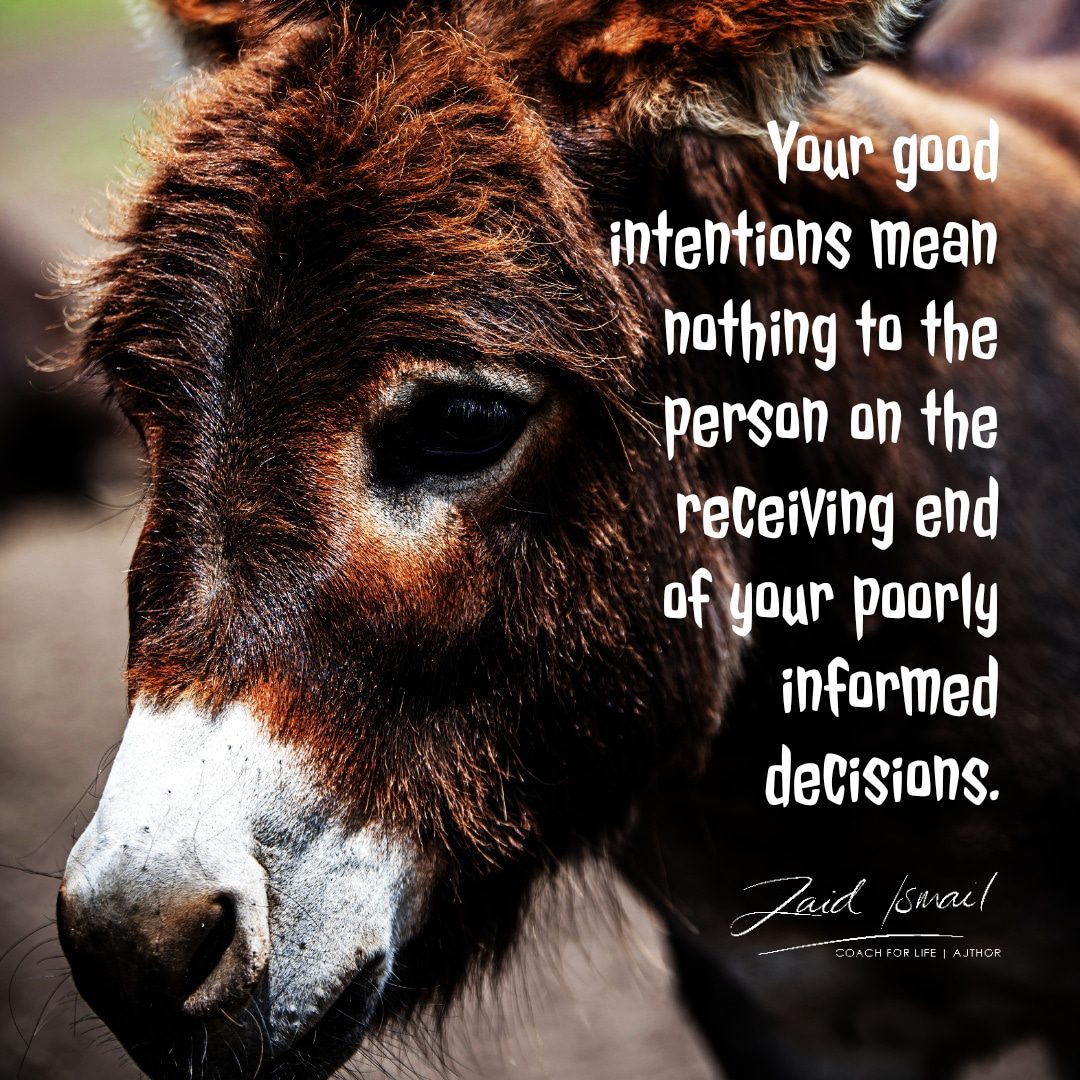
Fear causes us to fixate on our intentions, while defending the bad behaviour that such fear spawns.
The fear is most often associated with what we think is under threat, or that others won’t understand.
So we begin preempting what they intend towards us, or what threats they present to what we want for ourselves.
When we are driven by fear, we focus on finding all the evidence that validates our fear, and we subsequently ignore all the evidence that proves us wrong.
Because we don’t want to be wrong.
Because being wrong adds to the fear of not achieving our goals.
So we become defensive, aggressive, abrasive, arrogant, rebellious, and more in our efforts to protect what we assume to be under threat.
And in the process, we turn friends into enemies, and supporters into demons.
And when the intensity of the fear passes, or when we achieve our goal at any cost, we expect others to accept our good intentions without accepting accountability for the impact of our fear-driven behaviour on them.
That’s how we diminish the impact of the harm that we cause, when we fixate on our intentions and treat our fear-based assumptions as facts.
And that’s how we become a source of abuse towards others while we are convinced that we were victims of their lack of understanding.
That’s how arrogance is nurtured, and important relationships destroyed.
It always starts with you.
Own Your Life.
#selfworth #selfawareness #ownyourlife #theegosystem #mentalhealth #mentalhealthawareness #lifecoaching #zaidismail #gratitude #relationshipgoals #authenticity