When you find yourself putting your dreams on hold because you’re waiting for others to confirm that it’s a feasible project, or that you’re capable of achieving it, know that it’s not a dream. It’s simply a wish.
Dreams can either be an indulgence of escapism, or it can be a seed of passion.
Most use it as escapism to wish away the state of their lives, while believing that they’re oppressed by not having the opportunity to pursue their dreams.
Unless you are being physically restrained from making that big change, or taking that next step, your dream is yours to claim, or yours to abandon.
By the way, there’s nothing wrong with escapism, or daydreaming.
As long as you accept the purpose behind such moments and you don’t use it as reason to blame others for the lack of passion or progress in your life.
Caution: If you chase your dreams at the expense of important relationships, no matter how much your success will be celebrated by strangers, success will feel hollow.
So strike a balance between pursuing your dreams while being sure not to shut significant others out of your journey towards achieving it.
Moderation in everything.
Remember, once you’re successful, it’s a lot more difficult to determine who is sincere towards you, versus who is using you for your wealth or status.
So leave the door open for those around you to join you on your journey when they’re ready, but don’t stand at the doorway waiting for them before you pass through it.
Success is most enjoyed when we can share it with those we love. Otherwise, we’ll find it at our is never enough as we continue to seek fulfilment in achieving more, because we have no joy in what has already been achieved.
#hope #expectation #sincerity #selfworth #selfawareness #mentalhealth #mentalhealthawareness #lifecoaching #zaidismail #loveyourself #lifegoals #motivation #optimism #purpose #mindfulness #inspiration
Tag: inspiration
-

Own your dream
-

The enemy of mindfulness
We find ourselves in a state of duress, or stress, when we lose sight of what we can influence, whi fee helpless in the face of everything that we think is out of our control.
Whenever we’re faced with a problem, we either focus on mitigating the impact of the problem on us, or we focus on the opportunities to overcome the problem.
When we convince ourselves that the problem is bigger than us, and we also believe that walking away from it is not an option, or possible, we slip into a victim state of mind that weighs us down.
As a side note, whenever something appears impossible to resolve, it means that we have gaps in our understanding about what’s causing it to occur.
At that point, we should set out to seek a better understanding of the problem, rather than persisting in trying to find an answer with the limited information that we have.
This is the kind of thinking that needs to be applied when we’re faced with challenges in our lives.
The most common reason for feeling overwhelmed by life is because the assumptions that we made over the years about our significance or our ability to influence important relationships have grown to become the truths by which we live.
So we don’t even think of questioning those assumptions, despite circumstances having changed over the years, and more importantly, despite us having grown over the same period.
Becoming aware of these assumptions that we make when trying to solve any problem is the first critical step towards searching for answers.
But, mindfulness is needed to regain such perspective, and mindfulness is lost to the victim mindset.
The victim mindset is one that leaves us feeling defensive, or defenseless. Reclaiming your ability to positively influence the outcomes of your life then becomes the important problem to solve.
It always starts with you.
#hope #expectation #sincerity #selfworth #selfawareness #mentalhealth #mentalhealthawareness #lifecoaching #zaidismail #loveyourself #lifegoals #motivation #optimism #purpose #mindfulness #inspiration #personalp -
Escaping addiction
It’s not drugs that steal our children from us. Like us, they also need to feel significant.
Taking drugs is not just a bad habit. It’s a means to escape what we don’t want to deal with in the world around us.
Is it a bad decision? Absolutely. Because escaping something never resolves it, it only defers it to a later time.
But we all indulge in escapism of some kind, that’s why we have little to no communication in homes that centre around technology or social media, leaving the young ones struggling to find a space in which they belong, physically and emotionally.
The emotional connection that they then forge with fellow escapees is what makes drugs the escape of choice.
If we treat them as addicts, they will behave like addicts. If we deny what is lacking in their emotional make up, we’ll deny ourselves the opportunity to address it.
Addressing it doesn’t only benefit them, it also benefits us because the only reason that they would feel emotionally isolated is because we’re not emotionally accessible.
That means that we’re also denying ourselves the sweetness of life because if we’re emotionally unavailable, then we’re convinced that what is important to us is not important to anyone else.
That’s why we lose ourselves to duty and dismiss any demands to be emotionally available for those around us.
That’s how we create the environment that makes substance abuse or gambling, or other escapes attractive as a coping mechanism.
Break the cycle.
It always starts with you.
#drugs #addiction #narcissisticabuse #narcissisticparents #youth #selfworth #selflove #selfawareness #selfrespect #mindfulness #inspiration #lifecoaching #zaidismail #ownyourlife #theegosystem #mentalhealth #mentalhealthawareness #mentalhealthrecovery -
When sincerity is tested
Like the old saying goes, talk is cheap, and actions speak louder than words.
It’s easy to say the right thing, especially when times are good and what we’re committing to is convenient.
However, when our commitments pull us between what we want for ourselves versus what we committed to doing for someone else, that’s when our sincerity is tested.
But what defines our sincerity?
Is it how we want to appear to others or how we live by the values that we stand for?
The moment we’re focused on what others think of us, we play to the responses that we want from them, even when we’re doing something good.
The problem with this is that without realising it, our motivation slowly shifts from living by our values to how we are perceived by others.
That’s the beginning of how we lose ourselves to the attention that we get from others.
More than this, the lower our self-respect, the more inclined we’ll be to say the right thing while finding it difficult to do the right thing.
That’s when making excuses for our behaviour becomes easy when others challenge us about the commitments that we haven’t honoured.
This is an indication of a low level of self-respect.
Self-respect is tainted when we lack gratitude for who we are.
The more we dismiss the value of who we are, the more we’ll need validation from others. Hence the unhealthy cycle of focusing on what others think of us, versus being true to who we are.
We’ll only be true to who we are if we truly value who we are.
For this reason, don’t expect sincerity or consistency from one who is self-loathing. And realise that you are self-loathing when you struggle to be consistent or to follow through on the commitments that you make to others.
It always starts with you.
#sincerity #action #conviction #mentalhealth #mentalhealthawareness #mentalhealthrecovery #selfawareness #selfrespect #mindfulness #inspiration #selfworth #lifecoaching #zaidismail #loveyourself -
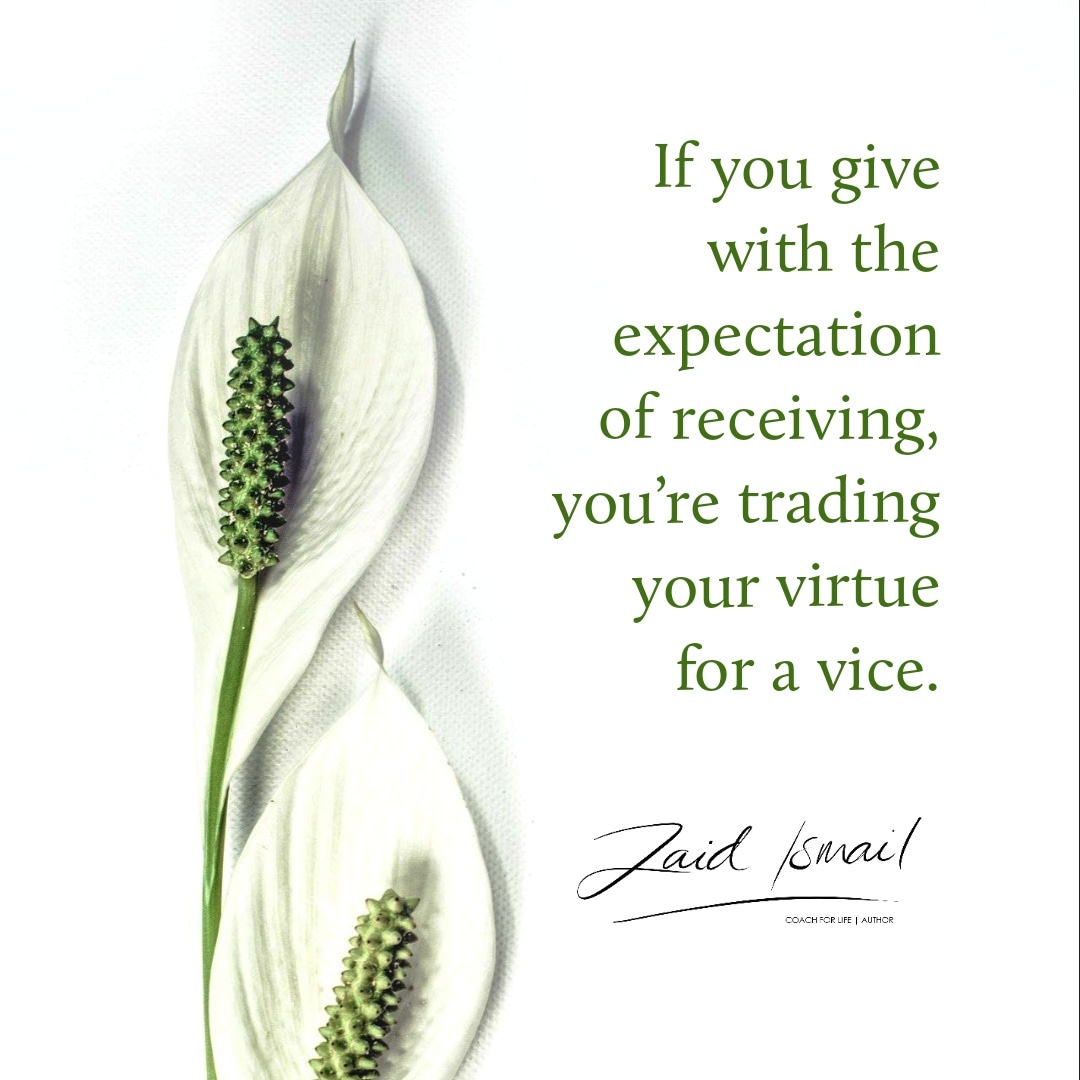
Don’t trade your virtues for vices
Don’t withhold the beauty of your spirit just because there is no one around to appreciate it.
Be who you are, and let others be who they choose to be.
The expectation of being treated the way we treat others is what causes much bitterness and anger.
It’s not worth it.
Give without the expectation of receiving. And when you don’t receive, give some more.
Waiting for others to return the favour before we do more, denies us the fulfilment of being who we are, while compromising our values to be who they are.
Remember, we cannot give what we don’t have.
When you withhold your gifts because you’re waiting for others to respond in kind first, you’re assuming that they have within them what drove you to give of yourself in the first place.
It’s a crazy cycle.
Break it by giving without the expectation of receiving from them in return.
That’s the secret to fulfilment and contentment in our lives.
When we expect something in return, we deny ourselves that fulfilment and we turn our good deeds into transactions.
When we transact with our virtues in that way, not only do we diminish the value of what we’ve done and who we are, but we also end up treating others the way that they’ve treated us.
That’s how we lose ourselves to our expectations from others.
It always starts with you.
#hope #expectation #sincerity #entitlement #gentleness #conviction #ownyourlife #theegosystem #mentalhealth #selfawareness #selfrespect #mindfulness #inspiration #philanthropy #generosityofspirit #givingback #lifecoaching #zaidismail #loveyourself #mentalhealthawareness #mentalhealthrecovery #mentalhealthmonth -
Allow your children to be their own person
We always have good intentions when we strive to give our children everything that we didn’t have.
Often, this includes protecting them from the hardships or difficulties that we experienced.
Unfortunately, when we do this, we end up protecting them from reality, and in the process, we deny them the very life lessons that taught us to appreciate what we have.
This is one of the most common reasons for kids growing up to be timid, entitled, or disrespectful…or all of the above.
Hardships and difficulties are character building experiences.
Find a way that strikes a balance between allowing them to experience it, and providing guidance and support as they navigate their way through it.
Too many assume that hardship is a denial of a good life.
It’s not.
Allow them to earn their privileges so that they’ll experience gratitude and fulfilment when they achieve it.
Lastly, when you shy away from something that weighs you down, or you try to hide it from them, you’re teaching them to feel ashamed of getting things wrong, or failing at achieving goals.
That’s how we raise them with a value system that conflicts with the kind of humans that we want them to be.
Be mindful of your rule as a parent, but more than this, be mindful of your contribution as a human being.
It always starts with you.
#parenting #children #fears #raisingadults #ownyourlife #theegosystem #mentalhealth #selfawareness #selfrespect #mindfulness #inspiration #youngadults #mentalhealthawareness #mentalhealthrecovery #selfworth #selflove #selfawareness #lifecoaching #zaidismail -
What are you waiting for?
I’ve often advised someone about something that I truly believed them to be capable of achieving, and the response I received was, “Not everyone is like you!”
Henry Ford said, “If you think you can, or you think you can’t, you’re right.”
Sadly, too many think that they can’t, and then blame the world for the state in which they find themselves.
But why would someone willingly put themselves down, or sell themselves short?
Did I hear you say fear of failure? No. That’s what we see, and often what they feel on the surface.
Dig a little deeper and you’ll realise that failure is such a threat because it threatens to reduce our significance among those who are important to us.
It’s the threat of insignificance through being incompetent or unsuccessful that fills us with the fear of failure.
But, we must always remember that fear is only the response to what we’re assuming is the probable outcome of our efforts.
In other words, when we’re convinced that we won’t be able to accomplish something, or we have doubts about achieving it, the assumptions that we’ve made is what we’re focused on. Hence the feeling of dread or fear when we contemplate the future outcome.
Hence the fear of failure.
The important question to consider is therefore not if we’re capable of achieving that goal, but rather why is our feeling of significance as a person defined by our level of success?
And before you say it’s because people judge you as a failure if you don’t accomplish things the way you’re expected to, the next question you should be asking is why does the judgement of others define your self-worth more than your opinion of yourself?
People’s opinions will only weigh you down if you give them permission to do so.
Talking about permission, when was the last time you gave yourself permission to learn from your failures instead of judging yourself for failing?
#optimisticquotes #mentalhealth #selfworth #selflove #selfawareness #selfrespect #mindfulness #inspiration #ownyourlife #theegosystem #embracingME #lifecoaching #zaidismail #loveyourself #lifegoals #motivation #optimism -
The need to be godly
Godliness, like humility, is lost the moment we lay claim to it.
It is something that we may exhibit in our conduct or demeanour, but not something that we can directly claim.
It is our ability to manifest the attributes of the divine in our character and in our treatment of others without wanting to appear pious or godly in our approach.
The need to claim such attributes of godliness reflects the insecurity that we feel about our standing among those around us.
The moment we’re focused on how we appear to others, we begin to lose ourselves to their validation.
Similarly, the moment we claim godliness, we lose ourselves to arrogance.
And arrogance is only required to compensate for our insecurities. It is a mask to hide our shame, or to claim our needs because we believe that we’re not significant enough for others to want to care about what we need from them.
That’s why we take, instead of waiting to be offered. Or why we insult or demean rather than advising sincerely.
It’s all a means towards demanding that our virtues be acknowledged because we feel unappreciated by those we care about the most.
If you don’t appreciate who you are, in the absence of validation from others, how can you expect others to appreciate you?
Gratitude begets sincerity, and sincerity fosters brotherhood. Or sisterhood. And claiming divinity or godliness has no place at all.
#compassion #sincerity #authenticity #mentalhealth #mentalhealthawareness #mentalhealthrecovery #selfworth #selflove #selfawareness #selfrespect #mindfulness #inspiration #ownyourlife #theegosystem #forgiveness #rewards #lifecoaching #zaidismail