You know that awkwardness that you feel when someone says something that you know is right but you’re not ready to hear it?
Or when a sincere advisor or significant other points out something you’re doing that isn’t helpful or good for you, and you get defensive about it?
Those are hints at the shame with which you view yourself regarding that habit or character trait.
When we judge ourselves harshly, we grow defensive the moment someone draws attention to what we already feel insecure about.
On the surface, we feel justified in defending ourselves because we feel judged.
However, if we weren’t already judging ourselves, we wouldn’t feel judged, we’d feel misunderstood.
Choosing whether or not to clarify that misunderstanding then becomes a matter of how much importance we place on the one who is making the incorrect assumption about us.
But when we feel judged, it’s much more difficult to be selective about who we get defensive with and end up in full attack mode on people who don’t deserve it.
The shame that we feel about ourselves is because we’re still seeing ourselves through the eyes of those we feel were never proud of us. Usually one or both parents.
Until we realise this, we’ll go through life believing that we are unfairly judged without being open to growing beyond that because in our obsession with defending ourselves, we were never open to receiving good advice on how to be better.
It always starts with you.
#ownyourlife #theegosystem #mentalhealth #mentalhealthawareness #lifecoaching #zaidismail #loveyourself #lifegoals #selfdevelopment #mindfulness #relationshipgoals
Category: Self Worth
-

The shame within
-

Dream killers
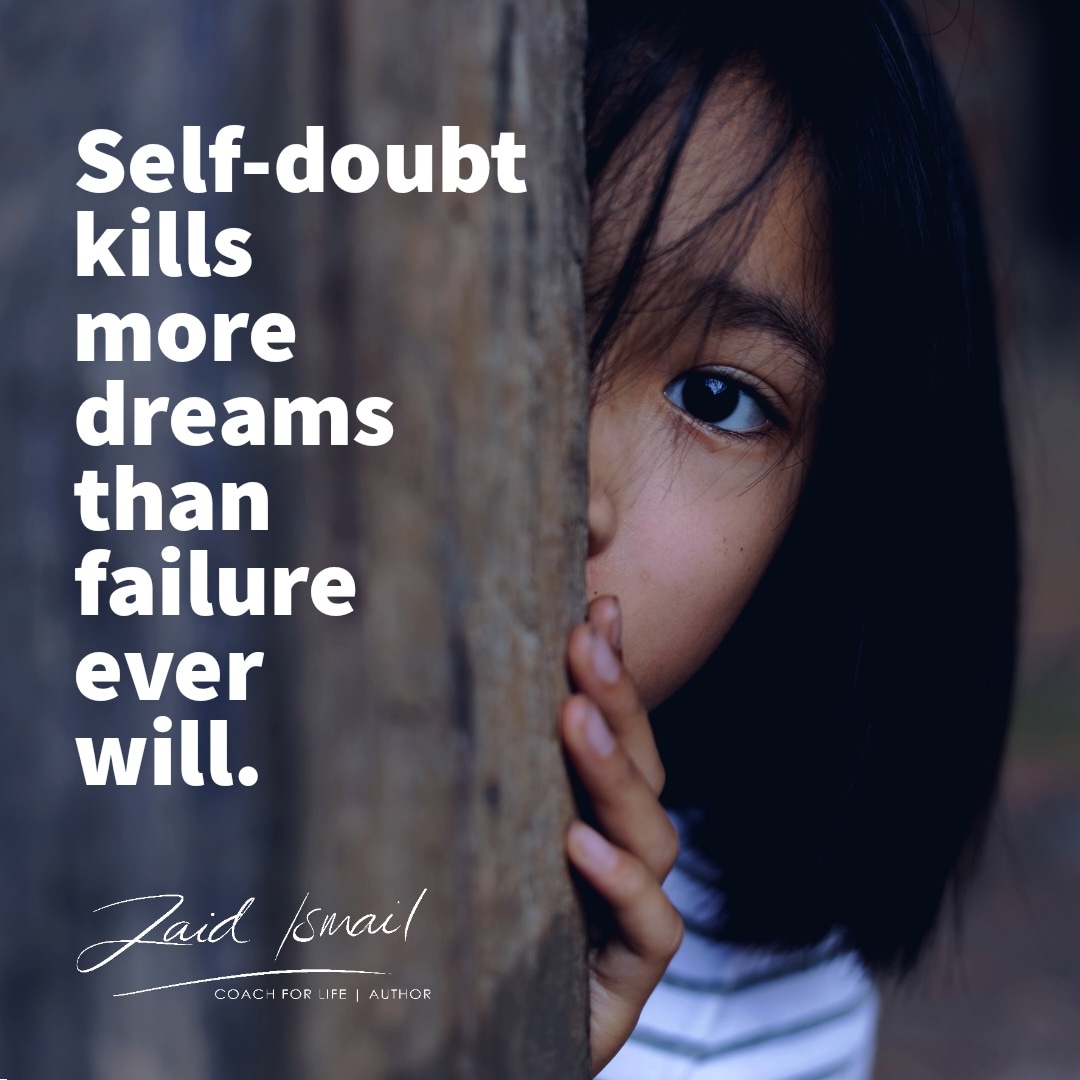
Do you find yourself waiting in the shadows, wondering when will it be safe to emerge and take that risk on something that you’ve always dreamt of achieving?
Are you waiting for the perfect moment to ensure that you get it just right?
Or do you find yourself mentioning it to any person that shows an interest in what you’re passionate about, always lighting up with excitement when you talk about it, but also ensuring that you have a good argument as to why you can’t do it just yet?
All the above is most often driven by self-doubt rather than the due diligence needed to ensure that you understand the dynamics to be successful at your passion project.
Due diligence has its place. But only in good measure. Otherwise it ceases to be due diligence and results in analysis-paralysis.
Analysis-paralysis is when we exhaust ourselves in research and understanding to the point of fatigue, so that we accumulate enough information about what may go wrong, while ignoring or downplaying the probabilities of what may go right.
It’s driven by a need for perfection that is a defence mechanism to protect ourselves from appearing incompetent in front of others.
The fear of failure destroys more hope than failure itself.
That’s why it’s important to choose your confidante carefully when wanting a sounding board about a project or venture that you’re passionate about.
Share it with naysayers, and they’ll convince you that your dreams are too big for your social standing.
Share it with visionaries, and they’ll inspire you to overcome the odds while focusing purposefully on the path that you need to navigate to achieve your dreams.
Wanting to run the race means nothing if you don’t get out of the starting blocks.
Decide…do you want to leave a legacy of what-ifs and if-onlys, or do you want to leave a legacy that uplifts and inspires?
#hope #expectation #sincerity #selfworth #selfawareness #mentalhealth #mentalhealthawareness #lifecoaching #zaidismail #lifegoals #dreams #ambition #authenticity #selfdoubt -
Settling for a hint of life
How we see ourselves is reflected in the choices that we make in life.
Not what is obvious about those choices, but what we’re trying to achieve through those choices.
Unfortunately, most are unaware of the second part. That underlying need that drives the choices that we make.
When we lose sight of that need, we feel drawn by instinct or desperation to do things that just ‘feel’ right, and then convince ourselves that we must trust our instincts.
But what if those instincts are driven by fear because we’re in survival mode after having had a bad childhood, or marriage?
Will our choices be healthy, or unhealthy?
If we’re not in tune with this side of who we are and how life has affected our sense of self, we’ll try desperately to create a good life for ourselves while losing ourselves in the process.
Eventually, we end up believing that the world has no place for us, or that it’s a cruel and harsh place, leaving us hoping or waiting to be saved…or waiting for death. Whichever comes first.
Reconnect with yourself in a way that is free of judgement, but full of understanding, and your choices will be informed by what you are passionate about, rather than what you desperately need from others to feel loved or accepted.
It always starts with you.
#selfworth #selfawareness #ownyourlife #selfmastery #mindfulness #personalpower #mentalhealth #mentalhealthawareness #lifecoaching #zaidismail -
But is it abuse?
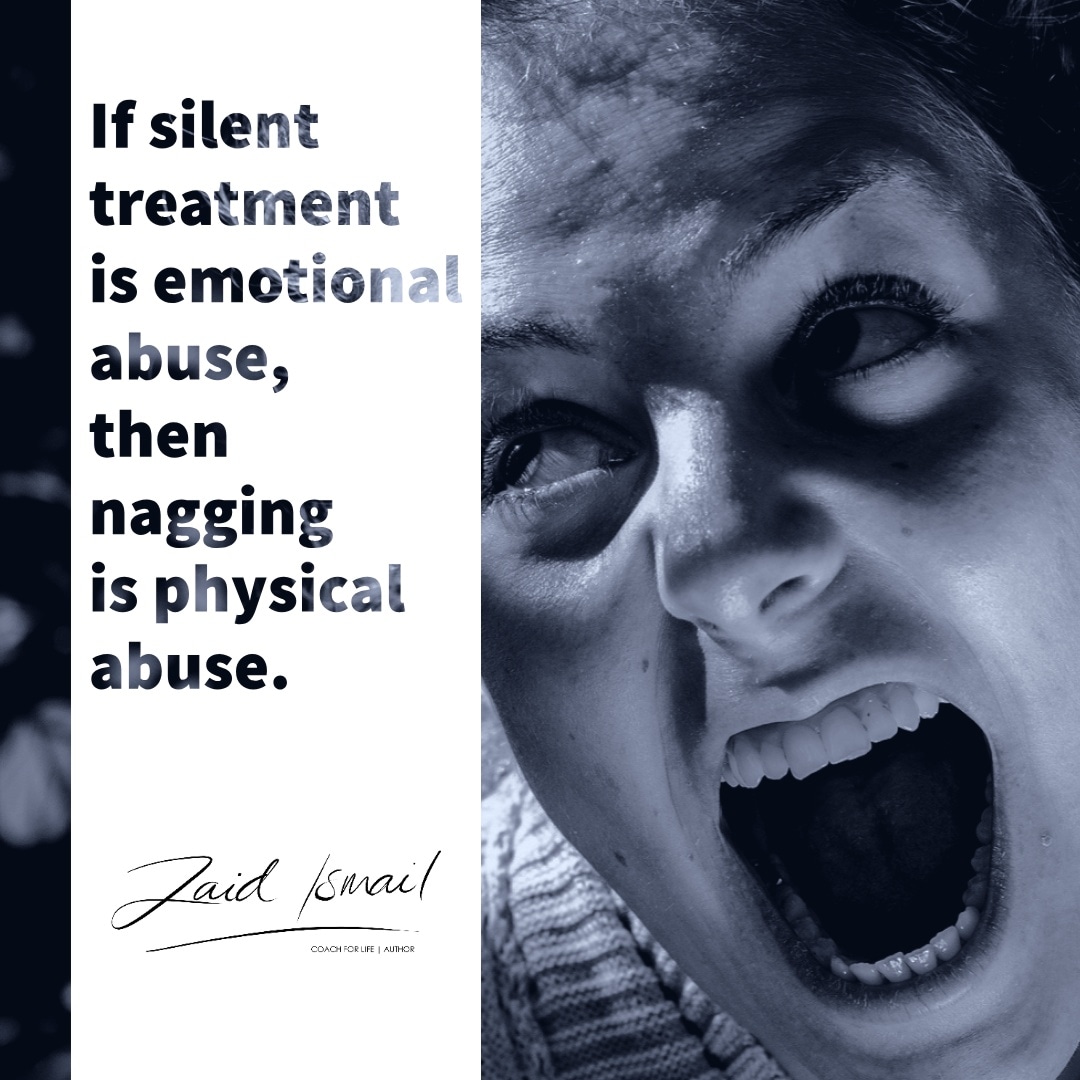
If the widespread belief that silent treatment is emotional abuse is to be accepted, then we must also consider the form of abuse that its counter behaviour imposes.
Silent treatment is not an assault on the senses and it doesn’t demand a response. The impact on the recipient of silent treatment is therefore dependent on what the recipient needs to feel validated or visible in that relationship.
It also means that the reason for the dysfunctional communication has to be considered beyond just the withholding of communication from one of the parties.
However, with nagging, it is an assault on the senses and has an inherent demand for a response.
Nagging is based on the assumption of insensitivity or unwillingness on the part of our partner, rather than trying to understand why the first or second request for something was not or could not have been agreed to, or why they see no point in repeatedly acknowledging the same point.
The important point is therefore not about whether it is or is not abuse, but rather why the communication has broken down to the point of such behaviours being the only means to express dissatisfaction with our partners.
Claims of abuse are counter-productive unless either party is physically prevented from walking away from such forms of ‘abuse’ .
The focus should therefore be on creating understanding about why communication has broken down, rather than supporting one partner against the other.
No one nags or remains silent if they believe that their reasonable voice will be appreciated.
#mentalhealth #mentalhealthawareness #lifecoaching #zaidismail #marriagecounselling #relationshipgoals #communication #empathy #ownyourlife #narcissiticabuse #narcissism -
Depression is not what you think it is
⚠ Trigger Warning ⚠
Depression is not a mental illness. It is a legitimate human emotion in the face of overwhelming odds, or the absence of hope.
It is a moment of pause when everything that we believed to be true about our world, appears to fail us.
By labelling this important human emotion as an illness, we dehumanise the human who is struggling to find hope in the midst of turmoil, or pain.
To break the cycle of depression, we must embrace the reasons for feeling depressed.
Embracing those reasons is not about judging whether we’re right or wrong, or strong or weak, for feeling depressed.
Embracing those reasons means to gain a fresh perspective on why we invested ourselves in people who appear to have taken our trust for granted.
When we lose sight of this trust that we placed in others, we also forget that we’ve grown to see ourselves through what we think they think of us because of how they responded to our efforts towards them.
In other words, we lost sight of who we are, because we assumed them to be someone they’re not.
Again, it’s not about judging them or ourselves.
Instead, it’s about understanding where our assumptions and beliefs were misinformed, so that we can connect with the real reasons why it didn’t work out the way we wanted, rather than assume that it’s because we were not enough.
Depression is always about the absence of hope in achieving something that is important to us, without which every other success in life feels empty and pointless.
It’s only through understanding how this plays out uniquely in our life, that we’ll be able to rise above the hopelessness that set in when we were distracted by the failure of not achieving our dreams.
Pause. Breathe. And try again. Only this time, wiser, and more capable than before.
#hope #expectation #sincerity #selfworth #selfawareness #mentalhealth #mentalhealthawareness #lifecoaching #zaidismail #loveyourself #lifegoals #motivation #optimism #purpose #ownyourlife -
Who defines your worth?
When our self-worth is low, we convince ourselves that we deserve pity and support for the state we’re in, because rising above it seems too daunting.
But it’s unlikely that we’ll realise that it’s a low self-worth driving such behaviour.
Instead, we’ll be convinced that the most important thing in the world is for the world to recognise just how difficult life is for us before we are willing to pick ourselves up and power through that last betrayal, or disappointment, or failed relationship.
The kind of thoughts that occupy our minds when in such a state include thoughts of preemptively defending ourselves against negative judgements about our life, or our lack of motivation, or our fear of commitment.
That’s how we start living inside our heads while believing that we’re just being realistic because we’ve learnt the harsh lessons after trusting one time too many, or being emotionally vulnerable to the wrong person.
The low self-worth is therefore a result of us losing sight of the good that we tried to contribute, despite the bad that we received in return.
It sets in when we convince ourselves that our best was not good enough, while ignoring the internal struggles that others were dealing with when we needed them to show up for us.
Our self-worth only suffers when we lose sight of the value of who we are, because we got distracted by the low self-worth of those around us.
When the need to protect yourself from the prying eyes of those who would judge you poorly triumphs over your need to aspire to achieve your dreams, you lose both, your self-esteem and your dreams.
Gratitude for the self is established through gratitude for the self. Not through the gratitude that others have for who you are.
It always starts with you.
#hope #expectation #sincerity #selfworth #selfawareness #mentalhealth #mentalhealthawareness #lifecoaching #zaidismail #loveyourself #lifegoals #motivation #optimism #purpose #mindfulness #relationshipgoals #companionship -
Dehumanising struggling humans
Trigger warning ⚠
As destructive as narcissistic behaviour is, it is not the entirety of any person’s being.
Narcissism is a result of intense insecurity about the self.
To compensate for this insecurity, the one who is insecure about their worth to others will always focus on hiding their shame, rather than admitting their vulnerability.
That’s why they’re so quick to preemptively defend themselves or to direct blame at others when things go wrong.
It’s simply a result of being exhausted from never having been enough, or significant enough to significant others in their lives.
People often assume that narcissistic behaviour is selfish because people who tend towards such behaviour come from privileged backgrounds, or always got what they wanted.
That’s part of the problem.
Having privilege doesn’t mean that we feel heard as human beings. Or that we feel seen.
Narcissistic behaviour is real, but it’s not something that cannot be changed, nor is it something that is consistent in every sphere of their life.
The worst thing for narcissism is to be coupled with someone who is needy or also insecure themselves.
If you’re insecure about who you are, your needs from someone who is struggling with narcissistic insecurities is like a threat to their feelings of inadequacy.
That’s why an insecure individual will be more affected by narcissistic behaviour than one who is grounded in their self-worth.
We must stop dehumanising humans by labeling them based on how we experience their behaviour.
Instead, we must seek to understand, with compassion and empathy.
But we can only do that if we have it within ourselves, for ourselves.
You can’t give what you don’t have.
#hope #expectation #sincerity #selfworth #selfawareness #mentalhealth #mentalhealthawareness #lifecoaching #zaidismail #loveyourself #narcissism #narcissiticabuse -
Reclaim your worth
Peace is most ravaged when we convince ourselves that we were treated badly by others, or by someone we trusted, because we weren’t good enough for them.
A betrayal of trust, no matter how noble the person, reflects cowardice on their part.
We only betray the trust that others place in us when we feel burdened by that trust, or we avoid accepting the responsibility that it demands of us.
Either way, it’s a shortcoming on the part of the betrayer, not the betrayed.
Sometimes we’re so focused on getting even with those who betrayed our trust that we fail to notice how that fixation distracts us from fulfilling the rights of others, which in itself is also a betrayal of trust.
Understand the internal struggle of those who treated you badly, so that you will realise that they were simply incapable of being better than that in that moment.
It may not take away the disappointment or the hurt, but that is part of your humanness.
When that disappointment overwhelms your joy in life and steals your enthusiasm for the future, it’s no longer because of how someone treated you,it’s because of how you see yourself because of how they treated you.
It’s that easy to give up your power to influence the outcomes and the happiness that you experience in life.
You do so by believing that how you were treated by troubled souls is a reflection of your worth.
That’s simply ingratitude for who you are.
Misplacing your trust in someone is a mistake made from good intentions.
Discard the mistake after learning from it. Don’t discard the good that inspired that good intention.
It always starts with you.
#truth #trust #betrayal #honesty #sincerity #authenticity #mentalhealth #mentalhealthawareness #mentalhealthrecovery #selfworth #selflove #selfawareness #selfrespect #reflection #mindfulness #dignity #lifecoaching #zaidismail