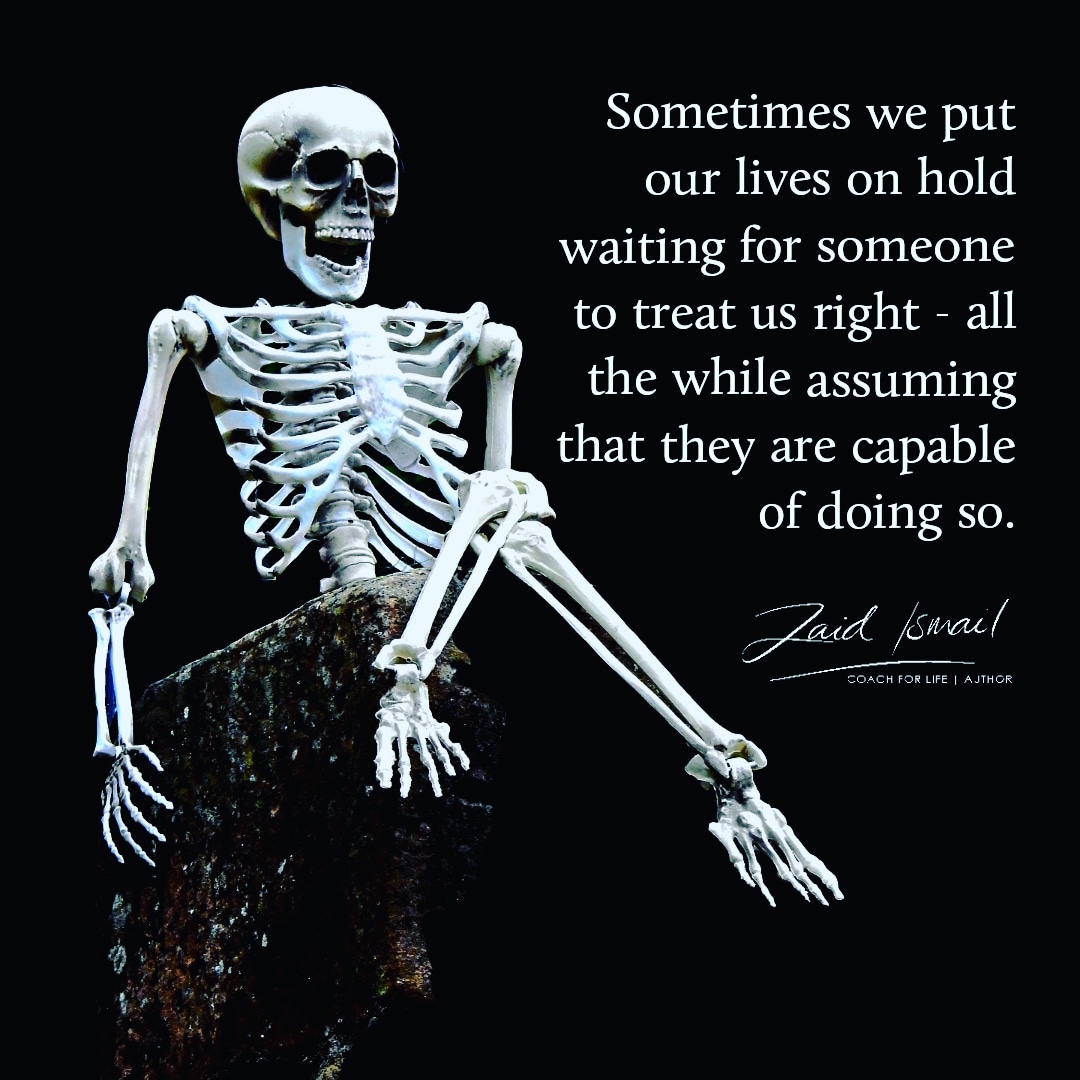
There is rarely a day that passes without me reading or hearing about someone who invested years, if not decades of their life, to people who were not invested in the relationship.
When the reality of that betrayal finally hits home, it destroys our spirit and convinces us that we’ve sacrificed the best years of our life while having nothing more to look forward to.
Nothing could be further from the truth.
The same way we were able to create beauty in such a desolate landscape, we must recognise that the best of us that we gave was simply the truth of who we were. And are.
The moment we discard that because it was discarded by an ingrate who was looking for servitude of their ego when they could have had love for their essence, we become ingrates just like them.
Don’t trade who you are for who they were. It’s never a fair trade. You owe yourself more than that.
And self-pity will only ever prevent you from being true to yourself.
Embrace the beauty of who you are despite the ugly of who they were.
That’s how we take back the gift that they discarded so that we may be able find a more fitting recipient.
As long as you’re breathing, there’s always hope.
#selfworth #selfawareness #ownyourlife #selfmastery #mindfulness #personalpower #mentalhealthrecovery #mentalhealth #mentalhealthawareness #lifecoaching #zaidismail #betrayal #narcissism #narcissisticabuse #relationshipgoals
Tag: mentalhealthrecovery
-

Don’t trade your best for their worst
-

A burdensome labour of love
Responsibility, when met with gratitude, feels like a labour of love.
Remove gratitude, and it becomes a burdensome load.
But only if gratitude is expected.
That’s when expectations weigh down on us more than responsibility, because of the internal wait for others to reciprocate, or to notice.
It’s not unreasonable to hold that expectation.
In fact, we should expect those around us to show gratitude or to share the load, so that the relationship is not reduced to one of a mere exchange of duties.
However, we must remember that they have the same expectation in return.
More than this, if we’re not aware of this expectation that we have, because it’s usually a subconscious one, we feel disappointment or a growing bitterness towards those who we feel are taking us for granted.
And again, the same is true in return from their side.
To overcome this, not only must we be aware of this expectation, we must also understand if the other person is aware of it, and if they’re capable of meeting it.
That opens a whole new can of worms. But that’s part of the fun of relationships, isn’t it?
Having silly moments of realisation when you discover that what you were fretting about was only real in your head because the support or gratitude you were looking for was there all along.
It just wasn’t in the form or expression that you were expecting.
#relationshipgoals #marriageadvice #marriage #mentalhealth #mentalhealthawareness #lifecoaching #zaidismail #loveyourself #lifegoals #motivation #optimism #purpose #companionship #mentalhealthrecovery -
Betrayed expectations
Without realising it, expectations create an underlying sense of entitlement regarding the outcomes that we want.
That entitlement is what influences our attitude and demeanour in how we approach things or relationships.
When we feel justified to have such expectations, we lose sight of the entitlement, which leads to the intensity of emotion that we experience when our expectations are not met.
That intensity of emotion is the sense of betrayal that we feel because entitlement is based on an assumed trust between us and the person who we believe was supposed to show up for us.
Problem is, most times, that expectation is in our heads and is unknown to the ones around us.
Sometimes we communicate it, but most times we don’t.
We need to trust the sincerity behind what significant others do for us, that’s why we are unlikely to tell them specifically what we need from them for two reasons.
Firstly, once we ask for something, we don’t know if they’re doing it out of obligation, or sincerity.
And secondly, we don’t want to appear needy or vulnerable, assuming that we’re even aware of the expectations that we have of them.
Mindfulness is key to healthy relationships. And healthy relationships are ones in which we can trust each other with our expectations of what’s important to us, without feeling like an imposition on the other.
How healthy are your relationships? And more importantly, how healthy is your relationship with yourself?
#selfworth #selfawareness #ownyourlife #selfmastery #mindfulness #personalpower #mentalhealth #mentalhealthawareness #lifecoaching #zaidismail #loveyourself #lifegoals #motivation #optimism #purpose #companionship #mentalhealthrecovery -
Do you practice self-serving justice?
The matter of justice doesn’t only apply to matters of criminal behaviour or social conduct, but it’s especially true for how we conduct ourselves within our family units.
It’s the injustices that we experience within our families that result in the misconduct that we express in our lives.
That injustice doesn’t always feel like a blatant abuse. Often, it’s a subtle avoidance of doing what’s right, or speaking out against family norms that are harmful to some.
When we benefit from such injustice, we find it acceptable, or at least defensible, to remain silent.
The way we benefit from it includes enjoying the inclusion or sense of belonging to the family unit.
It includes winning favour with he heads of the family, or earning our place at the table of the family business, or even securing our inheritance.
That’s when we become party to the injustice that affects even us, but from places that we assume to be detached from our family unit.
Injustice in the home is the root of injustice in this world.
First do right by your own before you go out into the world to do right by others.
This is not charity. It is justice in its truest form.
#truth #justice #fairness #equality #mentalhealth #mentalhealthawareness #mentalhealthrecovery #theegosystem #ownyourlife #lifecoaching #zaidismail #parenting #spousalabuse #gbv #relationshipgoals #familyvalues -
Understand before you judge harshly
Before you get upset with someone for not treating you the way that you want them to treat you, consider that what you need may not come naturally to them.
Without meaning to, we oppress others when we assume that just because we’re capable of something, they should be too.
This is especially true when it comes to emotional expression.
How emotionally expressive we are is directly related to how emotionally accessible our parents were to us during our childhood.
And no, not all siblings in the same household have the same experience, because not all parents treat their children equally.
So when we look at the behaviour of our adult partners and we compare them either to ourselves or to their siblings or other family members, we’re dismissing their specific life experience, while insisting that they be like everyone else around them.
Emotions cannot be sincerely and authentically expressed if it was never received in that way.
How it’s received – again – is relative to how emotionally grounded our past experiences may have been.
When you’re not getting the kind of emotional availability that you need from your partner, consider that it’s something that they may just not be connecting with because they’ve never experienced it in a safe and fulfilling way themselves.
And just because you’re expressing it to them now doesn’t mean that it suddenly changes it. It doesn’t, because your expectation of them to reciprocate makes that setting an emotionally vulnerable space for them.
Create an emotionally safe space for your partner before you judge them for being insensitive or cold, or else you may destroy their love for you just because they couldn’t express it the way that you wanted them to.
#hope #expectation #sincerity #selfworth #selfawareness #mentalhealth #mentalhealthawareness #mentalhealthrecovery #theegosystem #ownyourlife #lifecoaching #zaidismail #loveyourself #lifegoals #motivation #optimism #purpose #companionship #compassion #relationshipgoals -
Who defines your resilience?
“Resilience is our ability to cope with adversity when we focus on rising above, rather than sinking below. Too often we wait for a sympathetic outstretched hand to lift us up because we’ve convinced ourselves that we need lifting.” (The Egosystem)
Your resilience is directly affected by your belief in your ability to rise above what you are facing.
It’s OK to feel overwhelmed in the moment. Or even for a while after.
It’s OK to pause for breath, or to choose your battles.
It’s OK to have moments of weakness, or fragility.
Those are all part of the essence of being human.
But, the moment you allow that to define your self-worth, or you use it to convince yourself that you’re incapable of making something of your life because no one believes in you, you’re no longer being human. You’re being ungrateful for who you are.
Some may see this as judgemental. Or perhaps even harsh.
It’s harsher and more destructive to suppress the good that we are capable of creating while waiting for the bad that was done to us to be redressed.
That’s how evil triumphs over good.
That’s how misery becomes more important than joy.
All because we grew to be ungrateful of who we are without realising that it was just another struggling soul that treated us badly.
But because we’re unworthy of love or affection, or understanding, but because they were incapable of what we needed from them.
It always starts with you.
#hope #expectation #sincerity #selfworth #selfawareness #mentalhealth #mentalhealthawareness #mentalhealthrecovery #theegosystem #ownyourlife #lifecoaching #zaidismail #loveyourself #lifegoals #motivation #optimism #purpose -
Daydream your life away…
Sometimes we lose ourselves to nostalgia to the point of disconnecting from the life that we have.
Good memories are great, as long as it’s not a reason to take our current blessings for granted.
Many of us are so fixated on the life that we once had, that we neglect the people and the quality of life that we have now.
Sometimes, in fact often, we even neglect our health, because if we don’t have much to look forward to, there’s not much point in taking care of ourselves. Right?
Wrong.
When you only take care of yourself on special occasions, you’re taking yourself for granted the rest of the time.
Memories are created between those special occasions more than on any specific occasion itself.
When we hear of the good old days, we don’t hear of weddings and birthdays. The majority of the stories are about the wholesome and uncomplicated lives that we once lived. The family bonds, the solid friendships, the lekker meals and adventures.
If you find yourself only celebrating life on special occasions, you’re taking yourself and your life for granted.
Worse than this, you’ve probably lost your self-worth to how you want others to see you, and you don’t see yourself clearly anymore.
You reclaim your life by reclaiming the present moment.
But you can’t reclaim the present moment if you don’t see value in it.
And you won’t see value in it if you spend your days longing for the past.
Live romantically. Now. Not in the past. And your life will be everything you dreamed it could be.
It always starts with you.
#hope #expectation #sincerity #selfworth #selfawareness #mentalhealth #mentalhealthawareness #mentalhealthrecovery #theegosystem #ownyourlife #lifecoaching #zaidismail #loveyourself #lifegoals #motivation #optimism #purpose #romance #companionship #soulfood #soulmates #foreverincomplete #anincompletelovestory