One of the most common incorrect assumptions we make in life is assuming that others treat us badly because of who we are, and not because of their own demons.
This is especially true about how we feel about our relationship with one, or both of our parents.
Without realising it, two critical outcomes result from this incorrect assumption.
Firstly, we feel like victims in our lives because what we need from others always seems to be so elusive.
And secondly, it distracts us from the reality of the struggles that the other person, including our parents, may be going through.
When it comes to our parents, we easily lose sight of the human behind the role, until we eventually become parents and then judge them for not adequately preparing us for that role.
That’s how we inevitably make the same mistakes that they made because we lost sight of who we are.
If we connect with gratitude for who we are, and we focus on understanding, not judging why we may fall short from time to time, we’ll find it easier to connect with our humanness and in turn, with the humanness in others, rather than to judge them for not doing justice to their roles in our lives.
Generational cycles are not broken by trying to be better than those who came before.
It’s broken by seeking understanding of why they are the way that they are, so that through understanding them we can make better choices for ourselves.
When you ‘heal’ from your past, don’t abandon those who didn’t have more to give.
Treat them with the empathy and compassion that has been lacking in their lives so that they may also feel like significant humans who are not only valued for the role that they are expected to play in the lives of those around them.
This will improve our relationship with them, which in turn will improve the quality of life that we pass on to the next generation.
It always starts with you.
#hope #expectation #sincerity #selfworth #selfawareness #mentalhealth #mentalhealthawareness #lifecoaching #zaidismail #parenting #mentalhealthrecovery
Tag: mentalhealthrecovery
-

Generational assumptions
-

Escaping addiction
It’s not drugs that steal our children from us. Like us, they also need to feel significant.
Taking drugs is not just a bad habit. It’s a means to escape what we don’t want to deal with in the world around us.
Is it a bad decision? Absolutely. Because escaping something never resolves it, it only defers it to a later time.
But we all indulge in escapism of some kind, that’s why we have little to no communication in homes that centre around technology or social media, leaving the young ones struggling to find a space in which they belong, physically and emotionally.
The emotional connection that they then forge with fellow escapees is what makes drugs the escape of choice.
If we treat them as addicts, they will behave like addicts. If we deny what is lacking in their emotional make up, we’ll deny ourselves the opportunity to address it.
Addressing it doesn’t only benefit them, it also benefits us because the only reason that they would feel emotionally isolated is because we’re not emotionally accessible.
That means that we’re also denying ourselves the sweetness of life because if we’re emotionally unavailable, then we’re convinced that what is important to us is not important to anyone else.
That’s why we lose ourselves to duty and dismiss any demands to be emotionally available for those around us.
That’s how we create the environment that makes substance abuse or gambling, or other escapes attractive as a coping mechanism.
Break the cycle.
It always starts with you.
#drugs #addiction #narcissisticabuse #narcissisticparents #youth #selfworth #selflove #selfawareness #selfrespect #mindfulness #inspiration #lifecoaching #zaidismail #ownyourlife #theegosystem #mentalhealth #mentalhealthawareness #mentalhealthrecovery -
Cyclical abuse
At first, we remain in a bad relationship because we truly believe in the sincerity of the claims of our partner to want to improve, or to overcome what they’re struggling with.
After some time, if we’re not careful, our inability to get them to follow through will convince us that we’re not a good enough reason for them to be better.
When that continues for long enough, we begin to doubt our ability to be enough for anyone else, and thus find ourselves trapped in a cycle that we’re unintentionally sustaining.
Some may claim that they stay because it’s their way of expressing unconditional love.
Unconditional love, if it ever exists, is the sacrifice of one in favour of another. When you sacrifice yourself to compensate for the bad behaviour of someone else, that’s not love, that’s self loathing.
If you don’t love yourself, loving another becomes a cry for significance or acceptance, and love has nothing to do with it.
More importantly though, the choice of how to respond to bad or abusive behaviour is not binary. It’s not just about staying or leaving.
Between those two choices lies a number of ways to potentially break cycles of abuse, all of which requires a better understanding of why the abusive behaviour is the way in which the other person is trying to feel significant, or to rage at an injustice done to them in the past.
By understanding what drives their behaviour, we allow ourselves to see the human struggle behind the behaviour, rather than to judge the entirety of the human by their behaviour.
But this is only possible when we don’t feel inadequate about who we are in that situation.
A healthy self-esteem is therefore at the heart of truly breaking cycles of abuse, otherwise we may exit that situation, but we’re likely to be attracted to yet another cycle of abuse in our search for significance.
It always starts with you.
#abusiverelationship #selfworth #selfawareness #selflove #gratitude #appreciation #mentalhealth #mentalhealthawareness #mentalhealthrecovery #selfloathing #relationshipgoals #lifecoaching #zaidismail -
A brain dump
Optimism is not always enough. It helps, but sometimes, I just want things to go easy for a bit. If I knew that a single moment of trusting someone could lead to a lifetime of struggle, I would not have been so trusting, or at least not so generous with my trust.
But spilled milk and water under bridges offer no comfort. They only offer resolve. The resolve to move on rather than to stare pointlessly at the mishaps of my life. So I move on, each time with hope and optimism, each time having the wind knocked out of my sails, constantly reminded of how much easier it would be if only…if only they played their part..or they appreciated what they had…or they gave more and didn’t just take all the time…or…if only they honoured their trust, as much as I try to honour mine.
But that’s when I’m reminded of the poison of self-pity. That loathsome indulgence of focusing on how bad I have it, while growing bitter at those who consciously and unknowingly contribute towards my straitened state. Sometimes deliberately, but most times obliviously.
The trials of life are visited on those who are most aware of the human struggle of those around them. It compels one to be more gracious, more understanding, and more forgiving towards the shortcomings of those who do not do their fair share in our lives. But principle dictates that we do not abandon our station because in so doing, we contribute towards that very condition of theirs that subsequently weighs us down. That’s how we become part of the problem, when we abandon the burden of being part of the solution.
The relentless charge of life felt exciting in youth, but exhausting in my later years. There are days when I feel hopeful and passionate, with purpose and ambition. And there are days when I feel like remembering to hydrate is a life-sucking chore. The only thing that changes between the two is my indulgence in self-pity, or in my fixation on what is owed to me.
At such times, I remind myself that this world was created for respite, not for justice. What we give, will rarely be received in equal measure. Therefore, we must find a joy other than the expression of gratitude, or reciprocation, if we hope to sustain the very essence that breathes life into our waking hours.
It is the gratitude of who I am that I lose sight of, before the challenges begin to take their toll on me. I’m most weighed down when I look longingly at a significant other, waiting for a sign of sincere gratitude for, or at the least, understanding of what it takes for me to persevere beyond what has already transpired in my life. It is that pause for such validation that begins the slip into that soulless space of ingratitude, and of being left feeling wanting after exhausting my spirit in the service of those around me.
I think death will approach when picking myself up from that space will feel like a trial too many, or an investment too daunting in hope that is forever fleeting. On the balance, I am human, and I am needy of that balance that is only found in being appreciated by another. Not by any other, but by one who sees me, and not the tokens of who I am. One who sees the scars and bruises that tear at my being, each time I rise to face another round of brutal conflict with my demons, and the demons of those around me. It is only the loving gaze of one who sees all this of me, and more, that will ever set the scales in balance for this life to feel like a trial worth overcoming.
In the absence of such an embrace, it all feels dutifully empty. Without purpose beyond the belief that there is purpose in it. And the only motivation to persevere being the belief in the value of what I wish to create. Not even for the awaiting reward of what I’m doing. Because, if I believe the promise of my Lord to be true, to be rewarded for even an atom’s worth of good that I may do, then doing it with the reward in mind would be doubting the promise of my Lord.
I therefore act with conviction when I’m grateful for my ability to create value in the lives of those I meet, knowing that the One who blessed me with this ability, is more generous than any reward that I may expect in return.
Perhaps this is the reminder that I need to push on when I feel weighed down. It is the transactional life that steals our passion long before the trial itself. I must take more time to reflect on how transactional my life has become.
-
Dehumanising the human
Don’t become so fixated on labelling yours, or the behaviour of others, that you lose sight of the human struggle behind that behaviour.
Labels make it easier for us to deal with stuff.
The moment we give it a name, we can manage our expectations around it.
This is fine when it comes to abstract stuff and tasks or problems that we deal with as part of a regular day.
But it becomes detrimental when we start labelling behaviour and then responding to that label, rather than recognising the legitimacy of the human experience behind that label.
Popular labels include depression, bipolar, narcissism, and egotists, to name only a few.
It’s one thing describing what we’re observing as our experience of someone’s behaviour, but the moment we reduce the human to that label, we become part of the struggle that they’re already grappling with.
We must learn to connect with the human struggle long before we label it as an illness or a deficiency.
For example, we don’t suffer from depression, but we do have good reason to feel depressed because we’ve lost hope in something important working out the way we need it to.
And so it is with all other so-called mental illnesses.
We lose compassion and empathy, and thus disconnect from our own humanness, when we define the entirety of a being by a single label of unacceptable or unpleasant behaviour.
Reclaim your humanness, so that you may be able to honour the humanness of those around you.
Start by avoiding self-diagnosis of the emotional state of others.
#mentalhealth #mentalhealthawareness #mentalhealthrecovery #lifecoaching #zaidismail #compassion #trust #empathy #theegosystem #ownyourlife -
Do you hate apologising?
Ever reject an apology from someone only to be told, “Well, I apologised. So if you don’t accept my apology, then that’s your problem, not mine.”
Or something similar?
When you apologise and expect your apology to be accepted, you’re not apologising, you’re demanding that the other person just move on without any redress to the impact that your offence had on them.
An apology is more than just an acknowledgement of wrongdoing.
An apology, when sincere, must focus on assuring the other person of two things.
Firstly, that there is real remorse or regret about the way in which you conducted yourself.
And secondly, that you want to make up for the impact that it had on them.
If either of these are lacking, it’s not an apology. It’s simply a means to pacify your own conscience, and at best, it’s a formality.
Relationships can often be salvaged through sincere remorse for the mistakes that we make.
But, if we feel weak for admitting fault, then we have work to do on how we feel about ourselves, and it has nothing to do with how the other person may or may not respond to our apology.
If you find it difficult to apologise, chances are good that you’re also keeping score about who committed how many offences compared to the other.
Either way, it means that you live with the fear of being inadequate.
It always starts with you…and what you think of yourself.
Own Your Life.
#hope #expectation #sincerity #selfworth #selfawareness #mentalhealth #mentalhealthawareness #lifecoaching #zaidismail #sincerity #mentalhealthrecovery -
Good vs bad manipulation
Sometimes we choose to maintain the peace by giving of ourselves despite not wanting to.
Sometimes, we don’t want to deal with the upheaval that follows not doing what someone wants, so we do it anyway.
Sometimes, we’re afraid of the repercussions of not complying, so we comply despite not believing in what we’re doing.
Each time we compromise who we are or what we stand for to achieve an amicable or peaceful outcome, we lose ourselves to those outcomes.
It may seem to offer short term gains, but in the long term, it destroys our sense of self.
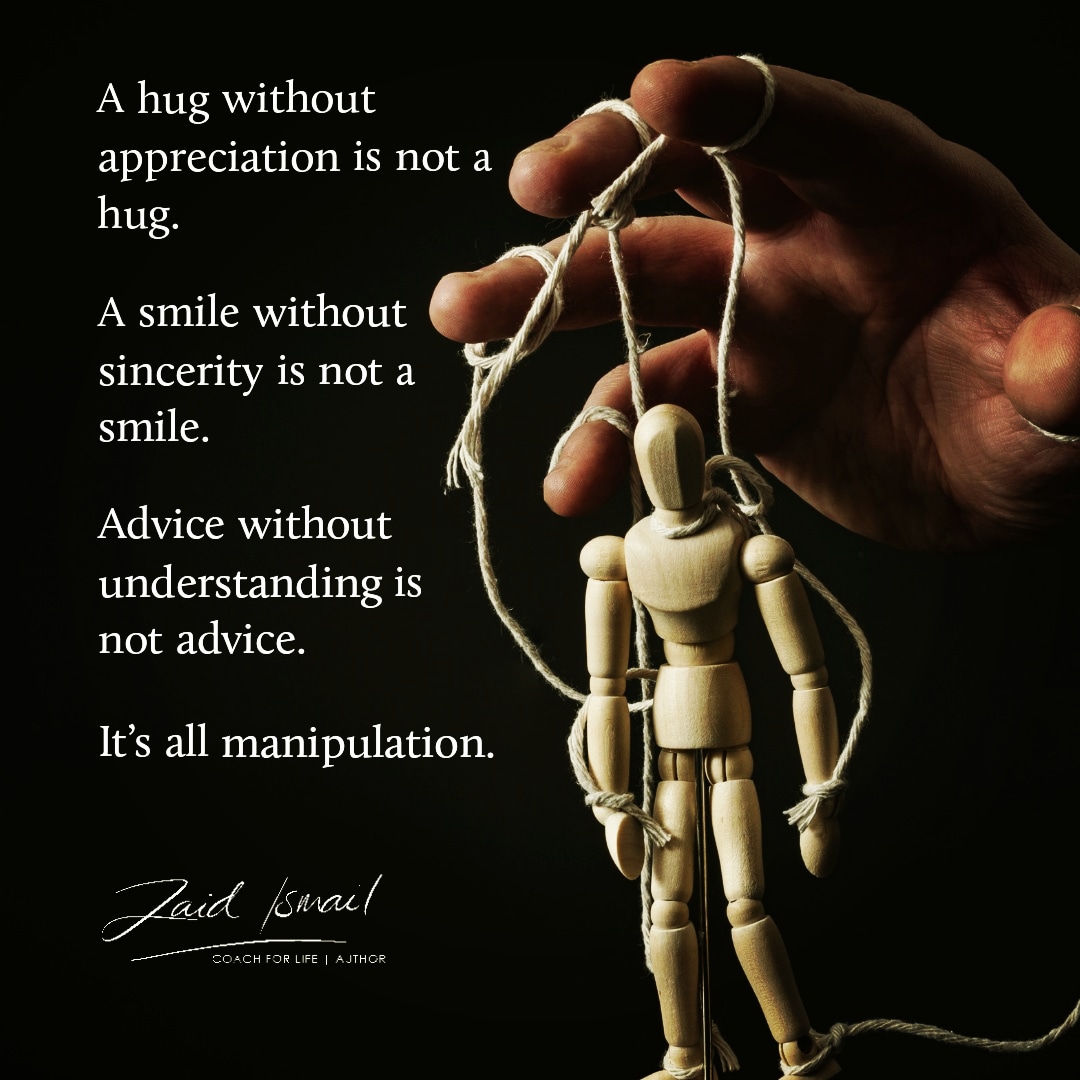
We all find ourselves in situations where such manipulation is required at some point because the timing is just not right to deal with what needs to be addressed.
The key is to be aware of why we’re choosing this approach, versus believing that it’s the only approach that will get us what we need, or want.
And the same is true for others who appear to be manipulative by nature.
It’s simply the fear of negative outcomes that has convinced them that who they are will never be good enough, so manipulation is the only way to maintain significance or to fulfil their emotional needs.
We’re all built with the exact same emotional needs.
We just lose our way for different reasons.
Self-awareness leads to understanding, and understanding is the cornerstone of compassion.
Therefore, we must always seek to understand our own conduct under similar circumstances, before we seek to judge others.
It always starts with…you.
#hope #expectation #sincerity #selfworth #selfawareness #mentalhealth #mentalhealthawareness #lifecoaching #zaidismail #compassion #mentalhealthrecovery -
When sincerity is tested
Like the old saying goes, talk is cheap, and actions speak louder than words.
It’s easy to say the right thing, especially when times are good and what we’re committing to is convenient.
However, when our commitments pull us between what we want for ourselves versus what we committed to doing for someone else, that’s when our sincerity is tested.
But what defines our sincerity?
Is it how we want to appear to others or how we live by the values that we stand for?
The moment we’re focused on what others think of us, we play to the responses that we want from them, even when we’re doing something good.
The problem with this is that without realising it, our motivation slowly shifts from living by our values to how we are perceived by others.
That’s the beginning of how we lose ourselves to the attention that we get from others.
More than this, the lower our self-respect, the more inclined we’ll be to say the right thing while finding it difficult to do the right thing.
That’s when making excuses for our behaviour becomes easy when others challenge us about the commitments that we haven’t honoured.
This is an indication of a low level of self-respect.
Self-respect is tainted when we lack gratitude for who we are.
The more we dismiss the value of who we are, the more we’ll need validation from others. Hence the unhealthy cycle of focusing on what others think of us, versus being true to who we are.
We’ll only be true to who we are if we truly value who we are.
For this reason, don’t expect sincerity or consistency from one who is self-loathing. And realise that you are self-loathing when you struggle to be consistent or to follow through on the commitments that you make to others.
It always starts with you.
#sincerity #action #conviction #mentalhealth #mentalhealthawareness #mentalhealthrecovery #selfawareness #selfrespect #mindfulness #inspiration #selfworth #lifecoaching #zaidismail #loveyourself