I believe that among the great deathbed regrets will be the realisation that we never truly showed the world who we are.
It’s the what-ifs and if-onlys that cause more regret and heartache than any bad decision.
Bad decisions are made with good intentions, yet we always choose to remember the negative outcome, rather than celebrate our innocence and sincerity for trying.
We do this because we’re more focused on what others think of us, than we are about what we know to be true about ourselves.
This bias against ourselves is one of the roots with which ingratitude takes hold in our life.
When that happens, we become martyrs in our own mind, as we focus on everything that didn’t work out, while losing sight of the beauty and blessings that we have.
Living up to your convictions, despite society, is what will provide you with peace and fulfilment when you need it most.
That is, in those final moments when you look back at the sum total of your life and wonder if you made the best of it, or did you only focus on the worst of it?
Redefine what peace means to you. It is always beyond just the absence of disagreement or hostility. Peace lies in being true to yourself, and appreciating the opportunities for growth that such conviction creates in those around you.
#hope #expectation #sincerity #selfworth #selfawareness #mentalhealth #mentalhealthawareness #mentalhealthrecovery #theegosystem #ownyourlife #ownyourshit #embracingME #motivation #optimism #zaidismail #peace #deathbedregrets #death #companionship
Category: Philosophy
-

Save yourself from regrets
-

The value of values
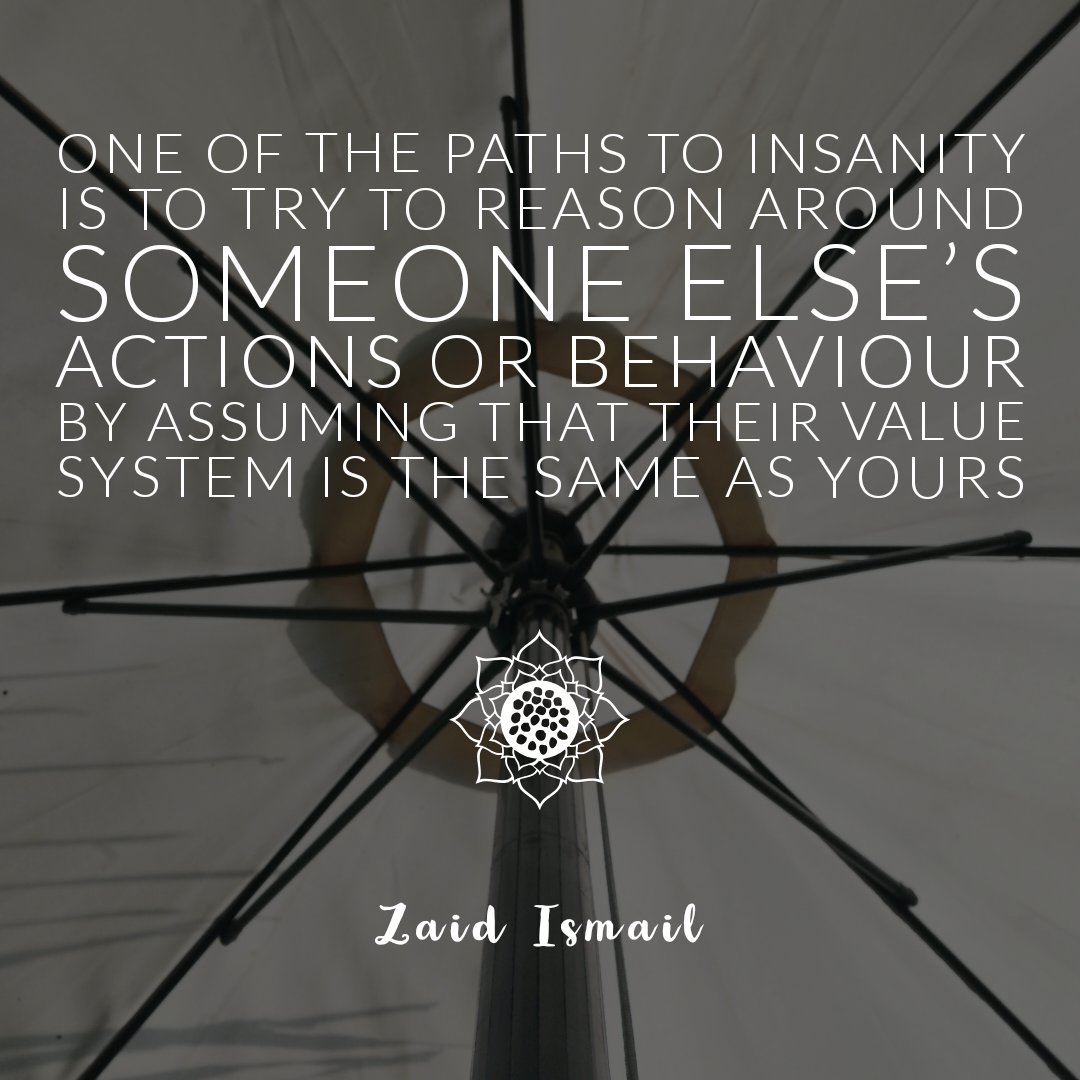
One of the paths to insanity is to try to reason around someone else’s actions or behaviour by assuming that their value system is the same as yours.
This includes people who come from the same culture, tradition, ethnicity, and even family as you do.
Our value system may be informed by a common framework or point of reference.
But, unless everyone complies 100% with that framework, each interpretation or implementation of those values becomes a unique value system, as unique as each individual.
When we don’t recognise these differences, we insist on compliance rather than understanding in the way each person adopts these values in their lives.
That’s the root of misunderstanding: The assumption that because we have shared values on some key issues, we have shared values on all issues.
Thus, relationships and homes are broken because of our expectations of compliance rather than our efforts towards understanding.
#values #counselling #culture #traditions #familytime #familyvalues #religion #relationshipgoals #mentalhealth #mentalhealthawareness #mentalhealthrecovery #theegosystem #ownyourlife #ownyourshit #embracingME #motivation #zaidismail #authenticity #leadershipcoach -
Wisdom with purpose
Acquiring knowledge without implementing it is like hoping to quench your thirst while standing in the rain.
Seeking to understand is great, but only if we apply that understanding in the way we treat others.
Similarly, acquiring technical knowledge may feed our fascination, but fulfilment lies in using that knowledge to create something of substance that offers value to others.
I think it was Al Ghazzali that said, “Why accumulate more knowledge if you don’t practice on the knowledge that you have?”
#education #learning #knowledge #fulfilment #reward #lifegoals #motivation #optimism #mentalhealth #mindfulness #inspiration #ownyourshit #ownyourlife #theegosystem #embracingME -
Worship me
Don’t use religion to elevate your ego.
By doing so, you use God to worship your ego, rather than subduing your ego to worship God.
The appearance of religiosity in others misleads many to assume that they possess piety.
Piety cannot be measured through outward appearance, only through experiencing a sincerity of action.
Sincerity, if shown due respect, makes an outward show of religiosity for the purpose of earning respect impossible to display.
-
Delusions of Godliness
The delusion of godliness diminishes our capacity to connect with the divine. When we assume ourselves to be above those that behave worse than us, or we assume that we hold within us the capacity and means to punish others, or withhold their reward, be it in this world, or the hereafter, we assume to hold divinity within us. This is even more detrimental when we impose punishment or apportion reward to ourselves. Understanding is grounded in compassion, and there is nothing closer to divinity than compassion and mercy. Consider this the next time you view yourself or others with harshness.
-
In search of home
Gratitude lays the foundation of the home.
Respect builds its walls.
Love and compassion provides the roof that protects you from the storm.
And passion gives you the windows to allow your soul to breathe.
As for faith…faith is the door that opens the path to all of it.
Virtues have limited effect or value if practiced in isolation. It sometimes has a detrimental effect when one is practiced in excess compared to the others. Balance, as always, is what leads to harmony, and harmony is the throne on which peace resides.
Find your balance. Find your peace.
-
Why we need more idealists
I am an idealist. It attracts mockery, condescension, ridicule and any number of other derogatory and passive aggressive responses from people that want to appear a certain way. But I choose to be an idealist in spite of them. The alternate may be choosing to be a realist. However, experience has taught me that realists are focused on reacting to challenges and working with what they have. Seldom do they strive to create something larger than their current reality. That means they are effective at maintaining the status quo, not at improving the human condition beyond it’s current ideal state.
I could be a pragmatist. Insisting that only what is within my control is what I should assume to hold any influence or control over. Practical realities assume that we know everything about what it is that we’re faced with. We never do. Thus, pragmatists are a hindrance rather than a benefit.
The world is plagued with problems created by realists who demand that the only realistic view of the world is their view because they have tangible evidence to support their view. But, right there lies the problem. The tangible is what distracts us from the greatness that lies beyond it. When we focus on manipulating what we have into permutations of what we know, we lose sight of what more is possible.
I choose to be an idealist because it is our belief in the intangible possibility of being more than we are now that has always spurred us into action. Inspiration does not lie in what is known. What is known is quickly taken for granted because, well, it is known. It is obvious. It is commonly accepted for what it is. But look beyond the known, look at the possibility of creating a new reality out of the dysfunction that exists within the current reality and suddenly we re-frame what possibilities the world holds for us.
Not only do we see purpose beyond duty, but we see duty in being dreamers. Duty in believing that we are capable of more than what we have and who we are. But, we resign such thinking to material gains. To improving quality of life through comforts or accumulation of wealth, or occasionally through philanthropy. All that has its place, but it doesn’t alter the human condition, it only makes it more bearable.
I choose to apply my idealism to the state of the human condition. I choose to use it to inform my choices to see beyond the distractions of apparent evil, and instead to gain sight and understanding of the wounds that drive such evil. But this approach is an approach that is not favoured by many. It finds ridicule, and rejection, just like idealists do, because it rejects the right to vengeance and instead focuses on the need for understanding and correction.
Justice defined by victims will be justice entrenched in vengeance. Rarely do victims consider a reality beyond either vengeance or forgiveness. The entire landscape between those poles is ignored because in seeking to understand, it demands that we accept accountability for the effort needed to reach such understanding. It demands that we set aside our fury and our rage so that we can understand why we were just a convenient outlet for the filth or the abuse or the violence that someone else harboured within them. Provocation is only an acceptable excuse for retaliation in the case of self-defense. Beyond that, provocation is a demand for understanding and justice. Unfortunately, the one blinded by hate or anger is seeking retribution from anyone that resembles the source of their anger and hatred. At that moment, it doesn’t matter that the target is innocent, it only matters that within the mind of the aggressor, the target resembles or represents the threat that robbed them of their humanity at some point. Without seeking to understand this, we will create victims who will become survivors, but will not progress beyond that. That the aggressor must be punished for their aggression is a given. But even that in itself is not enough. That in itself will never fully realise the ideals of justice. For this reason, even when justice is served, many don’t feel the sense of peace that should accompany such justice.
As I stated many times before, survivors don’t enjoy the sweetness of life, they only enjoy the deferral of death. As long as we consider ourselves to be survivors, we remain defined by the event or experience that we survived. Thriving is impossible when we are rooted to a moment in the past. Letting go of that moment becomes difficult when we have yet to experience a sense of justice, or vengeance for what was done to us. For this reason, even those that forgive continue to hold on to the effects of that experience, but through forgiveness have only given up the desire for direct retribution. Often, such retribution is entrusted to a higher power that prevails beyond the realities of this world as we experience it.
There are no easy answers for idealists. But there are simple ones for realists, and pragmatists, because they see things in obvious tones, and absolutes. Anything beyond that is considered an indulgence of ideals that have no value. And perhaps there are moments when this may be true. When urgency demands that ideals be suspended and practical realities take precedence. But, what is the result when such an approach becomes the norm? What happens when the value of that immediacy of response underpins the belief that it is the only value that is achievable? Is that when we set aside humanity in favour of perceived justice? Is that when retribution replaces justice, and balance or harmony is replaced by perceived rights?
I am an idealist because I believe, with conviction, that we are capable of better than who we are today, or who we have been over the generations that passed. I am an idealist because I recognise the value of the principles that spurred on our predecessors that we now idolise, or at times follow blindly, but I do not follow blindly. I choose to reinterpret their principles within the context of my life, because I understand, without doubt, that if something is not growing, it is dying. This is also true for the human condition. As long as we stagnate in our growth by holding on to beliefs from a distant past without appreciating the value of the principles that underpinned those beliefs, our condition begins to wither away. And as it is with all withering, the resultant decomposition of values will reveal the worst of us, because we chose to stop pursuing the ideal of being the best of us.
-
The Art of Deconstruction
I’ve watched silently, often with annoyance, how it is that so many are considered to be intellectuals for their ability to tear apart someone else’s argument or contribution. The more effective they are at breaking down an opinion that they disagree with, the more revered they are in some circles. That’s the part that I watch silently. The part that fills me with annoyance is when I see that after all that effort, they have nothing of meaning or substance of their own to contribute.
The rest that follow such antics applaud the efforts of those vain ones that love the sound of their own voices as they spew their anger disguised as eloquently articulated arguments filled with nothing more than criticism without purpose. The anger is what fascinates me. Always has. Its origins are so deeply protected that most convince themselves that their anger is a justified response to an oppression or an injustice. But they stop there. They don’t consider why that specific injustice or oppression angers them, nor do they consider why anger is their chosen response to it. Instead, their anger defines their contribution and they garner the respect and admiration from those that are equally angry, or are passively aggressively angry. I suspect the latter group is more despicable than the former because they even lack the conviction to be true to their anger.
Nonetheless, these cycles play out all the time. Often in a public setting, but quietly in a private setting too. It is the private setting that intrigues me most. I find it intriguing because it is where we experience either our power, or our cowardice. When we experience our cowardice, it becomes a priority to judge or criticise the efforts of others to distract attention away from our meekness, hence the deconstruction of the efforts of others to make something of their lives. When we experience our power, our belief in being able to contribute towards the quality of life of others drives us towards contributing towards their efforts to improve their chances of success, because we realise that their success doesn’t threaten our own. But most don’t experience this. Most only see what they think should be done better but rarely (if ever) make an effort to actually do it themselves.
Pointing out what is wrong with the world is easy. I look at the rhetoric and criticism against those that step up and fight the good fight, and most often that rhetoric or criticism finds its roots in a belief that the quoting of divine scriptures elevates the rank of the critic above that of the rank of the activist. This is yet another ploy to appear pious or spiritually awakened while conveniently ignoring the demand of such spirituality to lead by example.
When we have a bone of contention with another, it is not our words in fiery criticism against them that is going to convince them to behave differently. It is our act of sincere and meaningful engagement that will hold any sway over their efforts. Either we will convince them of the benefit of our views, or they will convince us of what we may not have considered about their reality. But without this experiential journey, this side-by-side engagement, the reality of the basis on which we disagree will always remain theoretical and food for the ego, rather than genuine contribution or upliftment of the soul.
Deconstruction is the art of debate, and the art of debate is firmly established in the need to be correct. Debate has never resulted in a sincere pursuit of the truth. That is left to the domain of discussion and contribution. But contribution demands that we offer of ourselves that which we seek to criticise in others. When our opinions define our self-worth, such contribution is far too daunting. Hence the safer path of deconstruction to earn significance from those that are equally frail in their conviction to meaningfully contribute, while the few that appear foolish enough to sacrifice their composure in favour of benefiting others remain a soft target for the whimsical leaders of debate groups.
I have no respect for the argument that points out what is wrong with someone else’s approach, or philosophy, if it isn’t accompanied by a sincere effort to offer guidance and assistance as well. Having an opinion is easy. It means that you don’t have to do anything except blurt out the thoughts that occur to you as you vegetate in front of your keyboard. Having an informed opinion goes one step further because that vegetation was accompanied by some effort towards fact checking or research. However, even that is inexcusable if not accompanied by actual participation in the process of changing the reality, and not just the perception of an issue that weighs others down.
Without willing and sincere engagement, an opinion is simply a fart pretending to be thunder. And global warming has ensured that there is no shortage of hot air to go around.