This is a reminder for those who think that everyone who wears their heart on their sleeves, or are just looking for attention.
It may not be healthy, but it’s their way of drawing attention to their struggle that they need help with.
How we respond either enables the unhealthy expression, diminishes their efforts to be heard, or uplifts them through creating understanding about how they may be able to rise above it.
Death by suicide is avoidable, and so is depression.
Both just need a small dose of kindness and understanding.
Don’t go venting at strangers.
If you need to vent, vent with people that know you so that they have no reason to believe that your frustration is a definition of THEIR worth.
So, if you see someone you don’t know venting, don’t respond with anger.
Break the cycle.
And if it’s someone you do know, let them vent without feeling a need to stop them.
Once they’re done, then try to find out what’s really going on.
No one behaves rationally in the midst of their rage.
But if they’re harming someone in the process, then intervene in the most calm way possible.
Don’t escalate the situation further.
And remember, it takes a village…if you don’t have a village to support your efforts, pace yourself and adjust your expectations of what you’re capable of in line with your reality.
You can’t pour from an empty cup.
So start by being kind to yourself, before you sacrifice yourself in the service of others.
#hope #expectation #sincerity #selfworth #selfawareness #mentalhealth #mentalhealthawareness #mentalhealthrecovery #theegosystem #ownyourlife #lifecoaching #zaidismail #loveyourself #suicideprevention #suicideawarness #depression
Tag: loveyourself
-
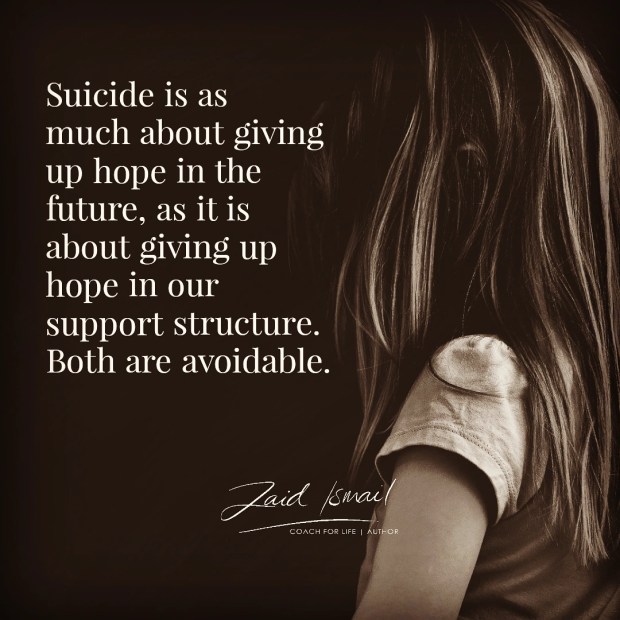
Suicide is avoidable
-

What are you waiting for?
When we find ourselves waiting for just the right moment, or that right feeling, or the perfect setting, or the ideal opportunity to present itself before we do something, we’re afraid of failure.
If we know, with understanding and rational thought, why we are not ready for something, that’s different.
When we have no real reason to put something off but we hesitate and make excuses, that’s when we’re not yet convinced about the value in what we want to do, or our ability to be successful at it.
Looking for reason without deliberate effort or purpose is how we pacify ourselves in our efforts to avoid failure.
When we focus on the value that we wish to create, and we accept that we are always learning something new even in spaces where we are very confident about our abilities, we will find the conviction to take action rather than to avoid failure.
The only reason failure weighs down on us so much is because we are defined by how others may judge us.
If you find yourself in such a head space, you need to reflect on why the opinions of others are more important than your opinion of yourself.
Improve your opinion of yourself, and it will be easier to take advice, learn from your mistakes, and grow from failure.
Own your life, or else someone else will.
#hope #expectation #sincerity #selfworth #selfawareness #mentalhealth #mentalhealthawareness #mentalhealthrecovery #selflove #lifecoaching #zaidismail #loveyourself #motivation #optimism #ownyourlife -
Rise
People that respect your victim-hood do so because it makes them feel better about themselves.
It doesn’t mean that they are malicious or have bad intentions. But they most likely don’t even realise it themselves.
In fact, you may be supporting others in ways that comfort you more than it helps them.
When we find familiarity in our struggles that others share, we risk polarising towards those who make us feel better about where we are, rather than seeking out those who may be able to guide us towards uplifting ourselves out of that space.
That’s one of the difficulties of being in a victim head space without realising it. We become really good at making others feel OK about their weakness while believing that we’re supporting them to overcome it.
Before you take offence to what I’m saying, you need to realise that you’re only a victim when you allow the oppression of others to define your self worth, and to dictate your effort towards establishing a life worth living.
The moment you own your life and rise above the impact of that oppression, you’re no longer a victim, you’re a fighter!
Not a survivor! A fighter!
You lose the sweetness of life when you focus on coping as best as you can.
That’s why you must always strive to rise above, to overcome, to prevail, and never to surrender or cope with what life throws at you.
You only get one shot at life.
Make it count.
#hope #expectation #sincerity #selfworth #selfawareness #mentalhealth #mentalhealthawareness #mentalhealthrecovery #theegosystem #ownyourlife #lifecoaching #zaidismail #loveyourself #motivation #optimism -
Embrace the whole of you
We often discard good advice because we don’t like the source.
Sometimes it’s because we don’t want to appear weak in front of them, and other times it’s because we are trying to save face after having treated them badly.
Emotional maturity is achieved when we are willing to learn from our enemies and loved ones alike.
It’s achieved when we are more focused on growth, than we are on how we may appear to others.
Emotional maturity is key to living with authenticity, and serving with conviction.
But, emotional maturity is not something that you can pursue directly. It is an outcome.
What we need to pursue directly is connecting with the gratitude of who we are, while seeking understanding of why they are who they are.
We must seek to understand the value of every good quality, positive trait, and also every flaw, while embracing how each of these contribute towards making up the whole of who we are as a human being.
Emotional maturity and quality of life, and relationships, follow from there.
Any other approach is not sustainable, because every other approach will be dependent on how others treat us, before we will be able to show up as our best selves in that moment.
Own Your Life. If not, someone else will.
#selfworth #selfawareness #ownyourlife #selfmastery #mindfulness #personalpower #ownyourshit #mentalhealthrecovery #mentalhealth #mentalhealthawareness #lifecoaching #zaidismail #loveyourself #emotionalmaturity #eq -
A victim of your own mind
There’s a difference between being a victim in the moment, versus holding onto the victim mindset long after the moment has passed.
We hold on to the victim mindset when we need others to recognise our struggle, or to acknowledge what we’re having to overcome or deal with.
The only reason this becomes necessary is because we feel unappreciated for the most part.
More than this, we also believe that if we don’t have the victim card to play, we will have no excuse when we fall short of the expectations of others.
The victim mindset is therefore a result of us believing that we’re not worthy in our own right, that’s why we need to give others something to appreciate about who we are and why we are that way.
This is a classic example of a self-defeating behaviour.
In addition to all this, when we’re in victim mode, we place demands on others to compensate for our shortcomings, resulting in strained relationships because they become responsible for how we feel about ourselves, while also having to take up the slack that we leave behind because of how exhausting the victim mindset can be.
You owe it to yourself to rise above the impact of your last experience. Waiting for justice or retribution, or even an apology only results in you placing your life on hold, and most often has zero impact on the one who treated you badly.
Don’t give them power beyond the event. If you do, you’re feeding the very cycle of abuse or bad behaviour that you feel victim to.
#selfworth #selfawareness #ownyourlife #selfmastery #mindfulness #personalpower #ownyourshit #mentalhealthrecovery #mentalhealth #mentalhealthawareness #lifecoaching #zaidismail #loveyourself #selfloathing #selfharm -
What’s your legacy?
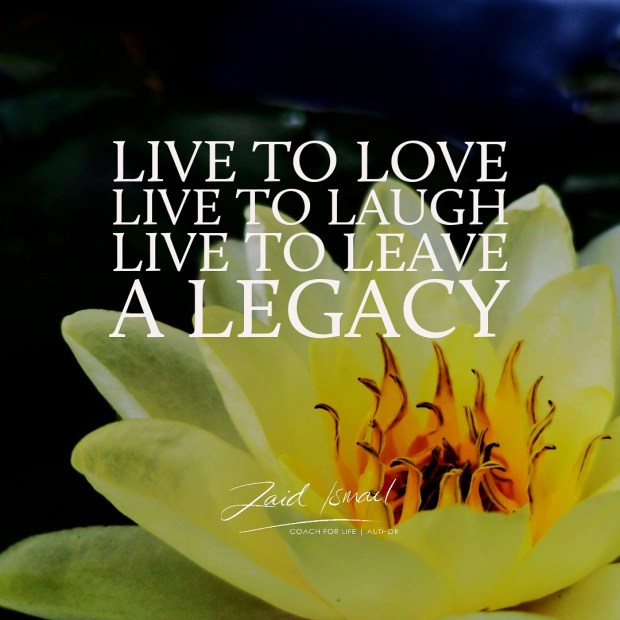
Live to love, to laugh, and to leave a legacy.
It is only through truly appreciating who we are, that we will be able to leave an imprint of love in the hearts of those we cherish.
Until we connect with that gratitude of self, our efforts will put smiles in the hearts of others, while our own faces carry smiles that barely reach our eyes.
Without such gratitude, our laughter will be nothing more than an attempt to release, in that moment, the heaviness that we harbour within.
And our legacy will be one of sacrifice and martyrdom, teaching our loved ones to sacrifice themselves in the service of others, while not teaching them how to connect with the sweetness of such service.
Material success is only a blessing if it uplifts, rather than enslaves.
Wealth that enslaves is the wealth that strokes our ego but deprives us of the joy of human connection, or denies us the bonds of beauty that feed our souls.
Laughter should not be sourced from a business deal that outwitted our opponents.
Such laughter will mock us in our later years when we realise that our fascination with wealth was merely a drop in the ocean of joy compared to the joy that we could have achieved in investing our incredible talents to brighten up the faces of loved ones, or even strangers.
Wealth is a means to an end. Don’t get so caught up in the means that you completely lose sight of your end.
#hope #expectation #sincerity #selfworth #selfawareness #mentalhealth #mentalhealthawareness #mentalhealthrecovery #selflove #love #laughter #joy #optimism #inspiration #leavealegacy #lifecoaching #zaidismail #loveyourself -
Do you know why?
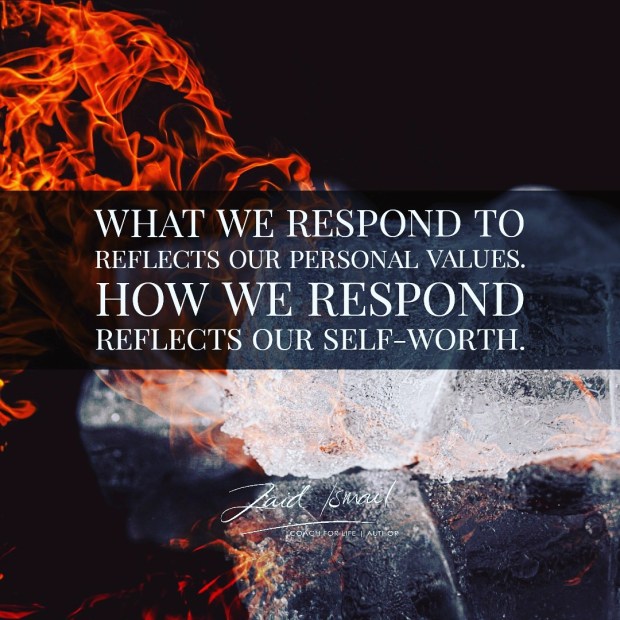
What we choose to respond to is a reflection of what is important to us.
The more important it is, the more intense or passionate our response.
Hence anger that bubbles over, or heartfelt pleas and messages to connect with someone about something.
The tone and demeanour of how we respond is a reflection of our self-worth.
The more aggressive or abrasive we are, the lower our self-worth in that moment and about that setting. And vice versa.
If we’re not mindful about our emotional needs from a given interaction, we’re likely to be distracted by the technical or practical aspects of what we’re dealing with, rather than understanding why it provokes such a strong response from us, or our partner.
Situational mindfulness is the easy part. That’s being aware of WHAT is going on around you so that you can respond appropriately.
Emotional mindfulness is more elusive, because it means that we need to be consciously aware of our emotional bias in that moment, or else we’ll lose sight of our bias when interpreting the actions or words of others. In other words, the WHY of our response.
Understanding your Egosystem that drives you is therefore critical towards improving the quality of your relationships, and your life.
If you’re struggling to understand why you can’t let go of something that appears hopeless, or why you feel so intensely about something that isn’t that important in the bigger picture, get your copy of The Egosystem now, and begin your journey of reconnecting with you, after having been distracted by the struggles of life.
#hope #expectation #sincerity #selfworth #selfawareness #mentalhealth #mentalhealthawareness #mentalhealthrecovery #theegosystem #ownyourlife #lifecoaching #coaching #zaidismail #lifegoals #loveyourself -
The living martyr
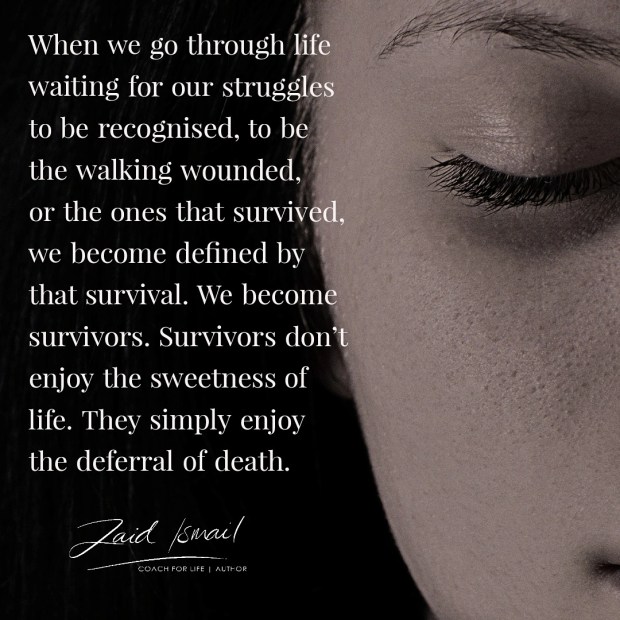
One of the biggest hang ups in life, is wearing our hurt as a badge of honour.
Our need to have our struggle recognised is born from the belief that we will not be appreciated if others don’t know what we went through.
It is born from the belief that our shortcomings must be tolerated or understood, or even accommodated by others because they don’t know what we’ve been through.
While some may look at this and think that it’s a reasonable expectation of compassion, the truth is, when we look to be seen in this way, we diminish the capacity we have to move beyond it.
We end up investing in the oppressed version of ourselves, while blaming the world for oppressing us.
If you believe that persevering through struggle is all you’re capable of, you’re oppressing yourself long before anyone else undermines your value.
Do you really believe that you’re capable of nothing more than to survive the struggles of your life, or do you believe that you have something of value to offer this world, despite your struggles?
Your answer to that question will determine if you live to survive by the rules of others, or if you live with a passion to leave this world in a better state than it was before your arrival because you believe you have something of value to contribute.
#selfworth #selfawareness #ownyourlife #selfmastery #mindfulness #personalpower #ownyourshit #mentalhealthrecovery #mentalhealth #mentalhealthawareness #lifecoaching #zaidismail #loveyourself #ownyourlife