Hope is not hope when it is rooted in futility. That is simply wishful thinking.
Hope is born from the belief that things can change.
It is not predicated by statements of ‘if only’ or ‘I wish’, but rather inspired by focusing on the probabilities and the opportunities that we have.
Hope is born when we focus on what we can do to uplift ourselves or change our state, rather than focusing on what we need from others before things can improve.
Hope is the most powerful statement of gratitude without having to claim being grateful.
It is not an attitude, nor is it blind faith.
It is awareness of who we are and what we’re capable of, so that what we discover to be our limits creates a yearning in us to acquire the skills, knowledge, understanding, and resources to push beyond those limits.
Hope is always present.
But when we surrender, we invest that hope in someone else saving us, because we gave up hope in our ability to rise above what we are facing.
Fear is the enemy of hope, and conviction is hope’s armour.
If you desire relief from an oppressor more than you desire to destroy the oppressor, you invest your hope in the benevolence, or the mercy of the one who oppresses you.
That is surrender, no matter how rebellious you may appear in your response.
If your optimism is not followed by meaningful and decisive action, you’re lying to yourself about being optimistic.
Where and in whom is your hope invested?
If you say that it’s invested in the Almighty, then be true to exercising the abilities and competence that He has endowed you with, instead of praying for Him to exercise it for you.
#hope #expectation #sincerity #selfworth #selfawareness #mentalhealth #mentalhealthawareness #lifecoaching #zaidismail #theegosystem #ownyourlife #istandwithpalestine
Category: Philosophy
-

Hopefully…
-

Fallacious philosophies
This is incorrect on many levels. Most importantly, it suggests that our thoughts inspire the actions of others.
That is patently incorrect.
It also suggests that if we focus on positivity, we’re guaranteed to attract positivity.
That is dangerously incorrect.
We all wear masks of some kind.
When someone offers us an opportunity to fill the gaps in our lives that those masks are intended to hide, we are attracted to them, and vice versa.
A healing spirit will attract a hurt soul, and hurt souls often attract the generosity of a healing spirit.
But that doesn’t mean that the one that is hurt will choose to be healed.
Many find comfort in the affection and care that their hurt attracts.
When that comfort defines their self worth, they will respond aggressively when expected to rise above it, or encouraged to heal from it.
That’s when the masks fail them and the relationship breaks down.
This law of attraction thinking is a fallacy that will harm more than it will heal.
Be careful of what philosophy you buy into.
#lawofattraction #mentalhealth #karma #fate #positivethinking #selfworth #goodintentions #ownyourlife #theegosystem #taqdeer #zaidismail #mentalhealthawareness -
The victim-hood of self-loathing
No good deed goes unpunished. I was reminded of this in recent days when the bitterness of a self-loathing human distracted me from what is important about life. It’s not the bitterness that was jarring. It’s the intensity, and the immensity of the self-loathing that has become the battle cry of too many that jarred me most.
The delusion that doing good attracts goodness adds to the mind-numbing effort of being human. We don’t attract what we do or what we give, we attract those who are most in need of what we’re offering.
That’s why the vapid seek the wholesome.
The weak seek the strong.
The self-loathing seek the grateful.
And the cursed seek the blessed.
But the twist is a terrible one. Just because you’re self-loathing doesn’t mean that you’re not blessed. It just means that you will not see in yourself what others see in you.
It’s easy to lose yourself to the bitterness of a world full of ingrates disguised as humans parading as the wounded selfless ones. But in that lies the clue to recognise the twist of that dagger of self-loathing before it is inserted into your tender flesh.
The selfless, the truly selfless, never parade.
The ones who wear their heart on their sleeves, their struggle on banners of goodness and humility, and their inaction as a claim to exhaustion from their reality are the ones who are ungrateful for who they are and what they have. That’s why they look for validation for what they parade in sometimes subtle tones, but most often in blatant distortions of their reality.
Naivety is the knife that you drive into your own gut when you trust blindly, serve loyally without question or wisdom, and when you surrender who you are for who you believe you must be.
Joy is ephemeral when not shared. It becomes a fleeting moment celebrated privately when what we honour comes to pass, but is just as quickly set aside because it doesn’t really matter if we don’t matter. It is this core of being human that turns our humanness into a frailty that is exploited by the self-loathing.
Self-loathing is born from our assumption that we are incapable of what is needed to earn affection or inclusion. Such an assumption demands that we must present our best case to defend our pitiful state before others see us as pitiful or lacking. That’s when our struggle grows to define us. That’s when we need everyone to revere our struggle and not dare to advise us to rise above it because rising above it becomes a threat to our sense of self.
If we don’t recognise the self-loathing in others, we’ll exhaust ourselves to the point of depletion in our efforts to be enough for them, or to inspire them to be better, or to believe in them until they begin to believe in themselves, while never holding them accountable for their ingratitude for everything that the have, and all that they are.
If we don’t recognise the self-loathing in others, we’ll assume that they’re victims of life, while losing sight of the victims of their carnage as they go through life taking from everyone but always having reason not to reciprocate in equal measure. That’s how a healthy self-esteem in one who is sincere in uplifting another can easily be exchanged for crippling self-doubt after struggling to understand why we may never be enough for one who seems so full of potential if only…If only they see themselves the way that we see them.
Self-loathing doesn’t create space for such realisation because self-loathing is the abdication of accountability for who we choose to be. Without accountability, there can be no healthy self-esteem because we need accountability to take a stand for what we stand for before we will ever experience the self-respect that results from standing for something that we believe to be important, rather than chasing things that make us important to others.
Self-loathing is the ultimate barometer of gratitude, or more accurately, ingratitude. If we can’t be grateful for who we are, how can we possibly be grateful towards others for what they do? We cannot give what we don’t have. Which means that we can only give what we have. That is how our behaviour, when understood clearly, reflects the light or the darkness that we court within.
-
Stop judging. Be human.
⚠️ TRIGGER WARNING
This meme showed up on my timeline earlier and highlighted everything that is wrong with the way in which we treat each other.
There are a few terms that I generally disagree with (sometimes very strongly) if used to describe people.
These terms include broken, damaged, toxic, and basically anything that reduces a human to a single repulsive notion.
We lose our humanness when we see someone’s bad behaviour and assume that to be the totality of who they are.
No one is toxic. We may have destructive behaviours, or dysfunctional perspectives and so on. But that doesn’t make us toxic.
It makes us a human that is struggling to find our humanness in the absence of understanding or compassion from someone significant.
What’s more ‘toxic’? A single person that is allowed to define the tone of an entire family, or a family that lacks any conviction in their own self-worth to be defined by a single person?
Enjoin what is right and forbid what is wrong, not only when it’s fashionable or easy, but especially when it’s difficult.
If we give up our ability to create good with those around us, we lose our right to complain about them letting us down.
If someone is angry or bitter, they’re feeling unappreciated.
Reduce a person’s sincere efforts towards fulfilling their part in a relationship to nothing more than duty and minimum expectation, and you’ll very quickly inspire ‘toxic’ behaviour on their part.
Drop the labels and start seeing the human behind the behaviour.
There will come a time when you will need others to show you the same empathy and compassion.
Just because you’re struggling to strike a balance between enabling bad behaviour versus understanding it doesn’t mean that the bad behaviour is toxic. It just means that you are not equipped or are not the right person to influence the positive change that you’d like to see in them.
Stop judging. Be human.
#emotionalabuse #mentalhealth #mentalhealthawareness #mentalhealthrecovery #selfworth #selfawareness #lifecoaching #zaidismail #theegosystem #ownyourlife #narcissist #narcissisticabuse -
Look back with understanding
When you don’t have a gentle hand to guide you, or an understanding structure to support you, life will be shaped through trial and error.
In the same way that we can’t give what we don’t have, nor can others offer us what they don’t have – no matter how much we need it from them, or may have rights to get it from them.
Realising this has been the saving grace of my sanity through a colourful life.
So many of us set out in life knowing who we don’t want to be based on our experiences with those around us – especially our parents.
But we fail to realise that it doesn’t prepare us, or give us anything to work with, in determining how to be who we want to be.
It may sound cryptic, but it’s not.
It’s easy to identify what we want to achieve in life, but if we don’t know how life works, we will keep tripping up on the subtleties that cause havoc in ways that we never anticipated.
No one sets out to destroy their own life, even if they persist in blatantly destructive behaviour.
They do so because they exhausted themselves living life wishfully instead of purposefully.
Such a mindset results from anger about what you don’t have, leading to acting with haste or impatience in striving for what you want.
The only antidote that I’ve discovered for this is to observe, with the intention of understanding, those who let you down or didn’t show up the way you needed them to.
Our trial and error, like theirs, denies others the wisdom and support that they need to learn how life works.
Self-pity or entitlement, and especially anger, will never change that reality, it will only repeat the cycles that may have caused us hardship.
It always starts with you.
#hope #expectation #sincerity #selfworth #selfawareness #mentalhealth #mentalhealthawareness #lifecoaching #zaidismail #theegosystem #ownyourlife #parenting #divorce -
Divinely obnoxious?
Godliness is like humility. It is lost when we actively pursue it.
Living by the doctrine to which you subscribe is infinitely more important than preaching it.
People learn from how you treat them, not from how you chastise them.
Judging the faith of another reveals the cracks in your self-worth more than it offers any revelation about the faith of another.
When our self-worth is low, our association with divinity, religion, or other groups will be used to compensate for what we believe we lack in ourselves so that we may get the respect that we need.
When we assume ourselves to be above those that behave worse than us, or those that disagree with us, we grow arrogant in our thinking and our ways, which directly opposes our efforts towards godliness, or piety.
When we speak on behalf of the Almighty, we assume to have knowledge of the unseen because we believe ourselves to be devout enough in our practices and superior in our morals to claim such authority.
Such pride and arrogance causes a decay in the soul that results in harshness, ingratitude, and rigidity, making it increasingly difficult to receive advice from sincere advisors.
All this conflict within us results from a low self-worth, because when your self-worth is low, your life will be focused on compensating for that, rather than living purposefully or sincerely.
Peace lies on the other side of gratitude, and gratitude is impossible if you lack awareness and appreciation for who you are, and who you want to be.
That, right there, is the building blocks of self-worth.
It always starts with you.
#compassion #sincerity #authenticity #mentalhealth #mentalhealthawareness #mentalhealthrecovery #selfworth #selflove #selfawareness #selfrespect #mindfulness #inspiration #ownyourlife #theegosystem #forgiveness rewards #lifecoaching #zaidismail -
Labelling humans
We dehumanise the human when we label their emotional experience as an illness.
The moment we attach a label to a life experience, we focus on the label and discard the merits of the experience.
We make people invisible when we deny the reality of their experience by suggesting that there is something clinically wrong with them, despite causality of their emotional upheaval being clearly associated with their experiences in life.
In other words, there is a clearly troubling or traumatising experience that they’ve endured to explain their emotional duress, yet we diminish their experience by ‘diagnosing’ them with an illness for feeling overwhelmed, anxious, or stressed, etc. simply because they’re affected by it for longer than we think they should be affected by it.
The victim readily embraces such labels because it offers hope where they feel hopeless, and allows them to abdicate responsibility for rising above it.
The oblivious or insensitive ones happily embrace such labels because it demands less emotional investment, or less accountability in their efforts to uplift or support those around them.
Our aversion to embrace the entirety of the human behind the troubled behaviour denies the victim a voice, or an opportunity to understand their painful experiences in life.
These labels are worn with shame because it denies us our humanness and makes us a symptom.
You cannot break the stigma of mental health by undermining the humanness of the ones affected by the stigma.
Kill the label, kill the stigma.
If you stigmatise someone’s real life experience, how can you possibly expect them to feel whole?
#mentalhealth #mentalhealthawareness #mentalhealthrecovery #suicide #suicideprevention #suicidalawareness #suicideawarenessmonth #depression #anxiety #ownyourlife #theegosystem #embracingME #zaidismail -
You cannot not have expectations
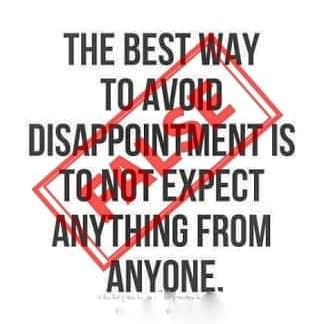
The advice to live life without expectations to avoid disappointment is disturbingly misleading.
If you’re striving to achieve this state of having no expectations of anyone, please stop.
When we convince ourselves that we should not expect anything from others, we also have to convince ourselves that they should not expect anything from us.
If that’s who you want to be, then prepare yourself for an isolated and lonely life where you are singularly responsible for everything that you want or need.
Any rational person knows that it’s impossible to live that way.
Expectations are fundamental to a healthy relationship.
Without it, there is no need for trust or loyalty because we expect nothing from anyone, so they’re all free to do as they please, right?
What cements a relationship is trusting that you can expect a significant other to show up for you the way that you need.
What convinces us of our worth to others is when they take comfort from knowing that we’re there for them. That’s an expectation that they have of us.
Focusing on not having expectations is a defence mechanism in response to having had our trust betrayed by someone close to us.
It’s an attempt to protect ourselves from ever being hurt that way again, resulting in us hurting others who had nothing to do with that betrayal.
If you don’t resolve that problem of how and why you felt betrayed, because betrayal is very often how we feel about someone’s behaviour rather than them actively trying to betray us, you will create a whole lot of new problems that you never intended to create.
By all means, be selective about who you expect things from in the same way that you shouldn’t trust every person that crosses your path.
Trust is earned, while respect is a reflection of who you are.
Confuse the two, or assume they’re the same, and life will become very complicated and onerous.
Don’t take advice from memes. Rather consider it as a point of reflection before acting on it.
#hope #expectation #sincerity #selfworth #selfawareness #mentalhealth #mentalhealthawareness #lifecoaching #zaidismail #theegosystem #ownyourlife