This is a reminder for those who think that everyone who wears their heart on their sleeves, or are just looking for attention.
It may not be healthy, but it’s their way of drawing attention to their struggle that they need help with.
How we respond either enables the unhealthy expression, diminishes their efforts to be heard, or uplifts them through creating understanding about how they may be able to rise above it.
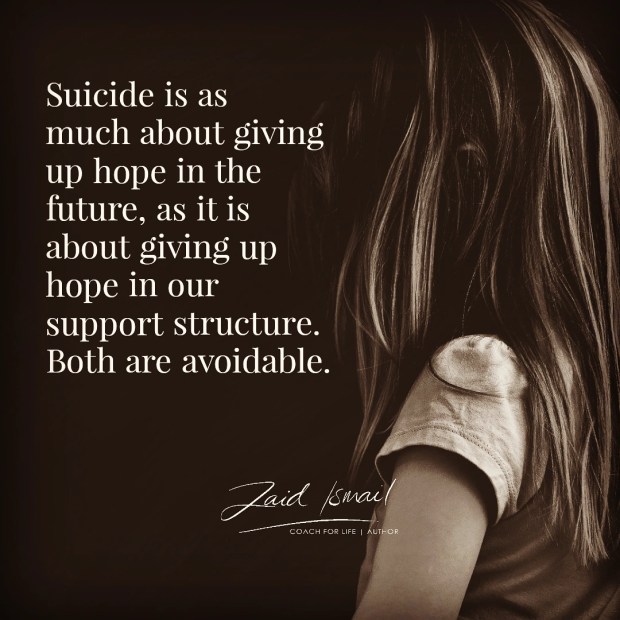
Death by suicide is avoidable, and so is depression.
Both just need a small dose of kindness and understanding.
Don’t go venting at strangers.
If you need to vent, vent with people that know you so that they have no reason to believe that your frustration is a definition of THEIR worth.
So, if you see someone you don’t know venting, don’t respond with anger.
Break the cycle.
And if it’s someone you do know, let them vent without feeling a need to stop them.
Once they’re done, then try to find out what’s really going on.
No one behaves rationally in the midst of their rage.
But if they’re harming someone in the process, then intervene in the most calm way possible.
Don’t escalate the situation further.
And remember, it takes a village…if you don’t have a village to support your efforts, pace yourself and adjust your expectations of what you’re capable of in line with your reality.
You can’t pour from an empty cup.
So start by being kind to yourself, before you sacrifice yourself in the service of others.
#hope #expectation #sincerity #selfworth #selfawareness #mentalhealth #mentalhealthawareness #mentalhealthrecovery #theegosystem #ownyourlife #lifecoaching #zaidismail #loveyourself #suicideprevention #suicideawarness #depression
Category: Life
-
Suicide is avoidable
-

What are you waiting for?
When we find ourselves waiting for just the right moment, or that right feeling, or the perfect setting, or the ideal opportunity to present itself before we do something, we’re afraid of failure.
If we know, with understanding and rational thought, why we are not ready for something, that’s different.
When we have no real reason to put something off but we hesitate and make excuses, that’s when we’re not yet convinced about the value in what we want to do, or our ability to be successful at it.
Looking for reason without deliberate effort or purpose is how we pacify ourselves in our efforts to avoid failure.
When we focus on the value that we wish to create, and we accept that we are always learning something new even in spaces where we are very confident about our abilities, we will find the conviction to take action rather than to avoid failure.
The only reason failure weighs down on us so much is because we are defined by how others may judge us.
If you find yourself in such a head space, you need to reflect on why the opinions of others are more important than your opinion of yourself.
Improve your opinion of yourself, and it will be easier to take advice, learn from your mistakes, and grow from failure.
Own your life, or else someone else will.
#hope #expectation #sincerity #selfworth #selfawareness #mentalhealth #mentalhealthawareness #mentalhealthrecovery #selflove #lifecoaching #zaidismail #loveyourself #motivation #optimism #ownyourlife -
Rise
People that respect your victim-hood do so because it makes them feel better about themselves.
It doesn’t mean that they are malicious or have bad intentions. But they most likely don’t even realise it themselves.
In fact, you may be supporting others in ways that comfort you more than it helps them.
When we find familiarity in our struggles that others share, we risk polarising towards those who make us feel better about where we are, rather than seeking out those who may be able to guide us towards uplifting ourselves out of that space.
That’s one of the difficulties of being in a victim head space without realising it. We become really good at making others feel OK about their weakness while believing that we’re supporting them to overcome it.
Before you take offence to what I’m saying, you need to realise that you’re only a victim when you allow the oppression of others to define your self worth, and to dictate your effort towards establishing a life worth living.
The moment you own your life and rise above the impact of that oppression, you’re no longer a victim, you’re a fighter!
Not a survivor! A fighter!
You lose the sweetness of life when you focus on coping as best as you can.
That’s why you must always strive to rise above, to overcome, to prevail, and never to surrender or cope with what life throws at you.
You only get one shot at life.
Make it count.
#hope #expectation #sincerity #selfworth #selfawareness #mentalhealth #mentalhealthawareness #mentalhealthrecovery #theegosystem #ownyourlife #lifecoaching #zaidismail #loveyourself #motivation #optimism -
How to abandon your dreams
Failure only threatens is if we feel defined by the outcome of our efforts in trying to achieve our goals.
Sometimes those goals are small things that influence the daily quality of our lives, and sometimes it’s big things that shape our future.
The source of fearing failure is in our need to be respected by those around us.
The only time we will be disrespected or diminished when we fail at something is when we surround ourselves with those who themselves are defined by how others see them.
In such environments, mediocrity and tradition will be sacred. Playing it safe will be considered responsible. And being risk averse will be considered maturity.
If the life that you seek is one without failure, without change, and without discovering who you truly are, then such environments are perfect for you.
But, as humans, we are restless in spirit, and adventurous in nature. We are driven by knowing that we left our mark and we improved the state of the world in the short time that we were here.
Mediocrity, conformance, and restraint therefore goes against our nature.
When we fight our nature from fear of exclusion or rejection, it’s only a matter of time before our health suffers, and our spirits will be dulled.
That’s how dreams are lost and hope is abandoned.
You owe it to yourself, and the next generation, to be true to the value that you are capable of creating in this world beyond just maintaining the status quo.
Live inspired.
#hope #expectation #sincerity #selfworth #selfawareness #mentalhealth #mentalhealthawareness #mentalhealthrecovery #selfrespect #mindfulness #inspiration #motivation #optimism #ownyourshit #ownyourlife #theegosystem #lifecoaching #zaidismail #lifegoals -
To be near death
Yesterday, I watched a man die.
I didn’t know him. I don’t know if he was a good person. Nor do I know if he was loved. But his body and his face had all the signs of one who lived in emotional duress.
He was a married man, and therefore most likely loved. He was an elderly man, and therefore had much life in his years. It appears that he may have succumbed to a heart attack. Alone. In a random street. In a public place. With no celebration of his life or his accomplishments to accompany him, or comfort him in his last moments. Except me, a stranger feeling for his pulse, awkwardly shifting him to ease his breathing, and waiting helplessly for more skilled assistance to arrive while my friend looked on equally helpless at what was unfolding in front of us.
His dignity was not spared by the lethargic paramedic that eventually arrived on scene. Nor by the inept control room operator that showed zero empathy or urgency in summoning help.
By the time I left, he was covered in a red blanket, just barely. His hair and feet peeping out of either end. And around his spent body, jovial spirits from five different emergency response services mulled about, paying no attention to the corpse on the sidewalk. He was no longer a name, nor a person. He was a body. A corpse. A reminder of the inevitability of death.
The only thought that remains, is that death passed me in the street yesterday. And like that man, I left home for a meeting, without any loved ones around, not knowing if I would return home, but assuming that I would. Because that’s what keeps us going, isn’t it? The probability of death in every moment of life is always lower than the probability of surviving that moment and having another, and another, and more.
Until there is no more. Without warning or ceremony. One day, there will be no more. And the only ceremony that will remain, will be the closure of our life, so that those who survive us may be able to continue living out their probabilities, comforted by the fact that it wasn’t them.
Yesterday, I stood side by side with death. And I feel numbed by the fact that it didn’t shake me as much as it should have. My effort to reclaim my humanness from an inhumane world continues.
-
What’s your legacy?
Live to love, to laugh, and to leave a legacy.
It is only through truly appreciating who we are, that we will be able to leave an imprint of love in the hearts of those we cherish.
Until we connect with that gratitude of self, our efforts will put smiles in the hearts of others, while our own faces carry smiles that barely reach our eyes.
Without such gratitude, our laughter will be nothing more than an attempt to release, in that moment, the heaviness that we harbour within.
And our legacy will be one of sacrifice and martyrdom, teaching our loved ones to sacrifice themselves in the service of others, while not teaching them how to connect with the sweetness of such service.
Material success is only a blessing if it uplifts, rather than enslaves.
Wealth that enslaves is the wealth that strokes our ego but deprives us of the joy of human connection, or denies us the bonds of beauty that feed our souls.
Laughter should not be sourced from a business deal that outwitted our opponents.
Such laughter will mock us in our later years when we realise that our fascination with wealth was merely a drop in the ocean of joy compared to the joy that we could have achieved in investing our incredible talents to brighten up the faces of loved ones, or even strangers.
Wealth is a means to an end. Don’t get so caught up in the means that you completely lose sight of your end.
#hope #expectation #sincerity #selfworth #selfawareness #mentalhealth #mentalhealthawareness #mentalhealthrecovery #selflove #love #laughter #joy #optimism #inspiration #leavealegacy #lifecoaching #zaidismail #loveyourself -
Peace always starts with you
The next time you find yourself having a disagreement with someone, consider if the way in which you conduct yourself is to demand that they show you due respect or consideration, or are you trying to establish understanding.
When we feel taken for granted or invisible in something that is important to us, we’re more likely to become defensive, aggressive, or passive aggressive in our efforts to get our point across.
If we’re not aware of our need for significance, we will go in search of significance in almost every setting.
This is how we end up yelling at cashiers, losing ourselves to road rage, and being argumentative with co-workers, as just a few examples.
Understanding why we feel insignificant is the first step towards breaking that cycle.
Understanding why those who are significant to us are not treating us with the significance that we need is the second step.
And the third step towards breaking this cycle of rage or bitterness at the world is to understand why we need such validation to feel significant before treating others in a way that is true to who we are, rather than being driven by the anger or disappointment that we feel.
Emotional mindfulness is core to the above, and having a healthy self-worth is what makes it possible to pace ourselves in our efforts towards creating the understanding and establishing the bonds that we believe will improve the quality of our relationships.
It always starts with you.
If you need help to understand what drives you to be less than who you want to be, reach out via my website at zaidismail.com or on WhatsApp at +27836599183, and let’s get the conversation started.
#selfworth #selflove #selfawareness #selfrespect #mindfulness #theegosystem #mentalhealth #mentalhealthawareness #mentalhealthrecovery #ownyourshit #ownyourlife #compassion #sincerity #authenticity #lifecoaching #zaidismail -
Prisons of our minds
Without realising it, we create most of the boundaries and the dependencies that we have on others, often without them being aware of it.
One of the reasons we do this is because that is our code of life that we’re honouring.
It’s our way of respecting or protecting what we see as sacred in that relationship.
However, it’s based on the assumption that our partner shares the same values, and values the same things.
Healthy communication will make such misalignment of expectations easier to deal with, and resolve.
But, the moment we tell someone what we need from them, we create an opportunity for doubt within ourselves about whether they’re doing something out of obligation, or sincerity.
That doubt is the beginning of the prison walls that we erect around ourselves, which slowly isolates us from our partner because we’re expecting them to notice what we need.
But expectations are important in a relationship.
Without it, the relationship loses value and the trust fades.
To avoid this, we need to develop a healthy emotional maturity in the relationship so that issues of trust, expectations, and duty can be discussed in ways that don’t threaten the self-worth of your partner.
More than this, we also need to realise that if we focused on what we’re not getting, and also focused only on what we’re giving, chances are good that we are unaware of what they need from us beyond the assumptions that we’ve made.
Thus, the prisons of our minds become the prisons of our lives.
#hope #expectation #sincerity #selfworth #selfawareness #mentalhealth #mentalhealthawareness #mentalhealthrecovery #lifecoaching #coaching #zaidismail #relationshipgoals #marriage #marriageadvice