Life conditions us to look at what we’re getting, rather than what is given.
That means that we focus on what we’re giving, and not what others are receiving from us.
That’s how we end up misinterpreting the signals that we get from them, while they also misinterpret the signals that they get from us.
The result: A lot of avoidable misunderstandings that break down good relationships.
The reason why everything is tainted or beautified by your self-worth is because that is the lens or the filter through which you view life.
When we have an unhealthy self-worth, life seems dreary and morbid without any hope that what’s important to us will be important to anyone else.
When our self-worth is healthy, we see opportunity to create value, and find reason to uplift others rather than wait to be uplifted.
Self-worth is often over complicated.
Simply put, it’s our belief in our ability to add value to the world and to the lives around us.
When we doubt this, or become distracted when our efforts to add value were rejected by someone significant, we question our value first, before we consider that they may have been going through their own difficulty that caused them not to see or believe in what we were offering.
That distraction is what leads to self-loathing.
Self-loathing therefore sets in when we stop seeing ourselves for who we are, and start seeing ourselves the way we think others see us.
Perhaps this is just another reason why the eyes are the windows to the soul.
When last did you see you and not what you think society thinks of you?
#hope #expectation #sincerity #selfworth #selfawareness #mentalhealth #mentalhealthawareness #lifecoaching #zaidismail #theegosystem #ownyourlife #mentalhealthrecovery
Tag: mentalhealthrecovery
-

Do you see you?
-

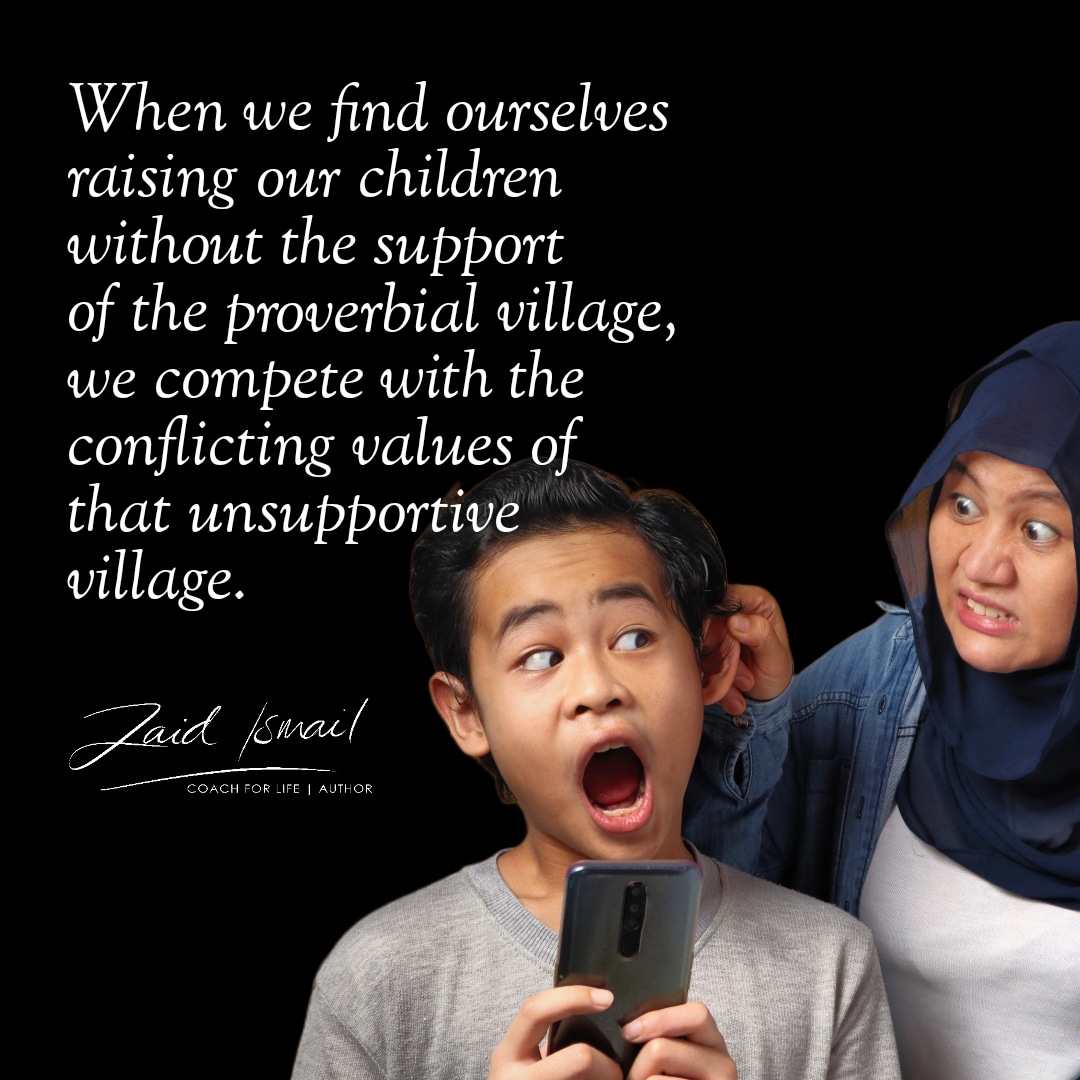
Be the village
While it takes a village to raise a child, it also takes a village to corrupt a child.
Parenting is a monumental challenge in itself, but becomes infinitely more challenging when being done by a single parent.
Add to the single parenting challenge by having an obstructive co-parent, and the challenge continues to grow ever more insurmountable.
If that’s not enough, throw in the depraved value system of the global village that is available on every Internet connected device that your child has access to, and suddenly you realise exactly what you’re competing with in trying to raise a wholesome, healthy, and grounded human.
But it’s not impossible to achieve, despite those impossible odds stacked against any dedicated parent/s.
Firstly, you need to realise the impact of your role in their life, especially when the self-pity sets in from the extended struggle of trying to be the most prominent influence in their life.
Secondly, you need to understand that wayward behaviour is their fears driving them towards wanting to be significant in their social circles. Focus on understanding those fears, rather than fixating on the bad behaviour.
Thirdly, even if they currently reject the values that you’re trying to instill, you cannot compromise on those values or else you convince them that it’s optional. Standing firm gives them a point of reference for later in life when they will need those values more than ever.
Lastly, parenting is not for those who need instant gratification, nor is it about the parent.
It’s about demonstrating the value and benefit of living life the way that you want them to live theirs, and not compelling them through the fear of consequences to do the right thing.
Fear is never a sustainable motivator to be a good person.
But sometimes it’s a necessary tool to break a harmful cycle.
Be very careful with how you use it.
#parenting #generationaltrauma #singleparenting #ownyourlife #theegosystem #lifecoaching #zaidismail #selfworth #selfawareness #mentalhealth #mentalhealthawareness #mentalhealthrecovery -
Divinely obnoxious?
Godliness is like humility. It is lost when we actively pursue it.
Living by the doctrine to which you subscribe is infinitely more important than preaching it.
People learn from how you treat them, not from how you chastise them.
Judging the faith of another reveals the cracks in your self-worth more than it offers any revelation about the faith of another.
When our self-worth is low, our association with divinity, religion, or other groups will be used to compensate for what we believe we lack in ourselves so that we may get the respect that we need.
When we assume ourselves to be above those that behave worse than us, or those that disagree with us, we grow arrogant in our thinking and our ways, which directly opposes our efforts towards godliness, or piety.
When we speak on behalf of the Almighty, we assume to have knowledge of the unseen because we believe ourselves to be devout enough in our practices and superior in our morals to claim such authority.
Such pride and arrogance causes a decay in the soul that results in harshness, ingratitude, and rigidity, making it increasingly difficult to receive advice from sincere advisors.
All this conflict within us results from a low self-worth, because when your self-worth is low, your life will be focused on compensating for that, rather than living purposefully or sincerely.
Peace lies on the other side of gratitude, and gratitude is impossible if you lack awareness and appreciation for who you are, and who you want to be.
That, right there, is the building blocks of self-worth.
It always starts with you.
#compassion #sincerity #authenticity #mentalhealth #mentalhealthawareness #mentalhealthrecovery #selfworth #selflove #selfawareness #selfrespect #mindfulness #inspiration #ownyourlife #theegosystem #forgiveness rewards #lifecoaching #zaidismail -
Labelling humans
We dehumanise the human when we label their emotional experience as an illness.
The moment we attach a label to a life experience, we focus on the label and discard the merits of the experience.
We make people invisible when we deny the reality of their experience by suggesting that there is something clinically wrong with them, despite causality of their emotional upheaval being clearly associated with their experiences in life.
In other words, there is a clearly troubling or traumatising experience that they’ve endured to explain their emotional duress, yet we diminish their experience by ‘diagnosing’ them with an illness for feeling overwhelmed, anxious, or stressed, etc. simply because they’re affected by it for longer than we think they should be affected by it.
The victim readily embraces such labels because it offers hope where they feel hopeless, and allows them to abdicate responsibility for rising above it.
The oblivious or insensitive ones happily embrace such labels because it demands less emotional investment, or less accountability in their efforts to uplift or support those around them.
Our aversion to embrace the entirety of the human behind the troubled behaviour denies the victim a voice, or an opportunity to understand their painful experiences in life.
These labels are worn with shame because it denies us our humanness and makes us a symptom.
You cannot break the stigma of mental health by undermining the humanness of the ones affected by the stigma.
Kill the label, kill the stigma.
If you stigmatise someone’s real life experience, how can you possibly expect them to feel whole?
#mentalhealth #mentalhealthawareness #mentalhealthrecovery #suicide #suicideprevention #suicidalawareness #suicideawarenessmonth #depression #anxiety #ownyourlife #theegosystem #embracingME #zaidismail -
It doesn’t make you stronger
The belief that what doesn’t kill you makes you stronger is a lie.
It may prepare us for greater trials and opportunities, but we also grow impatient or intolerant when we find ourselves facing the same issues repeatedly.
Life feels fulfilling and purposeful when we solve a problem and move on, but feels exceedingly frustrating when we are compelled to deal with the same problem every day.
Eventually, it’s not the repeated problem that gets to us but rather anyone associated with such problems.
Like going to work and dealing with disrespect or unreasonable demands to constantly have to explain or defend yourself, and then getting home and being faced with similar experiences in a different context.
Those themes that are similar between work and home is what feels like a trigger or a provocation because emotionally, it resonates with the insignificance that we feel in both places.
And the same is true in reverse.
What we experience in our home life preloads us for what we’re willing to tolerate in our public or professional life.
The more mindful we are about this, the less likely we are to rage at those who have nothing to do with our misery. Be they loved ones, or strangers.
Don’t go looking for character building experiences that will make you stronger.
Life has plenty in store for you by design.
#hope #life #ownyourlife #mentalhealth #mentalhealthawareness #mentalhealthrecovery #theegosystem #whatdoesntkillyou #whatdoesntkillus #peace #mindfulness #lifecoaching #zaidismail -
You cannot make them rise
I’ve seen, and experienced first hand, the disaster that awaits when we convince ourselves that the demons that others deal with is our responsibility to resolve.
Being kind, compassionate, and even understanding does not mean that we must own the decisions that others have made, especially when those decisions include them choosing to hold on to anger from their past instead of embracing the opportunities of the future.
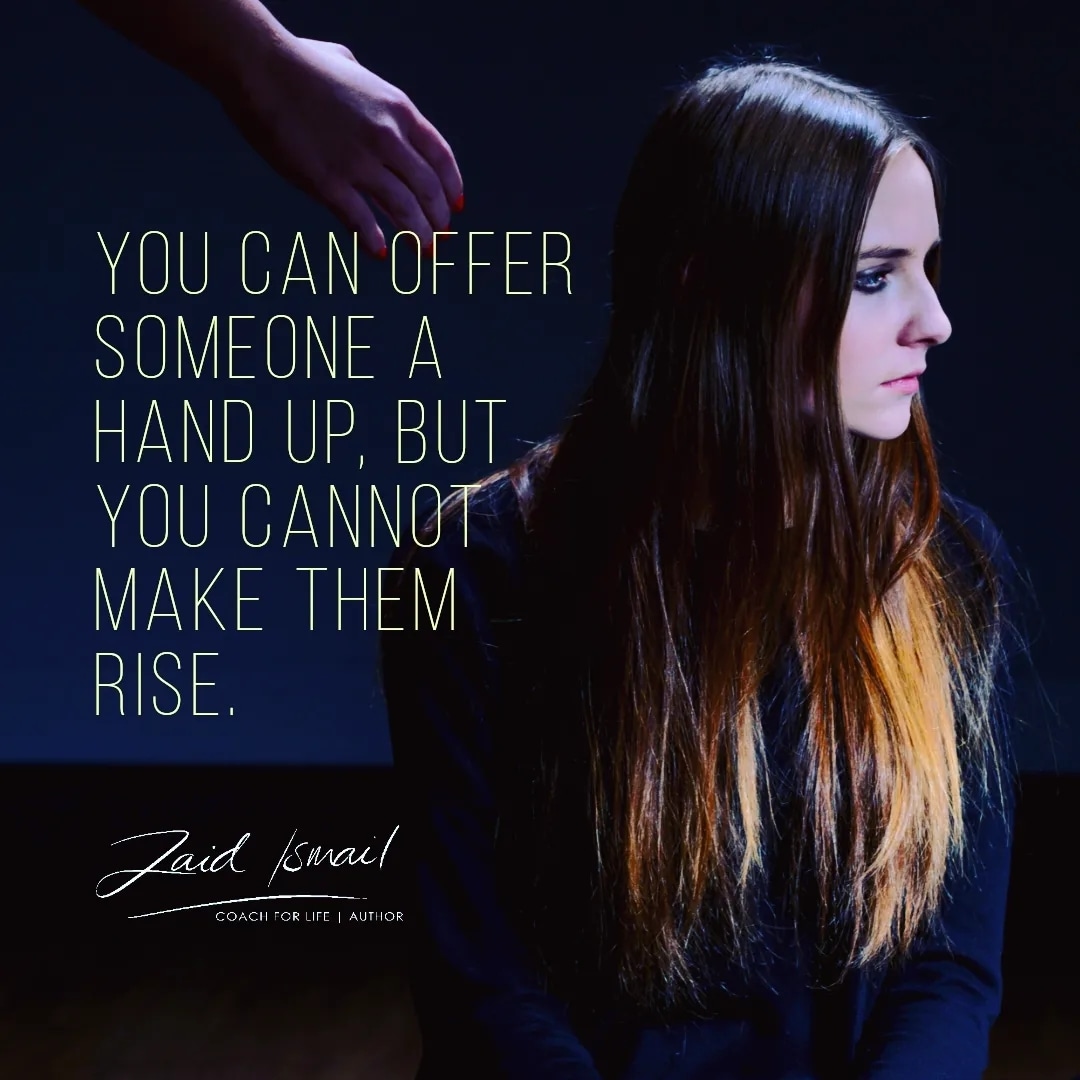
Remember that you can only offer someone a hand up, you cannot make them rise.
The same way that you must own the consequences of your decisions, you are responsible for giving them every opportunity to own theirs.
That includes not making yourself available as a doormat to them when they’re not owning it.
You’re not a hospital for the wounded egos of others.
Compassion doesn’t mean that you must be a martyr.
Sacrificing yourself to uplift another not only reflects ingratitude on your part for who you are and what you have, it denies your contribution of love to those that have a right to it, including yourself.
Moderation in everything, and everything in moderation.
Embrace your life fully, not only its struggles.
#selfworth #selflove #selfawareness #selfrespect #mindfulness #theegosystem #mentalhealth #mentalhealthawareness #mentalhealthrecovery #lifecoaching #zaidismail #ownyourlife #compassion #sincerity -
The meandering twists of fate
Betrayal is not always a result of harsh words, lies, or cruel action.
We’re often so focused on what we’re not getting from others, that we don’t pause to consider what they may not be getting from us either.
The deepest cuts are those that are inflicted when we trust someone to be there, but they walk away instead.
It’s when our rock in this world goes silent when we desperately need to hear their comforting voice.
The searing edge of the blade of betrayal is when we repeatedly make excuses for others failing us, but we’re discarded the moment we have a moment of weakness.
When there is inaction from those towards whom we look expectantly while recalling the times that they drew on our energy in moments when we barely had enough to sustain our own spirit, we find ourselves holding on, desperately clawing with both hands, to the remnants of the shards of our broken spirit, knowing that only we will be there for us, with the only solace needed being our trust in the One who created us.
People fail us for the same reasons that we may fail others.
It doesn’t make it right.
It doesn’t make it wrong.
It makes us all flawed humans who sometimes succumb to the demons of the past, while oblivious to the demons we just spawned in another because we were distracted.
Striking a balance between recognising their humanness, while allowing ourselves to be human, while protecting ourselves from the impact of their demons, while grappling with our own demons is what defines the struggle of life, and the devastating risk of love.
But we do it anyway, because without it, what would be the point of life?
#mindfulness #inspiration #introspection reflection #ownyourlife #theegosystem #embracingME #mentalhealth #mentalhealthawareness #mentalhealthrecovery #selfworth #selflove #selfawareness #selfrespect #zaidismail #lifecoaching -
Surviving sucks
I see too many people take pride in being a survivor, which in itself is not the biggest problem.
The problem arises when that act of survival defines you for the rest of your life.
When a traumatic event, or an abusive relationship, defines you beyond the immediate impact of experiencing it, you keep it relevant long after its occurrence.
We surrender our lives to the efforts of survival when we lose sight of our ability to change our circumstances as we wait for change to arrive.
What’s worse is that we don’t realise that those who are not showing up for us are likely in survival mode themselves.
That’s how we do to others what has been done to us without realising that we’re part of that cycle.
While we’re ‘surviving’ or waiting, those who have rights over us to show up for them as fully formed humans are denied the experience of feeling significant because we treat them as duty.
But, more important than this, it’s not their ignored rights that is the greatest oppression.
Taking for granted our ability to create ease and joy despite our backdrop of struggles is the worst oppression against ourselves.
That’s the greatest loss of all.
Nothing compares to the loss of opportunity to contribute towards the sweetness of life for yourself and for others.
Not even death compares, because in death there is no life waiting to be lived.
In death there is no need to create joy or to experience the wonderment of life.
Yet so many yearn for death because of a tormenting moment from the past, while discarding their ability to create joy because of the horrors caused by troubled souls.
That’s how we become equally troubled and repeat their mistakes in our own unique way while lamenting the burden of existence, forgetting that we gave up on life itself.
Regret and sorrow has its place only as long as it spurs us into action, otherwise it ceases to be about what happened to us and becomes an indulgence of self-pity because we need our struggle to be appreciated.
#selfworth #selfawareness #selflove #mentalhealth #mentalhealthawareness #mentalhealthrecovery #theegosystem #ownyourlife #lifecoaching #zaidismail