Believing in the universe waiting to serve you is no different than believing that the world revolves around your every need.
Good intentions do not automatically result in beneficial outcomes. In fact, it too often results in harm.
There’s a reason for the popularity of that old proverb that says that the road to hell is paved with good intentions.
Understand why your methods may not be effective in achieving what you intend to achieve, and you’ll find yourself less reliant on whispering to the universe and more confident in owning your life.
Good intentions are never enough.
Never have been enough.
Never will be enough.
Until you are willing to own the methods, the behaviours, the actions that you carry out to fulfil your intentions, you’ll always have reason to believe that life is working against you, or that others don’t appreciate you. Etc.
Own your life before it owns you.
#coachzaidismail #gratitude #lifecoaching #mentalhealth #mentalhealthawareness #mentalhealthrecovery #ownyourlife #selfawareness #selfworth #theegosystem #zaidismail #narcissisticabuse #toxic #emotionalabuse
Tag: mentalhealthrecovery
-

Good intentions are not enough
-

Do you remember your dream?
What will you be when you give up?
Sadly, too many live their lives this way resulting in them imposing their expectations on their children to fulfil the dreams that they abandoned.
Every generation complains about the generation before them and loses sight of such behaviour giving the next generation reason to complain about them.
We’re a strange bunch.
We distract ourselves with emotions and abandon practicality, then distort our practical efforts to reclaim our emotions.
If you lose sight of what is magical in the present moment, you’ll eventually convince yourself that you’re just a dreamy romantic when you find yourself speaking longingly of all the amazing opportunities that you sacrificed to create some life for others.
Meanwhile, it was an effort to protect yourself from failure or rejection that caused you to sacrifice your dreams, and not any purposeful duty.
Dreams will remain dreams if there is no purposeful conviction behind it.
It’s possible to integrate your efforts towards your dreams with the practical life that you must live.
In fact, it’s essential. How else are our children supposed to experience such conviction about the value of this single life that we have if all they ever witness is the drudgery of labour and duty?
Can you even recall what dreams you abandoned in favour of acceptance or validation from those around you?
Strike a balance before the imbalance ravages your peace.
#coachzaidismail #gratitude #lifecoaching #mentalhealth #mentalhealthawareness #mentalhealthrecovery #ownyourlife #selfawareness #selfworth #theegosystem #zaidismail -
Do you really love yourself?
What does ingratitude towards yourself look like?
I think it looks like this…
You focus on your aesthetic to feel better about your internal conversation.
You live loud with everything you do and possess because you’re concerned about how others perceive you.
You beat yourself up in private, but present yourself as confident and bold in public.
You over compensate to make space for people who treat you as an option, but go out of your way to exclude people who have high expectations of you.
You comfort yourself by preempting how others may judge you by telling yourself that they don’t know what you’ve been through.
You withhold your contribution of support or assistance if you don’t think others deserve it.
Your internal conversation is harsh resulting in health issues that you then use to seek pity from those around you for your self-imposed struggle.
You try to save others from your opinion of their lives believing that you’re doing it because you’re a good person, while not realising that you’re projecting your struggle onto them so that you can feel valued.
You take your time and your comforts for granted, always procrastinating on your own goals but over investing in assisting others to achieve their goals.
You see self-sacrifice without healthy boundaries as a virtuous way of life, and lose sight of the impact of such behaviour on your health and wellbeing, and on those who care about you.
If you find yourself growing angry or agitated at this list, chances are, you are feeling judged or attacked.
That’s a clear sign of how much the opinions of others about you holds more weight than your opinion of yourself.
A healthy self-worth is not a narrative. It’s not an internal dialogue. Nor is it a set of tools or methods.
A healthy self-worth is a state of being, and is only recognised in hindsight.
It is only through reflecting on how we handled situations that we are able to consciously determine if that is true to who we are or not.
If not, we focus on understanding what drove us towards such behaviour so that we become aware of the reasons for our behaviour rather than simply judging ourselves for behaving in that way.
Awareness is the critical step towards self improvement.
And self improvement is impossible if every piece of criticism or negative feedback makes you defensive. -
Break the stigma
I think it was Dr Wayne Dyer who said that if you change the way you look at things, the things you look at change.
This is true both positively and negatively.
Do you know someone who has a problem for every solution? Who sees doom and gloom at the happiest of moments? Who is preempting a negative outcome despite things going in their favour?
Do you think they have a mental illness, or have they just been hurt so many times before, that they are afraid to hope for a positive outcome? Are they simply protecting themselves from being let down again?
This is how we experience life when we finally give up hope about the future, or we give up hope about being appreciated.
That absence of hope is what causes us to feel depressed. Depression is a legitimate experience of human emotions after we’ve taken one too many hard knocks from life about something important to us.
The same is true for every other emotional experience.
Emotions are not deficiencies. They’re the essence of what makes us human.
If we ever hope to win this battle against a consistently declining quality of life, we need to stop referring to emotions as mental health, and we need to stop defining the duress that we experience in life as a mental illness.
We need to reconnect with the human behind the pain, instead of dehumanising them by denying the legitimacy of their emotional experience.
Break the stigma. Stop the labelling. Embrace the humanness.
#hope #expectation #sincerity #selfworth #selfawareness #mentalhealth #mentalhealthawareness #mentalhealthrecovery #theegosystem #ownyourlife #lifecoaching #zaidismail #loveyourself #lifegoals #motivation #optimism #purpose #grieving #death #failure #depression -
The struggle for self-worth
Our relationship with our father, whether they’re present or absent, still with us or passed on, shapes how we feel about ourselves more than any other influencing factor in our lives.
It’s not about whether they were good or bad as humans or as parents, but rather what we took from our experiences with them, or what we took from their absence.
A father who is absent because he has to work long hours to provide for his family, could still have a positive impact if he is not harsh and impatient with his children when he does have a few moments to share with them.
Similarly, a father who is present but always fixated on rules, boundaries, rituals, and the like, will create an emotional barrier between him and his children that will convince them that who they are doesn’t matter, and that what they achieve is all that matters.
That directly conflicts with our core human need to be of significance.
What we take, or what we believe to have been their motivation to be that way towards us in our early years, is what shapes how we show up for others in our later years.
Most people who have had a difficult relationship with their father know exactly how they don’t want to do things, or how they don’t want to be as parents, but that doesn’t mean that they know how to achieve what they want in their relationship with their children.
That’s how, without meaning to, we often become exactly like the parent/so that we once judged harshly for failing us as a parent.
The most effective way to break this cycle is to understand the true reasons why your father may not have been what you needed him to be despite his best intentions or efforts.
It’s only in seeing the demons of others that we will realise that how they showed up for us was not because of who we are, but rather because of how our needs from them provoked the demons that they were grappling with.
That’s how we learn from the shortcomings of others, rather than falling into the same deficiencies because we think we’re better than them.
See the human behind the role and you’ll feed the soul of those who desperately need it.
#parenting #narcissist #narcissisticabuse #lifecoaching #zaidismail #toxicparents -
The victim-hood of self-loathing
No good deed goes unpunished. I was reminded of this in recent days when the bitterness of a self-loathing human distracted me from what is important about life. It’s not the bitterness that was jarring. It’s the intensity, and the immensity of the self-loathing that has become the battle cry of too many that jarred me most.
The delusion that doing good attracts goodness adds to the mind-numbing effort of being human. We don’t attract what we do or what we give, we attract those who are most in need of what we’re offering.
That’s why the vapid seek the wholesome.
The weak seek the strong.
The self-loathing seek the grateful.
And the cursed seek the blessed.
But the twist is a terrible one. Just because you’re self-loathing doesn’t mean that you’re not blessed. It just means that you will not see in yourself what others see in you.
It’s easy to lose yourself to the bitterness of a world full of ingrates disguised as humans parading as the wounded selfless ones. But in that lies the clue to recognise the twist of that dagger of self-loathing before it is inserted into your tender flesh.
The selfless, the truly selfless, never parade.
The ones who wear their heart on their sleeves, their struggle on banners of goodness and humility, and their inaction as a claim to exhaustion from their reality are the ones who are ungrateful for who they are and what they have. That’s why they look for validation for what they parade in sometimes subtle tones, but most often in blatant distortions of their reality.
Naivety is the knife that you drive into your own gut when you trust blindly, serve loyally without question or wisdom, and when you surrender who you are for who you believe you must be.
Joy is ephemeral when not shared. It becomes a fleeting moment celebrated privately when what we honour comes to pass, but is just as quickly set aside because it doesn’t really matter if we don’t matter. It is this core of being human that turns our humanness into a frailty that is exploited by the self-loathing.
Self-loathing is born from our assumption that we are incapable of what is needed to earn affection or inclusion. Such an assumption demands that we must present our best case to defend our pitiful state before others see us as pitiful or lacking. That’s when our struggle grows to define us. That’s when we need everyone to revere our struggle and not dare to advise us to rise above it because rising above it becomes a threat to our sense of self.
If we don’t recognise the self-loathing in others, we’ll exhaust ourselves to the point of depletion in our efforts to be enough for them, or to inspire them to be better, or to believe in them until they begin to believe in themselves, while never holding them accountable for their ingratitude for everything that the have, and all that they are.
If we don’t recognise the self-loathing in others, we’ll assume that they’re victims of life, while losing sight of the victims of their carnage as they go through life taking from everyone but always having reason not to reciprocate in equal measure. That’s how a healthy self-esteem in one who is sincere in uplifting another can easily be exchanged for crippling self-doubt after struggling to understand why we may never be enough for one who seems so full of potential if only…If only they see themselves the way that we see them.
Self-loathing doesn’t create space for such realisation because self-loathing is the abdication of accountability for who we choose to be. Without accountability, there can be no healthy self-esteem because we need accountability to take a stand for what we stand for before we will ever experience the self-respect that results from standing for something that we believe to be important, rather than chasing things that make us important to others.
Self-loathing is the ultimate barometer of gratitude, or more accurately, ingratitude. If we can’t be grateful for who we are, how can we possibly be grateful towards others for what they do? We cannot give what we don’t have. Which means that we can only give what we have. That is how our behaviour, when understood clearly, reflects the light or the darkness that we court within.
-
You’re human. Be human.
We need to be careful with subscribing to a victim mindset.
Any form of abuse leaves emotional scars.
But that doesn’t mean it breaks us.
Nor does it mean that it’s impossible to heal from it.
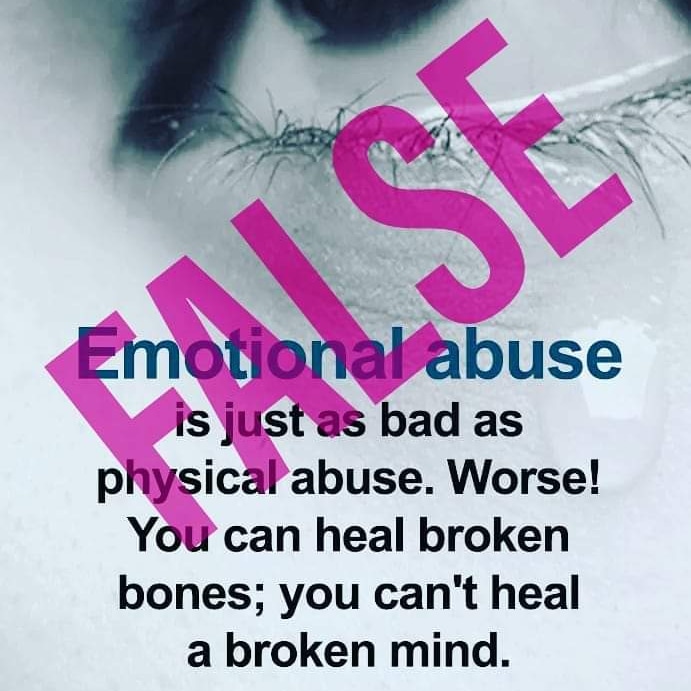
Don’t believe everything you read.
No human is broken.
And every mind can be healed.
When we convince ourselves that we’re broken or that we can’t be healed, we create a self fulfilling prophecy, because what you set out to achieve is what you will achieve.
Besides, it’s not the physical pain of physical abuse that sticks with us, it’s the mental and emotional anguish that it leaves that haunts us.
Memes like the one above are well meaning, but they cause more harm to our mental health than they offer benefit or relief.
Be careful what you take from the Internet.
Good intentions have destroyed many lives.
No matter how elaborate and sincere your effort at solving a problem may be, if you don’t understand the problem well enough, you will go about solving the wrong problem until you eventually convince yourself that the real problem cannot be solved.
There is a solution for every problem except death. So if you’re not figuring it out, it means that you need more information and a fresh perspective of what you’re dealing with.
Remember: No one is broken. No one is damaged. No one is beyond help. It takes a single moment of realisation to turn your entire world around.
#mentalhealth #mentalhealthawareness #mentalhealthrecovery #selfworth #selflove #selfawareness #selfrespect #mindfulness #theegosystem #ownyourlife #motivation #zaidismail #lifecoaching -
Stop judging. Be human.
⚠️ TRIGGER WARNING
This meme showed up on my timeline earlier and highlighted everything that is wrong with the way in which we treat each other.
There are a few terms that I generally disagree with (sometimes very strongly) if used to describe people.
These terms include broken, damaged, toxic, and basically anything that reduces a human to a single repulsive notion.
We lose our humanness when we see someone’s bad behaviour and assume that to be the totality of who they are.
No one is toxic. We may have destructive behaviours, or dysfunctional perspectives and so on. But that doesn’t make us toxic.
It makes us a human that is struggling to find our humanness in the absence of understanding or compassion from someone significant.
What’s more ‘toxic’? A single person that is allowed to define the tone of an entire family, or a family that lacks any conviction in their own self-worth to be defined by a single person?
Enjoin what is right and forbid what is wrong, not only when it’s fashionable or easy, but especially when it’s difficult.
If we give up our ability to create good with those around us, we lose our right to complain about them letting us down.
If someone is angry or bitter, they’re feeling unappreciated.
Reduce a person’s sincere efforts towards fulfilling their part in a relationship to nothing more than duty and minimum expectation, and you’ll very quickly inspire ‘toxic’ behaviour on their part.
Drop the labels and start seeing the human behind the behaviour.
There will come a time when you will need others to show you the same empathy and compassion.
Just because you’re struggling to strike a balance between enabling bad behaviour versus understanding it doesn’t mean that the bad behaviour is toxic. It just means that you are not equipped or are not the right person to influence the positive change that you’d like to see in them.
Stop judging. Be human.
#emotionalabuse #mentalhealth #mentalhealthawareness #mentalhealthrecovery #selfworth #selfawareness #lifecoaching #zaidismail #theegosystem #ownyourlife #narcissist #narcissisticabuse