The victim mindset wreaks the most destruction and creates the worst of oppressors.
The victim mindset is established when we find ourselves nursing wounds of experiences and betrayals that have long since passed.
The victim mindset is nurtured when we are emotionally impacted by the behaviour of those who play no meaningful role in our life.
The victim mindset becomes more deeply entrenched when we expect others to make up for our experiences from long before we ever knew them.
The victim mindset is the most debilitating, demoralising, and destructive mindset of them all because it takes offence from being challenged, insult from observation, or feels attacked when advised.
The victim mindset is set firmly on the belief that we are defined by how others treat us, or treated us.
The victim mindset denies us the mindfulness and accountability needed to own our life because we’re waiting for our perceived injustices to be remedied before we allow ourselves to move on.
The victim mindset confuses meaningful action with blind rage.
The victim mindset destroys, but never creates anything of benefit.
The victim mindset wastes away life while lamenting the past.
The victim mindset is a corruption of the soul that fails to separate the moment of being a victim with what we hold onto from the experience long after the experience has passed.
While we’re caught up in that victim mindset, we lose sight of how many around us become victims of our rage, our neglect, our self-consumed approach to life, and our abdication of responsibility in how we’re supposed to show up for them.
The victim mindset therefore spawns more victims, and the only way to rise above it is to own it and want to be more than that.
When you claim your rights before you honour your responsibilities, you’re in a victim state of mind, and you cause oppression while using your feeling of oppression to justify your behaviour.
It always starts with you.
#hope #expectation #sincerity #selfworth #selfawareness #mentalhealth #mentalhealthawareness #lifecoaching #zaidismail #theegosystem #ownyourlife #victimmindset #narcissism #narcissisticabuse
Tag: mentalhealth
-

You are your own worst victim
-

Labelling humans
We dehumanise the human when we label their emotional experience as an illness.
The moment we attach a label to a life experience, we focus on the label and discard the merits of the experience.
We make people invisible when we deny the reality of their experience by suggesting that there is something clinically wrong with them, despite causality of their emotional upheaval being clearly associated with their experiences in life.
In other words, there is a clearly troubling or traumatising experience that they’ve endured to explain their emotional duress, yet we diminish their experience by ‘diagnosing’ them with an illness for feeling overwhelmed, anxious, or stressed, etc. simply because they’re affected by it for longer than we think they should be affected by it.
The victim readily embraces such labels because it offers hope where they feel hopeless, and allows them to abdicate responsibility for rising above it.
The oblivious or insensitive ones happily embrace such labels because it demands less emotional investment, or less accountability in their efforts to uplift or support those around them.
Our aversion to embrace the entirety of the human behind the troubled behaviour denies the victim a voice, or an opportunity to understand their painful experiences in life.
These labels are worn with shame because it denies us our humanness and makes us a symptom.
You cannot break the stigma of mental health by undermining the humanness of the ones affected by the stigma.
Kill the label, kill the stigma.
If you stigmatise someone’s real life experience, how can you possibly expect them to feel whole?
#mentalhealth #mentalhealthawareness #mentalhealthrecovery #suicide #suicideprevention #suicidalawareness #suicideawarenessmonth #depression #anxiety #ownyourlife #theegosystem #embracingME #zaidismail -
It doesn’t make you stronger
The belief that what doesn’t kill you makes you stronger is a lie.
It may prepare us for greater trials and opportunities, but we also grow impatient or intolerant when we find ourselves facing the same issues repeatedly.
Life feels fulfilling and purposeful when we solve a problem and move on, but feels exceedingly frustrating when we are compelled to deal with the same problem every day.
Eventually, it’s not the repeated problem that gets to us but rather anyone associated with such problems.
Like going to work and dealing with disrespect or unreasonable demands to constantly have to explain or defend yourself, and then getting home and being faced with similar experiences in a different context.
Those themes that are similar between work and home is what feels like a trigger or a provocation because emotionally, it resonates with the insignificance that we feel in both places.
And the same is true in reverse.
What we experience in our home life preloads us for what we’re willing to tolerate in our public or professional life.
The more mindful we are about this, the less likely we are to rage at those who have nothing to do with our misery. Be they loved ones, or strangers.
Don’t go looking for character building experiences that will make you stronger.
Life has plenty in store for you by design.
#hope #life #ownyourlife #mentalhealth #mentalhealthawareness #mentalhealthrecovery #theegosystem #whatdoesntkillyou #whatdoesntkillus #peace #mindfulness #lifecoaching #zaidismail -
Who smiles first?
Are you perhaps the village idiot in someone else’s life, or maybe they’re filling that role in yours?
The answer to the question as to who puts a smile on the face of the village idiot is that no one does.
No one puts a smile on the face of the village idiot because no one notices the village idiot.
But everyone is always willing to take a smile from them, or to be entertained by them.
Who might that village idiot be?
That village idiot is the care giver, the supporter, the ones who serve without recognition, or the ones who uplift without asking for anything in return.
It’s the invisible ones that we expect things from, but don’t consider what they need from us.
Sometimes we’re the village idiots in other people’s lives.
But most often, we don’t recognise the village idiots in our lives because when we take people for granted, they become invisible or at the least, their contribution feels like our right or their duty.
And when they no longer provide us with what we need from them, we don’t stop to consider why.
If we do, we usually assume that they’ve changed, or that we’re no longer important to them.
So, we simply move on and find a replacement.
By making significant others invisible in their contribution to us, or only recognising it when we become invisible to them, we create the environment for depression, anxiety, abuse, and suicide, to name just a few common outcomes of feeling invisible.
So, I ask you again, who puts a smile on the face of the village idiot?
Remember : We only contribute towards a significant other when we believe that we matter to them.
When we discover that we don’t, or that we weren’t as significant as we hoped to be, it tests our emotional resilience and our self-worth.
How we respond to that test determines the difference between peace or pain.
#hope #expectation #sincerity #selfworth #selfawareness #mentalhealth #mentalhealthawareness #lifecoaching #zaidismail #theegosystem #ownyourlife -
Redirected rage
Our self-worth defines our behaviour in moments when we feel most unappreciated.
Whether a toddler, a teen, or an adult, we are provoked towards anger and bad behaviour when we feel taken for granted or irrelevant to those who matter to us.
It doesn’t mean that they must treat us badly.
It could be as simple as them not noticing what is important to us.
How we need to feel appreciated is unique to each of us.
Expecting others to know what’s important to us is how we test for significance without feeling vulnerable by expressing our needs.
In other words, the moment we need to tell others what we need from them to feel significant, it no longer feels like significance to us. It feels like neediness.
No one willingly seeks to express their needs without first trusting that it will not be used to weaken their position or standing with those around them.
But trust is the last thing we can rely on when our self-worth is low, because if we don’t think we’re worth it, we have absolutely no reason to believe that anyone else thinks we’re worth it either.
That’s how bad behaviour becomes the tool to distract attention away from how we feel about ourselves, while directing attention to what we think is a defendable gripe or anger that we have towards others, or towards life.
It’s a vicious cycle that starts in childhood, but ends with you.
#hope #expectation #sincerity #selfworth #selfawareness #mentalhealth #mentalhealthawareness #lifecoaching #zaidismail #theegosystem #ownyourlife -
You cannot make them rise
I’ve seen, and experienced first hand, the disaster that awaits when we convince ourselves that the demons that others deal with is our responsibility to resolve.
Being kind, compassionate, and even understanding does not mean that we must own the decisions that others have made, especially when those decisions include them choosing to hold on to anger from their past instead of embracing the opportunities of the future.
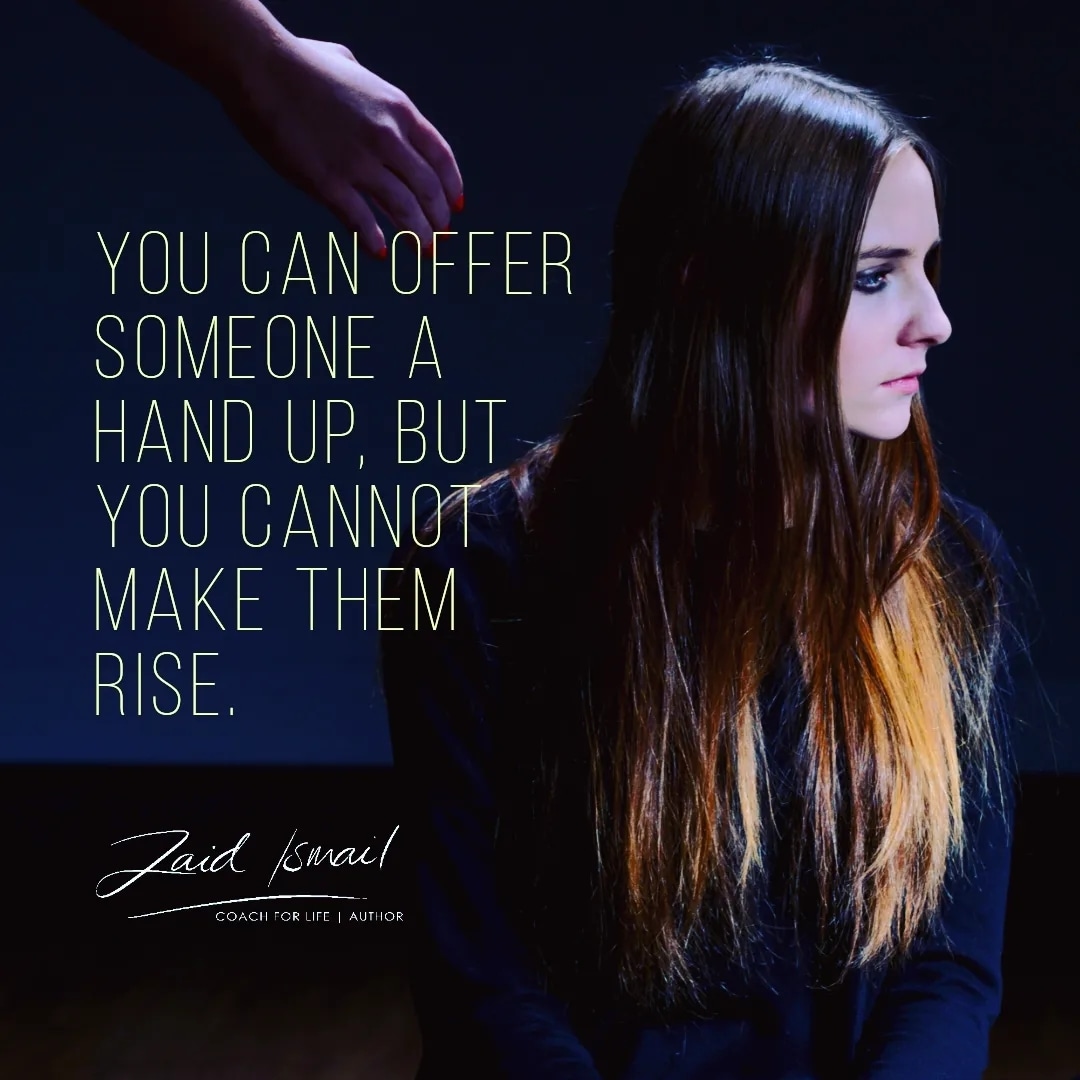
Remember that you can only offer someone a hand up, you cannot make them rise.
The same way that you must own the consequences of your decisions, you are responsible for giving them every opportunity to own theirs.
That includes not making yourself available as a doormat to them when they’re not owning it.
You’re not a hospital for the wounded egos of others.
Compassion doesn’t mean that you must be a martyr.
Sacrificing yourself to uplift another not only reflects ingratitude on your part for who you are and what you have, it denies your contribution of love to those that have a right to it, including yourself.
Moderation in everything, and everything in moderation.
Embrace your life fully, not only its struggles.
#selfworth #selflove #selfawareness #selfrespect #mindfulness #theegosystem #mentalhealth #mentalhealthawareness #mentalhealthrecovery #lifecoaching #zaidismail #ownyourlife #compassion #sincerity -
The past sucks eggs
Life sucks when we take our experiences with others from the past and project it onto the relationship that we have with someone in our present.
Sadly, this applies to all relationships, not just marriage or romantic partnerships.
It applies to the parent-child relationship as much as it applies to spouses.
Especially in times when we have a high prevalence of failed marriages, this plays out in the aftermath of such breakdowns of the home as children grapple with their place between their separated parents, and ex-spouses struggle to find a balance of power in their efforts to co-parent.
A lot of life is wasted as we rage about what we believe to be our justified anger at what happened in the past.
Sometimes, we’re so convinced that we have good reason to rage at what is happening in the present that we don’t notice that it is because of a past experience that the present one incites such rage within us.
The focus should never only be on why we have reason to be angry or to feel hurt.
More importantly, we must focus on whether the intensity of rage or hurt is understandable relative to the current situation.
When we do this, we stand a chance of focusing on resolving the current problem rather than contaminating it further because of how it reminds us of how we were treated badly in the past.
If you don’t own your contribution towards the current problems that you face, you will be owned by the demons of someone else’s past.
It always starts with you.
#hope #expectation #sincerity #selfworth #selfawareness #mentalhealth #mentalhealthawareness #lifecoaching #zaidismail #theegosystem #ownyourlife #marriagecounseling #divorce -
You cannot not have expectations
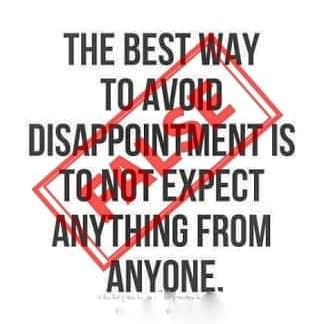
The advice to live life without expectations to avoid disappointment is disturbingly misleading.
If you’re striving to achieve this state of having no expectations of anyone, please stop.
When we convince ourselves that we should not expect anything from others, we also have to convince ourselves that they should not expect anything from us.
If that’s who you want to be, then prepare yourself for an isolated and lonely life where you are singularly responsible for everything that you want or need.
Any rational person knows that it’s impossible to live that way.
Expectations are fundamental to a healthy relationship.
Without it, there is no need for trust or loyalty because we expect nothing from anyone, so they’re all free to do as they please, right?
What cements a relationship is trusting that you can expect a significant other to show up for you the way that you need.
What convinces us of our worth to others is when they take comfort from knowing that we’re there for them. That’s an expectation that they have of us.
Focusing on not having expectations is a defence mechanism in response to having had our trust betrayed by someone close to us.
It’s an attempt to protect ourselves from ever being hurt that way again, resulting in us hurting others who had nothing to do with that betrayal.
If you don’t resolve that problem of how and why you felt betrayed, because betrayal is very often how we feel about someone’s behaviour rather than them actively trying to betray us, you will create a whole lot of new problems that you never intended to create.
By all means, be selective about who you expect things from in the same way that you shouldn’t trust every person that crosses your path.
Trust is earned, while respect is a reflection of who you are.
Confuse the two, or assume they’re the same, and life will become very complicated and onerous.
Don’t take advice from memes. Rather consider it as a point of reflection before acting on it.
#hope #expectation #sincerity #selfworth #selfawareness #mentalhealth #mentalhealthawareness #lifecoaching #zaidismail #theegosystem #ownyourlife