Blog

  • Break the cycle

    Break the cycle

    Character is what is built when we are faced with trials.

    Beauty is what we appreciate when we emerge from those trials.

    Those that have the greatest scars are the ones that appreciate life the most. But only if they don’t allow themselves to grow bitter in the process.

    After hardship comes ease, provided we don’t hold on to past hurts and betrayals.

    When we demand justice or retribution without understanding, we exchange places with those who oppressed us.

    That’s how we grow to be like the one who hurt us, because we become defined by the hurt in the same way that their hurt drove them to hurt us.

    The cycle is broken only when we seek to understand why, so that acceptance is possible, and forgiveness is sincere and not burdensome.

    Otherwise, forgiveness becomes an indulgence of our ego, rather than a true effort towards moving forward with peace in our heart.

    Break the cycle.

    Seek to understand.

    First your own pain.

    Then only will you grow to understand the pain of others.

    It always starts with you.

  • Are you waiting for permission to be who you want to be?

    Are you waiting for permission to be who you want to be?

    Note, who you want to be, not what you want to be.

    We’re so focused on what we want to be, what career, what achievements, what social standing, that we lose sight of who we want to be.

    That’s how we become defined by what we are, or what goals we are pursuing.

    Who we want to be refers to the kind of human we want to be.

    It sounds simple enough. Everyone wants to be kind, generous, understanding, compassionate, benevolent, and so on.

    There isn’t a single person that will say that they don’t want to be those things, and many who think that they are already that.

    So why then are we not experiencing others the way that we all claim we are conducting ourselves?

    It’s because we wait for permission to express kindness, understanding, and all those other beautiful attributes.

    That permission comes in the form of needing others to behave a certain way, or to treat us the way that we want to be treated before we’ll be good and loving and understanding towards them.

    That permission is what we get when we want to feel appreciated before we show gratitude, or we want to feel loved before we express affection. And so on.

    When we wait for such permission, we become defined by how we are treated, and thus, we become part of the harshness or coldness that we experience in our lives.

    So, who do you want to be?

    Are you who you want to be, or are you waiting for permission to be that person?

    Your life is yours to claim. It always starts with you.

  • Celebrate the dead. Discard the living.

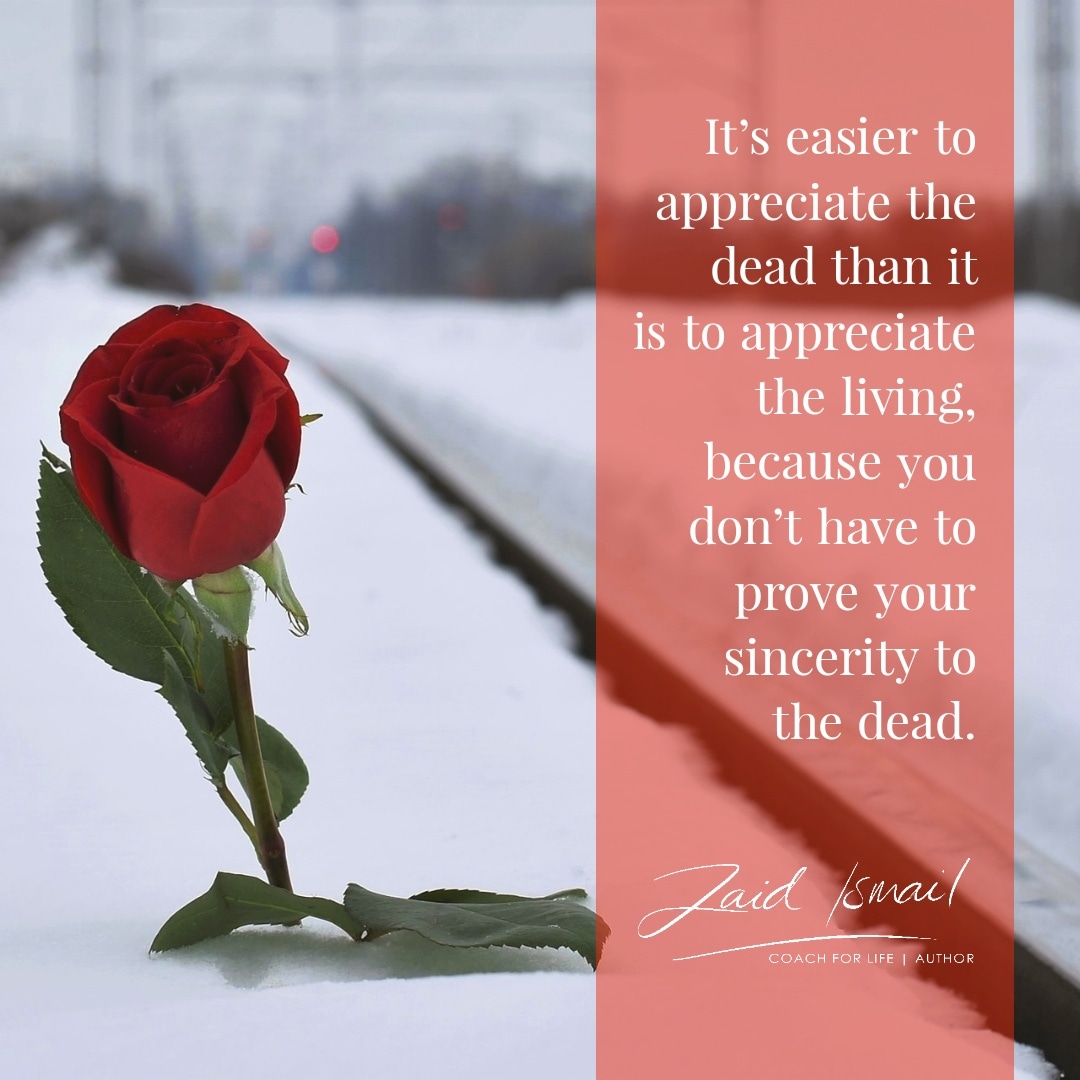
    Celebrate the dead. Discard the living.

    Ever notice how often people are revered when they’ve passed on, but the same people were neglected, ignored, or even treated badly while they were alive?

    Sometimes the reverse is also true. The one who passed on may have left a path of destruction in the lives of those around them, but because of their social standing or their role in their family, they’re revered to the point of exaggerating their good while dismissing the impact that they had on those who were victim to their ways.

    Some would have us believe that it’s because we must not disparage the dead. Which is true. We shouldn’t.

    But does that also mean that we must exaggerate their good to the point of diminishing the damage or harm that they caused?

    The reason we do this is not out of respect for the dead, but more likely because it draws attention to our virtue.

    It’s easier to demonstrate such kindness towards the dead, because they have no expectation from us to follow through with sincerity or commitment towards how important we say they are in our lives.

    If we were truly committed to establishing good, we would place as much emphasis on remedying the harm that they caused, while remembering the good that they did.

    If we don’t, we end up revering the dead to the detriment of the living, thereby reinforcing the harm that the deceased caused, and further oppressing those who are already struggling with the impact of the harm done to them by the deceased.

    That’s how we enable generational trauma.

    That’s how we create more harm for the victims of those oppressors who have passed on.

    That’s how we become part of that cycle of harm.


  • When one good thing ends, another begins

    When one good thing ends, another begins

    At the end of every road, a decision awaits.

    Do we stop and remain focused on the road we just travelled, or do we choose a path beyond that road so that our journey continues?

    If the road travelled was a difficult one, most focus on the difficulty and choose to protect themselves from such difficulty in future.

    They’re the ones who grow weary about life, and place their happiness in the hands of others.

    Life becomes a burden, and death a morbidly romantic destination.

    But those who look back on that difficult journey and recognise how they managed to create something of beauty, experienced something amazing, or developed a sense of gratitude for the accomplishments that would otherwise not have been possible are the ones who look ahead with excitement and optimism.

    They connect with their ability to live, despite the trials of life.

    They connect with their ability to create happiness for others, rather than waiting for others to create it for them.

    They realise that just as their journey was difficult up to that point, so too are the journeys that others travel equally difficult, if not more than the one that they’re on.

    They connect with gratitude, and create space for joy because they know that what has passed only prepared them to create even greater things in the future.

    Which of the two do you choose to be?

    Fixate on the injustice or unfairness of the past, or appreciate your ability to prevail with joy into the future?

    The choice is yours.

  • Allow your children to be their own person

    Allow your children to be their own person

    We always have good intentions when we strive to give our children everything that we didn’t have.

    Often, this includes protecting them from the hardships or difficulties that we experienced.

    Unfortunately, when we do this, we end up protecting them from reality, and in the process, we deny them the very life lessons that taught us to appreciate what we have.

    This is one of the most common reasons for kids growing up to be timid, entitled, or disrespectful…or all of the above.

    Hardships and difficulties are character building experiences.

    Find a way that strikes a balance between allowing them to experience it, and providing guidance and support as they navigate their way through it.

    Too many assume that hardship is a denial of a good life.

    It’s not.

    Allow them to earn their privileges so that they’ll experience gratitude and fulfilment when they achieve it.

    Lastly, when you shy away from something that weighs you down, or you try to hide it from them, you’re teaching them to feel ashamed of getting things wrong, or failing at achieving goals.

    That’s how we raise them with a value system that conflicts with the kind of humans that we want them to be.

    Be mindful of your rule as a parent, but more than this, be mindful of your contribution as a human being.

    It always starts with you.

  • Are you throwing away a good life?

    Are you throwing away a good life?

    If you find yourself feeling easily judged about your life, you’re focused on how others perceive you, rather than what you think of yourself.

    In fact, the moment you focus on what opinions others may have about your life or about who you are, it confirms that you are already judging yourself harshly.

    That insecurity distracts us from growing, and encourages us to defend and protect what we have.

    While defending and protecting may seem necessary, or even admirable, it is driven by the fear of losing what we have, rather than allowing us to appreciate our ability to thrive despite what life has thrown at us.

    There must be a healthy balance between the gratitude of what we have so that we maintain it responsibly, versus the belief that we are capable of constant improvement in the same way that we improved our lives over the years of struggle.

    It’s a subtle but critical realisation that will make the difference between feeling burdened and irritable about the present, or grateful and energised about the future.

    Take a moment to consider how much of your time and energy is invested in defending who you are or what you’ve achieved.

    Now compare that to the amount of time and energy invested in recognising the opportunities you have to achieve even more.

    Any sense of uneasiness or unhappiness at the thought of that is an indication of how much you’ve been taking yourself and your life for granted.

    Own Your Life.

  • Are you aware of your legacy?

    Are you aware of your legacy?

    Sometimes, when we’re faced with disappointment about how we’re appreciated by those dear to us, it’s easy to find reason to give up on what we wish to leave as a legacy for them in life.

    So, we withhold our contribution, or pull back on our participation in their lives, assuming that we don’t matter.

    Whether that turns out to be true or not doesn’t mean that we didn’t leave our mark. It just means that the mark we left was not truly a reflection of who we are.

    Giving up on what’s important to you just because it wasn’t as important to someone else means that it wasn’t truly important to you to begin with.

    What was more important to you was the anticipated appreciation or celebration of your contribution, and not the value that you wanted to create for them.

    When we lose sight of this, we also lose ourselves.

    Hope and dreams are most often abandoned because we waited for others to validate what we believed to be valuable in life.

    Regardless of how it plays out, your legacy will either be one of a passionate pursuit of achieving what you believed in, or an abandonment of hope because you were not accepted the way that you wanted to be.

    Either way, you leave a legacy. And if you lose sight of this, you’ll end up blaming the world for what you withheld in your contribution towards it.

    That’s how you feed the very cycles of life that broke your will to pursue your dreams.

    It always starts with you.

    Connect, with conviction, to what you want to add as value to the lives of others, and you’ll find fulfilment in that even if they don’t immediately connect with that value.

    That’s how we have less death bed regrets, and we leave a legacy worth celebrating.

  • A life full of things…except happiness

    A life full of things…except happiness

    While there may be truth in the saying that money doesn’t buy happiness but at least you can choose your misery, we need to consider if we really want to be choosing our misery or experiencing happiness?

    It all starts out with good intent.

    Earn some money to improve your quality of life, or create a home environment that is welcoming and comfortable for those you love, and hopefully in the process, feel appreciated for your efforts.

    But what happens when that appreciation is not as forthcoming as you need it to be?

    Sometimes, we look for that appreciation in a specific shape and form, and if it doesn’t appear in exactly that way, we assume that we’re not appreciated.

    That’s when our relationships become transactional as we start comparing who does how much to maintain the standard of living that we’ve grown accustomed to, while dismissing the efforts and intentions of the one doing all that.

    Valuing yourself comes before any expectation or need to be valued by others. If you don’t value yourself, you’ll look for that validation or appreciation to be served up in a specific way by others, thereby holding them accountable for how you feel about yourself.

    That’s how you end up having a life full of things, but a heart that lacks contentment.

    It always starts with you. You teach others what is important to you by how you treat them.

    And when you value yourself, you’ll realise that when others don’t value you, it’s because they’re struggling with their own self-worth and not because they don’t appreciate you or your efforts in their life.

    Own your life, and your emotional wellbeing will take care of itself.