The profundity of the verse from the Qur’an that says that if you are grateful, Allah will increase you, resonates strongly through every theme of life.
It is through gratitude that good is created, harm is kept at bay, and we are connected to what feeds our soul.
Therefore, what destroys good must be the opposite of gratitude.
It’s easy to call it ingratitude, but not so easy to identify it as that.
Ingratitude is not just the absence of gratitude, it’s the presence of everything that denies it.
It is the desire for that which undermines the good that we have, or pursuing that which we haven’t earned.
It is the betrayal of what we stand for, to feed the fear of losing something that was never real.
It the compromise of the authenticity of who we are, so that we may be accepted by another, because we can’t bear the thought of being alone with only our self-respect to keep us company.
Dishonesty is a denial of the self, long before it is a betrayal of trust.
That’s why it breathes destruction wherever it shows up, because it first destroys the self which then destroys the world around us because we grow desperate for others to make us feel whole.
All that because we were ungrateful for who we are.
Dishonesty is the enemy of dignity, and without dignity, the world will be at war with your soul.
“If you are grateful, I will surely increase you.” (Qur’an 14:7)
#selfworth #selfawareness #ownyourlife #selfmastery #mindfulness #personalpower #mentalhealth #mentalhealthawareness #lifecoaching #zaidismail #loveyourself #selfrespect #relationshipgoals #foreverincomplete
Tag: personalpower
-
Dishonesty, the destroyer
-

Settling for a hint of life
How we see ourselves is reflected in the choices that we make in life.
Not what is obvious about those choices, but what we’re trying to achieve through those choices.
Unfortunately, most are unaware of the second part. That underlying need that drives the choices that we make.
When we lose sight of that need, we feel drawn by instinct or desperation to do things that just ‘feel’ right, and then convince ourselves that we must trust our instincts.
But what if those instincts are driven by fear because we’re in survival mode after having had a bad childhood, or marriage?
Will our choices be healthy, or unhealthy?
If we’re not in tune with this side of who we are and how life has affected our sense of self, we’ll try desperately to create a good life for ourselves while losing ourselves in the process.
Eventually, we end up believing that the world has no place for us, or that it’s a cruel and harsh place, leaving us hoping or waiting to be saved…or waiting for death. Whichever comes first.
Reconnect with yourself in a way that is free of judgement, but full of understanding, and your choices will be informed by what you are passionate about, rather than what you desperately need from others to feel loved or accepted.
It always starts with you.
#selfworth #selfawareness #ownyourlife #selfmastery #mindfulness #personalpower #mentalhealth #mentalhealthawareness #lifecoaching #zaidismail -
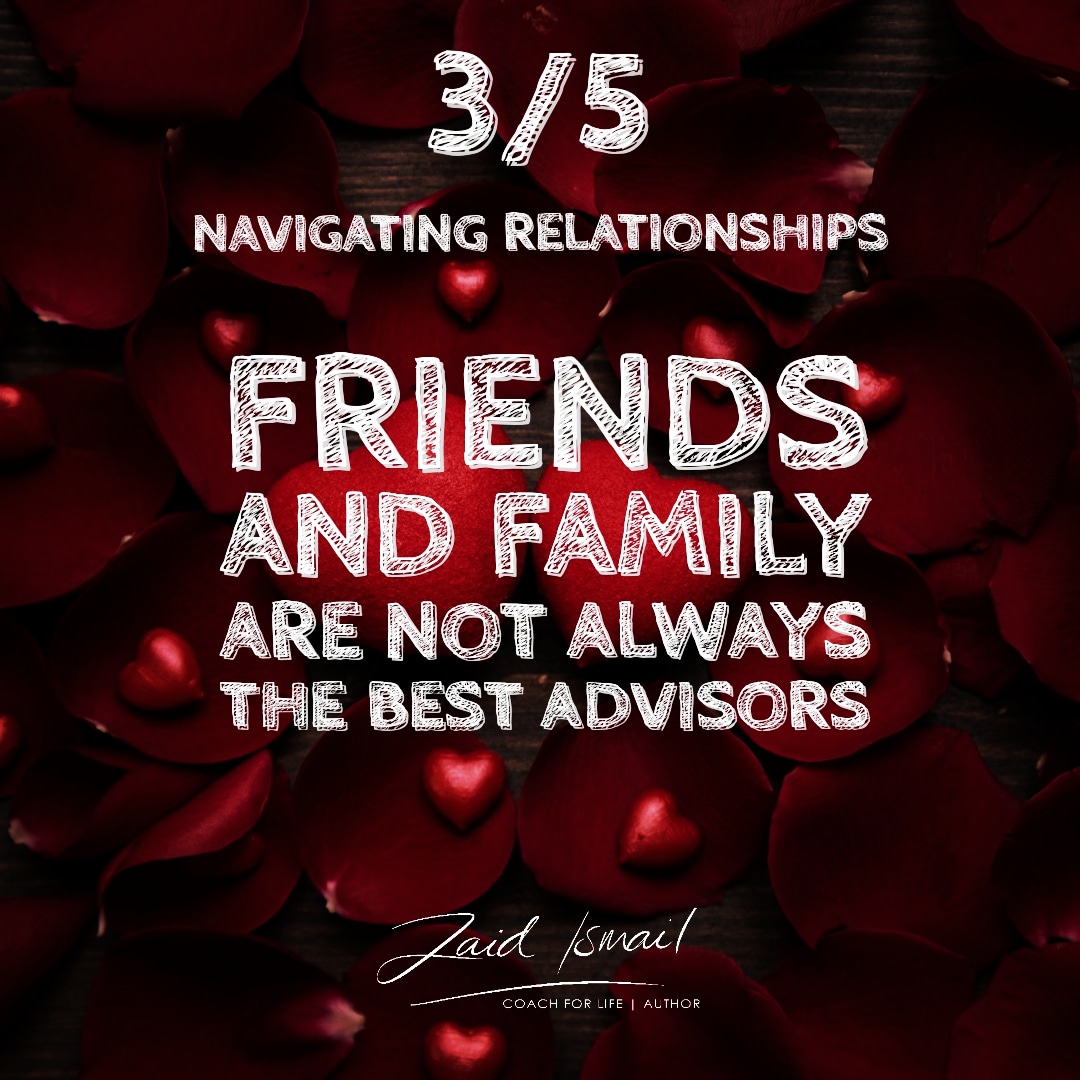
Navigating relationships – 3 of 5
Understanding why you or your partner behave the way that you do is only the first critical step in creating harmony and establishing that bond that makes a relationship resilient.
Once you have this understanding, you need to decide what to do with it.
That’s when having mature, objective, and sound advisors become the next critical part in our efforts towards establishing healthy relationships, both with ourselves and with those around us.
Loyalty often blinds friends and family towards protecting us, even when we’re not attacked nor being deliberately treated badly.
Their need to protect us is more about their fears from their own experiences or their need to feel significant in our lives, than it is about guiding us towards the best outcomes.
A sincere advisor is one who won’t protect you from the truth of your contribution towards the difficulties that you may be experiencing just because they’re afraid that you may be upset with them.
This is true not only for friends and family, but especially for coaches and therapists.
The golden rule when choosing an advisor is to confirm that they’re driven towards understanding your situation objectively, while offering insights into what is contributing towards it from both sides, before they insist on a course of action that you must follow.
In fact, when an advisor insists that you take specific steps towards resolving something, they’re no longer advisors. They’re instructors.
So be sure about whether you’re seeking instruction or advice on how to connect with your partner in a healthier and more meaningful way.
Instructions are based on someone else’s value system, while advice is aimed at providing insight into your reality so that you can make an informed decision based on your value system. Not theirs.
Choose carefully.
#marriageadvice #relationshipgoals #ownyourlife #theegosystem #mentalhealth #mentalhealthawareness #lifecoaching #zaidismail #silenttreatment #personalpower -
The enemy of mindfulness
We find ourselves in a state of duress, or stress, when we lose sight of what we can influence, whi fee helpless in the face of everything that we think is out of our control.
Whenever we’re faced with a problem, we either focus on mitigating the impact of the problem on us, or we focus on the opportunities to overcome the problem.
When we convince ourselves that the problem is bigger than us, and we also believe that walking away from it is not an option, or possible, we slip into a victim state of mind that weighs us down.
As a side note, whenever something appears impossible to resolve, it means that we have gaps in our understanding about what’s causing it to occur.
At that point, we should set out to seek a better understanding of the problem, rather than persisting in trying to find an answer with the limited information that we have.
This is the kind of thinking that needs to be applied when we’re faced with challenges in our lives.
The most common reason for feeling overwhelmed by life is because the assumptions that we made over the years about our significance or our ability to influence important relationships have grown to become the truths by which we live.
So we don’t even think of questioning those assumptions, despite circumstances having changed over the years, and more importantly, despite us having grown over the same period.
Becoming aware of these assumptions that we make when trying to solve any problem is the first critical step towards searching for answers.
But, mindfulness is needed to regain such perspective, and mindfulness is lost to the victim mindset.
The victim mindset is one that leaves us feeling defensive, or defenseless. Reclaiming your ability to positively influence the outcomes of your life then becomes the important problem to solve.
It always starts with you.
#hope #expectation #sincerity #selfworth #selfawareness #mentalhealth #mentalhealthawareness #lifecoaching #zaidismail #loveyourself #lifegoals #motivation #optimism #purpose #mindfulness #inspiration #personalp -
Empty apologies
“Hey, I apologised. If you don’t accept my apology, that’s your problem, not mine.”
Did someone say this to you after offending you or treating you badly?
Maybe you felt you had reason to say it to someone else that rejected your apology?
The moment we demand that our apology must be enough, we’re not interested in the hurt or offence that we caused, nor the trust that we may have damaged. We’re only interested in preventing the other person from having reason to be displeased with us.
As we know, apologies mean nothing without sincere remorse, or a change in behaviour.
And if we have sincere remorse about what we did, we won’t expect others to be OK with what happened just because we think they should be OK.
We’ll focus on sincerely understanding why it affected, or continues to affect them, and we’ll put in the effort to reestablish the trust that we broke or tainted.
If we don’t, it means that we’re stuck in self-pity rather than appreciating the impact that we have in the lives of those around us.
This is yet another way in which self-pity prevents us from realising our significance to others, and vice versa, because we’re so fixated on how bad we have it, or how we feel unappreciated, that we lose sight of how much we take them for granted.
It always starts with you.
#hope #expectation #sincerity #selfworth #selfawareness #ownyourlife #selfmastery #mindfulness #personalpower #mentalhealth #mentalhealthawareness #lifecoaching #zaidismail #loveyourself -
Respond with poetry
Responding in kind to the trials of life only gives those trials more power.
Instead, be the eternal romantic.
Look for the starry sky in the darkness, or the glow of the sunshine behind those grey clouds.
Romance is not about sharing a moment with another.
Romance is about embracing a moment for yourself despite the ugly around you.
Be romantic without waiting for permission.
Let your response to life be the poetry that uplifts the world.
There are enough prose writers out there.
We need more poetry…
More beauty…
More sincerity…
More authenticity…
Prose is our need to be heard, to be validated, and to be seen.
Poetry is our gift of everything that is beautiful and gratifying about life.
If you have the ability to create goodness and peace, that is your ability to write poetry on the timeline of your life.
Be poetic. Be romantic. Be you.
Own Your Life.
#hope #expectation #sincerity #selfworth #selfawareness #mentalhealth #mentalhealthawareness #lifecoaching #zaidismail #loveyourself #lifegoals #motivation #optimism #purpose #personalpower #poetry #romance -
Self-help guides are not sustainable
For those who believe that my books are self-help guides and are expecting instructions for life from it, this may clarify my approach for you.
The above photo is from The Egosystem p.25. I don’t believe in prescriptive exercises or methods when advising others about how to navigate the challenges in their lives.
Such prescriptive approaches assume that others are like us, and that their lives are like ours.
It also assumes that they have access to the same resources and support structures as we do, and that they interpret the events of their lives in the same way that we would.
None of that is true.
We’re each unique in our relationship with the world around us. That’s why a prescriptive approach will never be sustainable.
It may provide interim relief, but it will not be sustainable the moment your circumstances change.
Creating understanding and awareness about why you are who you are, and why you feel the way that you do allows you to choose your responses to life more mindfully, and in a way that is uniquely you.
Otherwise all we’re doing is creating mini-me versions of coaches and therapists and counsellors in the lives of our clients.
How does that help anyone? 🤔
Own Your Life.
#hope #expectation #sincerity #selfworth #selfawareness #mentalhealth #mentalhealthawareness #lifecoaching #zaidismail #loveyourself #lifegoals #motivation #optimism #purpose #mindfulness #personalpower -
Don’t trade your best for their worst
There is rarely a day that passes without me reading or hearing about someone who invested years, if not decades of their life, to people who were not invested in the relationship.
When the reality of that betrayal finally hits home, it destroys our spirit and convinces us that we’ve sacrificed the best years of our life while having nothing more to look forward to.
Nothing could be further from the truth.
The same way we were able to create beauty in such a desolate landscape, we must recognise that the best of us that we gave was simply the truth of who we were. And are.
The moment we discard that because it was discarded by an ingrate who was looking for servitude of their ego when they could have had love for their essence, we become ingrates just like them.
Don’t trade who you are for who they were. It’s never a fair trade. You owe yourself more than that.
And self-pity will only ever prevent you from being true to yourself.
Embrace the beauty of who you are despite the ugly of who they were.
That’s how we take back the gift that they discarded so that we may be able find a more fitting recipient.
As long as you’re breathing, there’s always hope.
#selfworth #selfawareness #ownyourlife #selfmastery #mindfulness #personalpower #mentalhealthrecovery #mentalhealth #mentalhealthawareness #lifecoaching #zaidismail #betrayal #narcissism #narcissisticabuse #relationshipgoals