Our self-worth defines our behaviour in moments when we feel most unappreciated.
Whether a toddler, a teen, or an adult, we are provoked towards anger and bad behaviour when we feel taken for granted or irrelevant to those who matter to us.
It doesn’t mean that they must treat us badly.
It could be as simple as them not noticing what is important to us.
How we need to feel appreciated is unique to each of us.
Expecting others to know what’s important to us is how we test for significance without feeling vulnerable by expressing our needs.
In other words, the moment we need to tell others what we need from them to feel significant, it no longer feels like significance to us. It feels like neediness.
No one willingly seeks to express their needs without first trusting that it will not be used to weaken their position or standing with those around them.
But trust is the last thing we can rely on when our self-worth is low, because if we don’t think we’re worth it, we have absolutely no reason to believe that anyone else thinks we’re worth it either.
That’s how bad behaviour becomes the tool to distract attention away from how we feel about ourselves, while directing attention to what we think is a defendable gripe or anger that we have towards others, or towards life.
It’s a vicious cycle that starts in childhood, but ends with you.
#hope #expectation #sincerity #selfworth #selfawareness #mentalhealth #mentalhealthawareness #lifecoaching #zaidismail #theegosystem #ownyourlife
Category: relationships
-

Redirected rage
-

You cannot make them rise
I’ve seen, and experienced first hand, the disaster that awaits when we convince ourselves that the demons that others deal with is our responsibility to resolve.
Being kind, compassionate, and even understanding does not mean that we must own the decisions that others have made, especially when those decisions include them choosing to hold on to anger from their past instead of embracing the opportunities of the future.
Remember that you can only offer someone a hand up, you cannot make them rise.
The same way that you must own the consequences of your decisions, you are responsible for giving them every opportunity to own theirs.
That includes not making yourself available as a doormat to them when they’re not owning it.
You’re not a hospital for the wounded egos of others.
Compassion doesn’t mean that you must be a martyr.
Sacrificing yourself to uplift another not only reflects ingratitude on your part for who you are and what you have, it denies your contribution of love to those that have a right to it, including yourself.
Moderation in everything, and everything in moderation.
Embrace your life fully, not only its struggles.
#selfworth #selflove #selfawareness #selfrespect #mindfulness #theegosystem #mentalhealth #mentalhealthawareness #mentalhealthrecovery #lifecoaching #zaidismail #ownyourlife #compassion #sincerity -
The past sucks eggs
Life sucks when we take our experiences with others from the past and project it onto the relationship that we have with someone in our present.
Sadly, this applies to all relationships, not just marriage or romantic partnerships.
It applies to the parent-child relationship as much as it applies to spouses.
Especially in times when we have a high prevalence of failed marriages, this plays out in the aftermath of such breakdowns of the home as children grapple with their place between their separated parents, and ex-spouses struggle to find a balance of power in their efforts to co-parent.
A lot of life is wasted as we rage about what we believe to be our justified anger at what happened in the past.
Sometimes, we’re so convinced that we have good reason to rage at what is happening in the present that we don’t notice that it is because of a past experience that the present one incites such rage within us.
The focus should never only be on why we have reason to be angry or to feel hurt.
More importantly, we must focus on whether the intensity of rage or hurt is understandable relative to the current situation.
When we do this, we stand a chance of focusing on resolving the current problem rather than contaminating it further because of how it reminds us of how we were treated badly in the past.
If you don’t own your contribution towards the current problems that you face, you will be owned by the demons of someone else’s past.
It always starts with you.
#hope #expectation #sincerity #selfworth #selfawareness #mentalhealth #mentalhealthawareness #lifecoaching #zaidismail #theegosystem #ownyourlife #marriagecounseling #divorce -
You cannot not have expectations
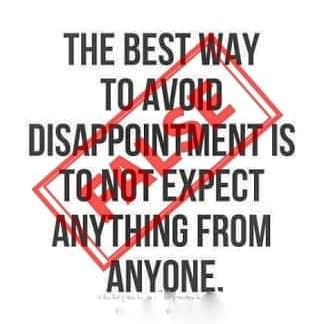
The advice to live life without expectations to avoid disappointment is disturbingly misleading.
If you’re striving to achieve this state of having no expectations of anyone, please stop.
When we convince ourselves that we should not expect anything from others, we also have to convince ourselves that they should not expect anything from us.
If that’s who you want to be, then prepare yourself for an isolated and lonely life where you are singularly responsible for everything that you want or need.
Any rational person knows that it’s impossible to live that way.
Expectations are fundamental to a healthy relationship.
Without it, there is no need for trust or loyalty because we expect nothing from anyone, so they’re all free to do as they please, right?
What cements a relationship is trusting that you can expect a significant other to show up for you the way that you need.
What convinces us of our worth to others is when they take comfort from knowing that we’re there for them. That’s an expectation that they have of us.
Focusing on not having expectations is a defence mechanism in response to having had our trust betrayed by someone close to us.
It’s an attempt to protect ourselves from ever being hurt that way again, resulting in us hurting others who had nothing to do with that betrayal.
If you don’t resolve that problem of how and why you felt betrayed, because betrayal is very often how we feel about someone’s behaviour rather than them actively trying to betray us, you will create a whole lot of new problems that you never intended to create.
By all means, be selective about who you expect things from in the same way that you shouldn’t trust every person that crosses your path.
Trust is earned, while respect is a reflection of who you are.
Confuse the two, or assume they’re the same, and life will become very complicated and onerous.
Don’t take advice from memes. Rather consider it as a point of reflection before acting on it.
#hope #expectation #sincerity #selfworth #selfawareness #mentalhealth #mentalhealthawareness #lifecoaching #zaidismail #theegosystem #ownyourlife -
The meandering twists of fate
Betrayal is not always a result of harsh words, lies, or cruel action.
We’re often so focused on what we’re not getting from others, that we don’t pause to consider what they may not be getting from us either.
The deepest cuts are those that are inflicted when we trust someone to be there, but they walk away instead.
It’s when our rock in this world goes silent when we desperately need to hear their comforting voice.
The searing edge of the blade of betrayal is when we repeatedly make excuses for others failing us, but we’re discarded the moment we have a moment of weakness.
When there is inaction from those towards whom we look expectantly while recalling the times that they drew on our energy in moments when we barely had enough to sustain our own spirit, we find ourselves holding on, desperately clawing with both hands, to the remnants of the shards of our broken spirit, knowing that only we will be there for us, with the only solace needed being our trust in the One who created us.
People fail us for the same reasons that we may fail others.
It doesn’t make it right.
It doesn’t make it wrong.
It makes us all flawed humans who sometimes succumb to the demons of the past, while oblivious to the demons we just spawned in another because we were distracted.
Striking a balance between recognising their humanness, while allowing ourselves to be human, while protecting ourselves from the impact of their demons, while grappling with our own demons is what defines the struggle of life, and the devastating risk of love.
But we do it anyway, because without it, what would be the point of life?
#mindfulness #inspiration #introspection reflection #ownyourlife #theegosystem #embracingME #mentalhealth #mentalhealthawareness #mentalhealthrecovery #selfworth #selflove #selfawareness #selfrespect #zaidismail #lifecoaching -
The demon child of ingratitude
Disrespect only ever becomes an option when we disrespect ourselves.
We don’t always disrespect ourselves because life is fluid, demanding different things from us at different times.
In those moments when we are expected to be more than we believe we’re capable of, or when we are corrected for something that we do because we want it without consideration for its consequences on others or ourselves, or when we demand privileges without fulfilling our responsibilities – it is then that we lose our composure and respond in ways that undermine others.
Disrespect is a form of anger and is a tool to achieve something without earning it.
Others may experience it as arrogance or narcissistic behaviour, but at the core of it, it’s an insecurity spawned by ingratitude.
Ingratitude sets in when we focus on everything that we want while diminishing the value of everything that we have.
It’s at the heart of a vicious cycle that begins with the anger or hurt that we feel about an unfortunate or unpleasant life event, which stirs a rage within us that drives us to want to claim our dues from the world rather than earn it.
Ingratitude fixates our gaze on risks and threats to our significance, rather than allowing us to focus on the opportunities that present themselves for us to achieve so much more than what we desire.
Anger is the distraction that justifies disrespect, and disrespect is our perceived tool for justice that distracts us from our ingratitude.
Few are willing to admit to being ungrateful.
The rest are too busy justifying their bad behaviour because of how they were treated badly by others, while growing oblivious to how they become just like, if not worse, than those who treated them badly.
Thus, the vicious cycle of harshness and ingratitude is maintained.
It always starts with you.
Do you respect yourself enough to be grateful for who you are and the life that you have?
#hope #expectation #sincerity #selfworth #selfawareness #mentalhealth #mentalhealthawareness #lifecoaching #zaidismail #theegosystem #ownyourlife #gratitude -
Embrace your demons
Relationships fail when the demons of both don’t play nicely with each other.
But demons are not so easy to recognise.
What feels like a right or a legitimate expectation is often underpinned by a demon from the past when those rights were denied, or those expectations dismissed.
Our innate need to be of significance to those we deem significant stir the demons within when that significance comes under threat.
It gets ever more complicated when the demon is associated with what comes next, and not what is.
Consider this.
Those who play it safe in life are protecting themselves from failure or inadequacy.
What they’re focused on may appear to be their absolute priority, and may even feel like it is their priority to them, without realising that what they’re focused on is to protect them from what it may lead to next.
That’s how success becomes a threat, or emotional availability feels like intense vulnerability.
The fear of abandonment means that we must protect ourselves from growing attached, or the fear of rejection means that we must preemptively reject before we’re rejected.
Thus, self-sabotage leads to self-fulfilling prophecies that convince our demons that we were right to protect ourselves from a threat that no one else understands.
That’s how our demons from the past ruin the promise of a beautiful future.
If you don’t own your demons, your demons own you.
It always starts with you.
#hope #expectation #sincerity #selfworth #selfawareness #mentalhealth #mentalhealthawareness #lifecoaching #zaidismail #theegosystem #ownyourlife #marriageadvice #divorce -
Well intended bad methods
Good intentions coupled with a bad method will result in bad outcomes.
When that happens, fixating on our good intentions won’t make any difference to the consequences of our actions.
The merit of what we do is always more important than the intention with which we do it.
The moment we flip that around, we cause harm while abdicating responsibility for the impact of our uninformed decisions on those who had nothing to do with our choices.
Sincerity and conviction come from wanting to achieve what we intended to achieve, rather than making excuses for why it wasn’t our fault when we fall short of our goal.
That’s when self-pity overrides our accountability and we convince ourselves that it was not in our destiny to have achieved that goal.
When we use destiny to explain our shortcomings, but accept praise for our successes, we lack conviction in who we are and what we stand for.
Conviction comes from sincerity of belief in the value system that we claim to uphold.
The moment that value system is open to compromise, we lose our bearings in life and become victims of the circumstances in which we find ourselves.
Conviction is impossible without self-worth.
And self-worth is impossible when we lack accountability while living our lives for an audience.
It always starts with you.
Goals would be pointless if they could always be achieved on our first attempt.
#hope #expectation #sincerity #selfworth #selfawareness #mentalhealth #mentalhealthawareness #lifecoaching #zaidismail #conviction #ownyourlife #theegosystem #narcissisticbehaviour #adulting