You know that awkwardness that you feel when someone says something that you know is right but you’re not ready to hear it?
Or when a sincere advisor or significant other points out something you’re doing that isn’t helpful or good for you, and you get defensive about it?
Those are hints at the shame with which you view yourself regarding that habit or character trait.
When we judge ourselves harshly, we grow defensive the moment someone draws attention to what we already feel insecure about.
On the surface, we feel justified in defending ourselves because we feel judged.
However, if we weren’t already judging ourselves, we wouldn’t feel judged, we’d feel misunderstood.
Choosing whether or not to clarify that misunderstanding then becomes a matter of how much importance we place on the one who is making the incorrect assumption about us.
But when we feel judged, it’s much more difficult to be selective about who we get defensive with and end up in full attack mode on people who don’t deserve it.
The shame that we feel about ourselves is because we’re still seeing ourselves through the eyes of those we feel were never proud of us. Usually one or both parents.
Until we realise this, we’ll go through life believing that we are unfairly judged without being open to growing beyond that because in our obsession with defending ourselves, we were never open to receiving good advice on how to be better.
It always starts with you.
#ownyourlife #theegosystem #mentalhealth #mentalhealthawareness #lifecoaching #zaidismail #loveyourself #lifegoals #selfdevelopment #mindfulness #relationshipgoals
Category: relationships
-

The shame within
-

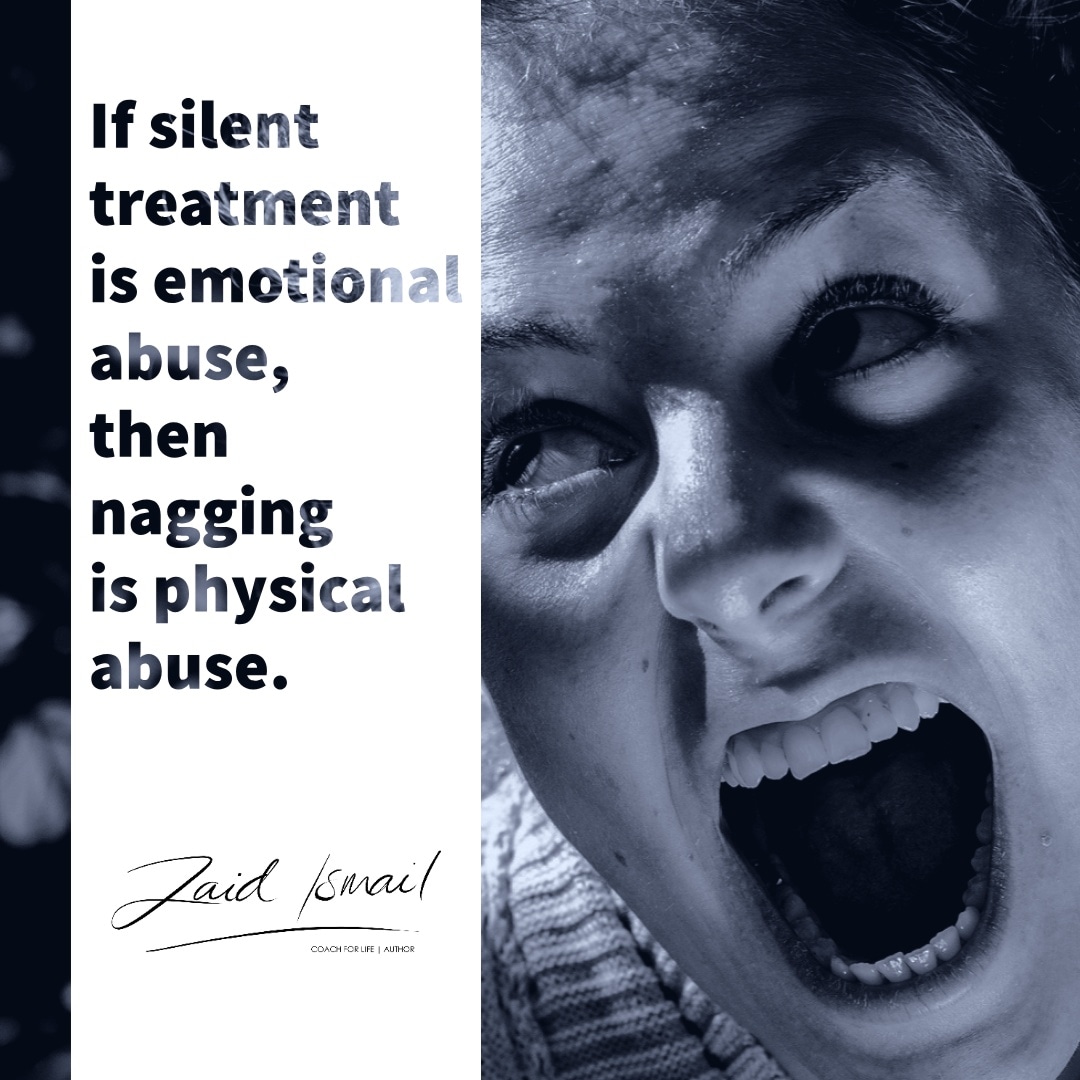
But is it abuse?
If the widespread belief that silent treatment is emotional abuse is to be accepted, then we must also consider the form of abuse that its counter behaviour imposes.
Silent treatment is not an assault on the senses and it doesn’t demand a response. The impact on the recipient of silent treatment is therefore dependent on what the recipient needs to feel validated or visible in that relationship.
It also means that the reason for the dysfunctional communication has to be considered beyond just the withholding of communication from one of the parties.
However, with nagging, it is an assault on the senses and has an inherent demand for a response.
Nagging is based on the assumption of insensitivity or unwillingness on the part of our partner, rather than trying to understand why the first or second request for something was not or could not have been agreed to, or why they see no point in repeatedly acknowledging the same point.
The important point is therefore not about whether it is or is not abuse, but rather why the communication has broken down to the point of such behaviours being the only means to express dissatisfaction with our partners.
Claims of abuse are counter-productive unless either party is physically prevented from walking away from such forms of ‘abuse’ .
The focus should therefore be on creating understanding about why communication has broken down, rather than supporting one partner against the other.
No one nags or remains silent if they believe that their reasonable voice will be appreciated.
#mentalhealth #mentalhealthawareness #lifecoaching #zaidismail #marriagecounselling #relationshipgoals #communication #empathy #ownyourlife #narcissiticabuse #narcissism -
Navigating relationships – 5 of 5
As romantic as it seems, needing someone to complete you means that you’re not at peace with yourself.
It’s not about whether it’s right or wrong. Instead, it’s about being aware of the demands that you’re placing on your partner, most likely without realising it.
If both are equally invested in such an approach to the relationship, no problem.
However, it also means that they need to experience emotional growth at the same rate, or else the one will outgrow the other, leaving their partner feeling abandoned or betrayed.
Expectations from, or of your partner is a good thing.
But, without mindfulness and understanding of what drives such expectations, and why they may or may not feel comfortable with such expectations being placed on them, relationships end up breaking down for all the wrong reasons.
The most critical factor in making a relationship work is ensuring that you’re both similarly emotionally mature.
When emotional maturity, and in turn self-worth from both sides, is in a healthy space, contentious and sensitive issues can be discussed and resolved with relative ease.
That’s when you’ll move from completing each other, to complementing each other.
The difference between the two is that you allow each other to be uniquely beautiful in the relationship without either one feeling threatened or smothered the moment there is a difference in the growth that either experiences.
If you’re contemplating walking away from someone you once loved and dreamed of making a future with, pause to consider if the reasons you’re leaving are really the reasons that your relationship is not what it used to be.
#mentalhealth #mentalhealthawareness #lifecoaching #zaidismail #silenttreatment #relationshipgoals #marriageadvice #companionship #expectation #narcissism -
Navigating relationships – 4 of 5
The importance of having a healthy support structure cannot be over emphasised.
Majority of relationships fail because support structures from one or both sides are focused on protecting their own from the assumed malicious intent of the other party, rather than trying to establish understanding between the couple, and supporting them towards building their relationship.
This need to protect before seeking to understand is the very same culture that leads individuals to believe that what they need from the relationship is more important than what they need to contribute to the relationship.
The old school wisdom that teaches us that we don’t only marry an individual, we marry their entire family, is true but very misunderstood.
Not only do we need to understand that the extended family will have expectations of us, but also that the family culture will influence the expectations that our partners have of us.
Believing that either our partner or we are capable of completely mitigating the impact of that extended family influence is naive.
At some point, sometimes very early in the marriage, the loyalties are tested through guilt-trips or blatant demands where we feel pulled between our support structures and our partners.
That’s when relationships go sour if the individuals involved are unprepared for that kind of emotional pressure.
That’s when choosing an independent and informed advisor becomes critical towards breaking the patterns that are leading to the breakdown of the relationship.
Choose carefully.
#mentalhealth #mentalhealthawareness #lifecoaching #zaidismail #silenttreatment #relationshipgoals #marriageadvice #companionship #understanding -
Navigating relationships – 3 of 5
Understanding why you or your partner behave the way that you do is only the first critical step in creating harmony and establishing that bond that makes a relationship resilient.
Once you have this understanding, you need to decide what to do with it.
That’s when having mature, objective, and sound advisors become the next critical part in our efforts towards establishing healthy relationships, both with ourselves and with those around us.
Loyalty often blinds friends and family towards protecting us, even when we’re not attacked nor being deliberately treated badly.
Their need to protect us is more about their fears from their own experiences or their need to feel significant in our lives, than it is about guiding us towards the best outcomes.
A sincere advisor is one who won’t protect you from the truth of your contribution towards the difficulties that you may be experiencing just because they’re afraid that you may be upset with them.
This is true not only for friends and family, but especially for coaches and therapists.
The golden rule when choosing an advisor is to confirm that they’re driven towards understanding your situation objectively, while offering insights into what is contributing towards it from both sides, before they insist on a course of action that you must follow.
In fact, when an advisor insists that you take specific steps towards resolving something, they’re no longer advisors. They’re instructors.
So be sure about whether you’re seeking instruction or advice on how to connect with your partner in a healthier and more meaningful way.
Instructions are based on someone else’s value system, while advice is aimed at providing insight into your reality so that you can make an informed decision based on your value system. Not theirs.
Choose carefully.
#marriageadvice #relationshipgoals #ownyourlife #theegosystem #mentalhealth #mentalhealthawareness #lifecoaching #zaidismail #silenttreatment #personalpower -
Navigating relationships – 2 of 5
When we’re insecure about who we are, we’re more likely to assume that the behaviour of those around us is because of what they think of us.
This places an unspoken burden on them that influences how they show up for us when we need them most.
If you want to understand your behaviour towards your partner, or their behaviour towards you, you need to be aware of the dynamics in your relationship with your own family. Especially your parents.
This is true for them as well.
When we have dysfunctional or even abusive relationships with our family or parents, what we lack in those relationships inevitably feeds our insecurity in our own relationships, and it influences what we expect from our partners to make up for what was always lacking.
Most often, this is a subconscious need or demand that we place on them, and that they place on us.
The more aware we are of this, the greater our chances of being able to remedy it without it contaminating an otherwise good relationship.
When we feel triggered by something that our partner does, it means that we’re still affected by a past experience that most likely occurred long before we met them.
Our trigger is ours to own, because it is our fear about what the future holds relative to what the current moment reminds us about our past.
Hence the fear and anxiety that prompts us to respond with intensity towards something seemingly innocent from others.
When you’re caught up in a bad cycle with someone, focus on what you’re contributing towards that cycle and change that, rather than focusing on what you need them to change to break that cycle.
It always starts with you.
#relationshipgoals #marriageadvice #ownyourlife #theegosystem #ownyourlife #lifecoaching #zaidismail #loveyourself #lifegoals #companionship -
Navigating relationships – 1 of 5
When faced with a serious disagreement in their relationship, couples often turn to their own families or friends for advice or support.
This can be helpful if the people providing such support or advice are mature and objective, rather than loyal above all else.
Most often, family and friends will support us in our complaints against our partners, hoping to protect us from being taken for granted, or treated badly.
This is especially true if we come from a family that has very traditional roles that focus on duty and obligation, rather than mutual contribution towards making a home.
When we are troubled by something that our partner is doing, we must seek to understand why they’re doing that, rather than judging them and rallying support for our position against them.
If you don’t have such maturity and wisdom in your relationships or your support structures, it’s best to identify up front in the relationship who will be your go-to in such situations.
Even if it’s a counsellor, coach, or therapist, be sure to find someone that you both trust when times are good, because it’s very difficult to agree on something like this when times are bad.
If you focus on understanding, being understood will be easier to achieve.
That’s why we should develop a good understanding with our partner’s support structure so that we can trust them to be objective when we need to figure out such issues in the relationship, rather than slipping into victim mode and presenting ourselves as the neglected or abused one to our own support structures, which often contributes to the break down of the relationship, rather than making it stronger.
Choose your advisors carefully.
#relationshipgoals #marriageadvice #mentalhealth #mentalhealthawareness #lifecoaching #zaidismail #silenttreatment #companionship #soulfood #marriagecounselling #conflictmanagement