Don’t become so fixated on labelling yours, or the behaviour of others, that you lose sight of the human struggle behind that behaviour.
Labels make it easier for us to deal with stuff.
The moment we give it a name, we can manage our expectations around it.
This is fine when it comes to abstract stuff and tasks or problems that we deal with as part of a regular day.
But it becomes detrimental when we start labelling behaviour and then responding to that label, rather than recognising the legitimacy of the human experience behind that label.
Popular labels include depression, bipolar, narcissism, and egotists, to name only a few.
It’s one thing describing what we’re observing as our experience of someone’s behaviour, but the moment we reduce the human to that label, we become part of the struggle that they’re already grappling with.
We must learn to connect with the human struggle long before we label it as an illness or a deficiency.
For example, we don’t suffer from depression, but we do have good reason to feel depressed because we’ve lost hope in something important working out the way we need it to.
And so it is with all other so-called mental illnesses.
We lose compassion and empathy, and thus disconnect from our own humanness, when we define the entirety of a being by a single label of unacceptable or unpleasant behaviour.
Reclaim your humanness, so that you may be able to honour the humanness of those around you.
Start by avoiding self-diagnosis of the emotional state of others.
#mentalhealth #mentalhealthawareness #mentalhealthrecovery #lifecoaching #zaidismail #compassion #trust #empathy #theegosystem #ownyourlife
Category: Life Coaching
-

Dehumanising the human
-

Raising humans
Parents are pretty much always well meaning, even when we behave like idiots.
We’re either trying to encourage our kids to be driven like us, or trying to raise them to be better than us.
And if we’re convinced that we’re not good for them, or that they deserve better, then we create distance between them and us because we are convinced that our presence may contaminate the wholesomeness of what they’re capable of being.
Either way, whether we’re present, absent, invested, or disinterested, the role that we play in their lives cannot be dismissed.
The more we’re given to our own fears and insecurities, the less justice we’ll do to raising them with a healthy sense of self.
Connecting with our fears and insecurities, and putting in the effort to understand ourselves better, is what will equip us to inspire our children to reach for their potential.
Otherwise, we’ll focus on discipline, good manners, decorum, and academic achievements, while hoping that they’ll somehow develop confidence and a healthy self-esteem simply through achieving good things.
Most often, this approach fails. It may produce functional adults, but it doesn’t produce emotionally grounded adults.
It emphasises the importance of duty and servitude, but it diminishes the importance of the human behind such attributes and achievements.
If you don’t have a healthy self-esteem, your battles will be projected onto your children, and it will contaminate their self-esteem in ways that will only become evident later in their lives.
Save yourself and them from a lifetime of internal struggle, and start dealing with your fears and insecurities in a meaningful way now.
Your future self will thank you for it, and so will your children.
It always starts with you.
#hope #expectation #sincerity #selfworth #selfawareness #mentalhealth #mentalhealthawareness #lifecoaching #zaidismail #loveyourself #parenting -
Gratitude is the sister of faith
When faced with trials, there are too many who surrender to coping with such trials instead of persevering to overcome them.
Purposeful perseverence is called for when we find ourselves in situations that are weighing us down.
No matter how little our resources or ability to influence the outcomes, using that little that we have while having faith that we will rise above it is what will slowly build the momentum to finally overcome the trying circumstances.
The moment we diminish even the little that we have or the little influence that we can bring to bear on the situation, we risk falling into ingratitude.
Ingratitude is the enemy of faith.
When we diminish who we are because of the way that others treat us, or because we convince ourselves that we are undeserving of better, we take ourselves for granted and give up any opportunity to improve the condition of our lives.
Faith is not born out of certainty, nor out of favourable conditions.
It is tested during moments of hardship, and is often taken for granted during moments of ease.
Thus, gratitude and faith become companions, because when we live with ingratitude for who we are, we will find ourselves in situations that will test our faith.
And the more we live with gratitude, not only for what we have but especially for who we are, despite the weight of life, we will always find comfort in knowing that we are capable of navigating the trials of life while having faith that ease will follow the hardship.
It is only through connecting with gratitude that we recognise the ease that followed the many hardships and trials of life, while ingratitude leaves us focusing on the persistent trials that followed those periods of ease.
Thus, a grateful heart connects with the reality that ‘this too shall pass’, because they continue to purposefully persevere in persuing good, despite not always having it within themselves to immediately overcome the bad.
It always starts with you.
Own Your Life.
#hope #expectation #sincerity #selfworth #selfawareness #mentalhealth #mentalhealthawareness #lifecoaching #zaidismail #loveyourself #lifegoals #motivation #optimism #purpose #gratitude #faith -
Do you hate apologising?
Ever reject an apology from someone only to be told, “Well, I apologised. So if you don’t accept my apology, then that’s your problem, not mine.”
Or something similar?
When you apologise and expect your apology to be accepted, you’re not apologising, you’re demanding that the other person just move on without any redress to the impact that your offence had on them.
An apology is more than just an acknowledgement of wrongdoing.
An apology, when sincere, must focus on assuring the other person of two things.
Firstly, that there is real remorse or regret about the way in which you conducted yourself.
And secondly, that you want to make up for the impact that it had on them.
If either of these are lacking, it’s not an apology. It’s simply a means to pacify your own conscience, and at best, it’s a formality.
Relationships can often be salvaged through sincere remorse for the mistakes that we make.
But, if we feel weak for admitting fault, then we have work to do on how we feel about ourselves, and it has nothing to do with how the other person may or may not respond to our apology.
If you find it difficult to apologise, chances are good that you’re also keeping score about who committed how many offences compared to the other.
Either way, it means that you live with the fear of being inadequate.
It always starts with you…and what you think of yourself.
Own Your Life.
#hope #expectation #sincerity #selfworth #selfawareness #mentalhealth #mentalhealthawareness #lifecoaching #zaidismail #sincerity #mentalhealthrecovery -
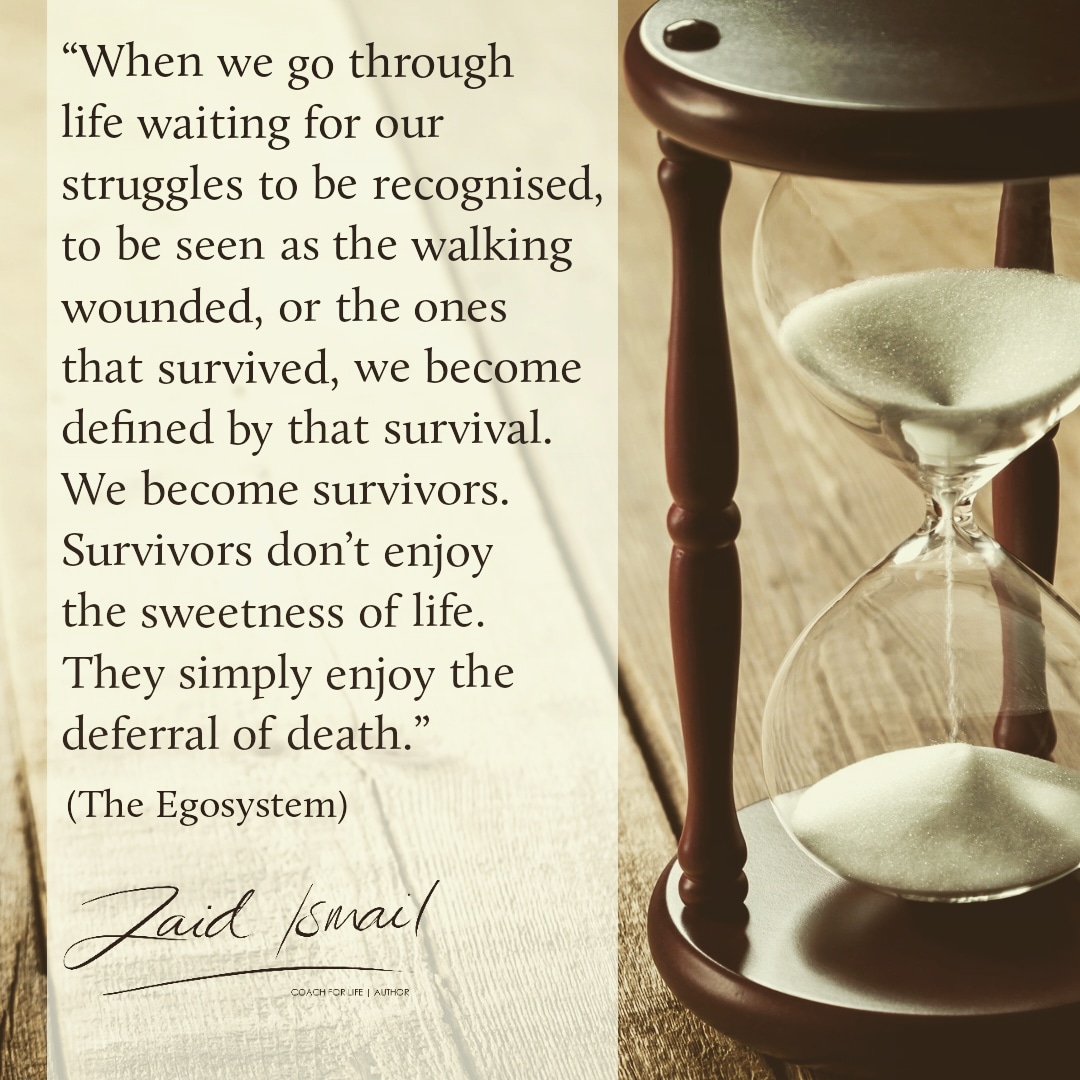
Enjoying the deferral of death
“When we go through life waiting for our struggles to be recognised, to be seen as the walking wounded, or the ones that survived, we become defined by that survival. We become survivors. Survivors don’t enjoy the sweetness of life. They simply enjoy the deferral of death.” From The Egosystem in the chapter titled Recognise My Struggle.
When we lack appreciation for who we are, we seek that validation from those around us by highlighting our struggles so that they may admire our strength or resolve.
When we focus on reciprocation, we find reason to emphasise what we do for others, often by mentioning it to anyone that will listen, because again, we lack appreciation for who we are and therefore go out in search of validating the good that we do for others, hoping that it will give us reason to feel worthy.
We wear the badge of martyrdom when we feel sorry for ourselves, believing that we’re not appreciated or valued, and that our only value to those around us is in how we serve them.
These are a few examples of how we diminish the value of what we do because we’re trading it for recognition or praise, rather than doing it because we believe in the value of what we do.
When we mention the good that we do, we become distracted by the praise, and we lose sight of the dignity of those we assisted by mentioning their neediness while highlighting our generosity.
At the heart of it all is a low self-esteem.
Once we reach the age of awareness, our self-esteem is no longer inherited from our parents. It’s defined by our gratitude for who we are and what we have.
The survivor mindset undermines gratitude because it anchors our focus on everything that we need to overcome, while distracting us from everything that is good and wholesome, or blessed in our lives.
That’s when the sweetness of life is lost, and feeling good about ourselves becomes dependent on how others acknowledge or praise the good that we do, or the struggles that we overcome.
At which point will we pause to consider how blessed we are to have the ability and the resources to overcome those very same struggles?
It always starts with you.
#hope #expectation #sincerity #selfworth #selfawareness #mentalhealth #mentalhealthawareness #lifecoaching #zaidismail #loveyourself #lifegoals #motivation #optimism #purpose #gratitude -
The fallacy of what was meant to be…
On the surface, this seems like a really positive perspective on life, right?
But let’s unpack it very quickly.
Being thankful for the experiences that we’ve had has merit because there is nothing so bad that there is no good in it.
What we take from our experiences is what gives us the opportunity to grow and to experience greater depths of emotions – both good and bad.
It’s only in experiencing the bad that we are able to appreciate the good, or else we’d take it for granted.
However, it’s the last part of this that I believe is a dangerously false notion to adopt.
Where you’re meant to be by whom? By what?
When we believe this to be true, we have less reason to question our uninformed or poor decisions that got us to this point because, you know, this is where we’re MEANT to be. Right?
It’s the last part that is false. It carries with it a fatalistic view of the outcomes of our lives because it implies that no matter what we did, we’d still be at this point because it was meant to be.
How does this kind of thinking affect someone who is tired of finding their efforts being taken for granted? Or no matter how hard they’ve tried, they keep finding themselves struggling to find peace or healthy relationships, or fulfilment, or success?
Is it because they were meant to be in such straitened circumstances by some force that g they have no control over?
Before you whip out the arguments about taqdeer, fate, destiny, and all that, consider what the point would be of our power of choice and reason if everything that happens to us was simply prewritten regardless of our effort to be better or achieve better than that.
If that understanding of destiny was true, what would be the point of applying ourselves towards any goal at all? Wouldn’t everything happen regardless of our efforts since it was ‘meant to be’?
It’s more accurate to say that the outcomes of the choices that we made was unavoidable because we didn’t know what we didn’t know. But that’s why we made bad choices, or naive decisions.
Not because it was meant to be, but because we didn’t know what we didn’t know.
Own Your Life.
#selfworth #selfawareness #mentalhealth #lifecoaching #zaidismail -
Self-help guides are not sustainable
For those who believe that my books are self-help guides and are expecting instructions for life from it, this may clarify my approach for you.
The above photo is from The Egosystem p.25. I don’t believe in prescriptive exercises or methods when advising others about how to navigate the challenges in their lives.
Such prescriptive approaches assume that others are like us, and that their lives are like ours.
It also assumes that they have access to the same resources and support structures as we do, and that they interpret the events of their lives in the same way that we would.
None of that is true.
We’re each unique in our relationship with the world around us. That’s why a prescriptive approach will never be sustainable.
It may provide interim relief, but it will not be sustainable the moment your circumstances change.
Creating understanding and awareness about why you are who you are, and why you feel the way that you do allows you to choose your responses to life more mindfully, and in a way that is uniquely you.
Otherwise all we’re doing is creating mini-me versions of coaches and therapists and counsellors in the lives of our clients.
How does that help anyone? 🤔
Own Your Life.
#hope #expectation #sincerity #selfworth #selfawareness #mentalhealth #mentalhealthawareness #lifecoaching #zaidismail #loveyourself #lifegoals #motivation #optimism #purpose #mindfulness #personalpower -
When sincerity is tested
Like the old saying goes, talk is cheap, and actions speak louder than words.
It’s easy to say the right thing, especially when times are good and what we’re committing to is convenient.
However, when our commitments pull us between what we want for ourselves versus what we committed to doing for someone else, that’s when our sincerity is tested.
But what defines our sincerity?
Is it how we want to appear to others or how we live by the values that we stand for?
The moment we’re focused on what others think of us, we play to the responses that we want from them, even when we’re doing something good.
The problem with this is that without realising it, our motivation slowly shifts from living by our values to how we are perceived by others.
That’s the beginning of how we lose ourselves to the attention that we get from others.
More than this, the lower our self-respect, the more inclined we’ll be to say the right thing while finding it difficult to do the right thing.
That’s when making excuses for our behaviour becomes easy when others challenge us about the commitments that we haven’t honoured.
This is an indication of a low level of self-respect.
Self-respect is tainted when we lack gratitude for who we are.
The more we dismiss the value of who we are, the more we’ll need validation from others. Hence the unhealthy cycle of focusing on what others think of us, versus being true to who we are.
We’ll only be true to who we are if we truly value who we are.
For this reason, don’t expect sincerity or consistency from one who is self-loathing. And realise that you are self-loathing when you struggle to be consistent or to follow through on the commitments that you make to others.
It always starts with you.
#sincerity #action #conviction #mentalhealth #mentalhealthawareness #mentalhealthrecovery #selfawareness #selfrespect #mindfulness #inspiration #selfworth #lifecoaching #zaidismail #loveyourself