Peace is most ravaged when we convince ourselves that we were treated badly by others, or by someone we trusted, because we weren’t good enough for them.
A betrayal of trust, no matter how noble the person, reflects cowardice on their part.
We only betray the trust that others place in us when we feel burdened by that trust, or we avoid accepting the responsibility that it demands of us.
Either way, it’s a shortcoming on the part of the betrayer, not the betrayed.
Sometimes we’re so focused on getting even with those who betrayed our trust that we fail to notice how that fixation distracts us from fulfilling the rights of others, which in itself is also a betrayal of trust.
Understand the internal struggle of those who treated you badly, so that you will realise that they were simply incapable of being better than that in that moment.
It may not take away the disappointment or the hurt, but that is part of your humanness.
When that disappointment overwhelms your joy in life and steals your enthusiasm for the future, it’s no longer because of how someone treated you,it’s because of how you see yourself because of how they treated you.
It’s that easy to give up your power to influence the outcomes and the happiness that you experience in life.
You do so by believing that how you were treated by troubled souls is a reflection of your worth.
That’s simply ingratitude for who you are.
Misplacing your trust in someone is a mistake made from good intentions.
Discard the mistake after learning from it. Don’t discard the good that inspired that good intention.
It always starts with you.
#truth #trust #betrayal #honesty #sincerity #authenticity #mentalhealth #mentalhealthawareness #mentalhealthrecovery #selfworth #selflove #selfawareness #selfrespect #reflection #mindfulness #dignity #lifecoaching #zaidismail
Tag: sincerity
-

Reclaim your worth
-

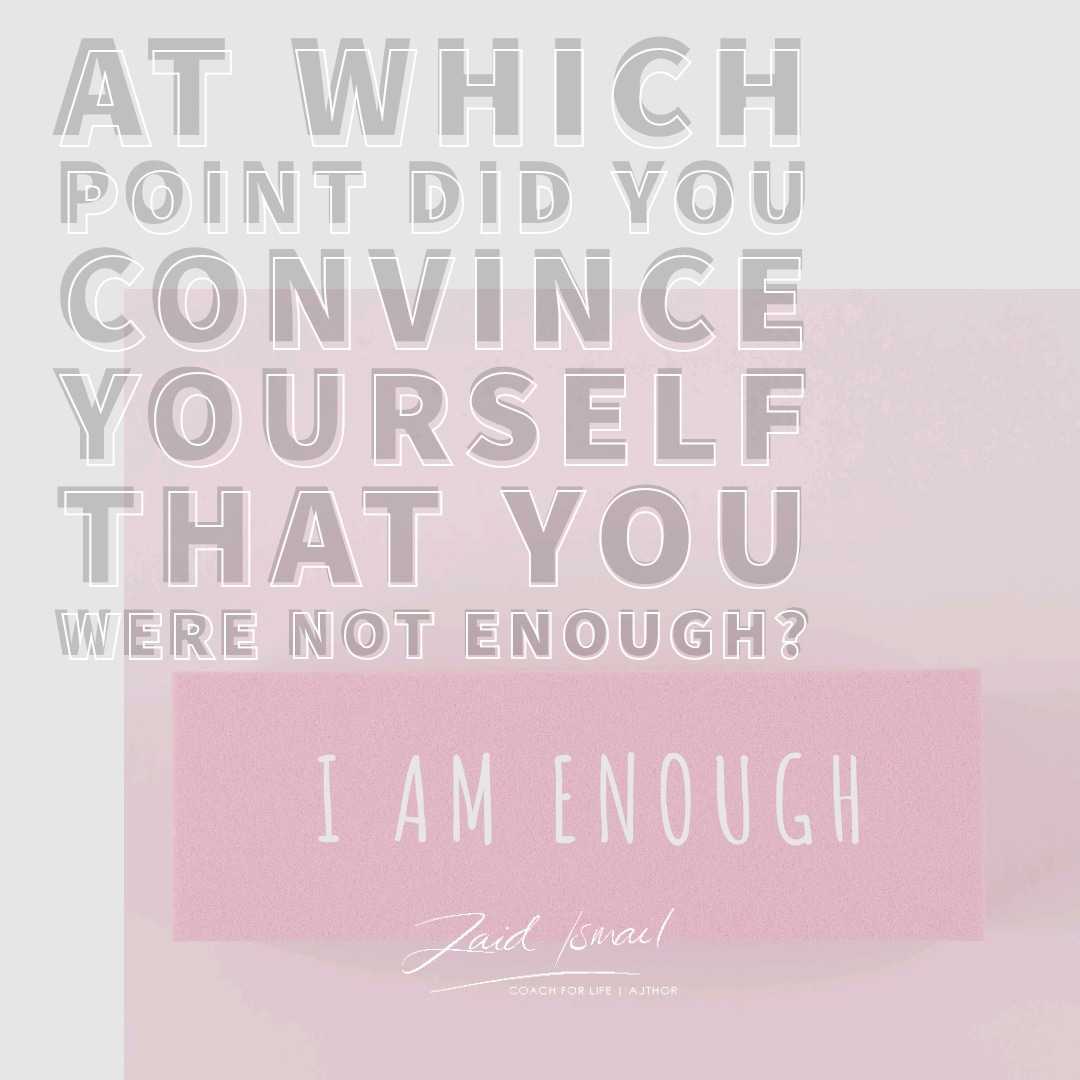
Who says you’re not enough?
When we find a need to repeat affirmations like ‘I am enough’ to ourselves in the mirror each day, we’re trying to convince ourselves to believe something that we are already convinced is not true.
If we believed it to be true, there would be no reason to try to convince ourselves about it each day.
Rather than convincing yourself that you’re enough, focus on understanding who convinced you that you weren’t enough to begin with.
When you figure that out, you’ll realise that you’ve been living life viewing yourself through that person’s eyes, which is why your relationship with yourself is based on judging your achievements relative to what you think they would think of you, rather than understanding what is needed to achieve your goals when you fall short.
Judgement is always based on how we think others see us.
Understanding is based on what we are trying to figure out in our efforts to achieve our goals.
The emphasis is on ‘our’ goals, and not on achieving milestones that are needed to get approval from others.
Recognising the difference between these mortivators that we focus on will result in mindfulness about whether we’re truly pursuing something we’re committed to, or is it something that we hope will win us favour with others.
If the latter, expect to be exhausted in your efforts to constantly please others, while convincing yourself that you’re enough when you look in the mirror, even though you don’t feel like you are.
You were born enough!
You lost sight of that when you focused on rejection or betrayal from one who themselves lost sight of the same thing earlier in their lives.
Break the cycle. Connect with gratitude for who you are, and compete with yourself only in improving who you are.
The rest will take care of itself. Especially the anxiety of life.
It always starts with you.
#hope #expectation #sincerity #selfworth #selfawareness #mentalhealth #mentalhealthawareness #lifecoaching #zaidismail #loveyourself #lifegoals #motivation #optimism #purpose #mindfulness -
Have we forgotten how to love?
Most of us have forgotten how to truly love another.
Love has become so commercialised, that we confuse a mutual exchange of interest and benefits as love.
That’s why we end up believing that only as long as we’re getting what we need, do we have reason to feel loved.
Meanwhile, we lose sight of the struggles of those we love when they are at war within themselves.
If we truly love another, we must love what we believe is the true essence of who they are, so that when they stumble or err out of being human, we’ll be inclined to want to understand why, rather than to judge them harshly before pushing them away.
Such sincerity and conviction is only possible when we connect with our humanness.
But most of us go through life seeing ourselves through the eyes of our parents or grandparents, or some other figure whose validation we need, before we feel OK about ourselves.
The longer we live life this way, the more anxious and unfulfilled life will be, because everything will be driven by the fear of not being good enough, and not by the aspiration to be the best that we believe we are capable of being.
As long as we judge ourselves based on how we need to be accepted by others, we’ll never be able to truly connect with the good that may exist between us and our significant others.
That’s how life becomes a transaction, and love becomes fragile.
Self-awareness therefore precedes acceptance of who we are, and acceptance is only possible with understanding, which is the root of gratitude for what we’re capable of.
It always starts with you.
#hope #expectation #sincerity #selfworth #selfawareness #mentalhealth #mentalhealthawareness #lifecoaching #zaidismail #loveyourself #lifegoals #motivation #optimism #purpose #mindfulness #relationshipgoals #ownyourlife -
Dignity is yours to claim
There is no shortage of examples of dignity in war zones, poverty or drought stricken areas, or in the midst of heinous terrorist attacks.
Notice how some people, when faced with soul-destroying realities, are still dignified in how they rise above it?
If you wait for your aggressor or abuser to treat you with dignity before you find reason to respect yourself, you’re doing life back to front.
When we expect recognition of our humanness from the world, we’re expecting our tormentor to become our mentor.
It’s irrational.
Dignity is not bestowed, it is claimed!
It is undignified to ask to be treated with dignity because that means that your dignity is dependent on how others treat you.
We either tolerate being treated with indignity, or we challenge and reject it.
If we don’t challenge such behaviour from others, we enable them to treat others badly.
Self-worth is at the core of dignity.
But self-worth is an outcome of the value that we see in ourselves.
It’s about how much worth we place on ourselves despite how others may take us for granted.
When we connect with that value that we hold within, gratitude for who we are, and importantly, gratitude for what we are capable of contributing in good towards others, will establish dignity in our sense of self, and resilience in our response to the trials of life.
It always starts with you.
Don’t outsource your dignity to others. They’re not responsible for how you feel about yourself.
P.S. For the first time in a very long time, I used my own photo for my post, and not one from Adobe Stock. Taken in San Lameer, on the KwaZulu-Natal South Coast.
#hope #expectation #sincerity #selfworth #selfawareness #mentalhealth #mentalhealthawareness #lifecoaching #zaidismail #loveyourself #lifegoals #motivation #optimism #purpose #mindfulness #inspiration -
The victim bully
The common trait between the blatant bully and the passive aggressive victim is that they both share a victim mindset.
The one demands significance through invoking fear in others, while the other tests for their significance by shaming or guilt-tripping others.
The victim mindset sets in when we allow ourselves to be defined by the impact of a harsh or hurtful experience long after the event has passed.
We hold onto the impact for a number of reasons, the most common of which include our need to have our struggle recognised by others so that their expectations of us can be reduced in line with what we believe we are only capable of.
In other words, it’s an excuse to avoid accepting accountability for those moments when we feel overwhelmed or incompetent.
The other common reason is to protect ourselves from creating an opportunity to be treated poorly or harshly again.
That’s how we end up sabotaging good relationships by constantly testing the sincerity and commitment that others have towards us.
Those with a victim mindset are in survival mode, denying themselves the sweetness of life while emphasising their struggle to create such a life, hoping that they will be appreciated for their courage and strength to persevere long after their struggle has passed.
At the core of the victim mindset is ingratitude.
It is ingratitude for everything that we are capable of, and all the opportunities that we have to create value for others.
Being a victim of aggression or hurtful behaviour in the moment of its occurrence may not always be avoidable, but remaining in that victim space beyond that moment is a choice that we make.
Those who own this choice will find it possible to move beyond the experience, while those who don’t will forever remain stuck in a moment that has long passed because they refuse to accept that they were not enough for someone important to them.
Choose carefully what and who you allow to define you.
#hope #expectation #sincerity #mentalhealth #mentalhealthawareness #lifecoaching #zaidismail #loveyourself #lifegoals #motivation #optimism -
Own your dream
When you find yourself putting your dreams on hold because you’re waiting for others to confirm that it’s a feasible project, or that you’re capable of achieving it, know that it’s not a dream. It’s simply a wish.
Dreams can either be an indulgence of escapism, or it can be a seed of passion.
Most use it as escapism to wish away the state of their lives, while believing that they’re oppressed by not having the opportunity to pursue their dreams.
Unless you are being physically restrained from making that big change, or taking that next step, your dream is yours to claim, or yours to abandon.
By the way, there’s nothing wrong with escapism, or daydreaming.
As long as you accept the purpose behind such moments and you don’t use it as reason to blame others for the lack of passion or progress in your life.
Caution: If you chase your dreams at the expense of important relationships, no matter how much your success will be celebrated by strangers, success will feel hollow.
So strike a balance between pursuing your dreams while being sure not to shut significant others out of your journey towards achieving it.
Moderation in everything.
Remember, once you’re successful, it’s a lot more difficult to determine who is sincere towards you, versus who is using you for your wealth or status.
So leave the door open for those around you to join you on your journey when they’re ready, but don’t stand at the doorway waiting for them before you pass through it.
Success is most enjoyed when we can share it with those we love. Otherwise, we’ll find it at our is never enough as we continue to seek fulfilment in achieving more, because we have no joy in what has already been achieved.
#hope #expectation #sincerity #selfworth #selfawareness #mentalhealth #mentalhealthawareness #lifecoaching #zaidismail #loveyourself #lifegoals #motivation #optimism #purpose #mindfulness #inspiration -
The enemy of mindfulness
We find ourselves in a state of duress, or stress, when we lose sight of what we can influence, whi fee helpless in the face of everything that we think is out of our control.
Whenever we’re faced with a problem, we either focus on mitigating the impact of the problem on us, or we focus on the opportunities to overcome the problem.
When we convince ourselves that the problem is bigger than us, and we also believe that walking away from it is not an option, or possible, we slip into a victim state of mind that weighs us down.
As a side note, whenever something appears impossible to resolve, it means that we have gaps in our understanding about what’s causing it to occur.
At that point, we should set out to seek a better understanding of the problem, rather than persisting in trying to find an answer with the limited information that we have.
This is the kind of thinking that needs to be applied when we’re faced with challenges in our lives.
The most common reason for feeling overwhelmed by life is because the assumptions that we made over the years about our significance or our ability to influence important relationships have grown to become the truths by which we live.
So we don’t even think of questioning those assumptions, despite circumstances having changed over the years, and more importantly, despite us having grown over the same period.
Becoming aware of these assumptions that we make when trying to solve any problem is the first critical step towards searching for answers.
But, mindfulness is needed to regain such perspective, and mindfulness is lost to the victim mindset.
The victim mindset is one that leaves us feeling defensive, or defenseless. Reclaiming your ability to positively influence the outcomes of your life then becomes the important problem to solve.
It always starts with you.
#hope #expectation #sincerity #selfworth #selfawareness #mentalhealth #mentalhealthawareness #lifecoaching #zaidismail #loveyourself #lifegoals #motivation #optimism #purpose #mindfulness #inspiration #personalp -
Success at what cost?
The core of being human is the need to be significant to others, especially with significant others.
Our efforts to be successful feel empty and unfulfilling if we have no reason to believe that it positively impacts the lives of those around us.
So, we set out to be successful so that we can be valued, so that we can feel fulfilled or at least have reason to believe that we’re making a meaningful contribution towards the good around us.
But, what happens when we have an unhealthy self-esteem?
Our focus shifts from wanting to be of benefit, to being afraid of not being good enough.
To compensate for the fear of not being good enough, we focus on equipping ourselves as best we can to avoid failure.
Ethics and integrity become optional when what feels like survival overtakes our better judgement.
And in this way, our low self-worth becomes the basis on which we raise our children, convincing them about the importance of education, while setting loose boundaries for integrity.
Thus, by not understanding the state of their self-worth, we raise what appears to be narcissists while believing we’re raising responsible adults.
All because we exaggerated the importance of education compared to the emphasis that we placed on self-esteem and integrity.
No one intentionally or deliberately raises children with a low self-worth, but we cannot give what we don’t have.
That’s why, when we’re lacking in self-worth as adults, we compensae for it by focusing on equipping our children to fit into the world around them, rather than to define that world.
That’s how we place education and success above honesty and integrity, or sound character, while only intending good for our children. Or for ourselves.
This is yet another reason why the best gift you can give your child is not a good education, it’s a healthy self-esteem.
The rest will take care of itself.
#hope #expectation #sincerity #selfworth #selfawareness #mentalhealth #mentalhealthawareness #lifecoaching #zaidismail #loveyourself #lifegoals #motivation #optimism #purpose #education #parenting #narcissism