Note to self: When you allow yourself to be defined by the scepticism of others, you impose their limitations on yourself.
Recognising that all mental and emotional limitations are self-imposed is critical to growth.
These limitations are revealed in how we believe we are compelled to respond to someone or some experience.
It is revealed in how we believe in our ability to do the extraordinary, while our support structure, or our tribe convinces us that we’re supposed to focus on responsibility only.
It is revealed when we look for validation and approval for our aspirations or ambitions, before we commit ourselves wholeheartedly towards its pursuit.
The greatness that exists in all of us is often snuffed out by our need to be accepted before we pursuit that which will set us apart.
Whose permission are you waiting for before you unleash your passion, or pursue your dream?
Tomorrow is not guaranteed, but death bed regrets are…if you don’t live a life that duly honours the struggles of your life.
Own your life. Before someone else does.
Photo credit : Adobe Stock
#selfworth #selfawareness #ownyourlife #selfmastery #mindfulness #personalpower #ownyourshit #mentalhealthrecovery #mentalhealth #mentalhealthawareness #lifecoaching #zaidismail #motivation #optimism #lifegoals
Tag: personalpower
-

Own your life
-

Are you grateful for you?
Whenever asked about gratitude, the inevitable response is one that is focused on everything we have around us.
Sometimes, we consider our health and our skills.
At other times we recognise the value of things not being as bad as they could have been.
And we convince ourselves that this is being grateful.
But how often do we stop to contemplate gratitude for the traits and attributes that we have which makes our appreciation of all of that possible?
How often do we stop to appreciate the essence of who we are, and the tough and selfless choices that we made under difficult circumstances, when we could easily have taken the selfish or easy way out?
This is not about judging the choices that we’ve made, but about recognising how we still showed up, with conviction, to do our best to make something good out of a bad situation.
You cannot nurture that which you don’t acknowledge to be true. So how are you going to nurture the value of who you are, if your gratitude is only focused on what you have?
Striking a balance between selfishness and gratitude for the self is what makes the difference between being defined by your struggles in life, versus defining the outcomes of the struggles of your life.
You won’t be able to determine the difference if you lack gratitude for who you are, and what your contribution is towards improving the state of your life, and the lives of those around you.
The next time you contemplate what you’re grateful for, be sure to include yourself in that moment of reflection.
Photo credit : Adobe Stock
#selfworth #selfawareness #ownyourlife #selfmastery #mindfulness #personalpower #ownyourshit #mentalhealthrecovery #mentalhealth #mentalhealthawareness #lifecoaching #zaidismail #loveyourself #gratitude #appreciation #compassion #kindness -
Know your worth
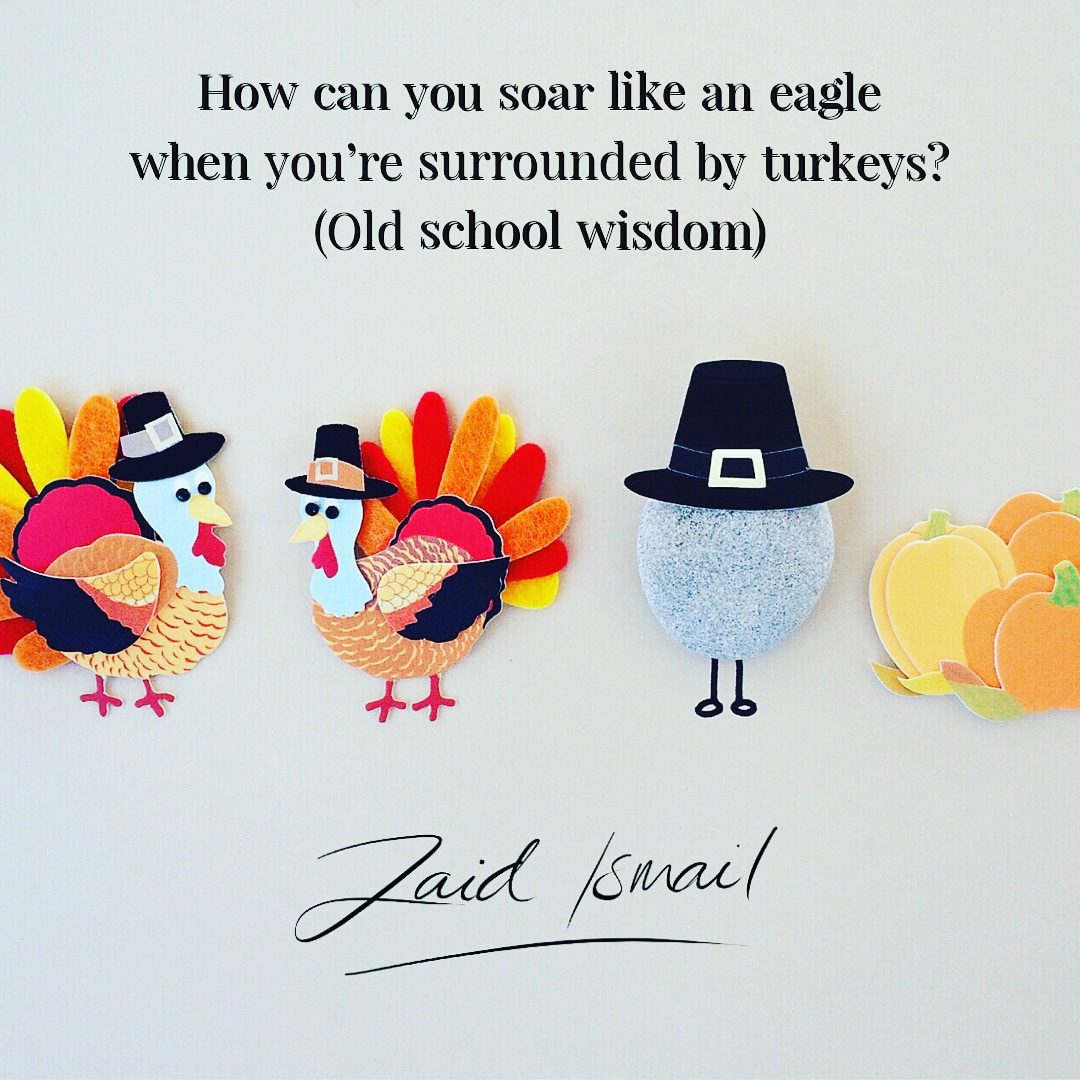
How many of us spend our lives trying to convince turkeys that they’re eagles, and in the process, sabotage our own growth and happiness?
To quote another piece of old school wisdom, birds of a feather flock together.
If you don’t know your own nature, you will associate with those who are not aligned with your goals or your passion in life.
That’s the easiest way to embrace mediocrity while yearning for greatness.
Of course, the downside to that is that if you’re surrounded by turkeys, and you claim your space, you may find yourself embracing loneliness and isolation.
The conundrum of life.
I pray that you are born into a home, a family, or at least a community that shares your passion and inspires your growth.
Photo credit : Adobe Stock
#selfworth #selfawareness #ownyourlife #selfmastery #mindfulness #personalpower #ownyourshit #mentalhealthrecovery #mentalhealth #mentalhealthawareness #lifecoaching #zaidismail #motivation #optimism #lifegoals #soulfood #soulmates #fuckit -
That toxic status quo
When we are raised in an environment focused on discipline before purpose, or compliance before understanding, we develop the belief that fitting in is more important than what is right.
This same mindset leads us to be bullish in our efforts to uphold the status quo because of the inclusion that it offers, while violently rejecting any opinions that challenge our cultural heritage or traditions.
The need to belong, to be validated by that social structure smothers any passion to contribute towards improving anything, because we’re led to believe that our traditions have already perfected everything.
Thus, the unique expression of the individual is snuffed out, only to be replaced by a militancy of spirit that is celebrated as devout submission.
Critical thinking is abandoned in favour of academic prowess, and without realising it, indoctrination is readily believed to be higher education.
All this leads to the subservient mindset that needs permission before choosing consciously, or seeks permission before thinking independently.
That’s how cycles of abuse are maintained, and the unique contribution of the individual is seen as an offence against the collective.
Everyone must know their place to uphold a power structure that reveres the powerful, while enslaving the minds of the masses.
And that is how the masses, the average soul, grows to believe that unless they have permission to break the bleak and toxic cycles of their lives, they have no choice but to comply quietly for the greater good of society.
Photo credit : Adobe Stock
#selfworth #selfawareness #ownyourlife #selfmastery #mindfulness #personalpower #ownyourshit #mentalhealthrecovery #mentalhealth #mentalhealthawareness #lifecoaching #zaidismail #socialorder #peerpressure #culturalbias #blindfollowing -
Don’t pay it forward
Vengeance is easier than understanding.
Bitterness is easier than forgiveness.
Mirroring the behaviour of those who treated us badly is easier than rising up to be better than them.
Each time we choose the easier path, we become the very monsters and degenerates that created the hurt and pain in our lives.
Too often, we raise our children with harshness because we are afraid of spoiling them.
Recognise that such fear never inspires moderation or a wholesome approach to life.
If you treat your children the same way that you were treated, understand that you will lose them to the world because they will despise what you stand for and discard any good you tried to teach them.
Your children have more options to choose a different path than you ever did. Give them reason to connect with the value of choosing the path that you believe will be good for them rather than simply demanding compliance with your rules or boundaries.
Parents with unresolved childhood trauma at the hands of their own emotionally inaccessible parents raise emotionally stinted children who need to escape the reality of life rather than embrace its beauty or opportunity.
If you want to break the cycle of abuse, the cycle of generational trauma, the cycle of harshness and detachment, or the cycle of dysfunction, you must first recognise its roots within yourself.
It always starts with you.
Photo credit : Adobe Stock
#selfworth #selfawareness #ownyourlife #selfmastery #mindfulness #personalpower #ownyourshit #mentalhealthrecovery #mentalhealth #mentalhealthawareness #lifecoaching #zaidismail #fuckit #parenting #singleparenting #children #narcissism #narcissisticabuse -
Recognise your demons
Some of the most disheartening moments we may experience include trying to help someone we care about while they reject our efforts.
The harder we try, the more they resist.
The more persistent we are, the greater their anger or bitterness towards us.
Most often, it’s not because of who we are or what we’re trying to do.
Most often, it’s because we represent the source of the shame that they are grappling with.
When someone feels inadequate, or like a failure, being around those who are composed, or appear successful feels like a threat to them because it risks highlighting their lack of achievement.
Sometimes, just being a good person while standing next to a self-loathing person is enough to bring out the rage in them.
Not because we tried to make them feel bad about their state, but because in our presence, their reasons for self-loathing were intensified.
Despite our best intentions in that moment, if we don’t realise that we represent what they detest about themselves, we’ll blame ourselves for not being good enough, when in fact the opposite was true.
As much as we may want to fight the demons of the ones we love, we must understand that some demons are a creation of their own minds, and can therefore only be fought themselves, or with those who don’t appear as a threat to revealing their shame.
If you need assistance in supporting someone you love through such an episode in their lives, or if you are the one grappling with this, reach out via my website at zaidismail.com or on WhatsApp at +27836599183 and together we can create the life that you’ve always wanted.
Photo credit : Adobe Stock
#selfworth #selfawareness #ownyourlife #selfmastery #mindfulness #personalpower #ownyourshit #mentalhealthrecovery #mentalhealth #mentalhealthawareness #lifecoaching #zaidismail #loveyourself #selfloathing #emotionalmindfulness -
Celebrate your humanness
Tears are not weakness because it takes strength to embrace your humanness.
The worst brutes lack the courage to be human because appearing unaffected by others is their idea of strength.
Sadly, such a show of strength seals their hearts to emotion and blinds their eyes to the harshness that they exhale, creating distance between them and those they wish to have closer.
They convince themselves that their cold exterior is needed to protect themselves from hurt while not realising that they created the self fulfilling prophecy that hurts them.
When comparing yourself against such emotional detachment, it’s easy to believe that you’re weak for feeling something that leaves them untouched.
No. The weakness is in them.
Strength is found in knowing that your humanness doesn’t define your resilience.
Being human makes makes resilience a beautiful trait.
Without it, life loses its sweetness, and resilience becomes a cold comfort without fulfilment.
Photo credit : Adobe Stock
#selfworth #selfawareness #ownyourlife #selfmastery #mindfulness #personalpower #ownyourshit #mentalhealthrecovery #mentalhealth #mentalhealthawareness #lifecoaching #zaidismail #loveyourself #emototionalattachment #coldheart -
Own your self-worth
Before we can allow the world to define us, we have to first give up what we believe to be true about ourselves.
I’ve seen so many test their significance in the lives of significant others, and when they don’t get the affection or inclusion that they want, they readily assume that it’s because they’re not good enough.
Why are we so inclined towards questioning our value, instead of seeing the complete human in the other person?
To see that complete human, we can’t dehumanise them by assuming that they are free of the self-doubt or insecurities that we may be struggling with.
We all just conceal our faults through different defences.
One of those defences is to appear aloof or uninterested in response to a show of affection from others because we’re afraid of rejection or disappointment.
We protect ourselves by only allowing safe options into our personal space.
Remember: if you appear too confident or composed in front of another, they may see it as a threat to revealing their lack of confidence.
Think about that the next time you don’t get the warm reception you were hoping for and decide to convince yourself that you weren’t good enough.
Everyone has their demons that they’re struggling with. Don’t always make it about yourself.
Photo credit : Adobe Stock
#selfworth #selfawareness #ownyourlife #selfmastery #mindfulness #personalpower #ownyourshit #mentalhealthrecovery #mentalhealth #mentalhealthawareness #lifecoaching #zaidismail #loveyourself