Tag: lifecoaching

  • The hypocrisy of self-loathing

    The hypocrisy of self-loathing

    The most toxic plague in the human condition is that of demanding kindness while withholding it.

    I watch with morbid curiosity the volumes of memes and quotes shared by many in which we are reminded to treat everyone with kindness because we never know what struggles they are enduring. Yet, those same people are waiting for such kindness to be shown to them before they are willing to share the same with those around them.

    It’s not as complicated as it sounds. Everyone wants to claim victim-hood, but no one wants to accept that they’re oppressors. We all believe that we’re justified in our harsh treatment of others, or in withholding our gentleness from fear of being taken for granted. It’s that same sense of justification that leads us to experience cruelty or callousness at the hands of those we wish would treat us with significance.

    But we don’t want to see in ourselves what we despise in others, because we can’t be held responsible for the vile behaviour that we display, because you know, we’re too angelic for that. So it must be because someone else made us that way.

    This life is replete with people demanding justice but denying the rights of those around them. People crying for compassion while treating with contempt those who hold them to a higher standard. People who remind others of what kindness looks like, while treating harshly anyone who disagrees with them or calls them out for their double standards.

    Life takes on burdensome tones and vapid outcomes when we try to live by a code that is not shared by those we hold dear. My idealism dictates that we must remain true to ourselves or else we risk becoming the very contaminant that leaves us feeling used and discarded. But idealism has exhausted my soul more than any other investment of myself in the lives of others.

    Idealism is what courts with madness when my ideals are seen as naive or foolish in the face of the disappearing humanness around me. My madness, however, has never been a cause for the concern of another. When it rears its head, I am quickly discarded. When it is tamed, I am superficially celebrated.

    It’s that superficiality that grates away at my reserves. The very fragile reserves that I have to pull me through another tiresome day lacking in warmth, understanding, or even a mildly sincere embrace.

    Window shopping rarely reveals the reality of the purchase. We dress ourselves up to appear as wholesome or as nonchalant as we’d have others believe we are, until they reach in to touch the essence that lies beneath that window dressing, not realising that what they caress beneath that facade is in fact the rawness of our self-loathing.

    It’s that self-loathing that is revealed in our harsh treatment of others. Our cold, callous ways towards those who would draw us closer out of love, not realising the we don’t know how to return such love. Rather than appear incompetent or lacking, we strike at them with feigned confidence and a dispassionate smile, subtly telling them to get lost while smiling sweetly as if to promise them a beautiful trip when they decide to undertake that journey. That journey of leaving us alone.

    What self-loathing doesn’t do is it doesn’t allow us the space to realise that when we despise in ourselves what others admire, we don’t only reject ourselves, we invalidate their love for us as well. And that invalidation leaves them questioning their worth, spawning within them the same self-loathing that we hold within. Thus, paying forward a harshness while reminding the world to treat us with kindness.

    The hypocrisy of self-loathing is a source of destruction that will forever be ignored, because our pity for our pathetic condition will forever convince us that the courage it took for another to see in us what no one saw in them is merely their misplaced investment in something that doesn’t exist. Perhaps it’s just their need to convince someone to see in them what they need to have seen.

    It’s a circle-jerk of epic proportions. And those who break that circle are ridiculed in moments of ease, but desperately sought out in moments of pain. And as soon as the pain passes, that misplaced confidence once more convinces us that they’re just reading too much into everything, or that they just don’t know how to have fun. Or they’re among those who take life too seriously.

    At least that’s what the delusional tell themselves in their efforts to justify their abdication of the responsibility that they have in destroying the self-esteem of those who once loved them. The world is lacking in compassion and understanding because of our self-loathing, not because of the cruelty of a few.

    As I’ve said before, the less human we feel, the more inhumane we behave. Those who view themselves with contempt have caused more pain than any other I’ve ever observed.
  • If tomorrow never comes…

    If tomorrow never comes…

    So often I hear people speak of tomorrow not being guaranteed, but still packing away that dinner set for just a special occasion.

    We delay making changes that we know we need to make to improve the quality of our life, or of the lives of those around us, because we think we have time.

    We look at inspirational memes that speak of valuing and appreciating loved ones while they’re here, but avoid reaching out to them, or inviting them into our spaces because we are not ready for it yet.

    Worse than all this, we hold within us the pain of past wounds, refusing to let go, because we convince ourselves that a single moment of hurt is what defines or contaminates every moment with someone thereafter.

    That’s how we deny healing.

    That’s how we defer life.

    That’s how we suffocate our dreams.

    And it’s all because of fearing the possibility of experiencing such pain or rejection, or failure again.

    So we protect ourselves from being vulnerable, while denying ourselves the love of life itself.

    The reality of death only sets in when death stares at us without blinking.

    Until that moment, we convince ourselves that we have time to start that important project tomorrow, or next week, or when we get leave from work, or maybe when we retire.

    Each time assuming that we’re guaranteed to reach those moments when we think things will be just right for us to finally make that change or to take that step.

    When time runs out, it runs out without warning, because it reminded us that we were losing life each time we celebrated another occasion but neglected the moments between those occasions.

    Stop taking your life for granted and begin today what you’ve been putting off for so many yesterdays.

    Tomorrow is not guaranteed.

    Photo credit : Adobe Stock

  • In pursuit of a life worth living

    In pursuit of a life worth living

    We get it wrong so often.

    We chase the means to an end and neglect the end.

    We find reason to exhaust ourselves in accumulating the trophies of life while discarding life along that journey.

    The celebrity lifestyle teaches us that a celebration of our accomplishments is rarely a celebration of who we are.

    The accumulation of wealth, the active pursuit of health, or the courting of fame all distract us from the truth of who we are as we grow to be defined by what we achieve.

    And in that way, we give others reason to judge us or to embrace us based on those achievements, rather than allowing them to connect with the human behind it all.

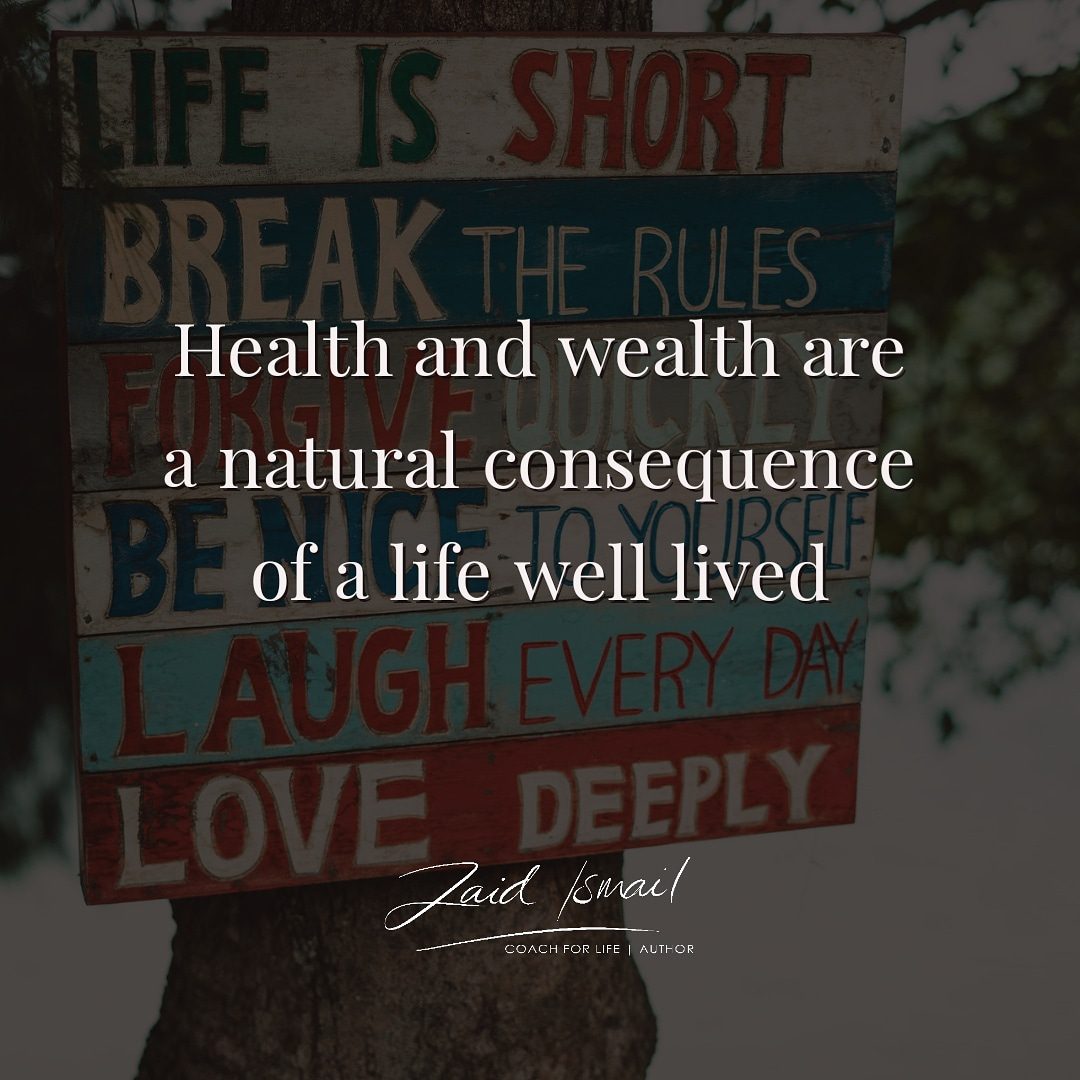
    A life well lived is one that is an expression of your authentic self.

    To know your authentic self, you must reach within before you become defined by what you have around you.

    It is through connecting with who we are, appreciating ourselves for the beauty and the flaws birthed from the struggles of our lives, and recognising the resilience of spirit that we possess that instils an authenticity of self that no trial will ever be able to smother.

    It is through this realisation of the self that we will apply ourselves with conviction, passion, and purpose in our pursuit of creating value in the lives of others.

    It is that value that is uniquely ours to contribute, that creates the fulfilment that feeds our soul, nourishes our body, and creates space for the rewards that such contribution inevitably earns.

    Wealth is relative. Contentment is not. Be sure you’re chasing the right one before you lose both. Or worse, before you lose yourself.

    Photo credit : Adobe Stock

  • Looking for love in all the wrong places

    The shame that we carry within us about what we believe is lacking about ourselves, sometimes causes us to reject those who embrace us despite knowing the worst side of us.

    But because we reject that part of who we are, and are not willing to see our humanness attaching shame to it, we try to escape the embrace of the one who accepts it, so that we can avoid facing it or dealing with it.

    That’s how we find ourselves pushing away those close to us, while trying to win favour or earn the affection or validation of someone who doesn’t know that side of us.

    Because when we try to escape who we really are, we find it necessary to also escape anything that reminds us of that version of ourselves that we’ve rejected.

    Growth and healing is not found in rejecting the scars or the wounds of the past.

    Growth is experienced when we dress those wounds with understanding and acceptance, and when we caress those scars with love and affection.

    Looking for acceptance from others while rejecting ourselves, creates a tension within us that makes us defensive the moment they get close to revealing the shame that we still hold within us, about ourselves.

    It is that defensiveness that destroys yet another good relationship, as we hold them accountable for the very same reasons that we once rejected those who made bad decisions in response to the hurt that we caused in their hearts.

    This is how we sabotage the life we’re trying to create, while blaming the world for not accepting us.

    Photo credit : Adobe Stock

  • Ingratitude breeds ingratitude

    Ingratitude breeds ingratitude

    When we’re ungrateful for who we are,
    When we deny any good in ourselves that others may see,
    When we ignore our beauty because there may exist some ugly,
    We protect ourselves from attachment to anything wholesome or beautiful in life.

    Our need for such protection is a deeply ingrained fear about never being good enough.

    Not good enough for the standards that we hope to live up to, nor good enough for what we think we need to be to those around us.

    The self loathing ensures that this conversation remains in our heads, and is only expressed as rage or bitterness, or many times, as deliberate ingratitude.

    But ingratitude does more than just take our lives for granted.

    Ingratitude convinces loved ones that they’re not good enough either.

    Ingratitude distorts good intentions into bad motives.

    Ingratitude breeds within others what we loathe about ourselves, while convincing us that it harms no one.

    Ingratitude is the real root of evil.

    It is ingratitude that destroys hope.

    It is ingratitude that destroys love.

    And it is ingratitude that destroys gentleness.

    You cannot give what you don’t have.

    When ingratitude for your self takes hold, the sincerity of any gratitude that you hope to express towards others lacks authenticity and leaves them questioning your sincerity.

    Ingratitude is a vicious cycle that destroys every good that it touches, and breaks every soul that may once have been whole.

    And that’s how peace becomes elusive.

    Photo credit : Adobe Stock

  • To be…

    To be…

    Much of life is wasted in the time spent considering if we should or shouldn’t do that thing that we’re passionate about.

    That consideration is most often based on our doubts about what others will think, and rarely because we doubt the value of doing it.

    Sometimes, we persevere and find the courage within ourselves to follow through despite the absence of support or encouragement from those around us.

    And sometimes we stop wanting to push through because we feel worn down and invisible.

    No one can change which choice we make. But the moment we choose that person that we want to share our passion with, without whom we see no point in sharing it, we give them the power to make that choice for us without them realising what power they have over us.

    Sometimes, telling them about it endears them towards us.

    But sometimes, the burden of expectation that it places on them pushes them further away, leaving us convinced that the value we thought we could share was not of much value at all.

    The human condition is a beautifully complicated mess.

    Photo credit : Adobe Stock

  • Don’t dance with the devil

    Don’t dance with the devil

    The devil lives in our doubts, and our demons thrive in our fears.

    What we take from life leaves us filled with hope, or ridden with fear.

    But because it’s what we take from it that matters, we can always revisit a memory or an experience and find something more wholesome to take from it.

    While we cannot change the past, we most certainly can change how it shapes us, and our relationships with those around us.

    The most common reason for not wanting to explore a fresh perspective of our past is because we need those doubts and fears to convince us never to expose ourselves to such experiences again.

    It’s got nothing to do with questioning our abilities, and everything to do with avoiding disappointment or pain. Because while we may know without a doubt that we’re capable of achieving something great, we’ll avoid even attempting it because of the possibility of the devastation of it being rejected or taken for granted by others.

    Don’t entertain the devil, and don’t surrender to your demons.

    Life awaits.

    Photo credit :Adobe Stock


  • Master patience

    Master patience

    Remembering to hold on to hope, and to abandon my expectations of others has always been my saving grace for my sanity and my dignity.

    Expectations, whether legitimate or not, are rooted in a sense of entitlement to receive what we need from others.

    Expectations are key to a healthy relationship, because when we can trust another to fulfil our expectations from them, it nurtures the bond that exists between us. Provided, of course, that such trust is mutual.

    However, if we’re not aware of our level of expectation and why we want it to be fulfilled by that specific other, we’ll become distracted by the feelings of betrayal should they fall short of our expectations.

    Worse still, when we’re unaware of the level of expectations that we have from those who are not in our circle of significant others, every acquaintance and every stranger is given power over our emotional state.

    Their failure to live up to our expectations feels like betrayal because entitlement is that unwritten social contract that convinces us that we deserve something from another, even if they may not be aware of it.

    If the relationship is important, switch to hope and continue to contribute as best as you can. Hope is grounded in the belief that they are capable of being better than who they are in that moment, but understanding that whatever is troubling or distracting them is what they need to first rise above before they can show up the way that we want them to.

    Expectations, and entitlement, is reflective of our needs, which when fulfilled, convinces us that we’re significant. Hence the anger or bitterness, or depression that sets in when our expectations are frequently taken for granted, making patience difficult to muster.

    Hope is the nourishment of patience, while expectation is the enemy of patience. So when you find yourself being impatient, check your expectations and consider embracing hope instead.

    Photo credit : Adobe Stock