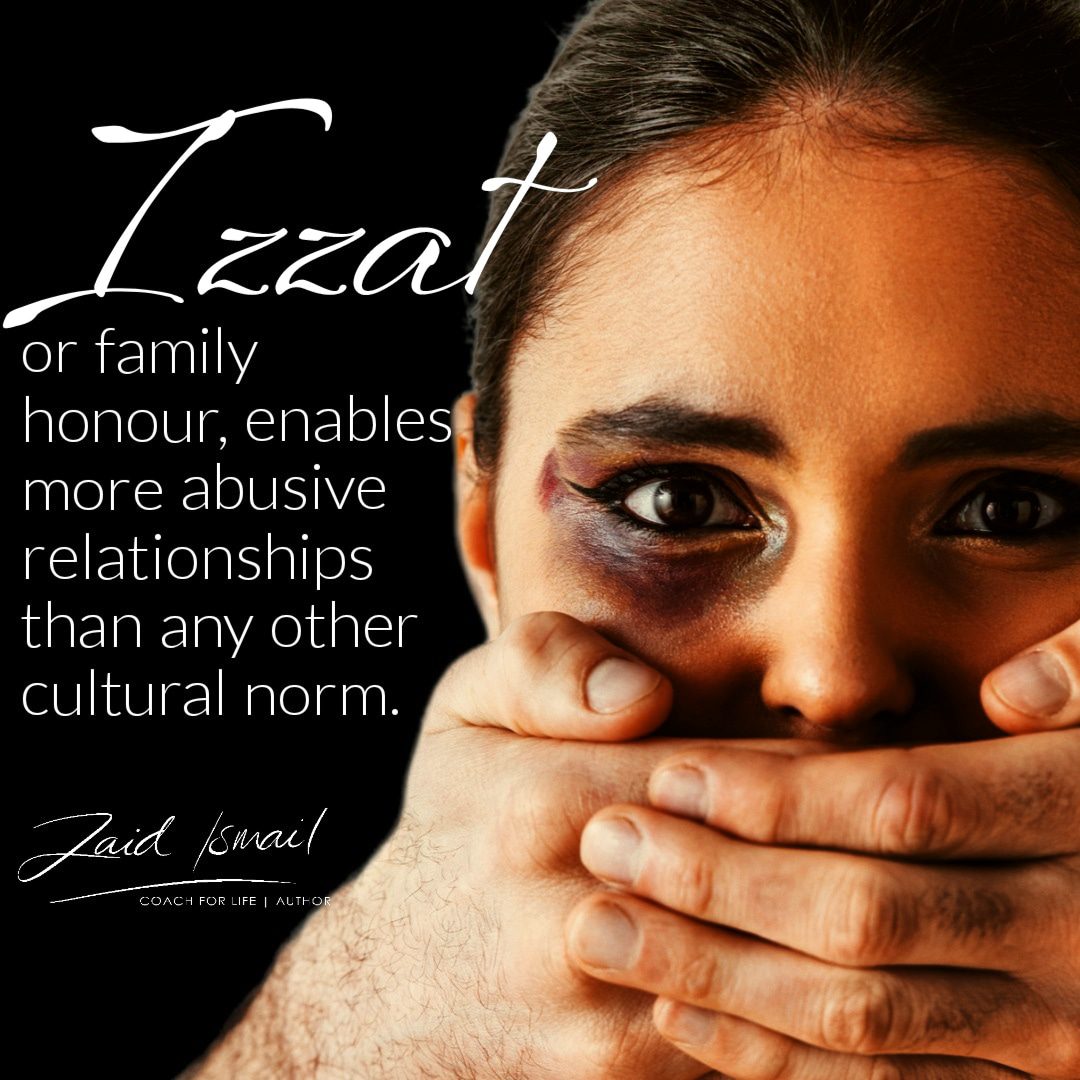
When honour is confused with social standing, abuse becomes an acceptable form of saving face.
Beyond considerations of family honour, this toxic cultural practice convinces the individual that infidelity becomes excusable because divorce is deplorable.
It convinces the brute of the justification of their rage when their partner rejects dehumanising practices by their in-laws.
It replaces ideals of honour and virtue with ideals of being celebrated by the community for the facade that we create of an empty shell of a life.
It teaches our children that what others think of you is always more important than what you think of yourself.
Because we’ve convinced ourselves that it is the village that gives us relevance, we’ve lost sight of how toxic that village has become.
Izzat is the excuse for marital rape, because our rights are infinitely more important than our responsibilities.
Izzat is the excuse for honour killings, because appearing weak is assumed to be caving in to justice, while upholding injustice.
Izzat has eroded the foundation of society, in all societies and not just the Indian culture, because women are seen as symbols of the grandeur of men, and men have grown to be defined by how much his woman raises his stature.
And in the war for self-worth, the physically weak suffer most, while the physically strong destroy the people around them because they don’t know how to deal with their weakness.
Break the cycle.
Own Your Life.
#abuse #maritalrape #honourkilling #honorkilling #mentalhealth #mentalhealthawareness #lifecoaching #zaidismail #relationshipgoals #narcissiticabuse #narcissisticparents #narcissism #cheating
Tag: narcissisticparents
-
Honourable destruction
-

Escaping addiction
It’s not drugs that steal our children from us. Like us, they also need to feel significant.
Taking drugs is not just a bad habit. It’s a means to escape what we don’t want to deal with in the world around us.
Is it a bad decision? Absolutely. Because escaping something never resolves it, it only defers it to a later time.
But we all indulge in escapism of some kind, that’s why we have little to no communication in homes that centre around technology or social media, leaving the young ones struggling to find a space in which they belong, physically and emotionally.
The emotional connection that they then forge with fellow escapees is what makes drugs the escape of choice.
If we treat them as addicts, they will behave like addicts. If we deny what is lacking in their emotional make up, we’ll deny ourselves the opportunity to address it.
Addressing it doesn’t only benefit them, it also benefits us because the only reason that they would feel emotionally isolated is because we’re not emotionally accessible.
That means that we’re also denying ourselves the sweetness of life because if we’re emotionally unavailable, then we’re convinced that what is important to us is not important to anyone else.
That’s why we lose ourselves to duty and dismiss any demands to be emotionally available for those around us.
That’s how we create the environment that makes substance abuse or gambling, or other escapes attractive as a coping mechanism.
Break the cycle.
It always starts with you.
#drugs #addiction #narcissisticabuse #narcissisticparents #youth #selfworth #selflove #selfawareness #selfrespect #mindfulness #inspiration #lifecoaching #zaidismail #ownyourlife #theegosystem #mentalhealth #mentalhealthawareness #mentalhealthrecovery -
Demand more…of yourself
Unless you believe that you are capable of achieving more, you will always hold on to less.
That belief is more about feeling worthy than it is about ability.
Sometimes, we look at how our best efforts were received and assume that the negative outcomes bear testament to the value that we have to offer.
We then find reason to withhold our contribution in future without pausing to consider that perhaps we invested our efforts in someone who wasn’t ready to value what we shared.
But, it’s never that simple, is it?
Often, we continue to invest because we believe in the untapped beauty or value that we see in them.
It is that belief that anchors us in the ‘if only’ and ‘what if’ scenarios that play out in our heads, while blinding our hearts from the beauty that awaits if only we invested our efforts more wisely.
At such times, we must look to those who see our beauty, rather than fixating on those who deny their own.
It’s the only way to break the cycle that diminishes our contribution towards creating joy in our lives, and in the lives of those around us.
#hope #expectation #sincerity #selfworth #selfawareness #mentalhealth #mentalhealthawareness #mentalhealthrecovery #theegosystem #ownyourlife #ownyourshit #embracingME #mybeloved #zaidismail #narcissism #narcissisticabuse #narcissisticparents -
Do more than survive
Those who respect your victim-hood do so because it makes them feel better about themselves.
They either feel more accomplished, or they find comfort in the familiarity of your struggle.
Sometimes it gives them purpose in their need to uplift others so that their lives feel more fulfilled.
Whether their intentions are good or not is not what’s important. The important point is that neither prompts you to rise above being a victim.
Those who support you in your moments of weakness or need but also encourage you to rise above it are the ones to cherish.
Before you take offence to what I’m saying, you need to realise that you’re only a victim when you allow the oppression of others to define your self worth, and to dictate your effort towards establishing a life worth living.
The moment you own your life and rise above the impact of that oppression, you’re no longer a victim, you’re a fighter! Not a survivor!
As long as you focus on surviving, you’re still defined by the moment of your oppression, even though you may have freed yourself from it.
Be more than the struggles of your life. It’s possible, and beautifully rewarding.
Photo credit : Naadirah Ismail
#hope #expectation #selfworth #selflove #selfawareness #selfrespect #mindfulness #inspiration #mybeloved #zaidismail #ownyourshit #ownyourlife #theegosystem #mentalhealth #mentalhealthawareness #mentalhealthrecovery #narcissism #narcissisticabuse #narcissisticparents -
Ephemeral existence…
Life, more than anything else, is about perspective.
In moments of struggle, we’re inclined to look back on the many times that we were weighed down in life.
Sometimes we reminisce about the good times, but from a place of hopelessness believing that we may never experience it again.
At such times, it feels like life is long and dreary.
But when we connect with joys from the past, and hope to recreate even greater joys in future, the fleeting nature of life is impressed upon us.
Our need to focus on the bad experiences is an attempt at protecting our fragile hearts from having to face such heartache or disappointment again.
Focus on the joys, and suddenly we connect with our ability to smile in the face of trials, and to reconnect with joy even after the gravest disappointment.
Breathe, beloved…our default state is joy, if only we’ll embrace it more than we hold onto the fear. A joyful life is always still possible as long as there is breath left in our lungs.
#hope
#expectation
#ownyourlife
#relationshipgoals
#joy
#mentalhealth
#mentalhealthrecovery
#mentalhealthawareness
#mybeloved
#narcissisticabuse
#narcissisticparents
#narcissisticpartner