It’s human to feel fatigued or despondent.
But, it’s not human to give up.
We’re wired to persevere. To overcome. To prevail. To improve what we have around us.
When we feel oppressed in our efforts to achieve these ends, we either grow despondent, or we grow aggressive.
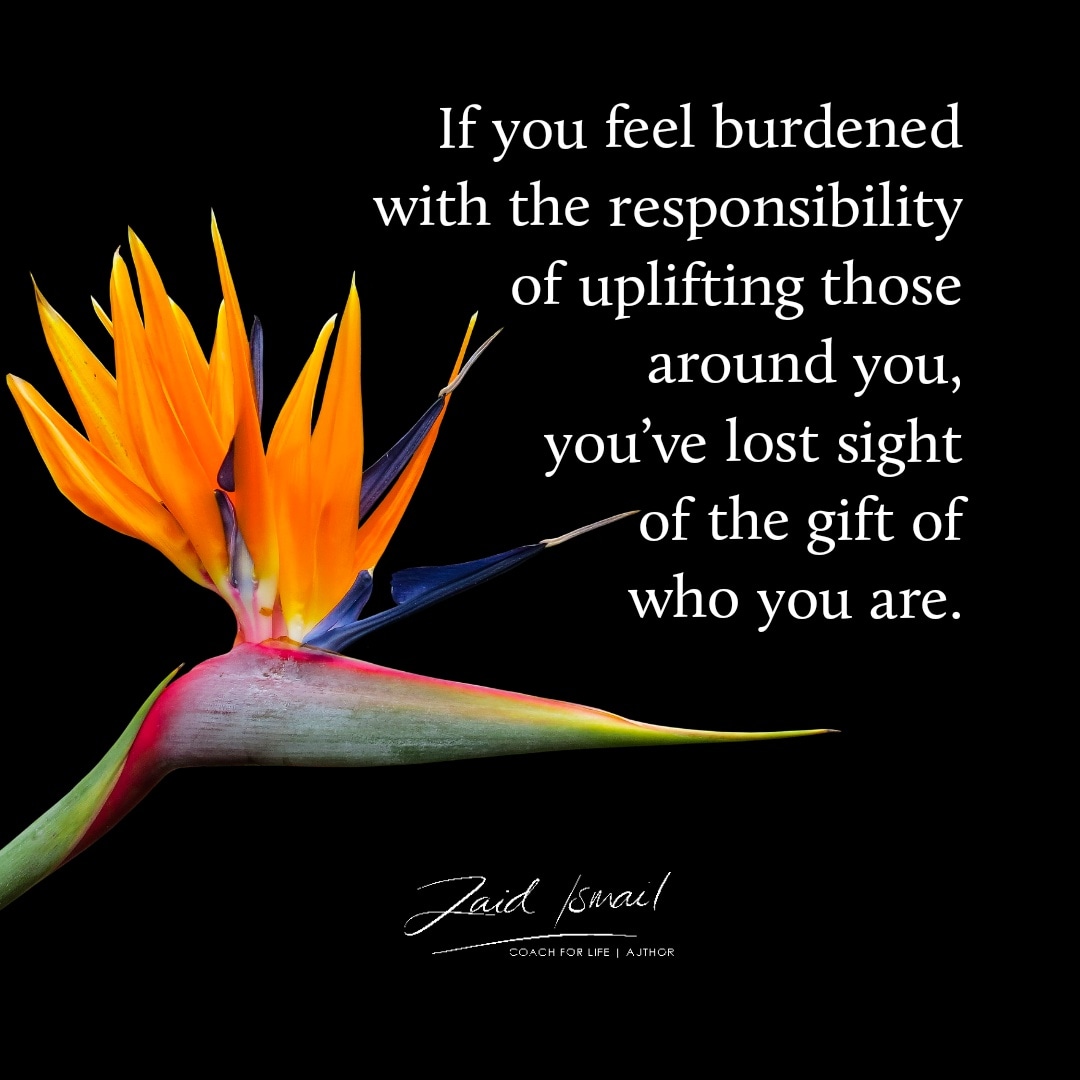
Both those reactions are an indication that we’ve lost sight of the gift of who we are.
When we feel burdened, we’re focused on whether our efforts will be appreciated, accepted, respected, or rejected, etc.
That means that we’re more focused on being significant in that moment, or in that relationship, rather than connecting with the value of what brings us joy that we want others to experience with us.
But, just like a gift, if we buy something for someone because we like it, without any concern about what they think of it, then we’re not really buying that gift for them, are we?
Similarly, when we find joy in living life a certain way, or connecting with an experience in a certain way, and we want to share that with others, our focus must be on how do we connect them to that experience. Not on whether they appreciate our efforts or trust our opinion about why that experience is important.
In other words, if your gift to someone is sincere, you don’t force them to like it. You put in the time and effort to understand what and how they would experience something they love, and try to gift it to them in that way. After all, it’s for them.
We find joy in connecting with others in that way.
The same must be true about offering the best of who you are to those around you.
Of course, you need to first appreciate who you are before you’ll be able to connect others to that joy within you that you want them to experience with you.
So, as always, the question is simple. Do you know yourself well enough to appreciate the gift that you hold within?
It always starts with you.
#hope #expectation #sincerity #selfworth #selfawareness #mentalhealth #mentalhealthawareness #mentalhealthrecovery #theegosystem #ownyourlife #lifecoaching #zaidismail #loveyourself #lifegoals #motivation #optimism #purpose
Tag: optimism
-
The gift of who you are
-

Own your choices. Own your life.
Surely my sincere pursuit of happiness and enlightenment cannot be the cause of my own misery?
Why didn’t someone make me aware of it?
Why didn’t someone say something?
Why couldn’t they just understand what I was going through?
Even if all those questions are answered in the affirmative. it does not change the reality of the fact that it was choices, well-meaning but sometimes destructive choices that we made sincerely and with conviction that isolates the very blessing that we set out to acquire.
We are not only accountable for the choices that we recognise.
That is an easy accountability to accept.
We are especially accountable for the choices that we don’t realise we’re making.
It is accepting accountability for the choices that we did not intend to make that influences our authenticity and often, the quality of the relationships that contribute towards the joy and comfort that we experience in life.
Neglect these out of fear of being accountable for causing harm or pain, and you will find yourself troubled by consequences that seemingly have no good reason to happen to a good person.
And that, I believe, is one of the reasons why bad things happen to good people.
But, don’t forget. If this is true for you, if it’s true for those around you as well.
When we see others making decisions that may bring harm or offence to us, we need to consider the above in their favour.
We’re all human.
The more aware we are of our humanness, the more humane we’ll be towards others.
It always starts with you.
#hope #expectation #sincerity #selfworth #selfawareness #mentalhealth #mentalhealthawareness #mentalhealthrecovery #theegosystem #ownyourlife #lifecoaching #zaidismail #loveyourself #lifegoals #motivation #optimism #purpose -
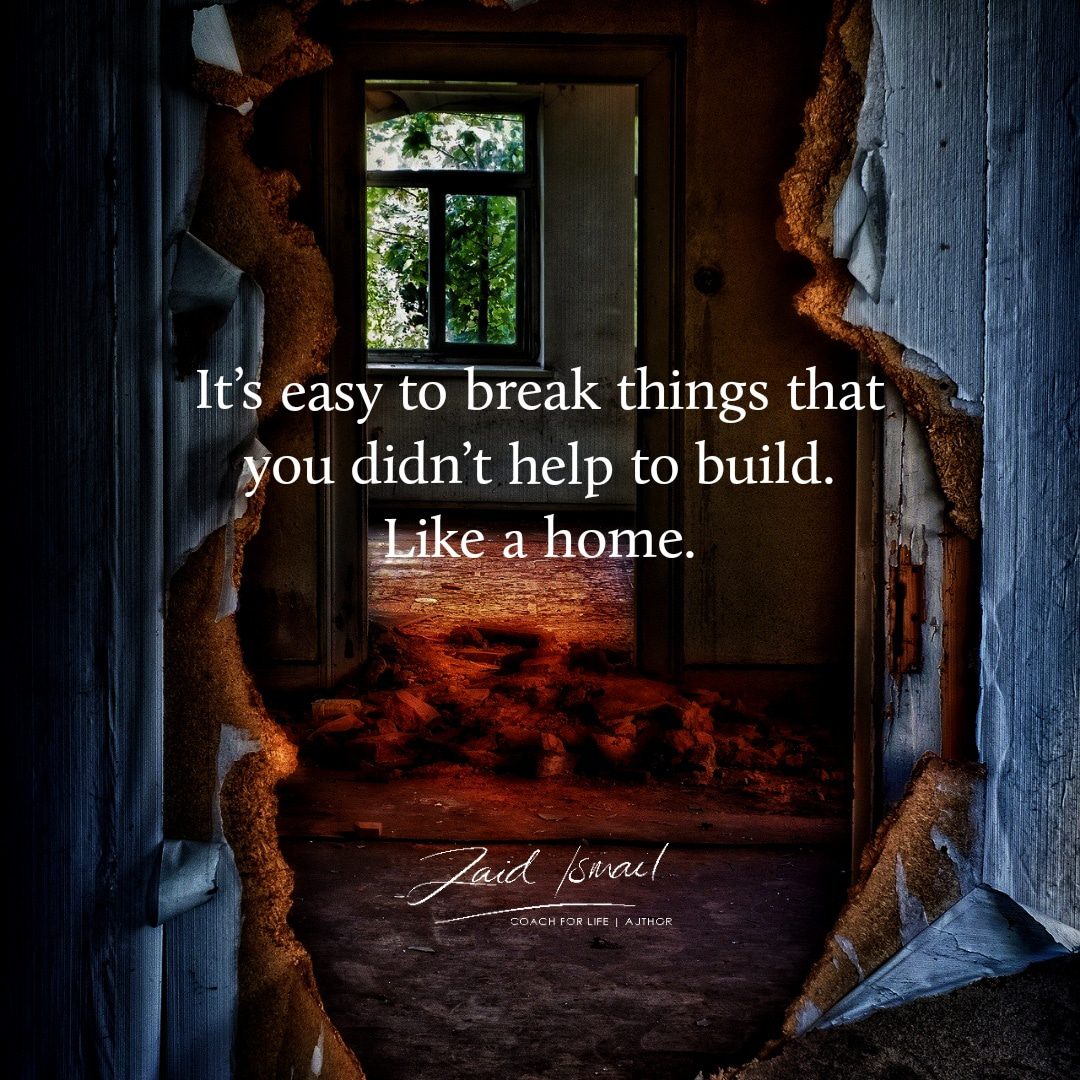
Home breakers
Those who live with the expectation of receiving what they need, rather than putting in the effort to create it with their own heart and hands, will take for granted that which others have exhausted themselves building.
Like a home. There are too many who expect to feel at home because of their material contribution, but don’t know what it takes to create that homely feeling.
Providing the house doesn’t make it a home. Nor does cleaning the house make it a home.
Buying the groceries doesn’t make an endearing family meal. Nor does cooking it.
What connects our efforts with the hearts of those around us is not in the material or dutiful contribution that we make. It’s in the love and appreciation that accompanies how we treat ourselves and them, that connects our hearts and creates a home.
Those who were raised in an environment where their responsibility was more important than their emotional needs will find it easier to judge the quality of their relationships based on what they get from it, rather than how they’re loved or appreciated.
True love and appreciation will automatically result in wanting to create that homely feeling, or that endearing family meal.
Without that love and appreciation, love becomes a transaction, and a check list of things to do so that we avoid blame when things go wrong.
The better we are at that check list, the more we believe we’re truly loving and appreciating life. Until we stop getting what we need.
But, as always, you can’t give what you don’t have.
If you treat yourself like a commodity, your affection for others will be based on the fear of not having them around, or not getting what you need from them.
Who they are and what they need will not feature at all. Sadly, you probably won’t even be aware of it when you’re in that state.
That’s why self awareness is so important. Because it always, always starts with you.
#hope #expectation #sincerity #selfworth #selfawareness #mentalhealth #mentalhealthawareness #mentalhealthrecovery #theegosystem #ownyourlife #lifecoaching #zaidismail #loveyourself #lifegoals #motivation #optimism #purpose #fatherhood #motherhood #parenting #relationshipgoals -
Break the stigma. Stop the label.
I think it was Dr Wayne Dyer who said that if you change the way you look at things, the things you look at change.
This is true both positively and negatively.
Do you know someone who has a problem for every solution? Who sees doom and gloom at the happiest of moments? Who is preempting a negative outcome despite things going in their favour?
Do you think they have a mental illness, or have they just been hurt so many times before, that they are afraid to hope for a positive outcome? Are they simply protecting themselves from being let down again?
This is how we experience life when we finally give up hope about the future, or we give up hope about being appreciated.
That absence of hope is what causes us to feel depressed. Depression is a legitimate experience of human emotions after we’ve taken one too many hard knocks from life about something important to us.
The same is true for every other emotional experience.
Emotions are not deficiencies. They’re the essence of what makes us human.
If we ever hope to win this battle against a consistently declining quality of life, we need to stop referring to emotions as mental health, and we need to stop defining the duress that we experience in life as a mental illness.
We need to reconnect with the human behind the pain, instead of dehumanising them by denying the legitimacy of their emotional experience.
Break the stigma. Stop the labelling. Embrace the humanness.
#hope #expectation #sincerity #selfworth #selfawareness #mentalhealth #mentalhealthawareness #mentalhealthrecovery #theegosystem #ownyourlife #lifecoaching #zaidismail #loveyourself #lifegoals #motivation #optimism #purpose #grieving #death #failure #depression -
Cheat old age
We seek safety and comfort in planning our life, our vacations, or careers to the last degree when we are afraid of being out of control, or missing opportunities that may result in regret later on.
Like everything else, there is a place for planning in life.
But, when that planning denies you the spontaneity of grabbing opportunities that present themselves without warning, then it’s no longer planning. It’s a need for control.
And control is a defence mechanism to prevent ourselves from appearing incompetent because we’re afraid of what we don’t know or didn’t plan for.
Spontaneity, impulsiveness, passion. These are the attributes that we embrace when we’re confident that we can navigate life as it shows up.
What they say about travelling is true about life. Plan your trip, but go with the flow.
Look back on your life and notice how much of it was unpredictable. Yet, here you are.
Do you really need to control every aspect of your life, or have you proven, without meaning to, that you’re capable of navigating the unpredictable?
Live. Don’t just exist.
#hope #expectation #sincerity #selfworth #selfawareness #mentalhealth #mentalhealthawareness #mentalhealthrecovery #theegosystem #ownyourlife #lifecoaching #zaidismail #loveyourself #lifegoals #motivation #optimism #purpose -
Break the cycle
Character is what is built when we are faced with trials.
Beauty is what we appreciate when we emerge from those trials.
Those that have the greatest scars are the ones that appreciate life the most. But only if they don’t allow themselves to grow bitter in the process.
After hardship comes ease, provided we don’t hold on to past hurts and betrayals.
When we demand justice or retribution without understanding, we exchange places with those who oppressed us.
That’s how we grow to be like the one who hurt us, because we become defined by the hurt in the same way that their hurt drove them to hurt us.
The cycle is broken only when we seek to understand why, so that acceptance is possible, and forgiveness is sincere and not burdensome.
Otherwise, forgiveness becomes an indulgence of our ego, rather than a true effort towards moving forward with peace in our heart.
Break the cycle.
Seek to understand.
First your own pain.
Then only will you grow to understand the pain of others.
It always starts with you.
#hope #expectation #sincerity #selfworth #selfawareness #mentalhealth #mentalhealthawareness #mentalhealthrecovery #theegosystem #ownyourlife #lifecoaching #zaidismail #loveyourself #lifegoals #motivation #optimism #purpose #forgiveness -
Are you waiting for permission to be who you want to be?
Note, who you want to be, not what you want to be.
We’re so focused on what we want to be, what career, what achievements, what social standing, that we lose sight of who we want to be.
That’s how we become defined by what we are, or what goals we are pursuing.
Who we want to be refers to the kind of human we want to be.
It sounds simple enough. Everyone wants to be kind, generous, understanding, compassionate, benevolent, and so on.
There isn’t a single person that will say that they don’t want to be those things, and many who think that they are already that.
So why then are we not experiencing others the way that we all claim we are conducting ourselves?
It’s because we wait for permission to express kindness, understanding, and all those other beautiful attributes.
That permission comes in the form of needing others to behave a certain way, or to treat us the way that we want to be treated before we’ll be good and loving and understanding towards them.
That permission is what we get when we want to feel appreciated before we show gratitude, or we want to feel loved before we express affection. And so on.
When we wait for such permission, we become defined by how we are treated, and thus, we become part of the harshness or coldness that we experience in our lives.
So, who do you want to be?
Are you who you want to be, or are you waiting for permission to be that person?
Your life is yours to claim. It always starts with you.
#hope #expectation #sincerity #selfworth #selfawareness #mentalhealth #mentalhealthawareness #mentalhealthrecovery #theegosystem #ownyourlife #lifecoaching #zaidismail #loveyourself #lifegoals #motivation #optimism #purpose -
When one good thing ends, another begins
At the end of every road, a decision awaits.
Do we stop and remain focused on the road we just travelled, or do we choose a path beyond that road so that our journey continues?
If the road travelled was a difficult one, most focus on the difficulty and choose to protect themselves from such difficulty in future.
They’re the ones who grow weary about life, and place their happiness in the hands of others.
Life becomes a burden, and death a morbidly romantic destination.
But those who look back on that difficult journey and recognise how they managed to create something of beauty, experienced something amazing, or developed a sense of gratitude for the accomplishments that would otherwise not have been possible are the ones who look ahead with excitement and optimism.
They connect with their ability to live, despite the trials of life.
They connect with their ability to create happiness for others, rather than waiting for others to create it for them.
They realise that just as their journey was difficult up to that point, so too are the journeys that others travel equally difficult, if not more than the one that they’re on.
They connect with gratitude, and create space for joy because they know that what has passed only prepared them to create even greater things in the future.
Which of the two do you choose to be?
Fixate on the injustice or unfairness of the past, or appreciate your ability to prevail with joy into the future?
The choice is yours.
#hope #expectation #sincerity #selfworth #selfawareness #mentalhealth #mentalhealthawareness #mentalhealthrecovery #theegosystem #ownyourlife #lifecoaching #zaidismail #loveyourself #lifegoals #motivation #optimism #purpose