Is your definition of success really your definition of success?
Or did you perhaps borrow it from society without really noticing?
Our fixation on appearing successful is so toxic, that we readily give up our hopes and dreams in favour of acceptance.
Most people don’t have a greater purpose in life beyond achieving what secures their place in society, or in their social circles.
The chase for acceptance or validation is how we die a million deaths in a single lifetime, but rarely live a single wholesome life before death.
Do we even know what a wholesome life feels like between all the distractions and our efforts to appease others?
When was the last time you reconnected with the idealistic teen in you?
If you had to meet your teenage self, would you be proud or disappointed in who you are now?
Or were you already wasted to the peer pressure back then that you’ve never known a life beyond that?
Today is a good day to reconnect with you.
#hope #expectation #sincerity #selfworth #selflove #selfawareness #selfrespect #mindfulness #inspiration #goals #mentalhealth #mentalhealthawareness #mentalhealthrecovery #success #reality #failure #life death #ownyourlife #coachzaidismail
Tag: failure
-

Have you ever truly lived?
-

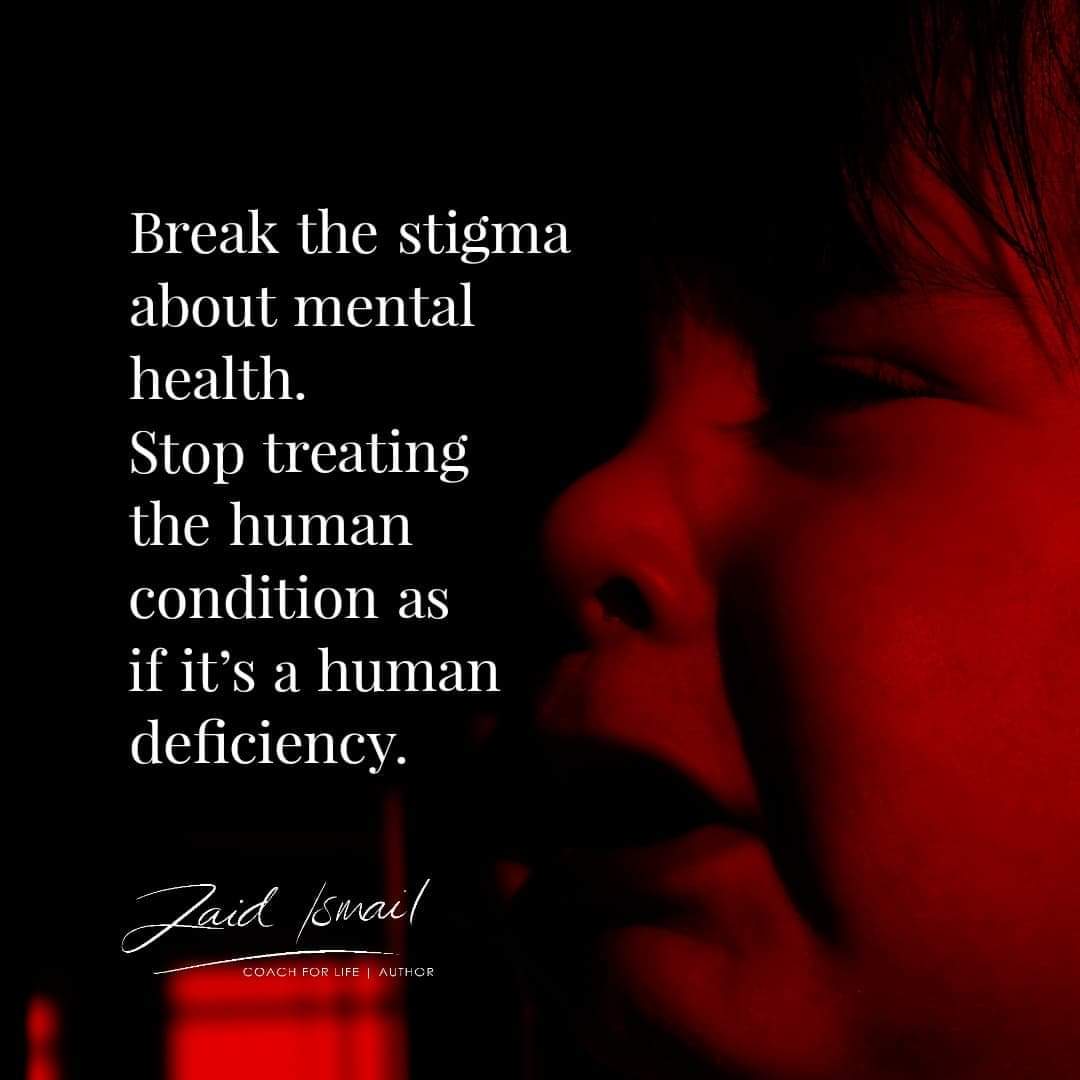
Break the stigma
I think it was Dr Wayne Dyer who said that if you change the way you look at things, the things you look at change.
This is true both positively and negatively.
Do you know someone who has a problem for every solution? Who sees doom and gloom at the happiest of moments? Who is preempting a negative outcome despite things going in their favour?
Do you think they have a mental illness, or have they just been hurt so many times before, that they are afraid to hope for a positive outcome? Are they simply protecting themselves from being let down again?
This is how we experience life when we finally give up hope about the future, or we give up hope about being appreciated.
That absence of hope is what causes us to feel depressed. Depression is a legitimate experience of human emotions after we’ve taken one too many hard knocks from life about something important to us.
The same is true for every other emotional experience.
Emotions are not deficiencies. They’re the essence of what makes us human.
If we ever hope to win this battle against a consistently declining quality of life, we need to stop referring to emotions as mental health, and we need to stop defining the duress that we experience in life as a mental illness.
We need to reconnect with the human behind the pain, instead of dehumanising them by denying the legitimacy of their emotional experience.
Break the stigma. Stop the labelling. Embrace the humanness.
#hope #expectation #sincerity #selfworth #selfawareness #mentalhealth #mentalhealthawareness #mentalhealthrecovery #theegosystem #ownyourlife #lifecoaching #zaidismail #loveyourself #lifegoals #motivation #optimism #purpose #grieving #death #failure #depression -
Break the stigma. Stop the label.
I think it was Dr Wayne Dyer who said that if you change the way you look at things, the things you look at change.
This is true both positively and negatively.
Do you know someone who has a problem for every solution? Who sees doom and gloom at the happiest of moments? Who is preempting a negative outcome despite things going in their favour?
Do you think they have a mental illness, or have they just been hurt so many times before, that they are afraid to hope for a positive outcome? Are they simply protecting themselves from being let down again?
This is how we experience life when we finally give up hope about the future, or we give up hope about being appreciated.
That absence of hope is what causes us to feel depressed. Depression is a legitimate experience of human emotions after we’ve taken one too many hard knocks from life about something important to us.
The same is true for every other emotional experience.
Emotions are not deficiencies. They’re the essence of what makes us human.
If we ever hope to win this battle against a consistently declining quality of life, we need to stop referring to emotions as mental health, and we need to stop defining the duress that we experience in life as a mental illness.
We need to reconnect with the human behind the pain, instead of dehumanising them by denying the legitimacy of their emotional experience.
Break the stigma. Stop the labelling. Embrace the humanness.
#hope #expectation #sincerity #selfworth #selfawareness #mentalhealth #mentalhealthawareness #mentalhealthrecovery #theegosystem #ownyourlife #lifecoaching #zaidismail #loveyourself #lifegoals #motivation #optimism #purpose #grieving #death #failure #depression -
Conviction
I always assumed that the key driver that prevented people from making the changes in their lives that they knew needed to be made was a lack of courage. That lack of courage I always assumed to be the result of fear to embrace the new while giving up the comfort zone or the dysfunction that we’ve grown to cope with. But after an interesting discussion with an undefined acquaintance yesterday I realised that there may be another dynamic to all this that I failed to notice. That dynamic is the issue of pride. Pride is what keeps most of us stuck in ways that we know are sub-optimal in our lives, but we stubbornly persist in our ways because backing down is so strongly associated with failure.
I think in that lies the key to understanding the influence that pride has on our convictions. Convictions, I’ve always believed, is a reflection of priorities. That which we place more emphasis on will receive a greater investment of energy, while everything else will fall in line behind that. So if the way we’re perceived by others is a higher priority than the way we find contentment in our personal space, then it stands to reason that we will nurture those behaviours that sustain that perception rather than make the adjustments that will give us peace. Say hello to chronic ailments and mental disorders. But I’ll leave that rant for another time.
The cycle doesn’t start/stop there because the question then arises as to what it is that influences the priorities that we choose for ourselves? The fact that these priorities are a result of an evolutionary process as we grow and is most often not a distinctive thought process that we experience consciously implies that we’re mostly unaware of these priorities that drive us. I guess in this case priorities are pretty much the choices we make in life. When those choices are well-informed, they serve us well. When they’re not, they drive us towards nurturing perceptions rather than substance.
The underlying drivers that prompt us to make these choices are our beliefs in our ability to be successful in the choices we make. More simply stated, if we are confident we’ll be successful, we’ll be more inclined to pursue the change or the improvement. But if we doubt our ability to reach that goal, we’ll compensate by finding distractions or excuses as to why it’s not possible or important for us to pursue it. That’s where that pride factor comes in. The more proud we are, the less likely we’ll be to expose ourselves to situations where failure is a real possibility. The only time we pursue such ‘risky’ endeavours is if we believe that the repercussions of not doing so would be more severe than the repercussions of failure, which brings us back to the issue of priorities.
If it’s more important for me to maintain the façade I created about the perception of success that I think others hold of me, I will sacrifice relationships or rights that others have over me, because fulfilling those rights or maintaining those relationships is not as important to me as being perceived as a success. Success in this case is not limited to material targets or wealth, but can also relate to simple things like being seen as independent, aloof, or righteous, to name a few examples.
Taking all this back to the opening thoughts, the correlation between the perception of failure if we back down, versus the pride of not wanting to be seen as a failure explains why it is that even in the face of overwhelming odds, we sometimes hold on to behaviours that we know are detrimental to our wellbeing. When the motivation to move forward is greater than the motivation to maintain the façade, that is when conviction will triumph over cowardice. However, I guess if we really wanted to, we could argue that conviction in maintaining the façade is what drives that behaviour as well, so it may be safe to say that conviction can be misguided if pride steps into the equation. And pride, as we know, is a result of focusing on what others think of us rather than being true to what we think of ourselves.
Perhaps conviction is more accurately associated with the latter, as in how we perceive ourselves? Pride prevents honesty in that introspection process because if we perceive ourselves through the eyes of others, we immediately curtail perspectives that may uncover flaws that we know will detract from that perception. This thought process is exhausting. I think that’s a pretty accurate reflection of why most people avoid it, and as a result, why we have so few that act with meaningful conviction and so many that behave like attention whores or victims to society. I suspect there isn’t much difference between the two.
-
It’s Probably Possible
I’ve often been accused of expecting too much from people, only to realise that they in fact expect too little from themselves. I’ve seen this play out on numerous occasions where I’ve demanded a level of delivery from colleagues or family members that was slated as unrealistic, only to see them achieve their targets anyway. To me, it proved that my observations of their self-imposed limitations were true. If I was indeed expecting too much, they would never have met the supposedly unrealistic expectations, but because they expected too little from themselves, they assumed that they were incapable of doing so to begin with and therefore started out on the back foot.
There is a fundamental difference between those with a can-do attitude and those with a I-see-a-problem-in-everything attitude. The one looks at the possibilities while the other focuses on the probabilities. As much as it sounds like a play on words, yet another accusation leveled against me on several occasions, there is a simple truth in it. When you consider probabilities, it immediately demands a focus on the expected hurdles, constraints, and other problems that may be experienced in trying to achieve something. Couple this with the predisposition that most have regarding their low expectations from themselves, and inevitably you end up with an individual that is going to be risk averse and safe, never pushing the boundaries, and rarely leading any efforts at all. In other words, you end up with a follower, often a blind one as well.
Such followers are easily capable of deflecting attention away from their negative attitude by offering ideas and suggestions indicating support and constructive input about how those hurdles and obstacles can be navigated. Worse than this, they probably don’t even realise what limitations they’re placing on themselves by focusing on the probability factors only, which makes it even more sad. But the reality is, they’ll help you fight the good fight, but they’ll never take you into new territory. Within the workplace, they will be the optimisers and renovators but never the innovators.
If you start out looking at what is the ideal, and considering what is possible, ignoring the hurdles and the obstacles, chances are good that you’ll find ways to sell that vision to others in a way that will give them reason to stop being so fixated on the distractions and instead, to use their skills at navigating around obstacles to help you achieve the common vision. Chances are, you’ll find yourself leading others through situations that would seem daunting to most. By default, a focus on possibilities emphasises a grounding in principles, which ultimately sets the foundation for leadership. Like someone said recently, leaders take you to places that you weren’t going to before.
I’ve always subscribed to the simple philosophy of starting out with the ideal in mind. Once that ideal vision has been created, then only tamper it with reality and practicality, but don’t sell it short just because others don’t see what you see. At times when the overwhelming majority are ready to throw in the towel because the probability of success is low, that’s when it’s important to revisit the vision you first embraced and to re-energise yourself around what is possible so that you can look beyond the probabilities of failure that you’re facing at that point.
-
The joy of fear
Heaven forbid we should live a romantic life. It is possible you know. To live a romantic life and still remain functional and practical about all life’s challenges. But it’s easier to fit in with the jaded crowds than to be true to ourselves, because the risk of failure is too great a source for potential embarrassment. POTENTIAL embarrassment. But the reality of the joy that we’ll experience if we lived romantically now will forever escape us because of our fear of embracing what we desire, lest it be stripped away from us in an untimely fashion.
We set ourselves up for heartache and failure, all the while pretending to be comforted by our superficial success in worldly endeavours, ensuring that not another living soul will ever see the romantic fool in us for fear of being mocked or ridiculed for that which is closest to our hearts. So fear drives us to suppress the romance, and embellish the facade so that it becomes the reality of our existence, when in fact it’s the reality of our deception.