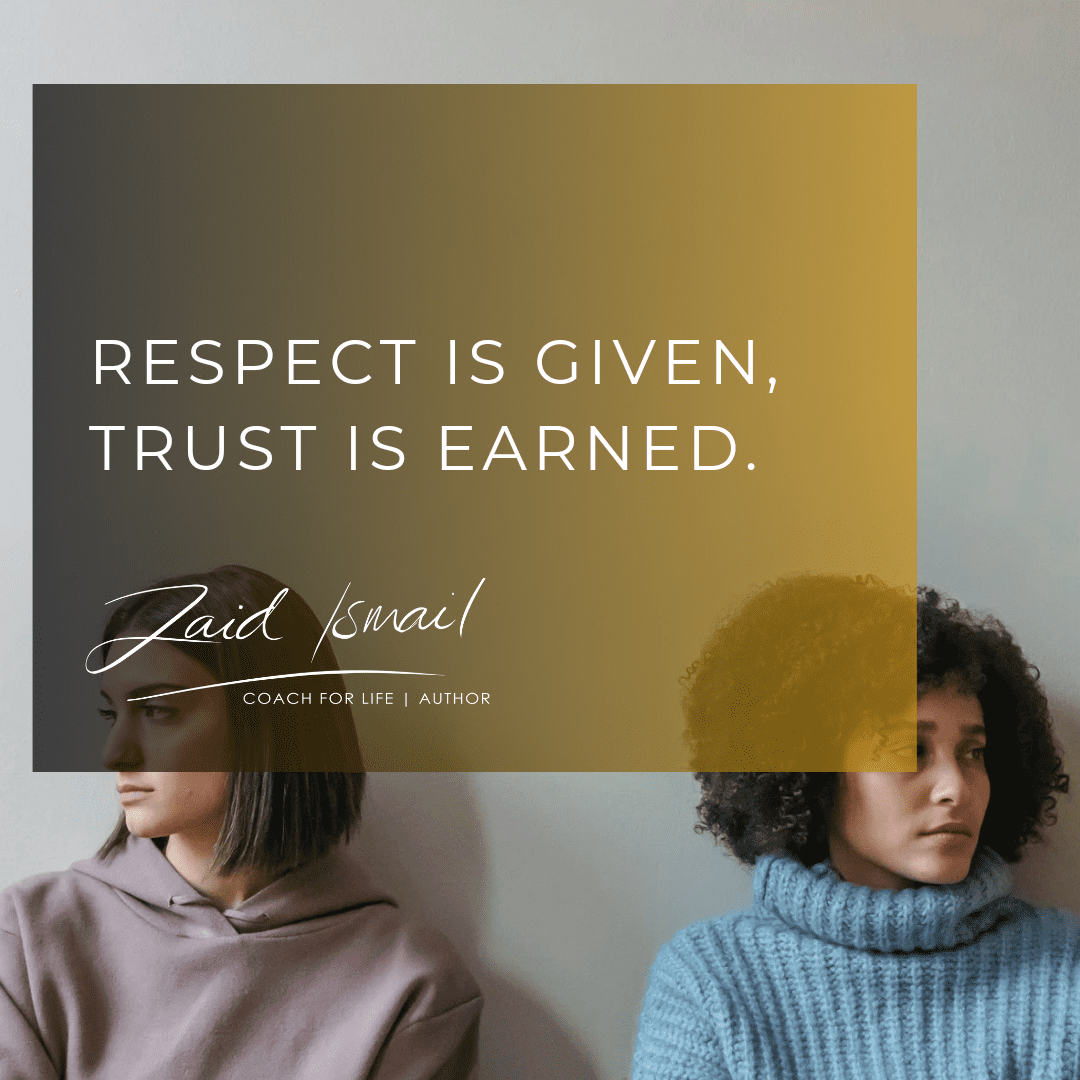
The old saying of ‘respect is earned’ robs you of self respect and replaces it with entitlement.
How we treat others is a reflection of who we are, not who they are.
Our ability to self regulate our offering of respect to those who may treat us badly is a reflection of how much we need them to treat us well before we feel good about who we are.
In other words, the less grounded we are in who we are, the more likely it is that others will impact our moods, our temper, and our overall emotional wellbeing.
Trust, on the other hand, is earned through consistency of effort about what’s important.
Trust cannot be negotiated or contracted.
If we have reason to doubt someone showing up for us, we won’t trust that they will.
That reason is sometimes because of them being unreliable, but is also often because of how someone else in the past may have disappointed us or betrayed our trust when we needed a similar thing from them. Like comfort, support, or just being there for us.
If we go through life trusting recklessly while withholding respect to those who, in our eyes, don’t deserve it, we will find ourselves reeling from betrayal long after it has passed while disrespecting those who don’t understand our pain.
Problem is, even we won’t understand our pain, so we’ll never be able to communicate it in ways that will allow those close to us to understand why we’re raging.
It all starts with self respect and self worth.
Without that, you will need others to treat you well before you treat yourself well.
Own your life.
#hope #expectation #sincerity #selfworth #selfawareness #mentalhealth #mentalhealthawareness #lifecoaching #zaidismail #theegosystem #ownyourlife #narcissisticabuse #narcissist #rage #anger #angermanagement #marriage #divorce
Category: Parenting
-
Respect is not earned
-

The absence of drama is not peace
The struggle in countering the influence of a village of idiots will never be truly appreciated until we experience the impact of the dysfunction that it produces in our lives.
That impact usually only becomes evident when we’re facing upheaval that challenges any sensibility that we may rely on about life.
Parenting is largely a lost art with the opportunity to outsource a large chunk of it to social media making it easy to ‘cope’ in that way.
Losing ourselves to our own struggles that rage in our minds blinds us to the impact of our obliviousness to those around us.
The absence of drama is not peace, nor is it wholesome family time.
That is what social media and social distractions offer us. The absence of contention or conflict.
That’s how we lose sight of the values that we’re imparting without meaning to, because on the one hand, we’re validating social media as a legitimate source of learning how life works, while also confirming that such an approach to parenting or to sharing life’s moments and wisdom is all that we have available to offer.
We have greater impact through what we don’t do than what we do.
Unfortunately, we’re mostly too distracted by needing validation for what we do that we lose sight of our abdication of accountability for what we should do more of…or just what we should be doing in the first place. Period.
Our demons that distract us from what others need from us destroys more relationships than any real conflict that exists between two people.
Own your life before you end up destroying someone else’s.
#parenting #divorce #marriage #marriagegoals #lifecoaching #zaidismail #theegosystem #ownyourlife #relationshipgoals #singleparenting -
The struggle for self-worth
Our relationship with our father, whether they’re present or absent, still with us or passed on, shapes how we feel about ourselves more than any other influencing factor in our lives.
It’s not about whether they were good or bad as humans or as parents, but rather what we took from our experiences with them, or what we took from their absence.
A father who is absent because he has to work long hours to provide for his family, could still have a positive impact if he is not harsh and impatient with his children when he does have a few moments to share with them.
Similarly, a father who is present but always fixated on rules, boundaries, rituals, and the like, will create an emotional barrier between him and his children that will convince them that who they are doesn’t matter, and that what they achieve is all that matters.
That directly conflicts with our core human need to be of significance.
What we take, or what we believe to have been their motivation to be that way towards us in our early years, is what shapes how we show up for others in our later years.
Most people who have had a difficult relationship with their father know exactly how they don’t want to do things, or how they don’t want to be as parents, but that doesn’t mean that they know how to achieve what they want in their relationship with their children.
That’s how, without meaning to, we often become exactly like the parent/so that we once judged harshly for failing us as a parent.
The most effective way to break this cycle is to understand the true reasons why your father may not have been what you needed him to be despite his best intentions or efforts.
It’s only in seeing the demons of others that we will realise that how they showed up for us was not because of who we are, but rather because of how our needs from them provoked the demons that they were grappling with.
That’s how we learn from the shortcomings of others, rather than falling into the same deficiencies because we think we’re better than them.
See the human behind the role and you’ll feed the soul of those who desperately need it.
#parenting #narcissist #narcissisticabuse #lifecoaching #zaidismail #toxicparents -
Don’t raise a tyrant
Understanding right from wrong is the easy part.
How to effectively respond to what is wrong without creating a new problem is the difficult part.
With the emphasis always being on knowing who is right and wrong, but hardly any focus on how to deal with such differences, we raise children who are intolerant or misguided in their fight for what is right.
Learning how life works is about more than just the rules. It’s about knowing how to be firm while still being empathetic, compassionate, and fair.
Every tyrant believes in their own mind that they are justified in what they’re doing.
Every tyrant has reason to compromise on what they believe is right because they are convinced that there is a greater good that is being served through such compromise.
Every tyrant doesn’t accept that they’re being a tyrant. They see themselves as defending a just cause.
If you don’t raise your children with understanding why there is benefit in upholding what is right, and why there is benefit in being gentle but firm about opposing what is wrong, you will raise a tyrant who will turn against you when you challenge them about something that they feel justified about.
That’s how we create Zionists in our own homes, and unleash tyrants into the homes of other people’s children when our children get married.
Understanding why is always more important than simply know what to do.
Without understanding why, we lose critical thinking, empathy, compassion, and worst of all, we lose our humanness.
Go beyond instructing your children about the rules to live by, and demonstrate through meaningful action and participation how it is that they must live by those rules.
Not only will the participation improve their self-worth, but the active demonstration will lead to more credibility behind what they must stand up for.
#parenting #raisingchildren #singleparenting #divorce #lifecoaching #zaidismail #theegosystem #ownyourlife #mentalhealth #mentalhealthawareness
-
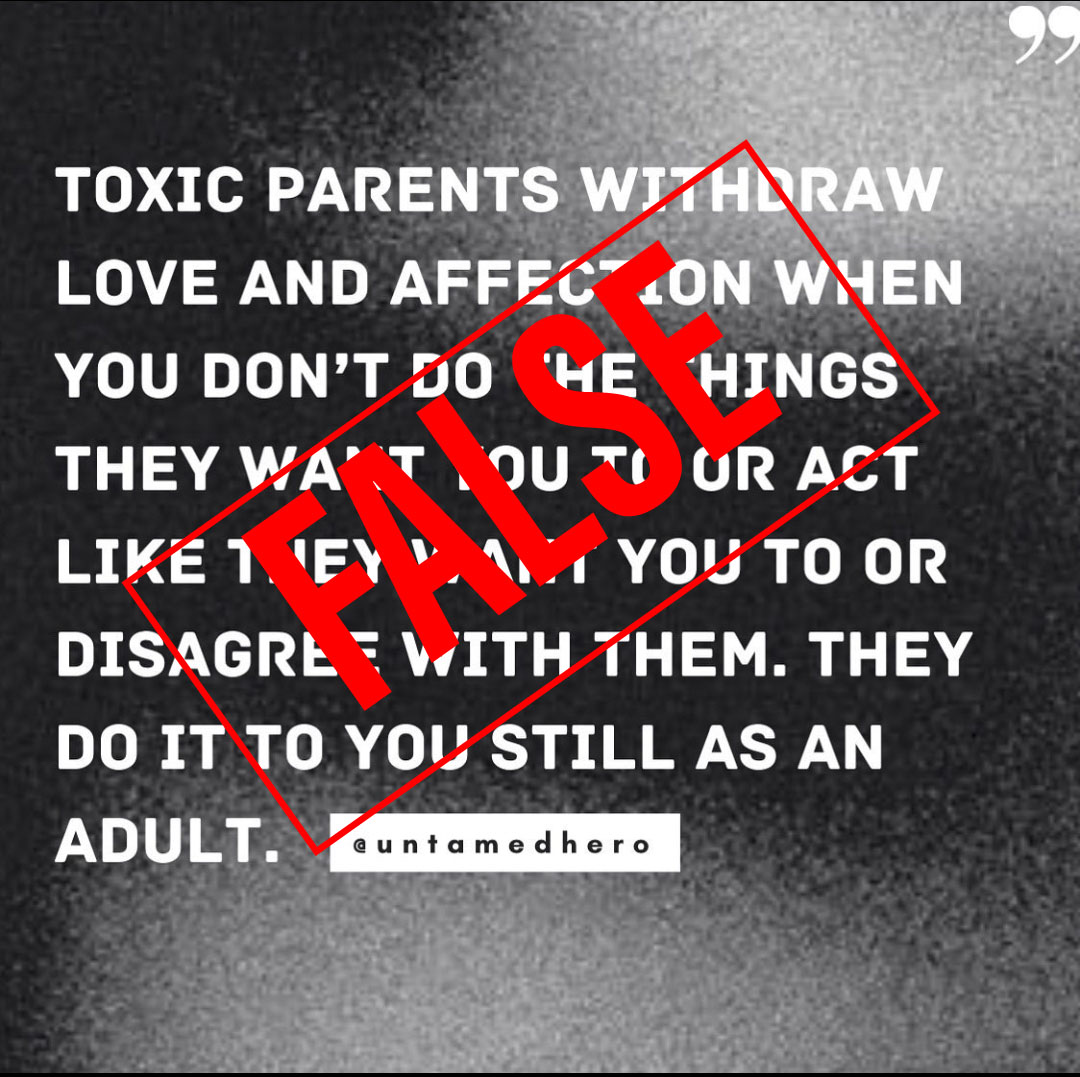
Toxic blah blah
The belief that people are toxic is self-serving.
The belief that parents are toxic is a sign of ingratitude.
The belief that others are not allowed to change how they behave towards you when you don’t honour what is important to them is entitlement.
The belief that what is important to us is more important than those who raised us is probably the closest thing to a toxic trait that we’ll find.
Societies that have withstood the test of time are the ones who honoured their elders and embraced the wisdom that was passed down to them.
Adapting that wisdom to solve contemporary problems is the failing of the current generation of parents and children.
People, not just parents, withdraw from relationships when they feel rejected, betrayed, dishonoured, disrespected, taken for granted, and more.
If you hold your parents to that standard of supposed toxicity, be sure to apply the same definitions to your own behaviour.
If you truly understood the effort, self-sacrifice, compromise of dreams and aspirations, and duress that a present parent must overcome to show up as a parent, you might understand why betrayal of trust, disrespect, or rejection hurts them enough to want to withdraw from the life of the child that they spent their life serving up to that point.
It’s fashionable these days to judge parents harshly while believing that the new generation has a better understanding of what’s needed to make life work.
Sadly, the current state of society proves otherwise.
How does your judgement of the people who raised you stand up to the scrutiny of the ‘toxic’ label that you’re so willingly throwing around these days?
You will be tested by that which you judge others about. Be careful.
Arrogance is a slippery slope.
#hope #expectation #sincerity #selfworth #selfawareness #mentalhealth #mentalhealthawareness #lifecoaching #zaidismail #theegosystem #ownyourlife #parenting #gratitude -
Look back with understanding
When you don’t have a gentle hand to guide you, or an understanding structure to support you, life will be shaped through trial and error.
In the same way that we can’t give what we don’t have, nor can others offer us what they don’t have – no matter how much we need it from them, or may have rights to get it from them.
Realising this has been the saving grace of my sanity through a colourful life.
So many of us set out in life knowing who we don’t want to be based on our experiences with those around us – especially our parents.
But we fail to realise that it doesn’t prepare us, or give us anything to work with, in determining how to be who we want to be.
It may sound cryptic, but it’s not.
It’s easy to identify what we want to achieve in life, but if we don’t know how life works, we will keep tripping up on the subtleties that cause havoc in ways that we never anticipated.
No one sets out to destroy their own life, even if they persist in blatantly destructive behaviour.
They do so because they exhausted themselves living life wishfully instead of purposefully.
Such a mindset results from anger about what you don’t have, leading to acting with haste or impatience in striving for what you want.
The only antidote that I’ve discovered for this is to observe, with the intention of understanding, those who let you down or didn’t show up the way you needed them to.
Our trial and error, like theirs, denies others the wisdom and support that they need to learn how life works.
Self-pity or entitlement, and especially anger, will never change that reality, it will only repeat the cycles that may have caused us hardship.
It always starts with you.
#hope #expectation #sincerity #selfworth #selfawareness #mentalhealth #mentalhealthawareness #lifecoaching #zaidismail #theegosystem #ownyourlife #parenting #divorce -
Be the village
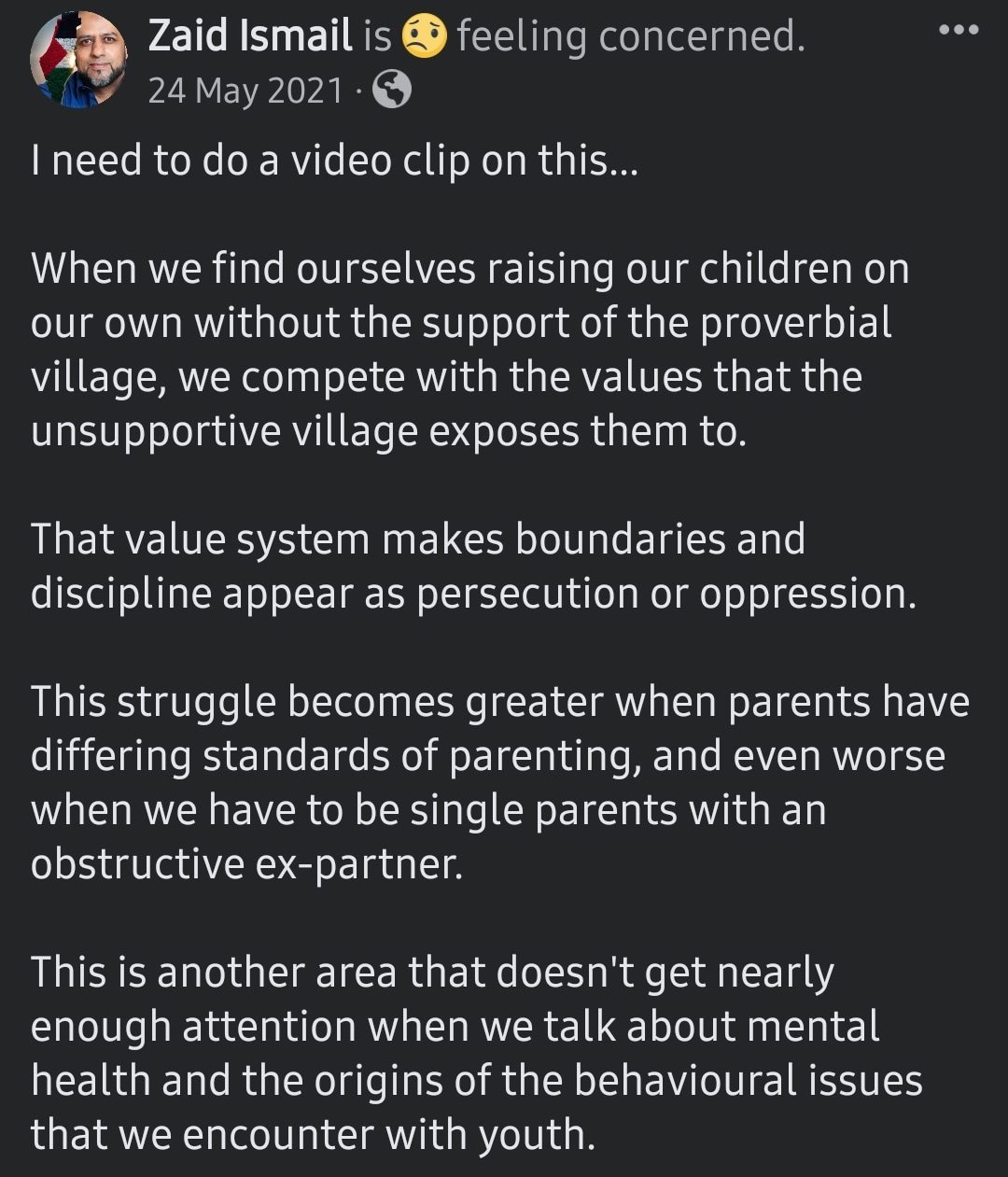
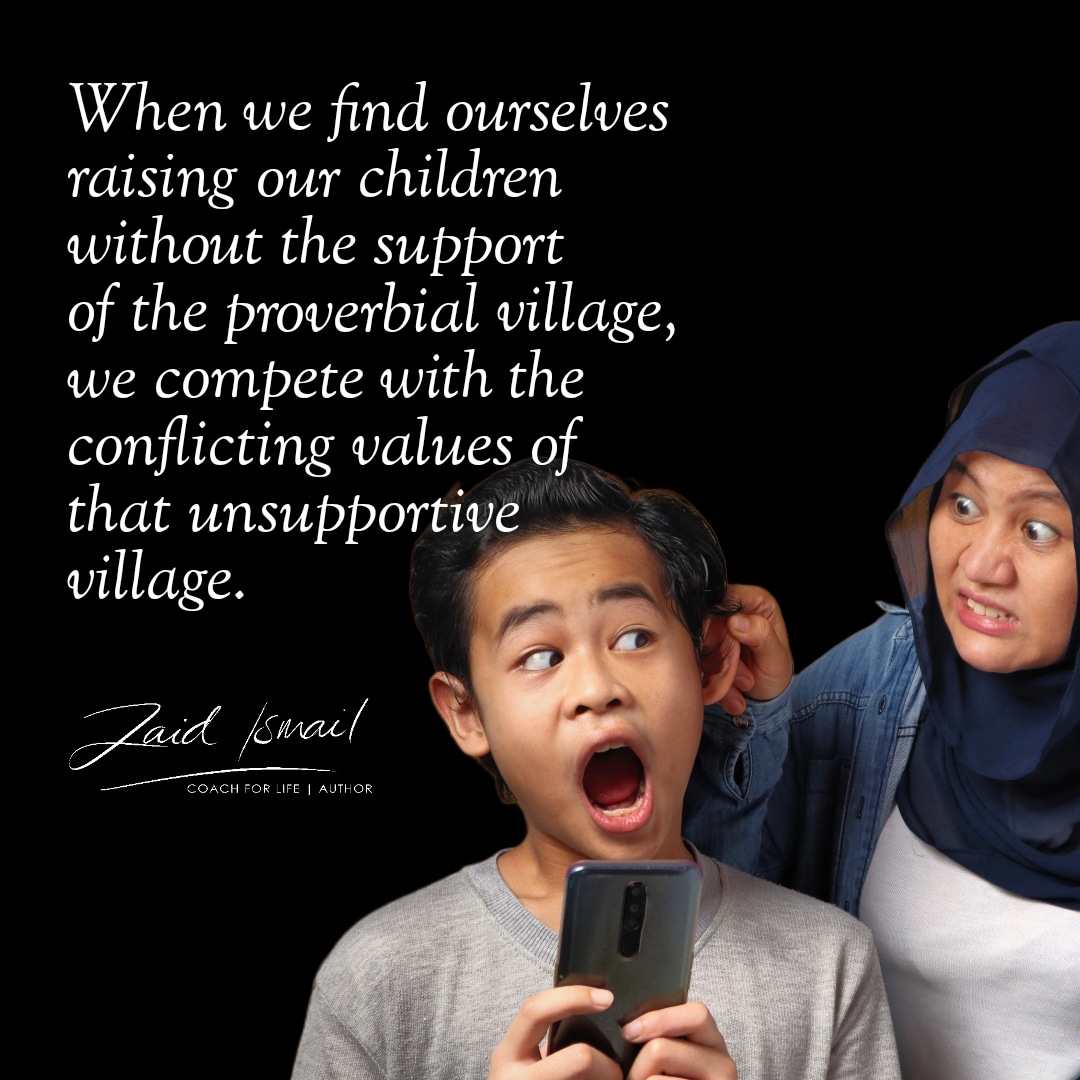
While it takes a village to raise a child, it also takes a village to corrupt a child.
Parenting is a monumental challenge in itself, but becomes infinitely more challenging when being done by a single parent.
Add to the single parenting challenge by having an obstructive co-parent, and the challenge continues to grow ever more insurmountable.
If that’s not enough, throw in the depraved value system of the global village that is available on every Internet connected device that your child has access to, and suddenly you realise exactly what you’re competing with in trying to raise a wholesome, healthy, and grounded human.
But it’s not impossible to achieve, despite those impossible odds stacked against any dedicated parent/s.
Firstly, you need to realise the impact of your role in their life, especially when the self-pity sets in from the extended struggle of trying to be the most prominent influence in their life.
Secondly, you need to understand that wayward behaviour is their fears driving them towards wanting to be significant in their social circles. Focus on understanding those fears, rather than fixating on the bad behaviour.
Thirdly, even if they currently reject the values that you’re trying to instill, you cannot compromise on those values or else you convince them that it’s optional. Standing firm gives them a point of reference for later in life when they will need those values more than ever.
Lastly, parenting is not for those who need instant gratification, nor is it about the parent.
It’s about demonstrating the value and benefit of living life the way that you want them to live theirs, and not compelling them through the fear of consequences to do the right thing.
Fear is never a sustainable motivator to be a good person.
But sometimes it’s a necessary tool to break a harmful cycle.
Be very careful with how you use it.
#parenting #generationaltrauma #singleparenting #ownyourlife #theegosystem #lifecoaching #zaidismail #selfworth #selfawareness #mentalhealth #mentalhealthawareness #mentalhealthrecovery