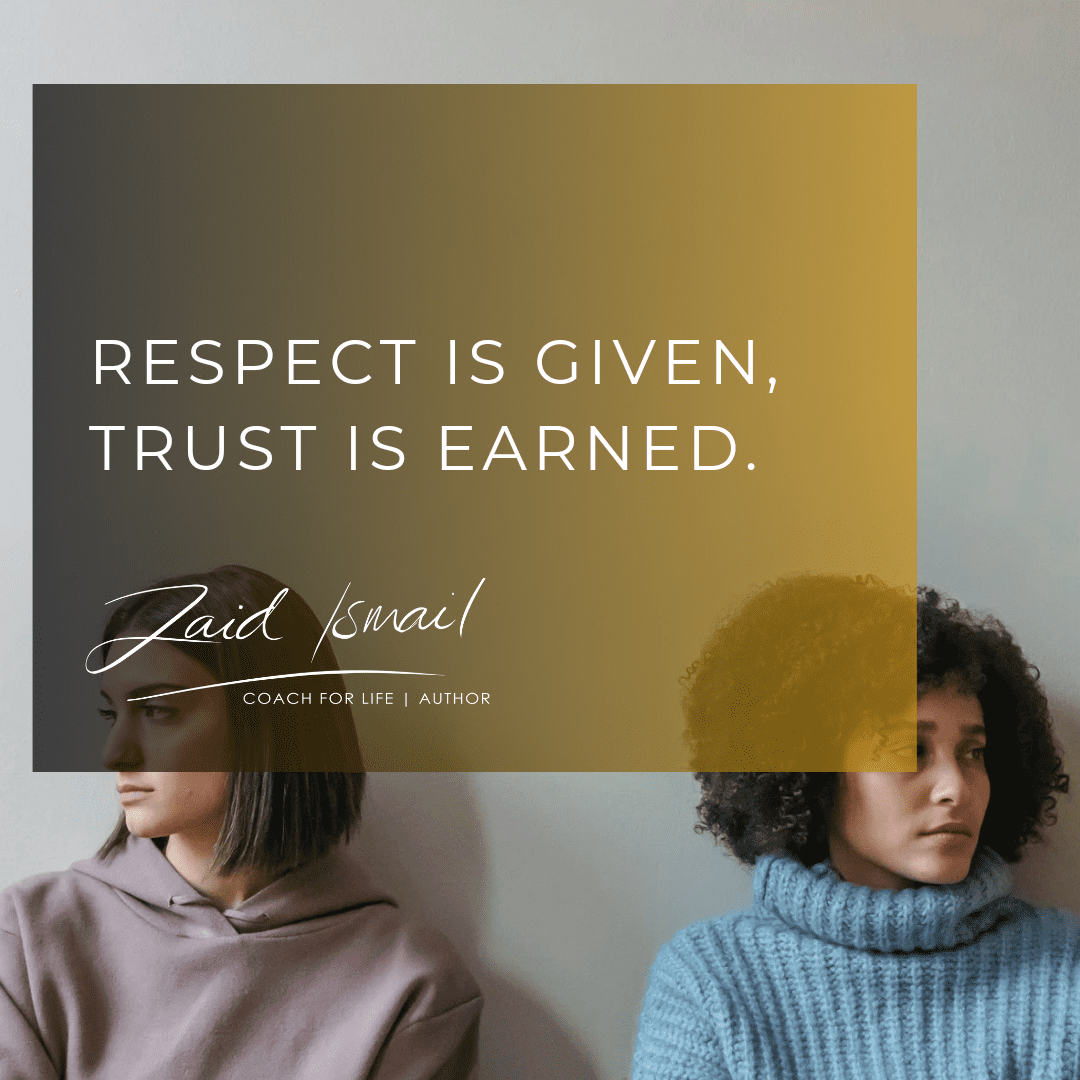
The old saying of ‘respect is earned’ robs you of self respect and replaces it with entitlement.
How we treat others is a reflection of who we are, not who they are.
Our ability to self regulate our offering of respect to those who may treat us badly is a reflection of how much we need them to treat us well before we feel good about who we are.
In other words, the less grounded we are in who we are, the more likely it is that others will impact our moods, our temper, and our overall emotional wellbeing.
Trust, on the other hand, is earned through consistency of effort about what’s important.
Trust cannot be negotiated or contracted.
If we have reason to doubt someone showing up for us, we won’t trust that they will.
That reason is sometimes because of them being unreliable, but is also often because of how someone else in the past may have disappointed us or betrayed our trust when we needed a similar thing from them. Like comfort, support, or just being there for us.
If we go through life trusting recklessly while withholding respect to those who, in our eyes, don’t deserve it, we will find ourselves reeling from betrayal long after it has passed while disrespecting those who don’t understand our pain.
Problem is, even we won’t understand our pain, so we’ll never be able to communicate it in ways that will allow those close to us to understand why we’re raging.
It all starts with self respect and self worth.
Without that, you will need others to treat you well before you treat yourself well.
Own your life.
#hope #expectation #sincerity #selfworth #selfawareness #mentalhealth #mentalhealthawareness #lifecoaching #zaidismail #theegosystem #ownyourlife #narcissisticabuse #narcissist #rage #anger #angermanagement #marriage #divorce
Tag: sincerity
-
Respect is not earned
-

The magic of accountability
Many people struggle with authenticity and finding a healthy balance in relationships because they are unaware of the impact of how they show up for themselves and for others. That lack of self-awareness is in a very huge way impacted by how we hold ourselves accountable for who we are.
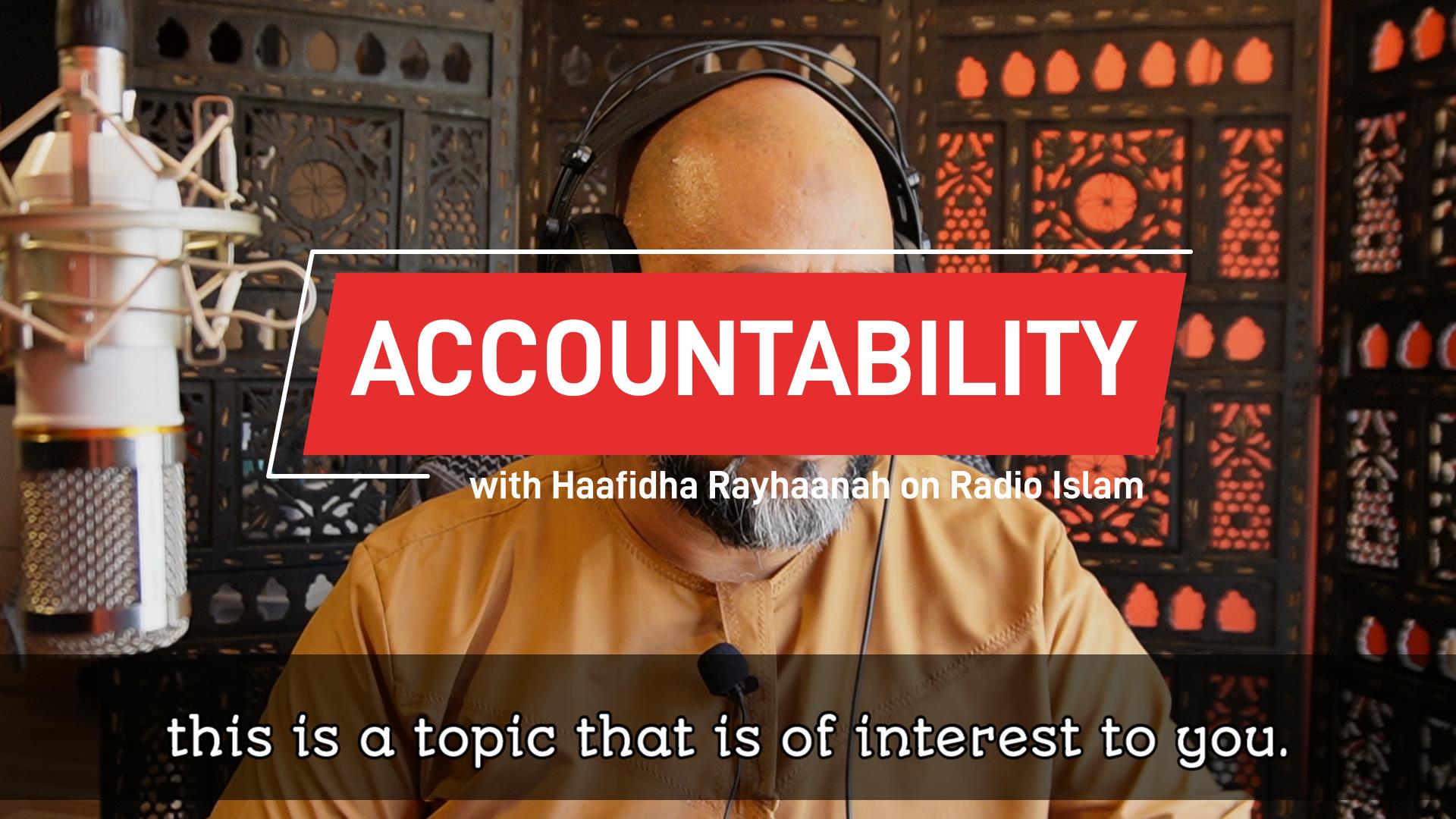
In this interview with Haafidha Rayhaanah, I unpack the little known dynamics of the far reaching consequences of accountability in our relationship with ourselves, and with those around us.
Remember, without accountability, you have absolutely nothing of substance in your relationship with anyone, including with life itself. Give yourself a fair chance to unlearn what has been holding you back for so long.
-
Hypocrisy destroys you
Avoiding the truth to avoid responsibility is an exercise in hypocrisy.
Supporting oppression to avoid the loss of privilege is an exercise in hypocrisy.
Hypocrisy harms the hypocrite more than it ever harms others.
The ones who experience such hypocrisy can still act against it, and can champion a cause to resist it.
The hypocrite, however, loses their soul and every ounce of their humanity when they stubbornly persist in their hypocrisy.
Not only does this deny them fulfilment or peace, it also destroys everything of value that makes their lives worth living, or their struggles worth enduring.
Thus the bitter are the most hypocritical, and the most hypocritical at the most oppressive among us.
Rationalising their hypocrisy to convince them otherwise is a futile exercise.
Instead, we must reject their assertions that are blatantly erroneous or contemptable, so that we don’t exhaust ourselves in their deliberate attempts at distraction from the truth, while the cause of justice suffers from our lack of focus.
It only gets complicated when we are unwilling to take a stand for what is uncomfortable or for what threatens the comfort of our existence.
Tyranny prevails when the masses value their so-called quality of life over their dignity and their humanity.
#justice #oppression #watermelon #palestine #genocide #gaza #icj #mentalhealth #integrity #selfworth #authenticity #zaidismail
-
Why envy is not good for you
The Japanese have a proverb that says that a bitter heart eats its owner.
Envy or bitterness begins with how you see yourself before you find reason for it in what others have or do.
When we’re cautioned about the negative effects of these traits, we often focus on the punishment and the harm to others.
Remember, we cannot give what we don’t have. Therefore, the envious or bitter one is consumed with such thoughts about their inadequacies, but from a position of blaming others for it.
Whether they have a legitimate gripe or not doesn’t change that reality, nor does it reduce the impact that it has on them and their health.
Trying to pacify them or trying to excuse them because of their difficult experiences (even in childhood) does nothing to uplift them.
Nor does it help us if we’re the ones struggling with such feelings of envy or bitterness towards others.
First, we must be willing to be unpopular before we are able to assist, because not validating someone’s emotional disposition often results in a negative response from that person.
Nonetheless, being told what we need to hear and not what we want to hear is the beginning of planting the seeds that will eventually grow into self-awareness and understanding.
You cannot uplift if you protect yourself or others from the truth just to spare them their feelings.
Similarly, we make it impossible for others to assist or advise us sincerely if we lash out each time we’re not supported in our views about life or about others.
To grow, you must be willing to be corrected.
Ideally, such correction should be gentle and reassuring, with empathy and compassion.
But that doesn’t mean that we should reject it if the tone is not what we want.
We must be more invested in wanting to learn than in how we want to be taught, otherwise we will go through life blaming others for not treating us the way that we want to be treated.
It always starts with you.
#mentalhealth#selfworth#lifecoaching#zaidismail#ownyourlife#mentalhealthawareness#narcissist
-
Check your entitlement
Expectations breed entitlement.
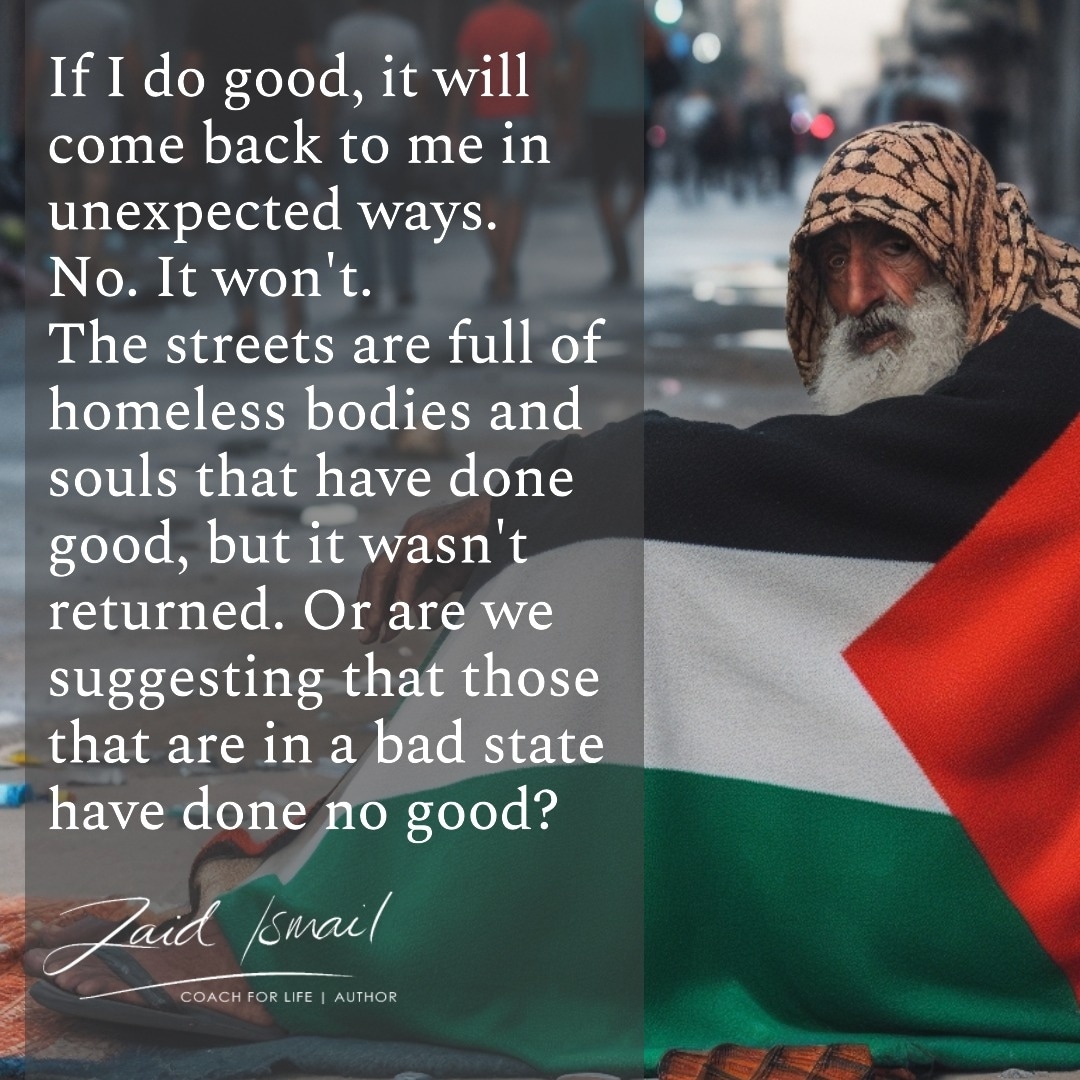
Like the entitlement of privileges that weren’t earned, or a free pass to abdicate responsibility because we’ve got it tough. Or entitlement to a homeland that belongs to someone else.
Conviction and sincerity are lost when we do things hoping for a good return.
We should do good because of who we are and what we choose to stand for. Not because we expect a return.
A return on investment is for business transactions, not for moral positions.
If you choose to fight for a cause, do it because it resonates with your values.
You honour your value system when you live by it, especially when it’s inconvenient or unpopular to do so.
When your values are used as a trading commodity with others, they’re not values, they’re tools for manipulation.
Accountability is a trigger for too many.
If you feel triggered when someone calls you to account, you have work to do on yourself.
Our triggers, frustrations, annoyances, anger, and emotional volatility is ours to own.
We cannot make others responsible for tiptoeing around it just because they ‘don’t know what we’ve been through’.
Their empathy or compassion towards us is a reflection of who they are, in the same way that ours is a reflection of who we are.
Outsourcing that or claiming that someone deserves not to receive it from us is an indulgence of our entitlement mentality, and not a defendable moral position.
Own your life. It always starts with you.
#hope #expectation #sincerity #selfworth #selfawareness #mentalhealth #mentalhealthawareness #lifecoaching #zaidismail #theegosystem #ownyourlife #narcissisticabuse #narcissist #rage #anger #angermanagement #istandwithpalestine #freepalestine #gazagenocide -
Hopefully…
Hope is not hope when it is rooted in futility. That is simply wishful thinking.
Hope is born from the belief that things can change.
It is not predicated by statements of ‘if only’ or ‘I wish’, but rather inspired by focusing on the probabilities and the opportunities that we have.
Hope is born when we focus on what we can do to uplift ourselves or change our state, rather than focusing on what we need from others before things can improve.
Hope is the most powerful statement of gratitude without having to claim being grateful.
It is not an attitude, nor is it blind faith.
It is awareness of who we are and what we’re capable of, so that what we discover to be our limits creates a yearning in us to acquire the skills, knowledge, understanding, and resources to push beyond those limits.
Hope is always present.
But when we surrender, we invest that hope in someone else saving us, because we gave up hope in our ability to rise above what we are facing.
Fear is the enemy of hope, and conviction is hope’s armour.
If you desire relief from an oppressor more than you desire to destroy the oppressor, you invest your hope in the benevolence, or the mercy of the one who oppresses you.
That is surrender, no matter how rebellious you may appear in your response.
If your optimism is not followed by meaningful and decisive action, you’re lying to yourself about being optimistic.
Where and in whom is your hope invested?
If you say that it’s invested in the Almighty, then be true to exercising the abilities and competence that He has endowed you with, instead of praying for Him to exercise it for you.
#hope #expectation #sincerity #selfworth #selfawareness #mentalhealth #mentalhealthawareness #lifecoaching #zaidismail #theegosystem #ownyourlife #istandwithpalestine -
Own your life
There are many unflattering adjectives that have been used to describe me over the years.
Before life got real, it used to trouble me to think that others had a negative opinion of me despite my best efforts to be a decent human.
It was a distraction that sometimes still gets the better of me. Fortunately, only in short bursts these days.
I don’t assume that I’m never any of what they accuse me of.
I know I’m entirely capable of being a difficult person, or even an abrasive and opinionated fool.
But, I only reconsider my actions if I receive such feedback from someone who is willing to engage beyond the insult or the negative assumption.
Everyone is opinionated. Many just don’t have the courage to speak plainly from fear of rejection or being unpopular.
Those are the ones that I ignore.
Not because I think I’m better than them, but because they have nothing of value that I can work with in my efforts to be better than who I was the moment before they shared their opinion about me.
Without such a mindful consideration of what people think of me, I literally would have been six feet under in an unmarked grave from having taken my own life because of the bitterness that others project onto me when they’re not willing to face their own demons.
My sanity and my life is mine to own.
If I give up that accountability, I will be no more than an attention whore praying for acceptance by the spineless.
Life is too short for such frivolity.
Own your life. If you’re not owning it, someone else is.
#hope #expectation #sincerity #selfworth #selfawareness #mentalhealth #mentalhealthawareness #lifecoaching #zaidismail #theegosystem #ownyourlife -
Toxic blah blah
The belief that people are toxic is self-serving.
The belief that parents are toxic is a sign of ingratitude.
The belief that others are not allowed to change how they behave towards you when you don’t honour what is important to them is entitlement.
The belief that what is important to us is more important than those who raised us is probably the closest thing to a toxic trait that we’ll find.
Societies that have withstood the test of time are the ones who honoured their elders and embraced the wisdom that was passed down to them.
Adapting that wisdom to solve contemporary problems is the failing of the current generation of parents and children.
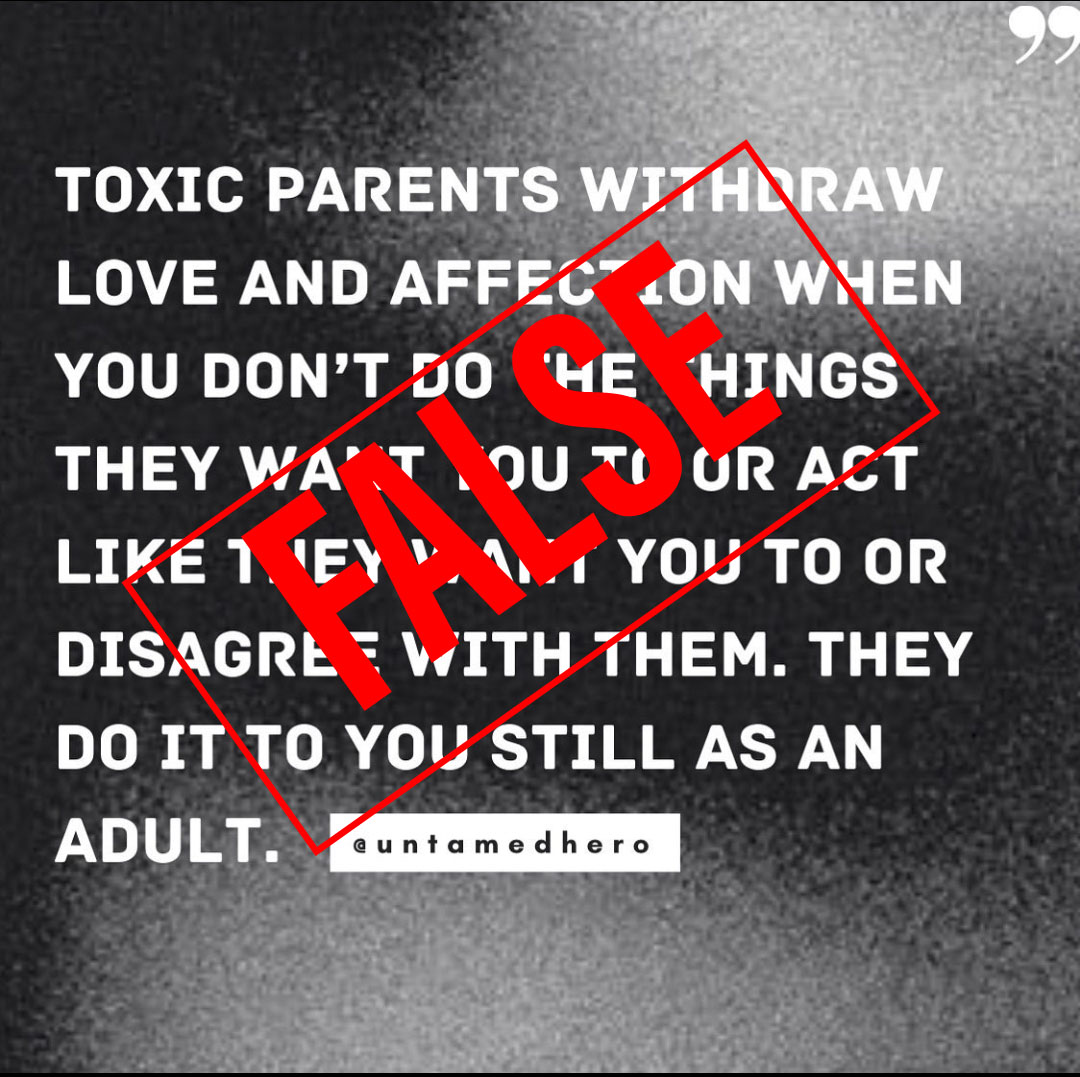
People, not just parents, withdraw from relationships when they feel rejected, betrayed, dishonoured, disrespected, taken for granted, and more.
If you hold your parents to that standard of supposed toxicity, be sure to apply the same definitions to your own behaviour.
If you truly understood the effort, self-sacrifice, compromise of dreams and aspirations, and duress that a present parent must overcome to show up as a parent, you might understand why betrayal of trust, disrespect, or rejection hurts them enough to want to withdraw from the life of the child that they spent their life serving up to that point.
It’s fashionable these days to judge parents harshly while believing that the new generation has a better understanding of what’s needed to make life work.
Sadly, the current state of society proves otherwise.
How does your judgement of the people who raised you stand up to the scrutiny of the ‘toxic’ label that you’re so willingly throwing around these days?
You will be tested by that which you judge others about. Be careful.
Arrogance is a slippery slope.
#hope #expectation #sincerity #selfworth #selfawareness #mentalhealth #mentalhealthawareness #lifecoaching #zaidismail #theegosystem #ownyourlife #parenting #gratitude