Self-pity is an indulgence in futility that results from picking at our wounds long after the betrayal from another has passed.
Waiting for someone to care about us before we care for ourselves is not about needing them to care as much as it is about us wanting them to see how important they are to us.
If they respond positively, it boosts our self-worth because someone we care about cares about us.
While that may seem perfectly reasonable, it still means that we only care for ourselves if we feel cared for.
That’s not self-worth, nor is it love. That’s ingratitude.
Trading with emotions to test a significant other’s commitment to us is passive aggressive guilt-tripping and not love or affection.
It’s a transaction of benefit because we’ve lost sight of the value of who we are regardless of what others think of us.
Of course, the critical dependency in this is that our belief in who we are is based on substance and not wishful thinking, or self-aggrandisement.
Self-pity serves as a distraction from the life that we want, because it demands that we place our life on hold waiting for someone else to care.
That’s when ingratitude digs deeper into our soul and the self-pity soon becomes self-loathing because we failed the test that we administered on another.
Doesn’t make sense, does it?
Neither does self-pity.
Don’t wait for someone to value you before you value yourself.
Own Your Life.
#hope #expectation #sincerity #selfworth #selfawareness #mentalhealth #mentalhealthawareness #lifecoaching #zaidismail #relationshipgoals #marriageadvice #divorce #theegosystem #ownyourlife
Tag: divorce
-

Pitying yourself into oblivion
-

Bitter sweet arrogance
Arrogance is a result of insecurity that is presented as unwarranted confidence.
While it’s easier to focus on the harshness that results from such behaviour, it’s more important to remember that only an insecure person will have a need to demand significance through arrogant behaviour.
Arrogance serves as a distraction from our harsh self-judgement.
If someone behaves arrogantly towards us, it feels like a personal attack because it undermines our significance or the respect and consideration that we believe we deserve.
Whether we deserve to be treated better than that or not is not the critical issue.
The fact that we need someone to treat us better than that is what defines where we’re at about how we value ourselves.
That’s where self-worth or self-loathing on our part either feeds that cycle of arrogance, or it breaks it.
Think of it this way.
If an arrogant person is behaving that way because they’re already feeling inadequate, and you demand that they treat you better than that, you’re simply reinforcing their reasons to believe that they’re inadequate.
You don’t resolve that by pointing out what you deserve from them.
You solve that by introspecting on why their struggle with themselves has such an impact on you.
Owning your self-worth is the beginning of finding peace in life.
But ensure that your self-worth is based on substance, and not just wishful thinking or baseless affirmations.
If there isn’t substance to your belief in yourself, your self-worth will result in you being selfish and destroying what could be a good relationship.
It always starts with you.
#hope #expectation #sincerity #selfworth #selfawareness #mentalhealth #mentalhealthawareness #lifecoaching #zaidismail #relationshipgoals #marriageadvice #divorce #theegosystem #ownyourlife -
Enabling abuse
We often believe in others the way we wish they would believe in us.
Sometimes, when we give up hope in someone believing in us, we find it that much more difficult to believe in others.
It’s these same emotional commitments that drive us toward making excuses for bad behaviour from someone close to us.
As with everything in life, without moderation, making such excuses becomes harmful.
Therefore, when we keep making excuses or creating space for someone who consistently behaves badly despite having been made aware of the harm of their ways, we enable an abusive relationship.
Many feel guilty for withholding affection or support under such circumstances from fear of transacting or ‘being like them’.
However, the moment we make it about how we feel or how we want to be seen, we lose sight of the harm that we’re enabling.
Just because we disagree with someone’s behaviour doesn’t mean that we hate or condemn them.
In fact, if we truly love or care about someone, we will not enable them to behave badly because we wouldn’t want someone we love to cause harm to others or to ourselves.
The moment you condone bad behaviour beyond accepting the humanness of one who makes a mistake, you’re not doing it for them anymore, you’re doing it to protect your ego.
Too many complain about being caught up in an abusive relationship but refuse to take accountability for their contribution towards enabling the abusive cycles in which they’re trapped.
You have to own your life before you can improve it.
It always starts with you.
#hope #expectation #sincerity #selfworth #selfawareness #mentalhealth #mentalhealthawareness #lifecoaching #zaidismail #relationshipgoals #marriageadvice #divorce #ownyourlife #theegosystem -
Conveniently judgemental
Judgement is only ever supposed to be the first step in correcting what’s wrong.
Sadly, it’s most often the only step that we take when faced with unbecoming behaviour from others.
Worse still, judgement is easy to dish out about issues and incidents that are none of our business because having an opinion on something topical is the easiest way to feel relevant.
Judgement is easy.
All it requires is the ability to compare what we see to a rule or a law that we believe is revered by others.
Such comparison requires zero understanding behind the behaviour, nor does it demand any action on our part to improve the situation.
All it requires is an opinion without empathy or compassion.
When passing judgement establishes our relevance in social circles, we grow emboldened by the attention we receive from those who agree with us, eventually assuming ourselves to be a moral authority that can speak on behalf of the Almighty.
That’s when we find justification to pass judgement about the faith and beliefs of others, and we become argumentative about religion and philosophy, and the personal matters of those we have no intention of assisting.
Passing judgement without understanding or accountability for the impact of such judgement is an indulgence of the ego and serves no good whatsoever.
Unless you are duly appointed to judge between two parties, restrain yourself from having an opinion on every person or issue that crosses your timeline.
Peace is found in leaving alone that which does not concern us.
And harm is caused by involving ourselves insincerely in that which does not concern us.
Check yourself before you feel a need to share your opinion on someone else’s life.
Or else you may be tested with that which you judge others about.
#justsaying #ownyourlife #theegosystem #mentalhealth #mentalhealthawareness #lifecoaching #zaidismail #mindyourbusiness #sincerity #relationshipgoals #marriage #divorce -
How much are you worth?
When your behaviour is driven by how others treat you, the good times become dull, and the bad times become dreary.
It might seem endearing to focus on how others treat you so that you can return the favour if they’re being sweet or kind, but that means that you are not being true to yourself in that moment.
Your response to someone should be based on how you feel about what is going on in that moment with them, and not a pacified version of you to avoid conflict or to not let them feel bad.
The reason this is important is because if you hold back for long enough, you slowly build up resentment about not being able to be yourself, while the other person has no idea that you’re holding back all the time.
That results in two entirely avoidable issues.
Firstly, they have very good reason to doubt your sincerity when they discover that you’ve been less than sincere all this time.
Secondly, neither will you nor they know the real you behind that show of pleasantries.
That’s just one more way to suck the joy out of life while waiting to find happiness.
Being true to yourself must be your first priority in any relationship. That’s what adds to the substance of it all.
But being true to yourself doesn’t mean being inconsiderate or abrasive, or being self-centred or offensive.
It means speaking your truth and expressing yourself with passion and sincerity without diminishing the other person in the process.
It’s about giving them an opportunity to experience the real you, the way that you want to be experienced, and not the way that you think they deserve to experience you.
It always starts with you.
#hope #expectation #sincerity #selfworth #selfawareness #mentalhealth #mentalhealthawareness #lifecoaching #zaidismail #parenting #relationshipgoals #divorce #theegosystem #ownyourlife -
Life is nothing without gratitude
Gratitude is only possible if you’re present in the moment you’re in.
Fear distracts us from the present moment by reminding us of the past and tainting our experience of the present.
It’s when we look for evidence in the present moment of the causes of pain from our past, that we find reason to protect ourselves from the future, while missing the value of the present.
Many of life’s beautiful moments are lost because we’re waiting for someone to recognise our struggle, or to make up for our pain.
It’s not about whether you deserve better or not.
It’s about whether you do better with what you’ve got.
Putting your life on hold while waiting for justice or revenge only puts YOUR life on hold. No one else’s.
When you finally realise this, you either have reason to rage even more because you suddenly noticed how everyone else’s lives moved on while you still haven’t received justice, or you have reason to realise that it’s your life that is being wasted for a moment that has already passed.
By all means, seek justice if need be.
However, don’t cause further injustice to yourself and to those who have rights over you by destroying the good you have while waiting for the bad to be avenged.
Gratitude is impossible when we’re fixated on the past.
And happiness is impossible if we’re afraid of the future.
It always starts with you. Now.
Own Your Life.
#hope #expectation #sincerity #selfworth #selfawareness #mentalhealth #mentalhealthawareness #lifecoaching #zaidismail #ownyourlife #theegosystem #gratitude #relationshipgoals #marriageadvice #divorce -
Selective inheritance
Our relationship with our parents, whether they were present or absent, wholesome or abusive, will have a distinct impact on how we shape our character through life.
Not only will we develop our sense of self based on how we felt in their presence, but they are also our main point of reference in how to raise children, or show up as a partner to our spouse.
Whether you actively adopt or actively reject what you experienced with them, that becomes the grounding point that informs your decisions about what is or isn’t acceptable in your future relationships, and specially in your parenting style.
Judgement has nothing to do with it because knowing right from wrong or good from bad is easy.
There is no shortage of material and advisors to point out what or who is right or wrong.
Unfortunately, there’s a critical shortage of advisors to help us to understand why, despite knowing what’s right, so many of us struggle to do what’s right. Including our parents.
Connecting with the human behind the role, both in your parents and in yourself or your partner, reignites the empathy and compassion that judgement kills within us.
It is judgement that makes us harsh and rigid towards each other, while understanding breeds appreciation and compassion, if not affection.
Join me with panelists Hana Haths and Dineo Nomayeza Sibuyi on Saturday, 29 October 2022 at 2pm for an in depth discussion about this and other topics related to the gender wars that prevail in the SA Muslim community.
Tickets available at zaidismail.com at a nominal charge of R100 for in-person attendance and R60 for Zoom participation if you’re not in the Johannesburg area.
Refreshments will be provided.
Limited seating available so book now before the last minute rush.
#events #parenting #generationaltrauma #mentalhealth #mentalhealthawareness #lifecoaching #zaidismail #marriageadvice #divorce #relationshipgoals -
Recycling generational trauma
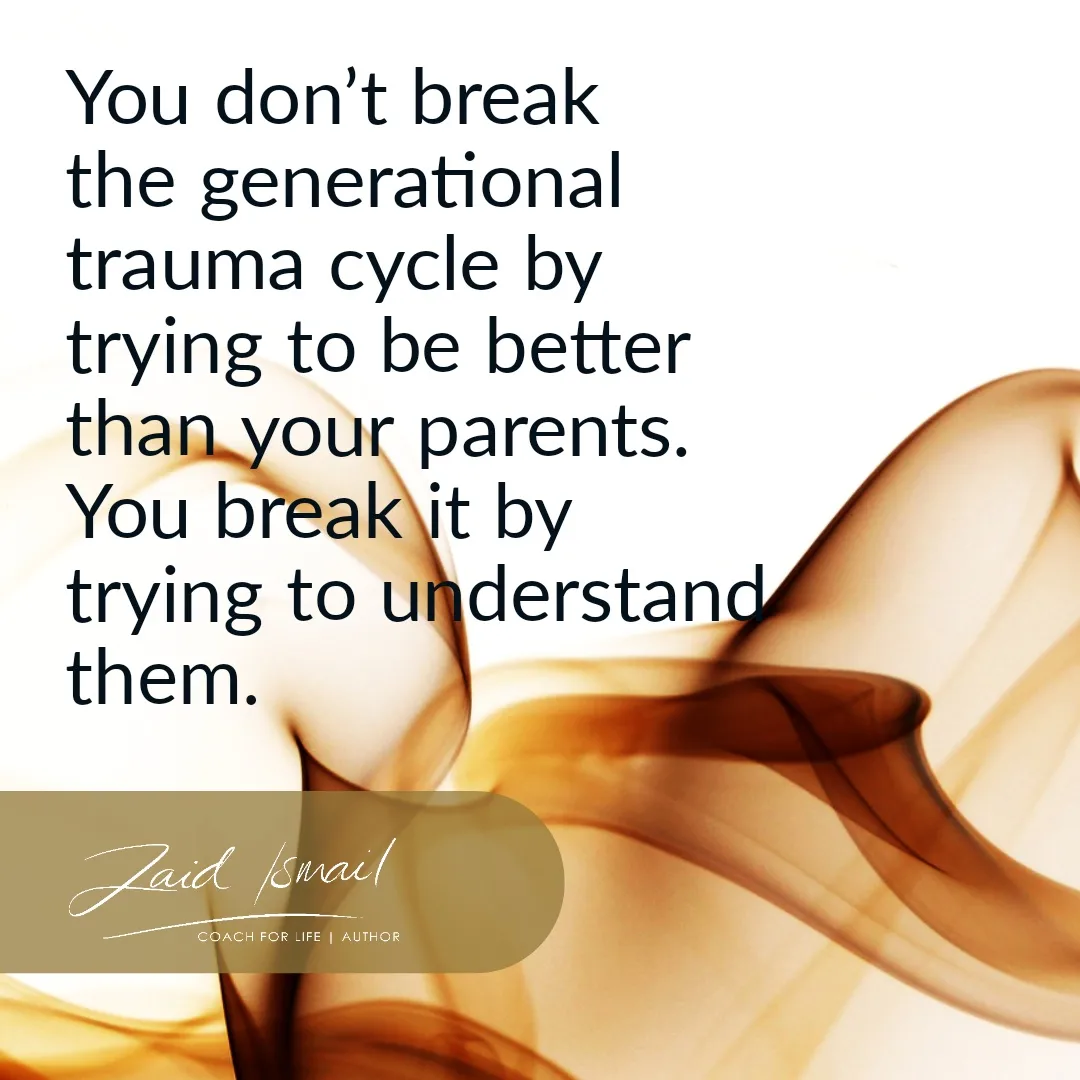
One of the biggest mistakes in trying to break the generational trauma cycle is that we focus on NOT wanting to be like our parents.
All that allows us to do is figure out what we don’t want for ourselves and our children.
While that might seem like enough, it also means that we will only become aware of our own unhealthy traits that we’re passing onto our children through trial and error.
Remember that knowing what you don’t want doesn’t mean that you know what is good or healthy. It means that you only know what of the unhealthy stuff you don’t want, but it doesn’t mean that you know what other unhealthy stuff awaits you.
Trial and error is a very painful and exhausting way to figure out how to build healthy relationships with our children, or with our parents, and by extension, with our partners.
By focusing on what we don’t want in life, we go through life in defence mode because we’re constantly protecting ourselves from the threats that may lead to a repeat of our experiences in our childhood or past relationships.
Thus, we risk replacing one cycle of generational trauma with another.
Seeking to understand why our parents may not have been capable of more than what we got from them is key to breaking the cycle.
But, we don’t know what we don’t know. That’s why fresh perspectives are needed in our efforts to unravel these difficult experiences of life.
This will be one of the key discussion points at the next event on Gender Wars on 29 October 2022.
If you haven’t booked your ticket yet, do so now at zaidismail.com.
Zoom tickets also available.
#events #genderwars #ownyourlife #theegosystem #mentalhealth #mentalhealthawareness #lifecoaching #zaidismail #parenting #generationaltrauma #marriageadvice
#divorce